Protecto's pitch deck targets the burgeoning need for privacy-compliant AI implementation within large enterprises. By positioning themselves as a 'Data Transform' layer, they enable companies to utilize sensitive information in LLMs without violating global regulations like GDPR or CCPA. The deck is anchored by a highly experienced founding team with backgrounds at Microsoft and Apple, which lends significant credibility to their technical claims. While the deck excels at explaining the 'how' through clear architectural diagrams and case studies, it lacks specific financial projections and a…
Key takeaways
- The company positions itself as a critical bridge between sensitive enterprise data and Generative AI applications (Slide 5).
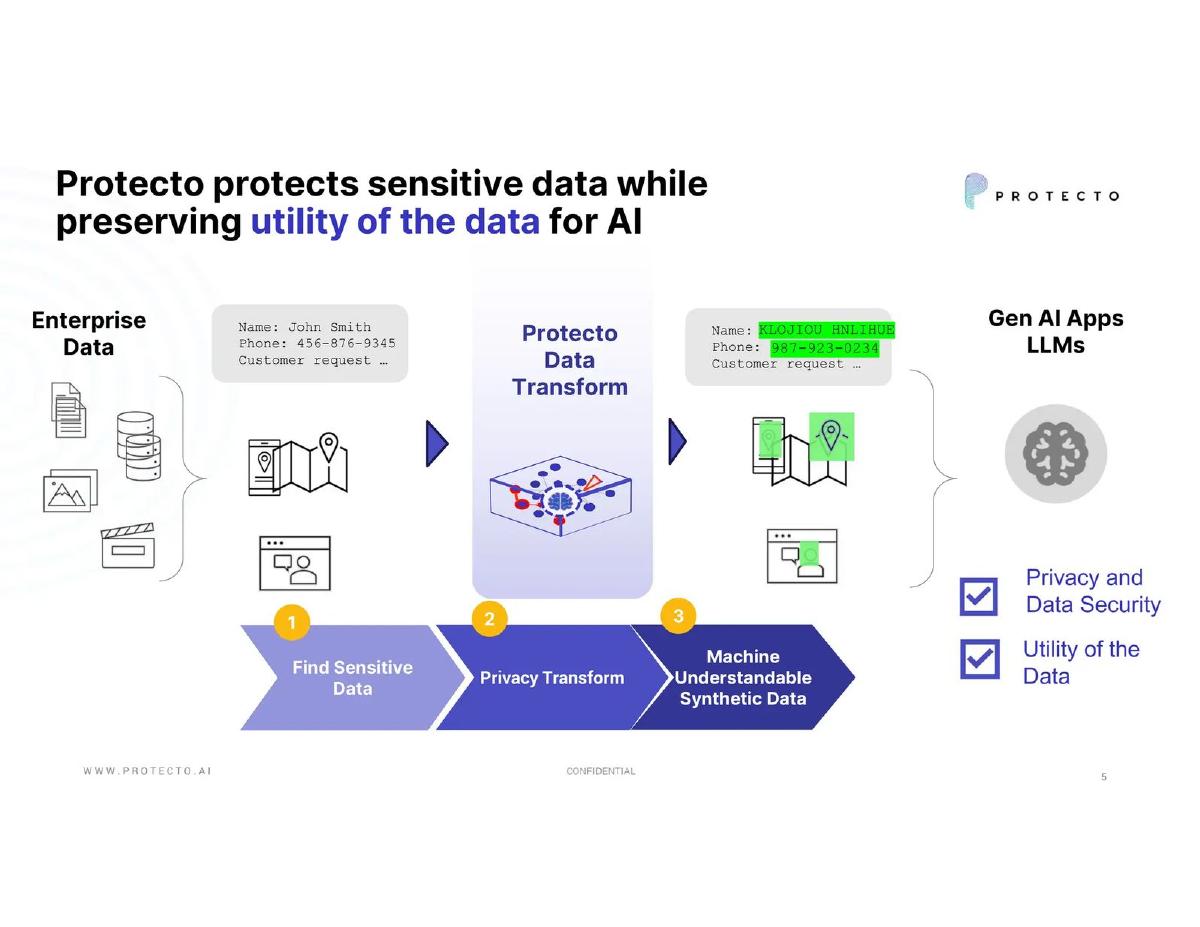
- Protecto utilizes a three-step process: finding sensitive data, privacy transformation, and creating machine-understandable synthetic data (Slide 5).
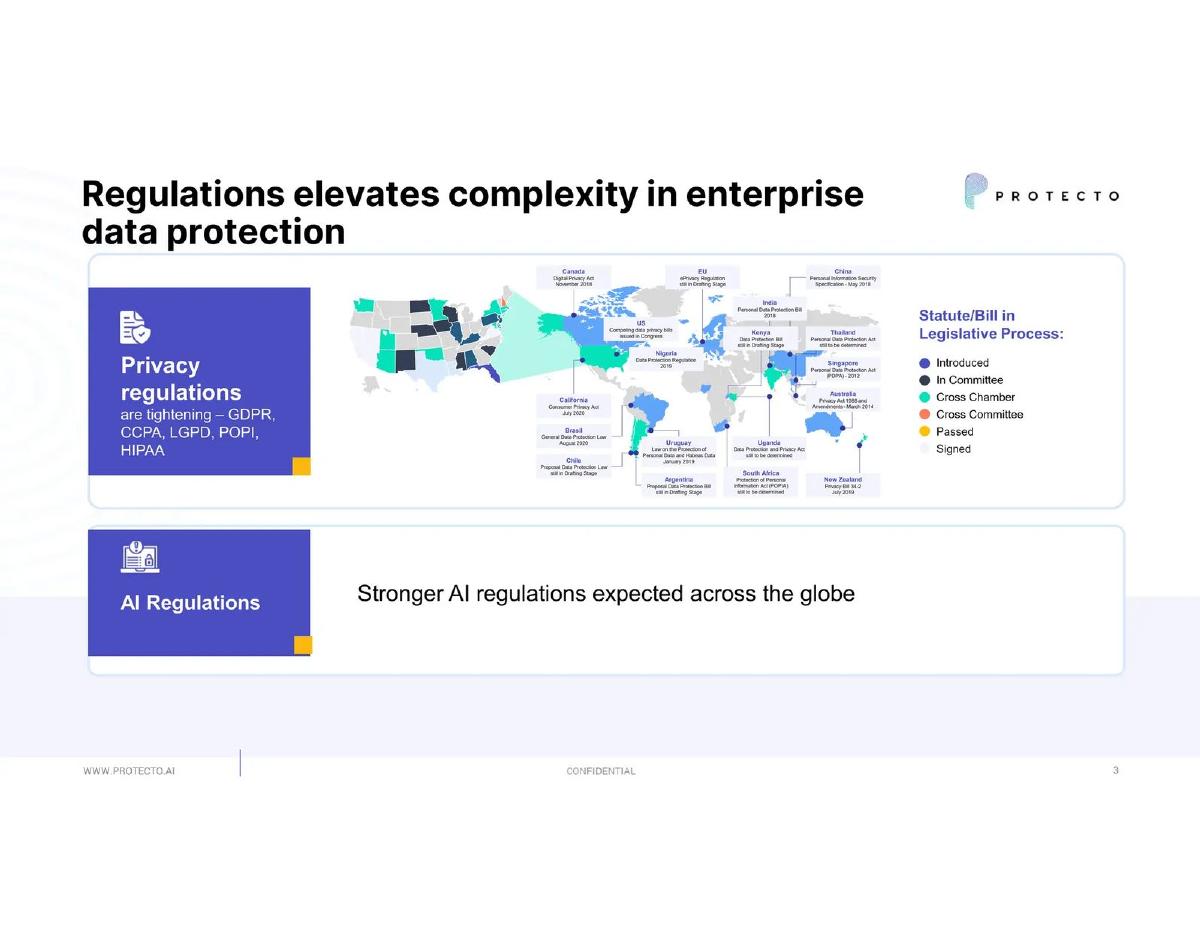
- The regulatory landscape is used as a primary market driver, citing tightening global standards like GDPR, CCPA, and HIPAA (Slide 3).
- The solution covers the entire AI lifecycle, from building and training to tuning (RAG) and deployment (Slide 7).
- A case study demonstrates the product's ability to enable data residency by removing PII before data reaches OpenAI instances (Slide 9).
- The founding team features deep technical expertise, including a CEO who scaled a previous startup to $10M ARR and a CTO with 18 years at Apple (Slide 11).
- Early traction is evidenced by a list of customers including Kar Global, Brookfield, Belcorp, and Nokia (Slide 11).
- The roadmap indicates a move toward vertical-specific solutions and multi-modal privacy engineering (Slide 13).
Protecto: Securing the Generative AI Pipeline
Protecto's pitch deck is a technical and regulatory-focused presentation designed to appeal to investors who understand the infrastructure bottlenecks of enterprise AI. The deck moves quickly from the global regulatory 'why' to the architectural 'how,' relying heavily on the pedigree of its founders to bridge the gap between a complex problem and a viable product.
Slide 1: Title and Positioning
The cover slide introduces Protecto with the tagline: "Privacy and Data Protection for Modern AI World." The branding is clean, using a fingerprint-inspired 'P' logo that reinforces the themes of identity and security. The inclusion of the URL (www.protecto.ai) and a 'Confidential' watermark sets a professional, enterprise-ready tone from the outset.
Slide 3: The Regulatory Catalyst
Slide 3, titled "Regulations elevates complexity in enterprise data protection," serves as the 'Problem' slide. Instead of focusing on a single pain point, it presents a global map of privacy statutes (GDPR, CCPA, LGPD, POPI, HIPAA). The slide categorizes these by their legislative stage—introduced, in committee, passed, or signed. By highlighting that "Stronger AI regulations [are] expected across the globe," Protecto establishes an urgent market need driven by legal necessity rather than just operational preference.
Slide 5: The Solution Architecture
This is the core 'Product' slide. It illustrates how Protecto sits between "Enterprise Data" (documents, databases, images) and "Gen AI Apps / LLMs." The process is broken down into three numbered steps: 1. Find Sensitive Data, 2. Privacy Transform, and 3. Machine Understandable Synthetic Data. The key value proposition is highlighted in blue: "Protecto protects sensitive data while preserving utility of the data for AI." This addresses the primary fear of AI developers—that securing data will make it useless for training models.
Slide 7: Full Lifecycle Integration
Slide 7 demonstrates the versatility of the platform, showing "Data Protection throughout your AI Lifecycle." It maps the product to four stages: Build/Train, Tune/RAG, Deploy, and Use. The slide also lists technical integrations, showing logos for data sources like Hadoop, Snowflake, Salesforce, and ServiceNow , as well as AI frameworks like OpenAI, Hugging Face, LangChain, and LlamaIndex. This visual proof of ecosystem compatibility is vital for a seed-stage infrastructure startup.
Slide 9: Case Study - Data Residency
Slide 9 provides a concrete example of the product in action for "A Large Consumer Tech" customer. The goal was to use OpenAI for processing driver history and criminal records without violating data residency requirements. The diagram shows Protecto acting as a gateway that removes PII before the data crosses into a "Specific Geography" for the OpenAI Enterprise Private Instance. This slide effectively moves the conversation from abstract technology to a solved business problem.
Slide 11: Team and Traction
The "Founders with deep data experience" slide is arguably the strongest in the deck. Amar Kanagaraj (CEO) is noted as a second-time entrepreneur who scaled a previous company to "$10M ARR" and has experience at Microsoft and Sun Microsystems. Baskaran Alagarsamy (CTO) is credited with "18+ years in Apple" and leading privacy engineering efforts there. The slide also lists a team of "15+ Engineers" and early customers including Kar Global, Brookfield, Belcorp, and Nokia. The mention of "Angel Investors (Nov 21)" from Google, Microsoft, and large tech CIOs adds further social proof.
Slide 13: Near Term Roadmap
The final slide shown outlines the future of the product. It lists "GPTGuard" for secure ChatGPT use in enterprises and plans for "Vertical Specific" solutions (Financial, Healthcare) and "Multi-Modal" capabilities. The roadmap ends with "Privacy Engineering," suggesting a move toward automated privacy metrics. A large portion of this slide is redacted in the provided version, but the visible headers indicate a clear path toward expanding the platform's reach.
What Works in This Deck
1. Technical Clarity: The deck does not shy away from the mechanics of the product. By using clear flowcharts (Slides 5 and 7), the founders explain exactly where their software sits in the modern tech stack. This is essential for selling to technical VCs and enterprise CTOs.
2. Founder-Market Fit: The backgrounds of Kanagaraj and Alagarsamy are perfectly aligned with the problem they are solving. Having a CTO who managed privacy at Apple-scale is a massive competitive advantage that the deck highlights effectively.
3. Regulatory Tailwinds: By framing the product as a solution to a legal mandate (Slide 3), Protecto transforms their software from a 'nice-to-have' into a 'must-have' for compliance-heavy industries.
What is Missing
1. The Financial Ask: While the source listing mentions a $4 million seed round, the slides themselves do not detail the terms of the raise, the valuation, or how the funds will be allocated between engineering, sales, and marketing.
2. Competitive Landscape: The deck assumes a vacuum. There is no mention of other synthetic data players (like Gretel or Tonic) or traditional DLP providers. Investors will want to know why Protecto's 'Machine Understandable Synthetic Data' is superior to existing masking or anonymization techniques.
3. Business Model: There is no slide explaining the pricing structure. Is it per-user, per-token, or a flat enterprise license? For a seed round, understanding the path to monetization is as important as the technology itself.
Lessons for Founders
Lead with Pedigree: If your team has worked at the highest levels of the industry you are disrupting, make that the centerpiece of your pitch. Protecto's team slide (Slide 11) does the heavy lifting for their technical credibility. · Use Case Studies: Abstract diagrams are good, but a specific 'before and after' story (Slide 9) makes the value proposition tangible. It shows that the product isn't just a theory; it's already solving high-stakes problems for large companies. · Map the Ecosystem: For infrastructure startups, showing where you fit among existing tools (Slide 7) is crucial. It reassures investors that your product won't require a complete overhaul of the customer's current stack. · Focus on 'Utility': In the world of privacy tech, the trade-off is usually security vs. performance. By explicitly stating they preserve 'utility' (Slide 5), Protecto addresses the number one objection to data anonymization tools.
Frequently asked questions
- What is Protecto's core technology?
- Protecto's core technology is a 'Data Transform' engine that identifies sensitive information and converts it into 'Machine Understandable Synthetic Data.' Unlike traditional masking, this process aims to preserve the utility of the data for AI training and inference while ensuring that no actual PII (Personally Identifiable Information) is exposed to the LLM or external cloud providers.
- How does Protecto handle different stages of the AI development cycle?
- As shown on slide 7, Protecto integrates across the full lifecycle. In the 'Build/Train' and 'Tune/RAG' phases, it scans and de-identifies data. During 'Deploy' and 'Use,' it provides response controls to prevent PII leaks and scans prompts for sensitive data, acting as a DLP (Data Loss Prevention) filter for AI interactions.
- Who are the founders and what is their background?
- The team is led by CEO Amar Kanagaraj, a second-time entrepreneur who previously scaled a startup to $10M ARR and held roles at Microsoft and Sun Microsystems. CTO Baskaran Alagarsamy brings 18 years of experience from Apple, where he led privacy engineering efforts and managed petabyte-scale data problems. This combination of commercial scaling and deep technical privacy engineering is a major highlight of the deck.
- What market problem is Protecto solving?
- Protecto addresses the 'compliance vs. innovation' conflict. Enterprises want to use LLMs but are blocked by strict privacy regulations (GDPR, CCPA) and data residency requirements. Protecto allows these firms to use tools like OpenAI or Amazon Bedrock by ensuring sensitive data never leaves the controlled environment in an identifiable format.
- What is missing from the Protecto pitch deck?
- The deck is notably missing a specific 'Ask' slide detailing how the $4 million seed funding will be spent. It also lacks a detailed competitor analysis and specific unit economics or revenue growth charts. While it lists impressive customers like Nokia and Brookfield, it does not provide the specific contract values or growth metrics associated with them.