Payu addresses the lack of internet and computer penetration in Sub-Saharan Africa through a decentralized mesh network and low-cost hardware. The deck outlines a strategy to deploy 'Angaza PCs'—affordable computing units—alongside a voucher-based internet subscription model. With a projected market size of $5.8 billion by 2015 based on a $15/month spend per user, Payu positions itself as a more affordable, open-source alternative to competitors like Microsoft Flexgo. The financials project a transition from an operating loss of $789,715 in Year 1 to a profit of over $19 million by Year 5. Wh…
Key takeaways
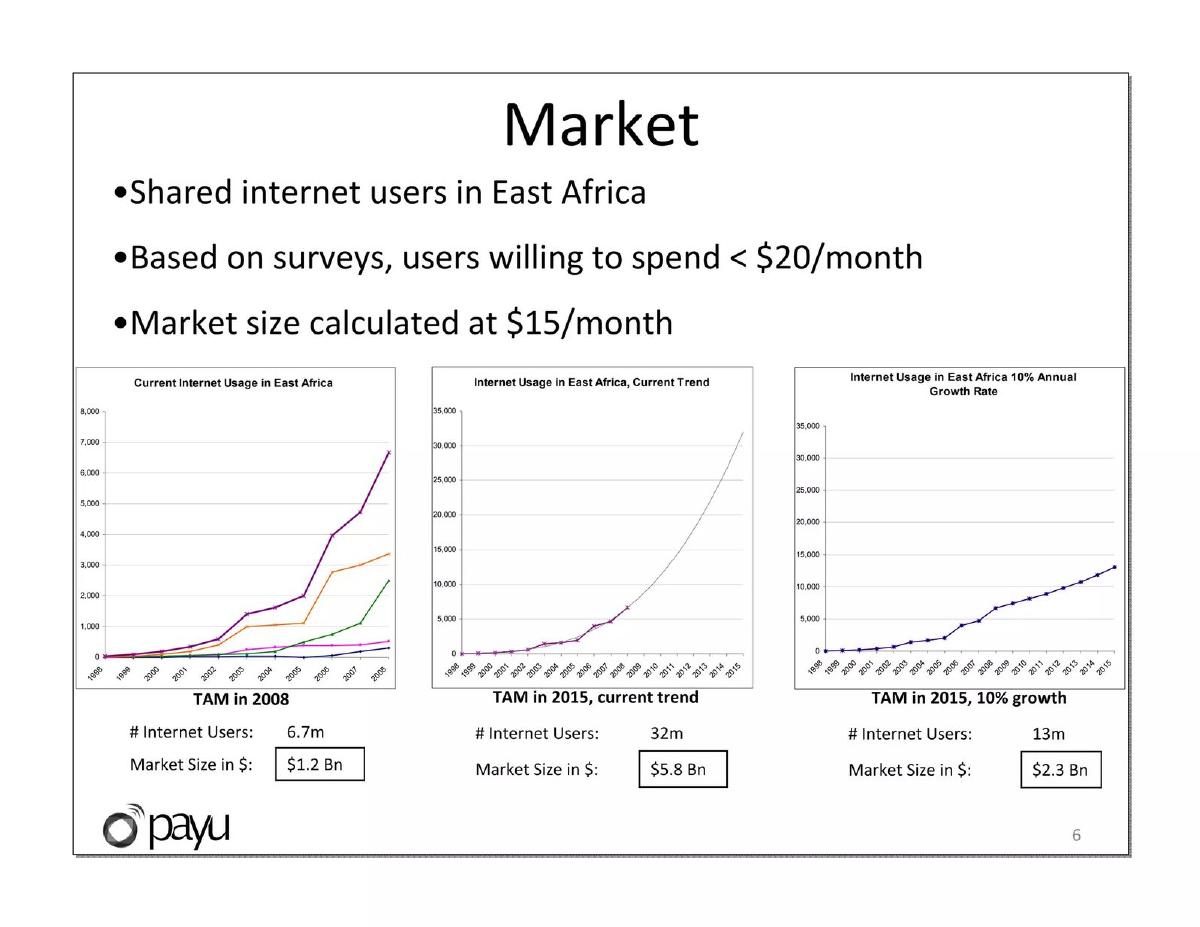
- The company targets a market of shared internet users in East Africa willing to spend less than $20 per month (Slide 6).
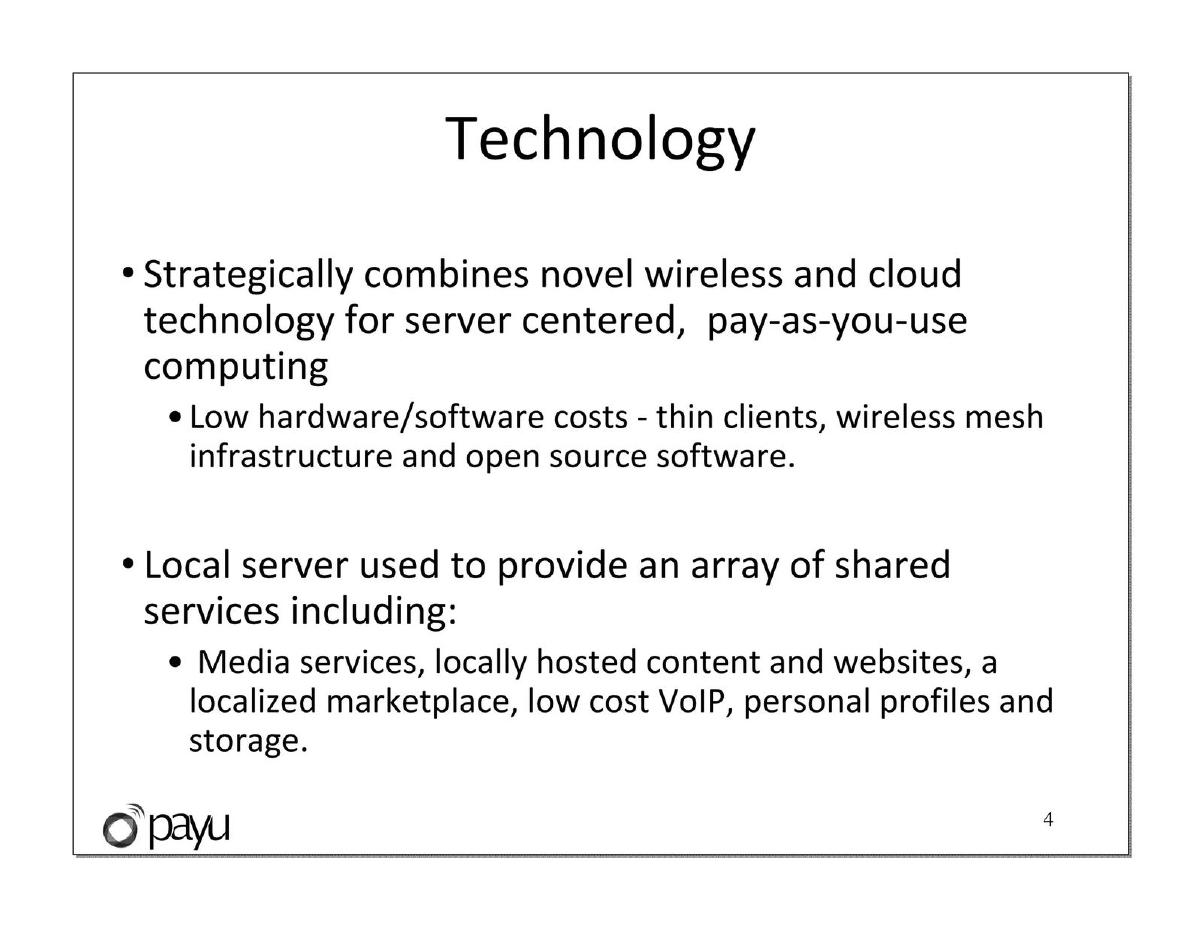
- Payu utilizes a mesh network architecture where a local server provides shared services like VoIP, media, and storage to client computers (Slide 4).
- The hardware strategy includes a $50 'Angaza PC' bundled with pay-as-you-go internet connection (Slide 7).
- Financial projections show total sales growing from $400,238 in Year 1 to $30,854,103 in Year 5 (Slide 10).
- The founding team consists of three MIT graduates from the class of 2009 with backgrounds in Engineering and Management (Slide 11).
- Pilot programs were successfully conducted in Rwanda in collaboration with the Office of the President and the Rwanda Information Technology Authority (Slide 12).
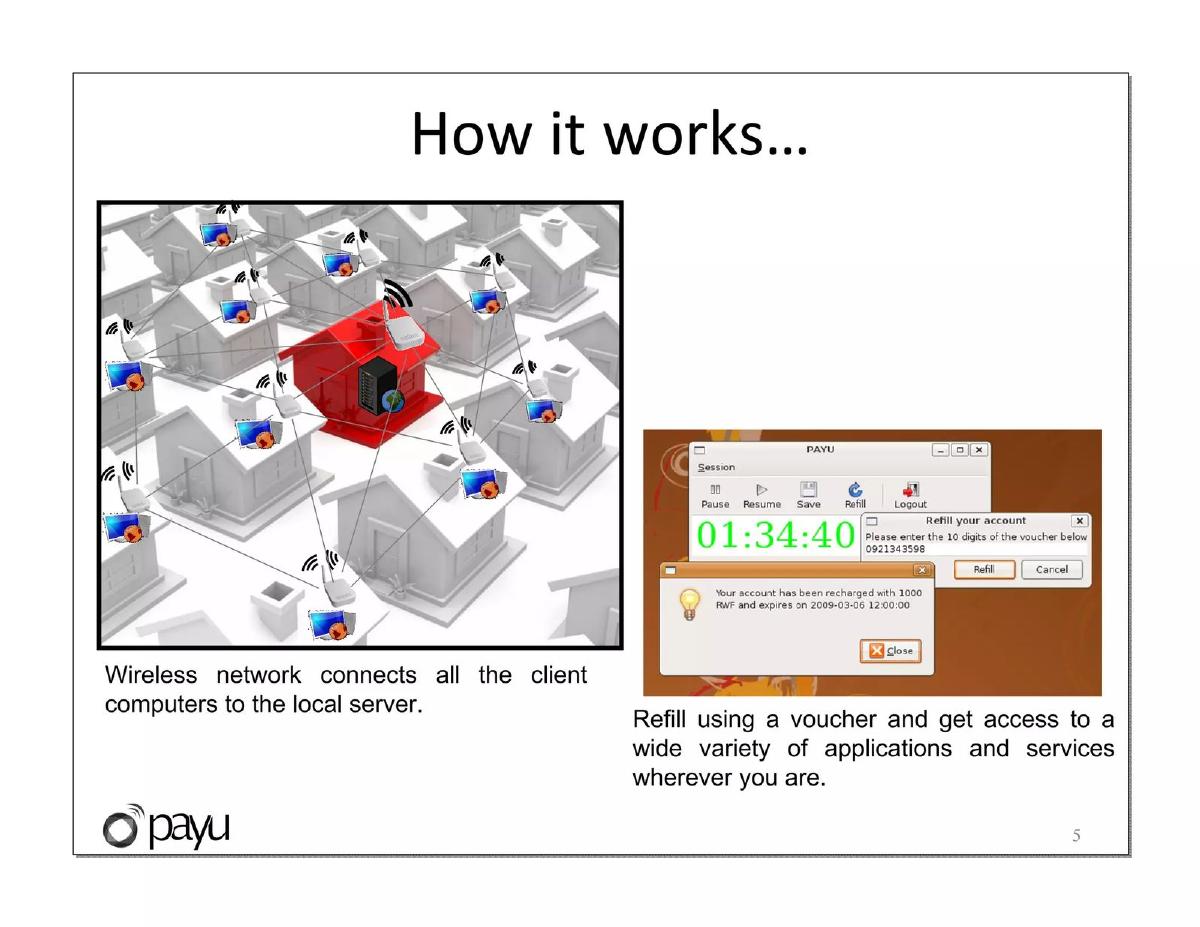
- The business model relies on a voucher-based system for refills, allowing users to access applications and services on demand (Slide 5).
- Growth plans are aggressive, aiming for over 438,000 total users by Phase 7 of deployment (Slide 9).
Payu Pitch Deck Teardown
Slide 1: Title and Team
The cover slide introduces Payu with a logo featuring a signal icon, suggesting a focus on connectivity. It lists the website (payucomputing.com) and contact information. The three founders—Adnaan Jiwaji, Guy Kayombya, and Ammar Jiwaji—are named. Images of hardware components, including a small form-factor PC and a wireless router, are displayed, immediately signaling that this is a hardware-plus-service play.
Slide 2: What is PAYU?
This slide defines the company's mission: providing affordable internet and computing services to the masses in East Africa. It describes the product as a "customizable and easily deployable pay-as-you-use computing platform." Key features mentioned include access to packaged services like educational software, health software, and on-demand entertainment.
Slide 3: Why Now?
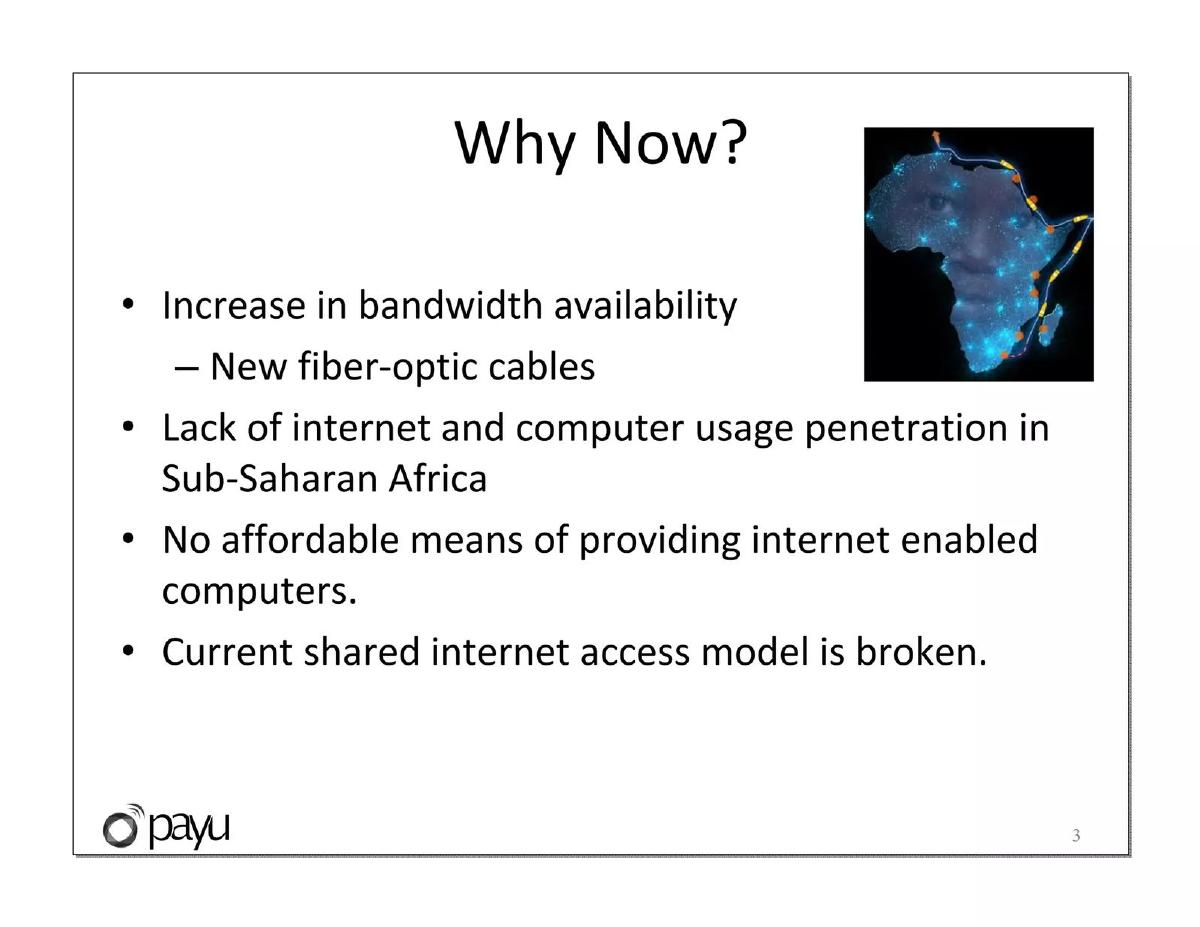
The market timing slide highlights an increase in bandwidth availability due to new fiber-optic cables in the region. However, it notes a persistent lack of internet and computer penetration in Sub-Saharan Africa. The slide argues that the current shared internet access model is "broken" and that there is no affordable means of providing internet-enabled computers to the population.
Slide 4: Technology
Payu details its technical stack here. The system combines wireless mesh technology with a server-centered, pay-as-you-use model. By using thin clients, open-source software, and mesh infrastructure, they aim to keep hardware and software costs low. The local server provides shared services, including media, locally hosted websites, a marketplace, VoIP, and personal storage.
Slide 5: How it works...
This slide uses a 3D diagram to illustrate a mesh network where multiple houses are connected to a central red house containing the server. A screenshot of the user interface shows a session timer (01:34:40) and a voucher refill window. The text explains that users refill their accounts using a voucher to gain access to applications and services.
Slide 6: Market
The market analysis is based on surveys showing users are willing to spend less than $20 per month, with a calculated market size based on $15 per month. Three charts show growth trends. The "TAM in 2008" is cited at 6.7 million users and $1.2 billion. The "TAM in 2015" is projected at 32 million users and $5.8 billion under current trends, or 13 million users and $2.3 billion at a 10% annual growth rate.
Slide 7: Customer Stories
Two personas are presented. The first is a Tanzanian family of four with a $200 monthly income who needs an affordable way to communicate. The solution is a $50 Angaza PC with bundled internet. The second is a Kenyan woman with an old, unresponsive Windows computer who can use a PAYU router and USB to access a "virus-free, always up-to-date" operating system.
Slide 8: Competitors
Payu lists four competitors: Microsoft Flexgo (Brazil), Novatium (India), Zonbu (US), and Selcom Wireless (Tanzania). The slide differentiates Payu by its use of open-source software (vs. Microsoft), wireless mesh (vs. Novatium's wired network), and its specific focus on the East African market.
Slide 9: Growth
This slide presents a seven-phase deployment schedule spanning from September 2010 to December 2015. It tracks metrics including Base Stations, Satellite Stations, Last Mile Coverage Areas, Angaza PC Sales, and Total PAYU Users. By Phase 7, the company aims for 438,171 total users and 38,880 PC sales.
Slide 10: Financials
A five-year financial table projects significant growth. Total sales are expected to rise from $400,238 in Year 1 to $30,854,103 in Year 5. While the company projects operating losses in Year 1 ($789,715) and Year 2 ($816,930), it forecasts a swing to profitability in Year 3 ($961,562), reaching $19,102,485 in operating profit by Year 5. COGS and expenses (Salaries, Infrastructure, Marketing) are also broken down.
Slide 11: Team
The team slide highlights the academic credentials of the founders. All three graduated in 2009 from the Massachusetts Institute of Technology (MIT). Adnaan holds a Master of Engineering in Electrical Engineering and Computer Science; Guy-Richard holds a B.S. in Computer Science and Engineering; Ammar holds a B.S. in Management Science. A group photo is included.
Slide 12: Rwanda Pilot
This slide details a pilot conducted in January in collaboration with the Rwandan government. They set up computers in a coffee shop and a high school to gather feedback and test the system in areas with poor connectivity and regular power outages. A photo shows a user at a terminal.
Slide 13: Tanzania Deployment (Part 1)
Payu partnered with SimbaNet, a leading ISP in Tanzania, to market services. They deployed a 20-computer setup for an internet café in the suburbs, with half the computers in the café and the rest offered to surrounding residents, creating a "new paradigm of decentralized internet cafés."
Slide 14: Tanzania Deployment (Part 2)
The second Tanzania slide discusses a WiFi network deployment in Dar-es-Salaam. It notes they attracted a "healthy amount of users" but also realized the threat of competition from local companies. They claim to have identified and "ironed out" bottlenecks and kinks during this phase.
Slide 15: Additional Slides
A transition slide indicating the start of the appendix or supplemental information.
Slide 16: Customer Stories (Continued)
Two more personas are added. One is a "technically inclined man from Uganda" who wants to generate revenue by supplying internet access via a microfinance loan for Angaza PCs. The second is a "professional manager" who uses his laptop to connect to PAYU WiFi during lunch breaks via an SMS-based payment system.
Slide 17: Customer Stories (Schools)
This slide focuses on the education sector, specifically Lyceé de Kigali in Rwanda and Kibaha Secondary School in Tanzania. The "Pain" is a shortage of computers in labs, and the "Answer" is the purchase of Angaza PCs bundled with educational collaboration tools.
Slide 18: Market Segments
The final slide categorizes the target market into three segments: Home Users (community-based deployment), Anchor Institutions (schools, hospitals, libraries), and Internet Resellers (cafés, hotels, shops). It notes that resellers can be financed via microfinance.
What Payu Does Well
The deck is exceptionally strong in its technical explanation and pilot data. By showing actual photos and results from Rwanda and Tanzania, the founders prove that their hardware and mesh network actually work in the challenging environments they are targeting. The financial slide is detailed, providing a clear view of how they expect revenue streams to shift from hardware sales to recurring subscriptions over time. The MIT pedigree of the founding team adds significant credibility, especially for a technically complex hardware play.
What is Missing from the Payu Deck
The most glaring omission is a specific "Ask" slide. There is no mention of how much capital is being raised, what the valuation is, or what the specific milestones for the next round of funding will be. Additionally, while the deck mentions competitors, it lacks a standard competitive matrix to show feature-by-feature advantages. There is also no discussion of the regulatory environment in East Africa, which is a major factor for any company acting as a quasi-ISP. Finally, an exit strategy or long-term vision for the company beyond Year 5 is not addressed.
What Founders Should Copy
Founders should emulate the "Customer Stories" format used on Slides 7, 16, and 17. Instead of just listing features, Payu explains the "Pain" and the "Answer" for specific, relatable personas. This makes the value proposition tangible. The "Growth" slide (Slide 9) is also a great example of how to break down a complex rollout into logical phases with specific KPIs for each. Lastly, the use of pilot data to validate a business model in a difficult market is a gold standard for early-stage decks; it moves the conversation from "if this works" to "how we scale this."
Frequently asked questions
- What is the core technology behind Payu?
- Payu uses a combination of wireless mesh infrastructure and cloud technology. It employs a local server to distribute content and internet access to thin clients (low-cost computers). This decentralized approach allows them to provide services in areas with poor existing infrastructure and frequent power outages, as demonstrated in their Rwanda pilot.
- How does Payu generate revenue?
- Revenue is diversified across four main streams: sales of the Angaza PC, recurring PAYU subscriptions, sales of routers and USB devices, and fees from users served by third-party resellers. The model is built on a pay-as-you-go voucher system, making it accessible to low-income users who cannot commit to monthly contracts.
- Who are the primary competitors mentioned in the deck?
- The deck identifies Microsoft Flexgo (Brazil), Novatium (India), Zonbu (US), and Selcom Wireless (Tanzania) as competitors. Payu differentiates itself by using open-source software to lower costs compared to Microsoft and by utilizing wireless mesh technology instead of the wired networks used by Novatium.
- What were the results of the Tanzania deployment?
- In Tanzania, Payu partnered with SimbaNet to launch a 20-computer setup in a suburban internet café. They also deployed a WiFi network in Dar-es-Salaam. These deployments helped the team identify technical bottlenecks and realize the threat of competition from local companies, which they claim to have 'ironed out'.
- Is there a specific funding request in this deck?
- No. The deck provides detailed five-year financial projections and growth phases, but it does not state a specific dollar amount being raised, the valuation, or the intended use of funds. This suggests the deck may be used for general partnership or early-stage pitching rather than a final investment round.