PaySur is a fintech platform targeting the Latin American market, specifically Argentina, Chile, Colombia, and Mexico. The deck outlines a solution for simplifying payments and purchases through a multi-platform approach (web, mobile, and API). A standout feature mentioned on Slide 2 is the ability for clients to receive 'immediate funding' if they lack a balance, which ties into their monetization strategy of charging percentages for debt collection and fixed amounts for granting advances. While the deck identifies major competitors like Mercado Pago and Rapipago on Slide 5, it lacks critica…
Key takeaways
- PaySur positions itself as an 'Integrated platform to financial execution' on Slide 1.
- The solution includes immediate availability of funds for companies and 24/7 operability, as stated on Slide 2.
- A key differentiator is the provision of immediate funding for payments when a client has no balance, cited on Slide 2.
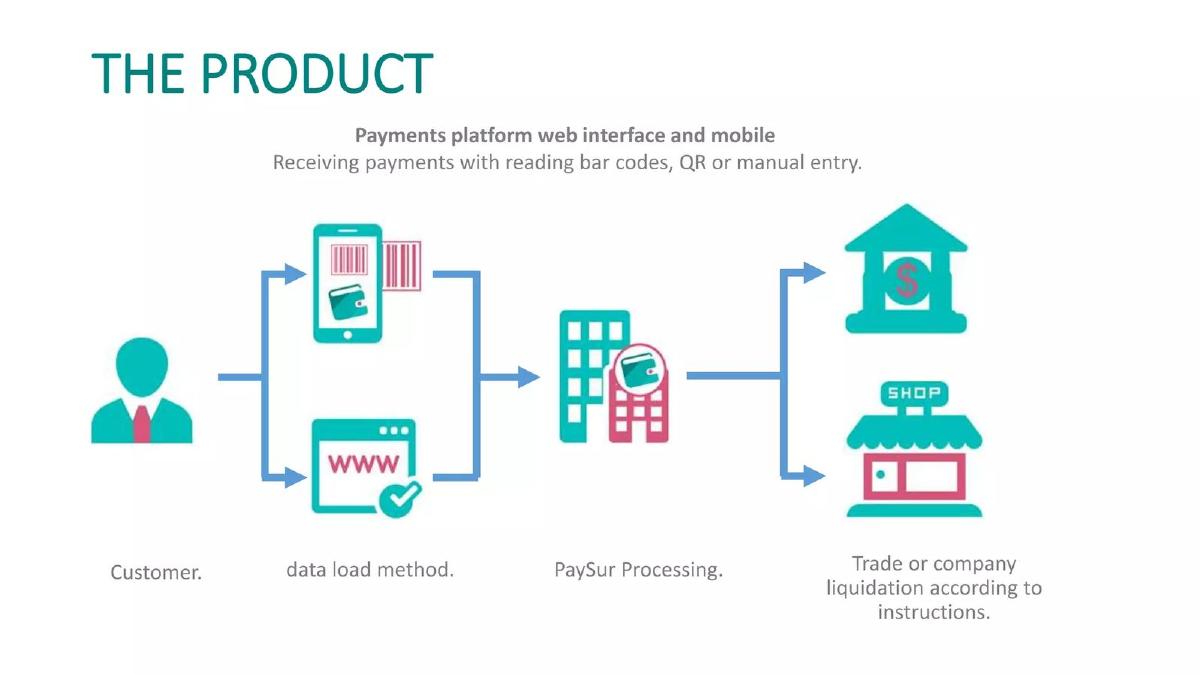
- The product workflow involves reading bar codes, QR codes, or manual entry for processing, according to Slide 3.
- Monetization is driven by three streams: collection management (percentage), commission grants (fixed amount), and commission processing (percentage), detailed on Slide 4.
- The deck identifies six competitors, including Mercado Pago and Rapipago, on Slide 5.
- The founding team includes a CEO with over 9 years of experience and a Marketing lead with over 15 years, as shown on Slide 6.
- Target markets are explicitly listed as Argentina, Chile, Colombia, and Mexico on Slide 7.
PaySur Pitch Deck Analysis
PaySur presents a straightforward, albeit high-level, pitch deck for a fintech platform aimed at the Latin American market. The deck focuses heavily on the functional characteristics of the product and its monetization model, but it leaves significant gaps regarding market validation and financial projections. The following teardown examines the seven provided slides to understand the company's positioning and what a potential investor might find lacking.
Slide 1: Title Slide
The opening slide introduces the company name, PaySur , accompanied by a wallet icon logo. The subtitle defines the company as an "Integrated platform to financial execution." This phrasing is somewhat broad, suggesting that the company handles more than just simple transfers, potentially encompassing credit, processing, and settlement. The branding is clean, using a teal and white color palette, but the slide lacks a specific location or date, which is common in early-stage decks but less helpful for establishing context.
Slide 2: The Solution
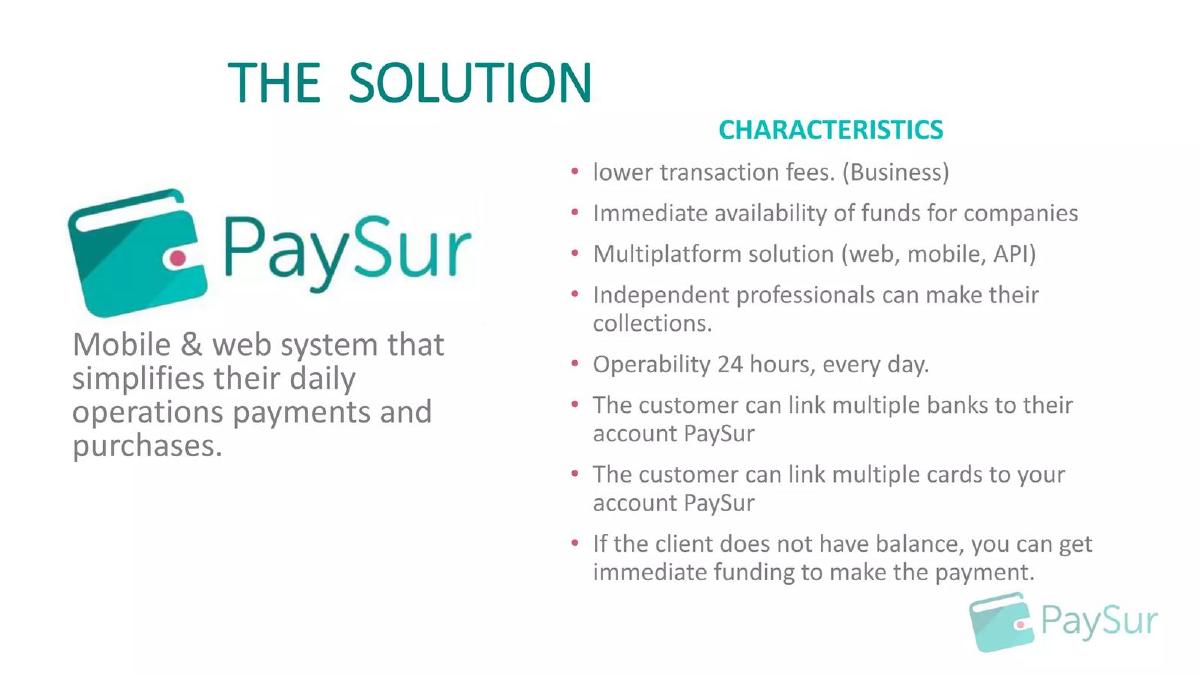
Slide 2, titled "THE SOLUTION," describes PaySur as a "Mobile & web system that simplifies their daily operations payments and purchases." The slide lists eight specific characteristics of the platform:
Lower transaction fees for businesses. · Immediate availability of funds for companies. · Multiplatform solution (web, mobile, API). · Independent professionals can make their collections. · Operability 24 hours, every day. · The customer can link multiple banks to their account PaySur. · The customer can link multiple cards to your account PaySur. · If the client does not have balance, you can get immediate funding to make the payment.
The final point regarding "immediate funding" is the most significant differentiator. It suggests that PaySur is not just a payment gateway but also a lending or micro-credit provider, which is a high-margin but high-risk business model in emerging markets.
Slide 3: The Product
This slide provides a visual workflow of the "Payments platform web interface and mobile." It illustrates the journey from the "Customer" through the "data load method" (which includes "reading bar codes, QR or manual entry" ) to "PaySur Processing." The final step shows the funds moving to a "Trade or company liquidation according to instructions," represented by bank and shop icons. This diagram confirms that PaySur acts as a middleman between the consumer's payment action and the merchant's settlement, emphasizing the flexibility of input methods (QR vs. Barcode) which is critical in regions where physical invoices are still prevalent.
Slide 4: Monetization
The "MONETIZATION" slide is one of the most detailed in the deck, breaking down revenue into three categories: 1. Collection management (Percentage): Described as "Debt collection management for customers who pay off their term cash advance." This confirms the credit aspect of the business. 2. Commission grant (Fixed amount): This is a fee for "administrative expenses by granting money to cover advance payments." This represents the upfront cost to the user for accessing credit. 3. Commission process (Percentage): A standard processing fee "Applied to companies and individuals who use the system of charging for mobile scanning or manually typing invoices, services or products." By combining interest-like fees (collection management) with service fees (commission grants) and transaction fees (commission process), PaySur is attempting to capture value at every stage of the transaction lifecycle.
Slide 5: Competition
The "COMPETITION" slide identifies six major players in the region:
Rapipago: A physical platform for collecting charges. · Pago Fácil: Another physical platform for collecting charges. · Bank: Represented by a classical building icon, noted as a physical platform. · Mercado Pago: Identified as an online platform for collecting charges. · Credit Cards (Visa/Mastercard): Listed as an online-physical platform. · RIPSA Pagos: A physical platform for collecting charges.
The slide acknowledges that PaySur is entering a market dominated by massive incumbents like Mercado Pago (the fintech arm of Mercado Libre) and ubiquitous physical payment networks like Rapipago. However, the deck does not explain how PaySur will win against these giants, other than the previously mentioned "immediate funding" feature.
Slide 6: Equipo (Team)
The team slide features four members, providing a mix of management and technical backgrounds:
Gabriel Galdeano (CEO): Manager at an international level with "more than 9 years of experience" in finance, electronic platforms, and risk analysis. · César Millán (CTO): A quality control specialist and industrial innovation student, also noted as the "Hardware designer PaySur." · Agustín Orella (CCO): A business profile focused on strategy, planning, and continuous improvement. · Germán Castaño (Marketing and Design): A systems engineer with "more than 15 years in the private sector" and experience in project management.
The mention of a "Hardware designer" for the CTO is interesting, as it implies PaySur may have intended to produce its own physical POS terminals or scanning devices, though this is not explicitly detailed in the product slide.
Slide 7: Contact and Geography
The final slide lists the target countries: Argentina, Chile, Colombia, and Mexico. It also provides the website ( and a contact email. This slide serves as a geographic scope statement, indicating that the founders view the platform as a cross-border solution for the Spanish-speaking Latin American market.
What Works in the PaySur Deck
The deck is concise and avoids excessive jargon. The Monetization slide (Slide 4) is particularly strong because it clearly defines three distinct ways the company intends to make money, which is often a point of confusion in fintech pitches. By separating the credit-related fees from the transaction-related fees, the founders show they understand the different levers of their business model. Additionally, the Product slide (Slide 3) uses simple iconography to explain a complex flow, making it accessible to non-technical investors.
What is Missing from the PaySur Deck
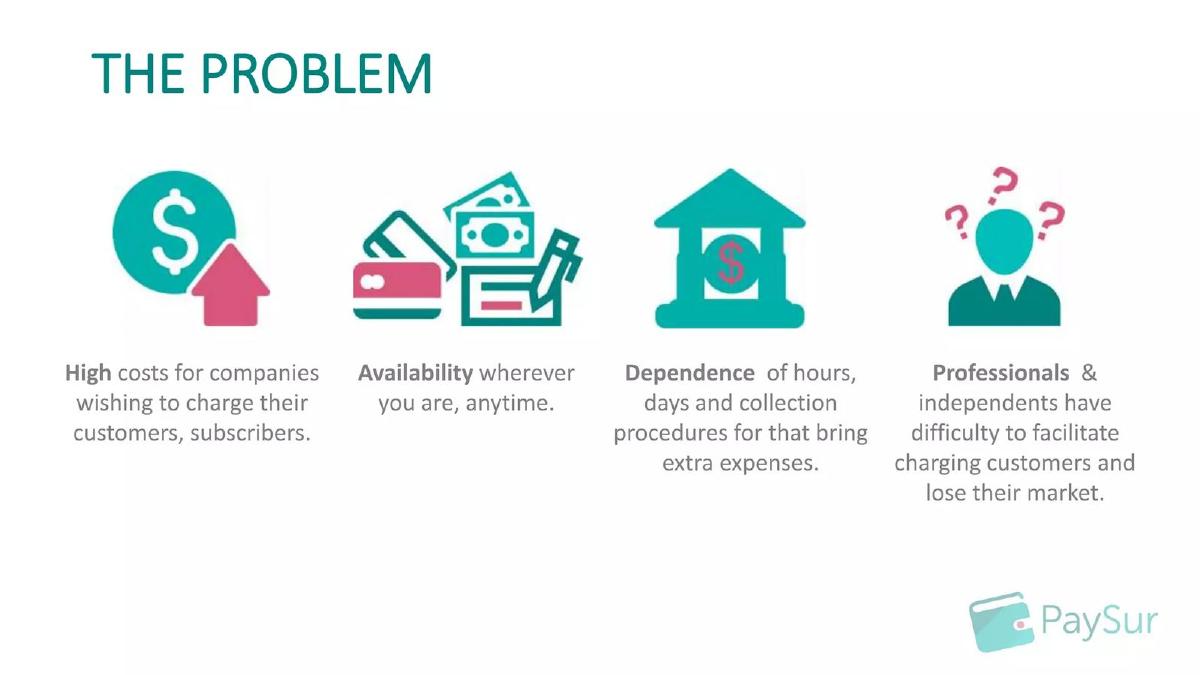
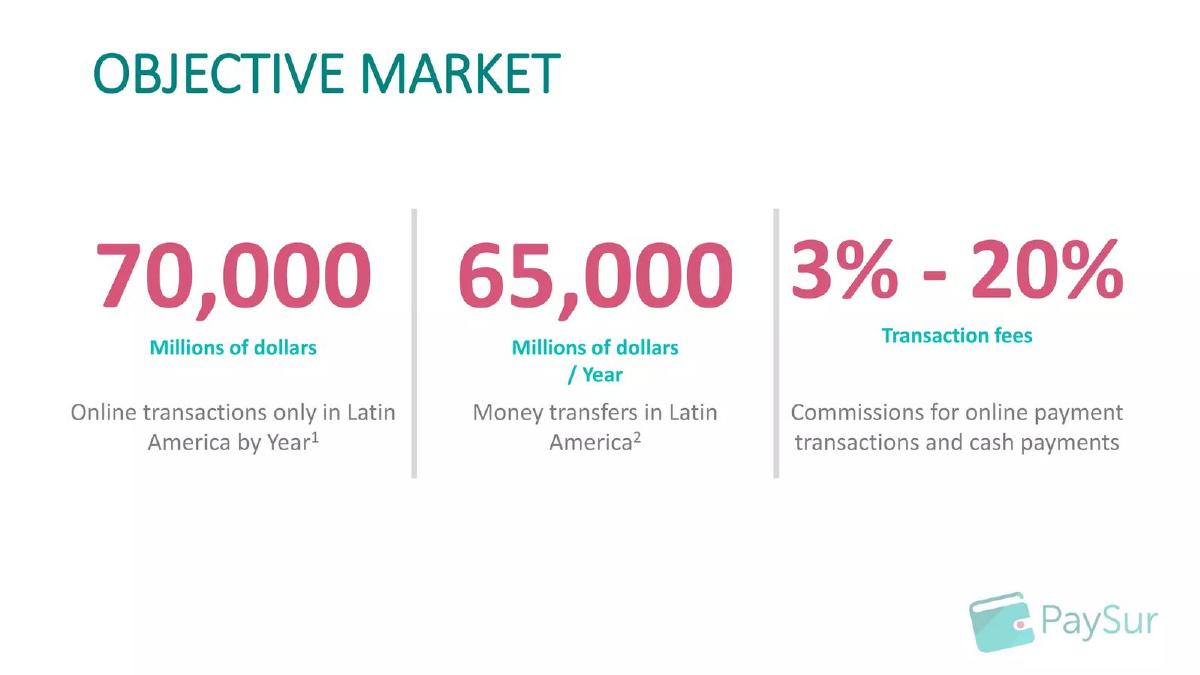
While the deck covers the basics of the product, it omits several critical components required for a successful fundraise: 1. The Problem: There is no slide explaining why current solutions are inadequate. Why do people need "immediate funding"? What is wrong with using Mercado Pago or Rapipago today? 2. Market Size: There are no figures for the Total Addressable Market (TAM). Investors need to know if this is a billion-dollar opportunity or a niche tool. 3. Traction: This is the most glaring omission. There are no mentions of current transaction volume, user count, or partnerships. Without these, the deck feels like a theoretical exercise rather than a business in motion. 4. The Ask: The deck does not state how much capital is being sought, the valuation, or the intended use of funds. 5. Unit Economics: While monetization is explained, the deck does not touch on Customer Acquisition Cost (CAC) or Lifetime Value (LTV), which are vital for a platform competing with established giants.
What a Founder Should Copy
Founders should emulate the clear categorization of revenue streams found on Slide 4. Many fintech decks lump all revenue into "fees," but PaySur correctly identifies that administrative fees, interest-based percentages, and processing percentages are different animals. The geographic focus on Slide 7 is also a good practice; rather than saying "we are going global," the founders have identified four specific, high-growth markets where their solution is relevant. Finally, the visual simplicity of the product flow on Slide 3 is a great way to communicate a technical process without overwhelming the viewer with text.
Frequently asked questions
- What is PaySur's primary value proposition?
- PaySur aims to simplify daily payment operations for both businesses and independent professionals. According to Slide 2, it offers a multi-platform solution (web, mobile, API) with lower transaction fees and the unique ability to provide immediate funding for payments if the user's account balance is zero. This suggests a focus on liquidity and accessibility in the Latin American financial ecosystem.
- How does PaySur generate revenue?
- As detailed on Slide 4, the company has three revenue streams. First, 'Collection management,' where they take a percentage for managing debt for customers paying off cash advances. Second, a 'Commission grant,' which is a fixed amount for administrative expenses when granting money for advances. Third, a 'Commission process' percentage applied to companies and individuals using the system for scanning or manual invoice entry.
- Who are the main competitors identified by PaySur?
- Slide 5 lists six competitors across physical and online platforms. These include Rapipago, Pago Fácil, and RIPSA Pagos (physical platforms), Mercado Pago (online platform), traditional banks, and a generic representation of credit cards (Visa/Mastercard) which act as both online and physical platforms. This indicates PaySur is competing in a crowded field of established payment processors.
- What geographic markets is PaySur targeting?
- The final slide (Slide 7) lists four specific countries: Argentina, Chile, Colombia, and Mexico. This focus on the 'Southern Cone' and Mexico suggests a regional strategy tailored to Latin American financial regulations and consumer behaviors, particularly regarding the use of cash-in/cash-out networks and alternative credit.
- What critical information is missing from the PaySur deck?
- The deck is missing several standard venture capital requirements. There is no 'Problem' slide defining the specific pain point, no 'Market Size' (TAM/SAM/SOM) data, and no 'Traction' slide showing current users or volume. Most importantly, there is no 'Ask' slide detailing how much money is being raised or how the funds will be allocated to achieve specific milestones.