Alloy’s 2021 seed deck is a textbook example of how to use brand identity to bridge the gap between clinical necessity and consumer lifestyle. Raising $3.3M, the company targeted the 55 million American women in menopause by positioning hormone treatment as a modern, science-backed essential rather than a niche medical issue. The deck relies heavily on the 'Kairos' venture studio pedigree and high-profile advisors like Bobbi Brown to establish immediate credibility. While it lacks specific unit economics or a detailed competitive matrix, it excels at defining a clear, underserved demographic…
Key takeaways
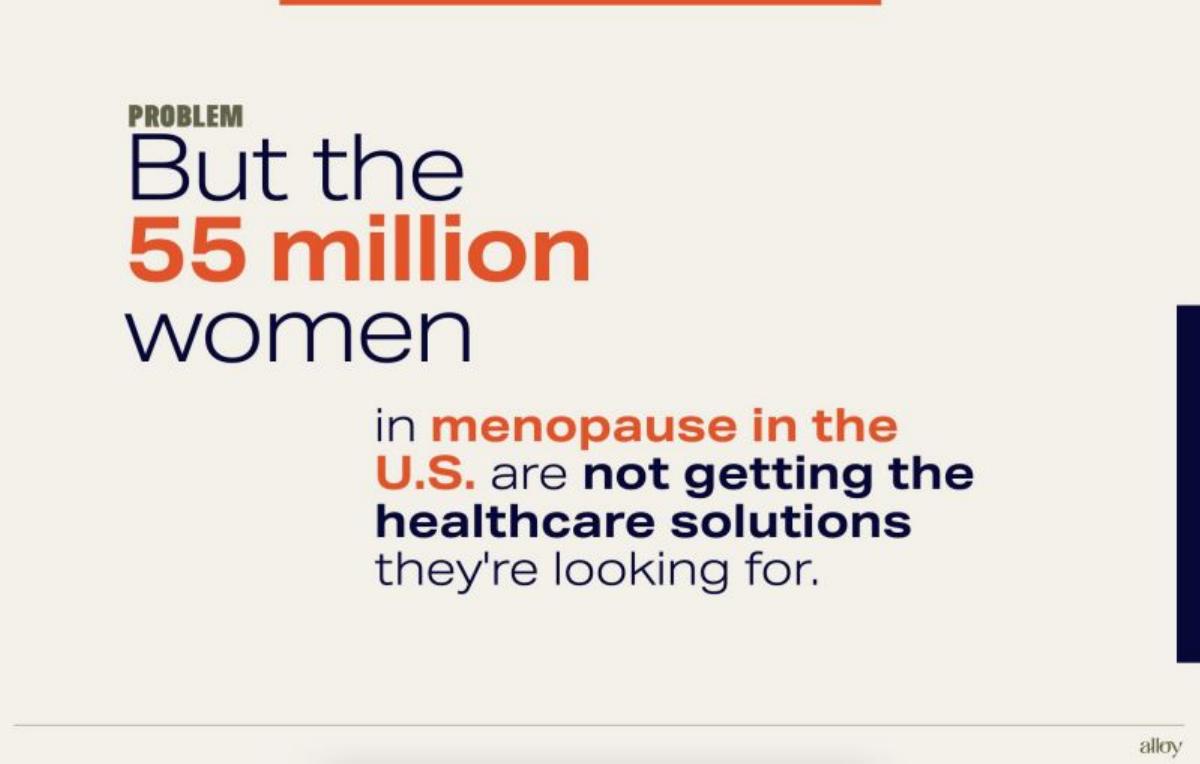
- The deck identifies a massive, underserved market of 55 million women in the U.S. currently in menopause (Slide 3).
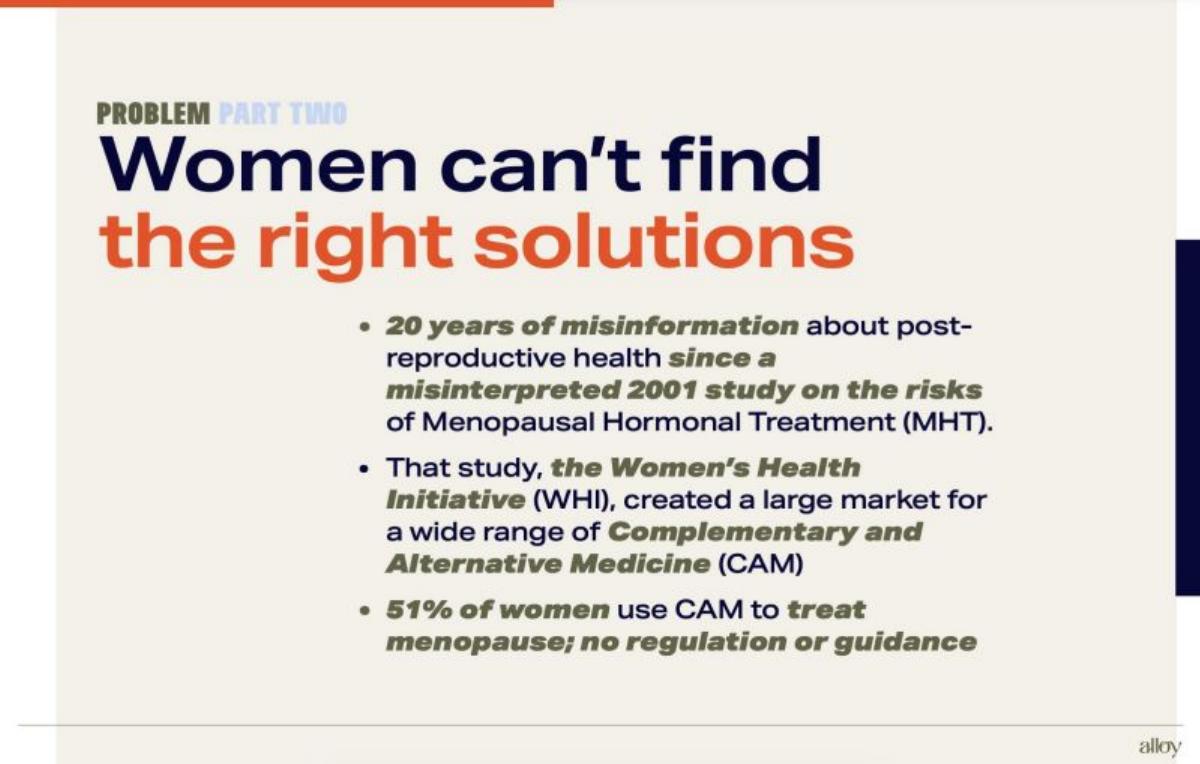
- Alloy positions itself as a corrective to 20 years of medical misinformation following a 2001 study on hormone treatment (Slide 4).
- The product offering is a four-step D2C funnel: quiz, medical assessment, home delivery, and ongoing care (Slide 11).
- A significant pricing advantage is claimed, with offerings projected to be 25%-75% less expensive than competitors (Slide 16).
- The company leverages high-profile social proof by featuring Bobbi Brown on its advisory board (Slide 19).
- Alloy highlights its membership in the Kairos family, citing a portfolio revenue jump from $78M to $238M in one year (Slide 20).
- The initial launch strategy focuses specifically on treating hot flashes, the most severe menopause symptom (Slide 9).
- Future expansion plans include mental health, sexual health, and the $45 billion US supplement market (Slide 17).
The Narrative: Reclaiming the Menopause Conversation
Alloy’s pitch deck is less about complex medical technology and more about cultural repositioning. In 2021, the 'femtech' space was booming, but much of the venture capital was flowing toward fertility and menstruation. Alloy identified a massive gap: the 55 million women in the U.S. experiencing menopause. The deck’s primary achievement is taking a topic often shrouded in 'shame' and 'misinformation' and turning it into a high-growth D2C opportunity.
Slides 1-2: The Vision and the Demographic
The deck opens with a high-energy cover slide featuring a woman in her 40s in a dynamic pose. This immediately signals that Alloy is not a 'clinical' or 'depressing' brand. The subtitle, "A radically honest, holistic solution for women's health after 40," sets the tone. Slide 2 reinforces this with the statement, "We believe women over forty deserve to feel fantastic." By using high-quality lifestyle photography, they are signaling to investors that they understand the aesthetic and emotional language of their target customer.
Slides 3-5: The Problem Triple-Threat
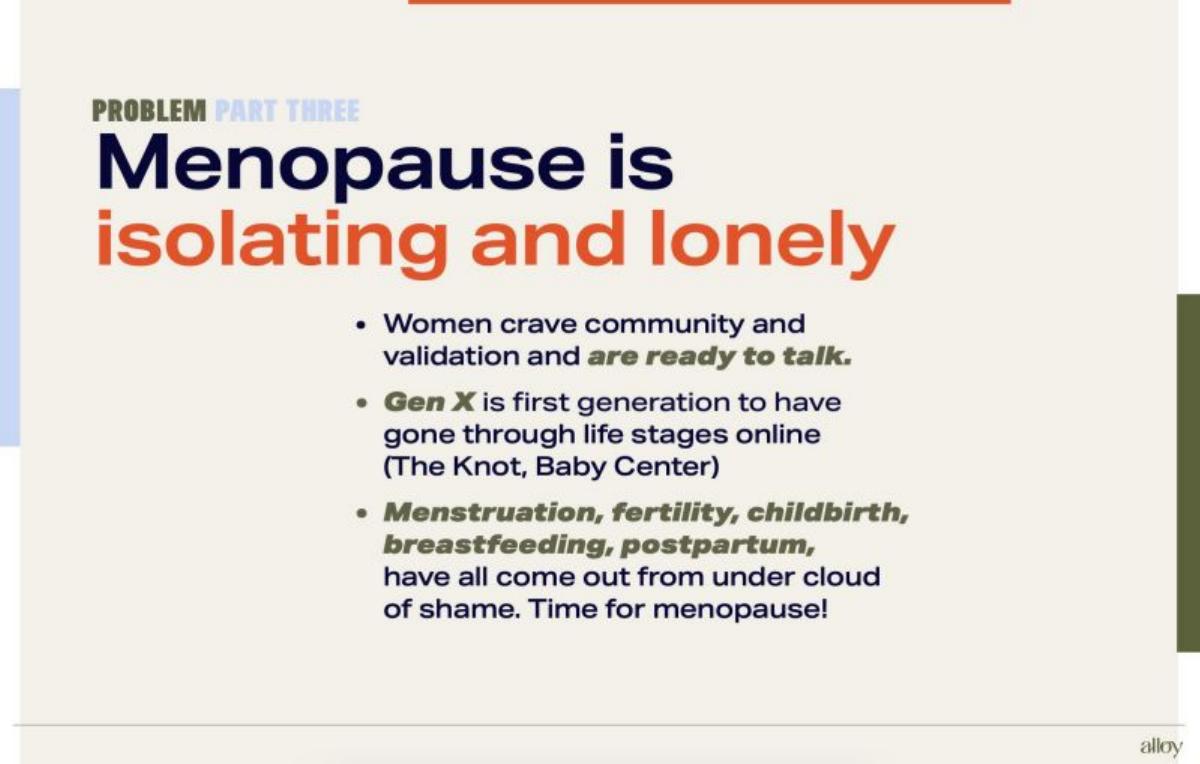
Alloy breaks the problem into three distinct parts. Slide 3 provides the scale: 55 million women in the U.S. are in menopause and lack solutions. Slide 4 addresses the 'why'—citing 20 years of misinformation stemming from a misinterpreted 2001 study on Menopausal Hormonal Treatment (MHT). This is a crucial slide because it explains the market inefficiency; women want treatment, but fear and lack of regulation have pushed 51% of them toward unregulated 'Complementary and Alternative Medicine' (CAM). Slide 5 adds the emotional layer, noting that menopause is "isolating and lonely," and that Gen X is ready to bring this conversation online just as they did with platforms like The Knot and Baby Center.
Slides 6-10: The Purpose and Value Proposition
After the 'Introducing Alloy' transition on Slide 6, Slide 7 defines their purpose: helping women "age healthfully." Slide 8 (and its duplicate on Slide 10) uses a Venn diagram to show their three pillars: Menopause trained physicians, Connection to community, and Evidence-based solutions. Slide 9 is a strategic 'wedge' slide. It admits they can't solve everything at once, so at launch, they are "targeting the most severe symptoms of menopause: hot flashes." This focus is a positive sign for investors, showing a disciplined go-to-market strategy.
Slides 11-12: The Product and User Experience
Slide 11 outlines the "Alloy Offering" in four steps: a quiz, an online medical assessment, home delivery of prescriptions/OTC products, and ongoing care via unlimited messaging. This is a standard D2C telehealth funnel, popularized by companies like Hims or Ro. Slide 12 provides UI/UX mockups, showing a clean, mobile-first interface that uses bold typography and relatable imagery. The messaging on the screen— "Over 40? Don't feel like yourself? We got you." —is direct and empathetic.
Slides 13-15: Clinical Credibility and Science
Because Alloy is dealing with hormone treatments, medical authority is non-negotiable. Slide 13 introduces Sharon Malone, MD , and notes that all doctors on the platform will be NAMS-certified . Slide 14 gets specific about the science, listing FDA-approved bioidentical estradiol and micronized progesterone. It also includes a significant market stat: "The MHT Market Size is poised to reach $39.6 Billion by 2027 Globally." Slide 15 focuses on the 'Community' aspect, promising monthly Q&As and tailored emails, which serves as a retention strategy beyond just selling pills.
Slides 16-17: Competition and Expansion
Slide 16 is the 'moat' slide. Alloy claims to be the "only menopause telehealth solution to ship prescriptions nationally" and highlights a "25%-75%" pricing advantage. This is a bold claim that suggests they have optimized their supply chain or are willing to operate on thinner margins to capture market share. Slide 17 shows the 'Additional Market Opportunities,' including mental health ($225B spending), sexual health ($11B market), and supplements ($45B market). This tells investors that while they are starting with hot flashes, the LTV (Lifetime Value) of the customer could be enormous as they expand into other categories.
Slides 18-21: The Team and the Kairos Pedigree
Slide 18 lists the Seed Funding Milestones, which are refreshingly specific: scaling to 4 engineers and 5 marketing staff, and transitioning tech in-house by Q1 2022. Slide 19 features the Advisory Board, notably Bobbi Brown . Having a household name in beauty and lifestyle on the board is a massive signal of brand potential. Slide 20 is perhaps the most important for the 'close.' It reveals that Alloy is part of the Kairos family . It lists sister companies like Rhino, Bilt, and Little Spoon, noting that the portfolio's collective annualized revenue rose from $78M in 2Q20 to $238M in 2Q21 . This 'guilt by association' with high-growth winners likely did a lot of the heavy lifting in the $3.3M raise.
What Works in the Alloy Deck
Demographic Clarity: They don't just say 'women.' They say 'Gen X women over 40' and explain why this specific cohort is ready for a digital solution. · Visual Identity: The deck looks like a high-end magazine. It avoids the 'medical blue' tropes of healthcare and uses warm, sophisticated colors that appeal to their target buyer. · The Wedge Strategy: Focusing on hot flashes first (Slide 9) gives the company a clear, measurable starting point rather than trying to boil the ocean of 'aging.' · Institutional Credibility: Leveraging the Kairos portfolio metrics (Slide 20) provides a safety net for investors, suggesting that the founders have access to a proven growth playbook.
What is Missing from the Alloy Deck
Unit Economics: While they mention a pricing advantage, there is no mention of Customer Acquisition Cost (CAC) vs. Lifetime Value (LTV). For a D2C company, these are the most important numbers. · Detailed Competitive Matrix: They claim to be 25-75% cheaper, but they don't name the competitors or show a feature-by-feature comparison. · The Founders: Interestingly, the deck focuses on the Advisory Board and the Kairos family but doesn't have a dedicated slide for the actual day-to-day founders and their specific backgrounds. · Regulatory Roadmap: Shipping prescriptions nationally is complex. The deck mentions they do it, but doesn't explain the legal or pharmacy infrastructure behind it.
What Other Founders Should Copy
The 'Problem Part 1, 2, 3' Structure: Breaking a complex problem into scale, misinformation, and emotional impact makes the solution feel inevitable. · High-Profile Advisors: If you are in a consumer-facing vertical, a single 'name' advisor like Bobbi Brown can be worth more than five pages of technical specs. · The 'Family' Slide: If you are part of an incubator or have a lead investor with other winners, don't be afraid to show their growth stats. It proves you are in an ecosystem that knows how to scale. · Bold Typography: In a sea of boring decks, Alloy's use of large, serif fonts and high-contrast layouts makes the deck memorable and professional.
Frequently asked questions
- What is Alloy's core business model?
- Alloy operates as a direct-to-consumer (D2C) telehealth platform. They monetize through a combination of medical consultation fees and the sale of prescription and over-the-counter (OTC) treatments, specifically focused on hormone replacement therapy like estradiol and progesterone.
- How does Alloy differentiate itself from other menopause startups?
- According to slide 16, Alloy claims three main differentiators: national prescription shipping reach, a pricing advantage of 25%-75% over competitors, and being the only 'comprehensive end-to-end solution' that combines doctors, OTC products, and prescriptions in one delivery.
- Who is the target audience for Alloy?
- The deck specifically targets women over 40, with a focus on the 'Gen X' generation. They argue that this demographic is the first to have navigated major life stages (like marriage and childbirth) through online platforms, making them prime candidates for telehealth.
- What medical credibility does the deck provide?
- Alloy emphasizes that all doctors on their platform are certified by the North American Menopause Society (NAMS). They also feature Sharon Malone, MD, as a key figure guiding their treatment protocols on slide 13.
- What are the primary milestones Alloy aimed to achieve with this seed round?
- As stated on slide 18, the goals included scaling the team (4 engineering, 5 marketing, 1 ops), transitioning technology in-house by Q1 2022, launching press campaigns, and validating key financial metrics like CAC and conversion rates.