Green Handz is a waste management technology platform designed to digitize and incentivize the recycling process in the Philippines. The deck focuses on a three-pronged software solution consisting of a Customer App, a Collector App, and a management Dashboard. By partnering with established entities like Green Antz and major consumer brands, Green Handz aims to formalize the informal waste sector and drive a 60% recovery rate for plastic by 2030. The presentation highlights a clear execution timeline from 2021 to 2023, emphasizing a rewards-based system where users earn points redeemable thr…
Key takeaways
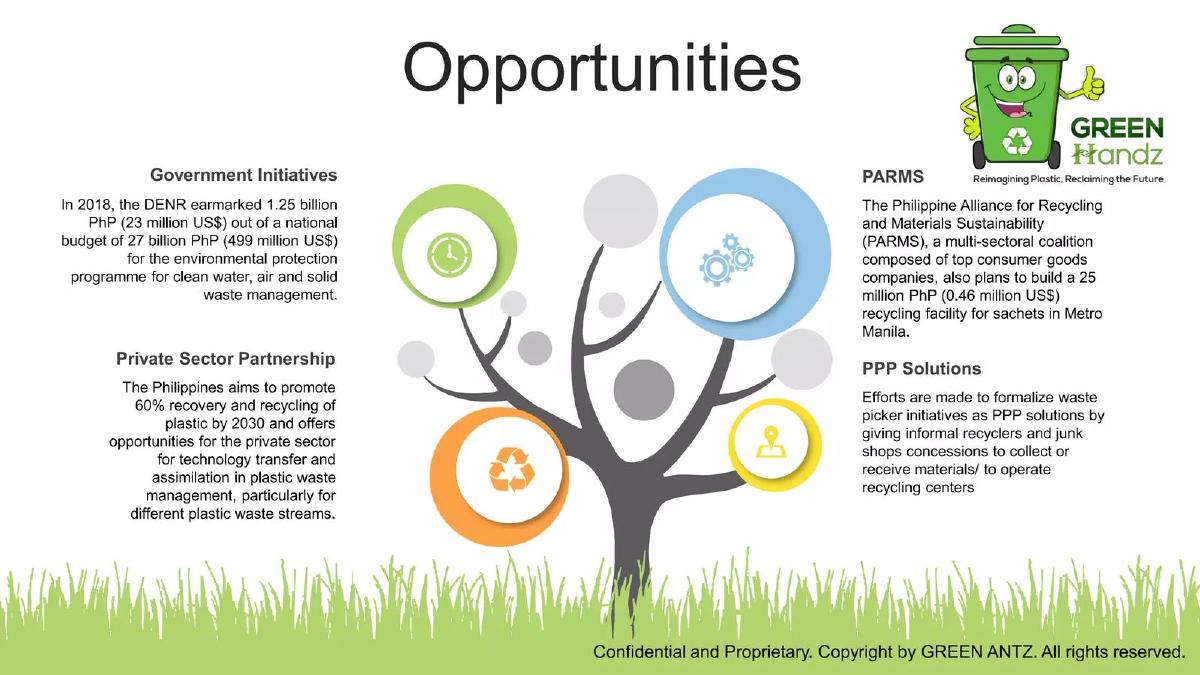
- The company targets the Philippine waste management market, citing a 2018 DENR budget of 1.25 billion PhP for environmental protection (Slide 2).
- Green Handz positions itself as a partner to PARMS, which plans a 25 million PhP recycling facility for sachets in Metro Manila (Slide 2).
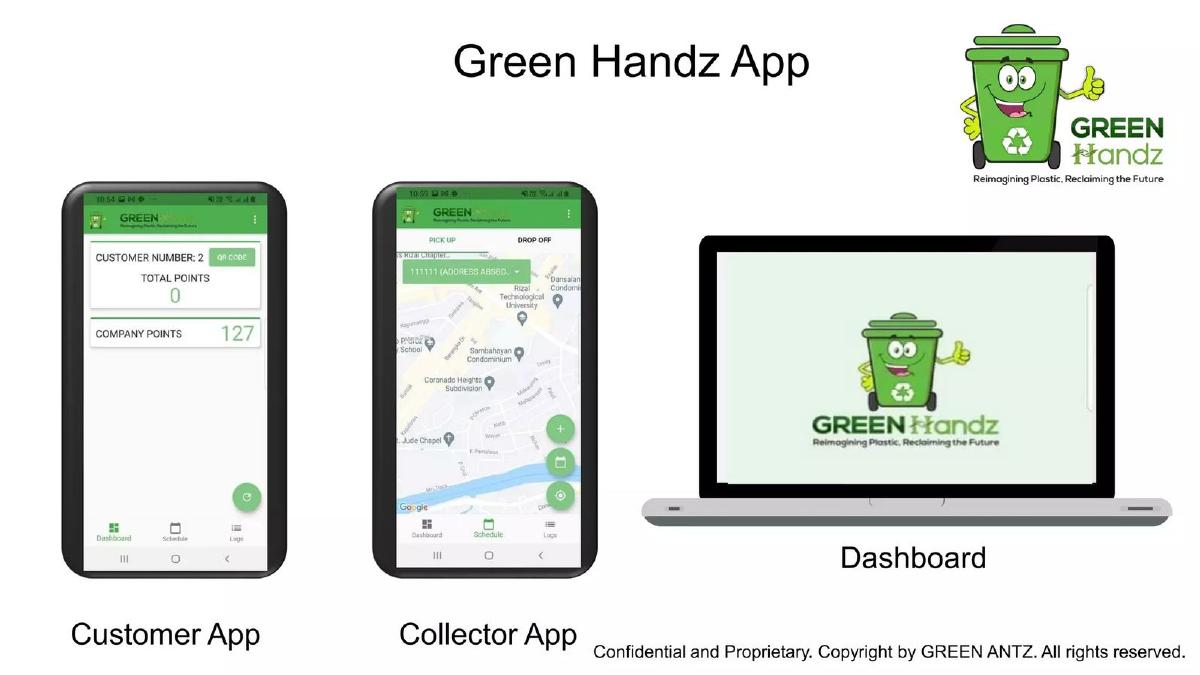
- The product ecosystem includes three distinct interfaces: a Customer App for scheduling, a Collector App for confirmation, and a Dashboard for tracking (Slide 4).
- The platform uses a QR code-based verification system to facilitate transactions between customers and collectors (Slide 5).
- The Customer App interface shows integration with major brands including Nestle, Shopee, Colgate-Palmolive, and Havaianas for points tracking (Slide 6).
- Redemption partners listed include Shell Select, GCash, and BitGreen, indicating a diverse rewards ecosystem (Slide 7).
- The development timeline spans from May 2021 (Feature Updates) to a planned full implementation in 2022 and further updates in 2023 (Slide 8).
- The deck emphasizes a Public-Private Partnership (PPP) approach to formalize informal waste picker initiatives (Slide 2).
Green Handz: Digitizing the Waste Value Chain
Green Handz presents a solution tailored to the specific environmental and economic landscape of the Philippines. The deck, copyrighted by GREEN ANTZ, suggests a strategic alignment with an established player in the circular economy space. The following is a slide-by-slide teardown of the 8 provided slides from the 16-slide deck.
Slide 1: Title and Branding
The cover slide introduces the company name, Green Handz, alongside the tagline: "Reimagining Plastic, Reclaiming the Future." The logo features a personified green recycling bin giving a thumbs-up, signaling a community-friendly, approachable brand. A footer note indicates the material is confidential and proprietary, with the copyright attributed to GREEN ANTZ, a known social enterprise in the Philippines specializing in eco-friendly building materials.
Slide 2: Market Opportunities
This slide establishes the macro-environment. It cites significant government backing, noting that in 2018, the DENR earmarked 1.25 billion PhP ($23 million USD) for environmental protection programs. It also highlights the Philippine goal of 60% recovery and recycling of plastic by 2030. Crucially, it mentions PARMS (Philippine Alliance for Recycling and Materials Sustainability) and their plan for a 25 million PhP recycling facility in Metro Manila. The slide frames the opportunity around Public-Private Partnership (PPP) solutions to formalize informal waste pickers.
Slide 3: Strategic Pillars
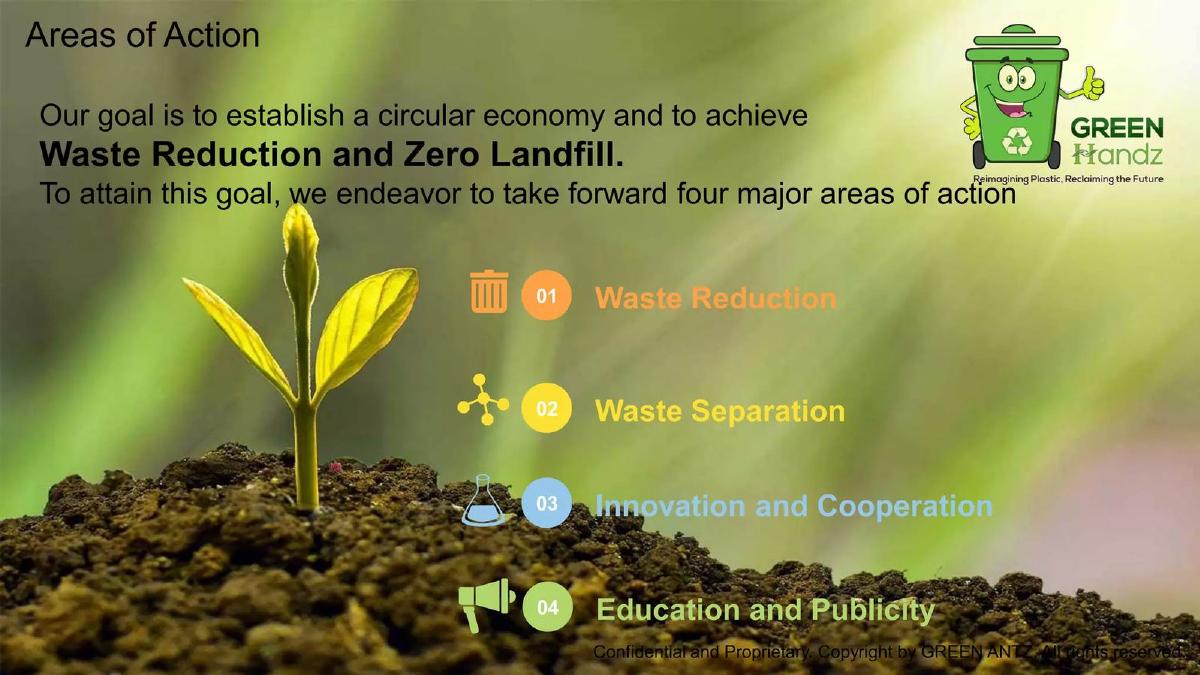
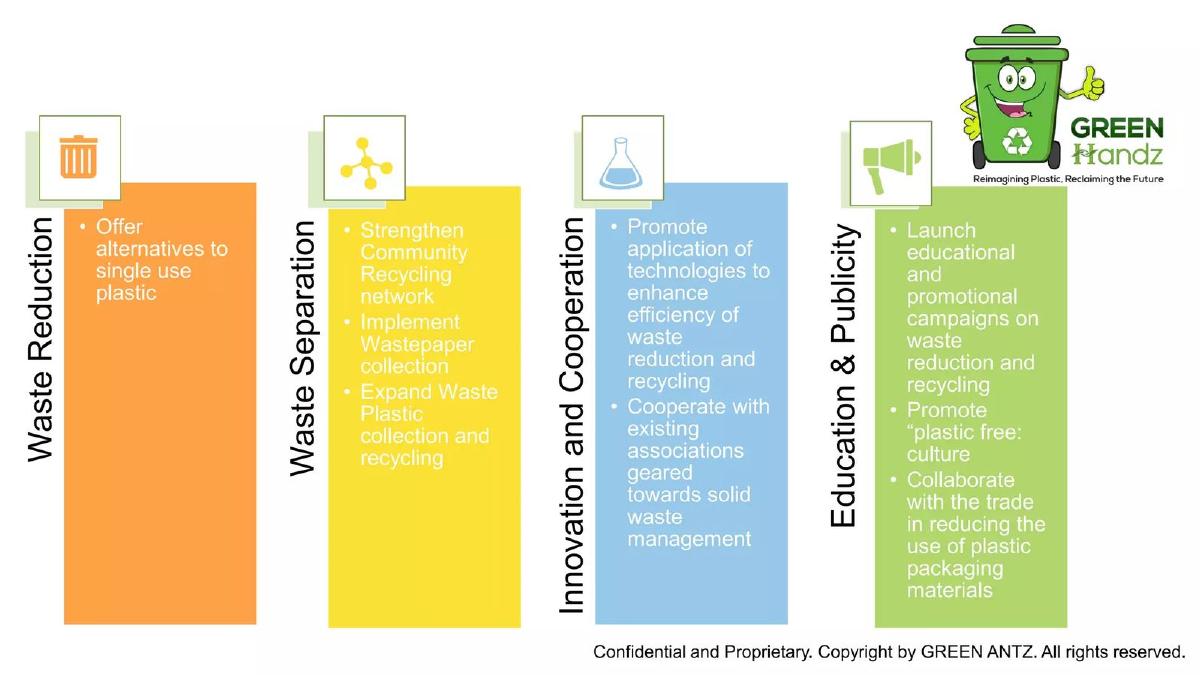
Green Handz outlines four pillars of operation: Waste Reduction (offering alternatives to single-use plastic), Waste Separation (strengthening community networks and implementing wastepaper and plastic collection), Innovation and Cooperation (promoting technology and cooperating with existing associations), and Education & Publicity (launching promotional campaigns and promoting a "plastic-free" culture). This slide serves as the mission statement for the company's activities.
Slide 4: Feature Matrix
This slide provides a technical overview of the platform's functionality. It breaks down features across three interfaces:
Customer App: Handles registration, scheduling, tracking, profiles, and points summaries. · Collector App: Manages confirmation of pickup, tracking, and pickup schedules. · Dashboard: A comprehensive view for administrators to track all metrics, including confirmation, history, and schedules.
Slide 5: User Interaction (QR Verification)
The deck uses visual mockups to explain the transaction flow. Slide 5 shows the "My QR" screen on the Customer App and the "Scan QR" screen on the Collector App. This indicates a secure, digital handshake to verify that a collection has occurred, which is essential for maintaining the integrity of a points-based incentive system.
Slide 6: Brand Integration and Points Tracking
This slide shows the Customer App's interface for tracking points by brand. It features logos for Nestle, Shopee, Colgate-Palmolive, Havaianas, Universal Robina, and Green Antzable. Each brand is associated with a weight (kg) and a points value. The Collector App side shows a simple interface for inputting the weight (kg) and confirming the transaction. This demonstrates a B2B2C model where brands likely subsidize the points to meet their Extended Producer Responsibility (EPR) goals.
Slide 7: The Rewards Ecosystem
Slide 7 illustrates the redemption process. Once points are earned, they become "Green Rewards." The slide lists several redemption channels: Green Antz Drop-Off Stations, Shell Select, GCash (a dominant mobile wallet in the Philippines), Green Optionz, and BitGreen. This variety of redemption options—from physical goods to digital cash and potentially cryptocurrency—is a strong value proposition for user retention.
Slide 8: App Development Timeline
The final slide in this set provides a roadmap. It starts in May 2021 with feature updates, moves to User Acceptance Testing (UAT) in June 2021, and targets a launch in September 2021. Full implementation is slated for 2022, with further feature updates in 2023. The slide notes that the timeline depends on development resources and integration with Green Antz.
What Works in This Deck
Specific Market Context: The deck does an excellent job of citing local Philippine government figures and specific coalition names like PARMS. This shows the founders understand the local regulatory and subsidy environment. Clear Product Roles: By separating the features into Customer, Collector, and Dashboard views, the deck clearly explains how the technology facilitates a multi-sided marketplace. Brand Partnerships: Showing recognizable logos like Nestle and GCash provides immediate social proof and suggests a viable path to monetization through corporate social responsibility or EPR budgets.
What Is Missing
The Team Slide: In the provided 8 slides, there is no mention of the founders or their background. In a logistics-heavy business like waste management, the team's ability to execute is paramount. Unit Economics: While the points system is explained, the underlying economics are not. How much does Green Handz charge the brands? What is the cost per kilogram of plastic recovered? The Ask: There is no slide detailing how much money is being raised or how those funds will be allocated. Competitive Analysis: The deck assumes a vacuum. It does not address other waste management startups or traditional waste collection services.
Founder Recommendations
Copy the Partnership Strategy: If you are building in the ESG or circular economy space, follow Green Handz's lead by aligning your product with existing corporate coalitions and government targets. It makes the 'Opportunity' slide much more compelling. Use Clear Mockups: The simple, clean app mockups in slides 5 and 6 are effective. They don't overcomplicate the UI but show exactly how the user interacts with the service. Formalize the Informal: The focus on giving informal recyclers "concessions to collect" (Slide 2) is a sophisticated way to address labor in emerging markets. Founders should look for ways to bring existing informal systems into their digital platforms rather than trying to replace them entirely.
Frequently asked questions
- What is the primary problem Green Handz is solving?
- Green Handz addresses the lack of formal infrastructure and incentives for plastic recycling in the Philippines. By providing a digital platform that connects households (customers) with waste collectors and offering tangible rewards for recycling, they aim to increase the national plastic recovery rate toward the government's 60% goal by 2030.
- How does the rewards system work for the end user?
- Users register via the Customer App to schedule waste pickups. Upon collection, a QR code is scanned to verify the transaction. The app tracks the weight of materials collected (e.g., 2800kg) and awards points (e.g., 500 points) which can be redeemed for goods or digital currency through partners like GCash or Shell Select.
- Who are the key partners mentioned in the deck?
- The deck lists significant corporate and institutional partners, including Green Antz (the parent/copyright holder), PARMS, and the DENR. Consumer brand partners shown in the app mockups include Nestle, Shopee, Colgate-Palmolive, Havaianas, and Universal Robina.
- What are the technical components of the Green Handz platform?
- The platform consists of a Customer App (registration, scheduling, points summary), a Collector App (pickup confirmation, tracking, schedule management), and a centralized Dashboard that provides oversight for all activities, including history and tracking.
- What critical information is missing from this pitch deck?
- The provided slides omit several standard venture capital requirements: there is no slide detailing the founding team's expertise, no financial model or revenue projections, no competitive landscape analysis, and no specific 'Ask' regarding the amount of capital being raised or the valuation.