Greengar’s pitch deck is a product of the early App Store gold rush, emphasizing raw download volume and cross-platform potential over complex financial modeling. With 8 million downloads cited on slide 2, the company established immediate credibility in a nascent mobile market. The deck highlights 'Whiteboard: Collaborative Drawing' as its primary engine for growth, showcasing real-time synchronization across iOS, Android, and desktop devices. While the deck lacks traditional slides for unit economics, market sizing (TAM/SAM), or a specific financial 'ask,' it compensates with strong social…
Key takeaways
- The deck leads with a massive traction hook, claiming 8 million downloads for the Whiteboard app on slide 2.
- Greengar emphasizes a cross-platform strategy, showing the app functioning on smartphones, tablets, and desktops on slides 11 and 12.
- The team is globally distributed, with core members located in San Francisco, Vietnam, and Singapore as shown on slide 9.
- The founders have relevant technical backgrounds, with two USC graduates in Computer Science and Engineering from the class of 2009 (slide 5).
- The product focus is on real-time collaboration and sharing, specifically targeting educational or presentation use cases (slide 8).
- Social proof is utilized through an endorsement by Scott Flansburg, the 'Fastest Human Calculator' (slide 7).
- The deck is notably missing a formal 'Ask' slide, financial projections, or a competitive landscape analysis.
- The final slide sets an ambitious goal of reaching 1 billion, though it does not specify if this refers to users or revenue (slide 13).
The Hook: Immediate Traction
Slides 1-2: The Opening Gambit
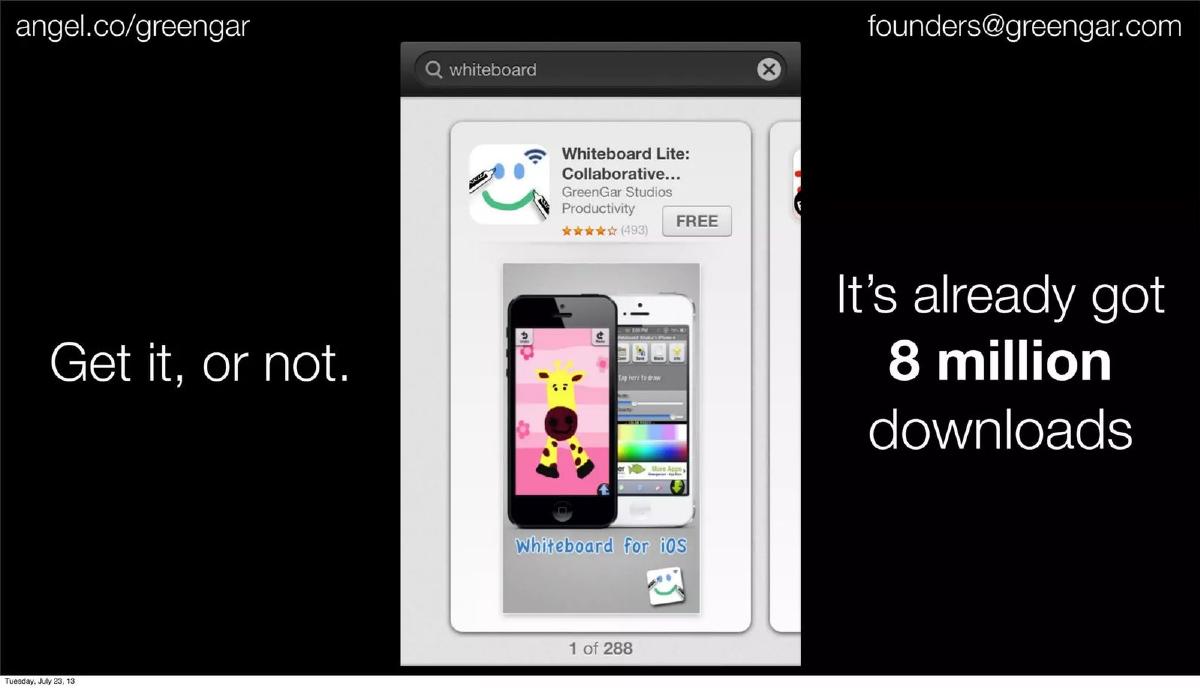
Greengar opens with a minimalist black slide asking, "Are you on your iPhone?" (Slide 1). This is a classic 'know your audience' move, immediately centering the conversation on the hardware that drives their business. It is followed immediately by the 'Traction' slide (Slide 2), which is the strongest part of the deck. It displays the App Store listing for "Whiteboard Lite: Collaborative Drawing" and states, "It's already got 8 million downloads."
By leading with 8 million downloads, Greengar bypasses the need to prove product-market fit. In 2008-2013, these were massive numbers for an independent studio. The slide also shows a 4.5-star rating from 493 reviews, providing immediate social proof. The phrase "Get it, or not" suggests a level of confidence—or perhaps bravado—common in early mobile startup culture.
Slides 3-4: Product and Vague Monetization
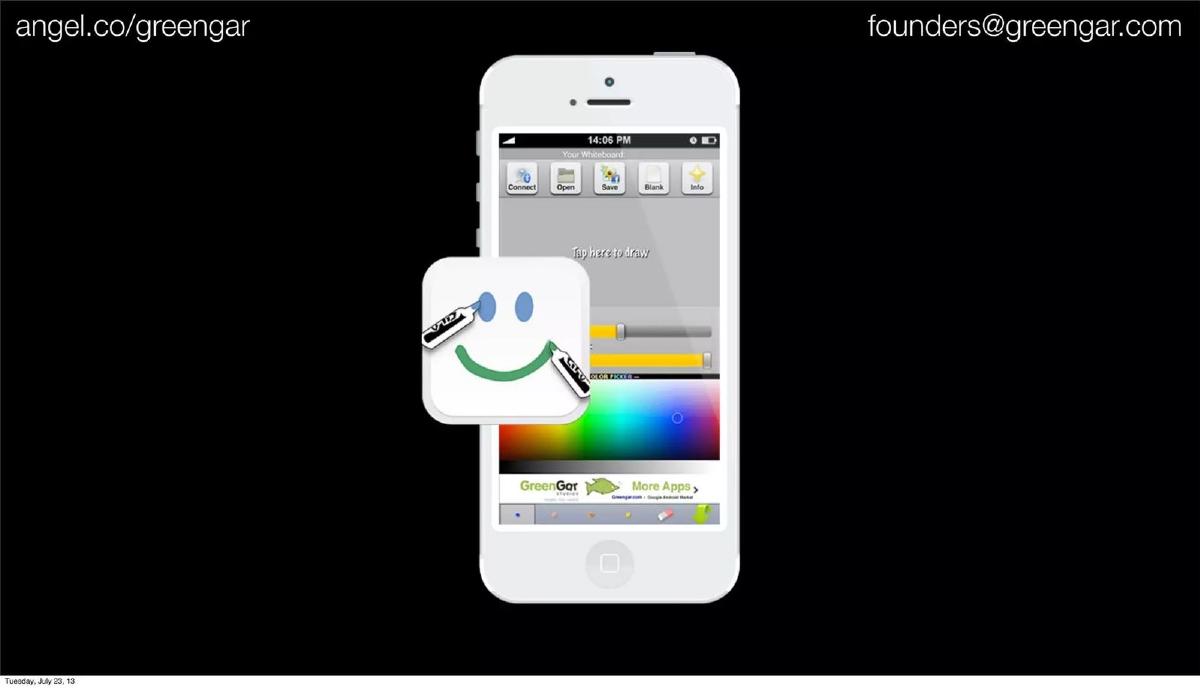
Slide 3 provides a full-screen mockup of the Whiteboard app on an iPhone. The interface is simple: a color picker, drawing tools, and a 'Connect' button. This reinforces the 'Collaborative' aspect mentioned in the title. Slide 4 is an enigma; it features a dark background with faint, floating dollar signs. While it clearly alludes to money, it fails to explain the business model. Is it ad-supported? Is there a pro version? The deck leaves the investor to guess how those 8 million downloads translate into a sustainable business.
The Team and Social Proof
Slides 5-7: Pedigree and Endorsements
The team slide (Slide 5) introduces Thuy Truong (CEO) , Elliot Lee (CCO) , and Long Trieu (Lead Developer) . The founders highlight their USC backgrounds (Computer Science and Computer Engineering, Class of 2009). Thuy Truong is noted as the founder of 'Parallel Yogurt' and a former sales specialist at B of A (Bank of America). Elliot Lee is credited with building and selling two websites and making a web page at age 8. This establishes a mix of technical skill and entrepreneurial history.
Slide 6 features a photo of Nathan Smith , labeled as a "Distinguished Consumer (Child)." This is likely an attempt at humor or to show the app's ease of use across demographics. More substantial is Slide 7, which features Scott Flansburg , the "Guinness World Record Fastest Human Calculator." Showing a world-renowned mental athlete using the app on a tablet provides a high-level endorsement for the tool's utility in educational or professional settings.
The Vision: Real-Time Collaboration
Slides 8-10: Use Cases and Global Reach
Slide 8 uses a simple illustration to show the app's value proposition: "Real-time collaborating and sharing." It depicts a teacher-like figure sharing PDF, PowerPoint, and Keynote files from a tablet to a projector and multiple student devices. This positions Whiteboard not just as a drawing toy, but as an EdTech or enterprise presentation tool.
Slides 9 and 10 emphasize the company's international footprint. A world map shows team members in San Francisco, Vietnam, and Singapore . Slide 10 overlays the Whiteboard icon in the center of this map with dotted lines connecting the regions. This serves two purposes: it explains how they manage a 24-hour development cycle and highlights the 'collaborative' nature of the company itself.
Slides 11-12: Cross-Platform Capability
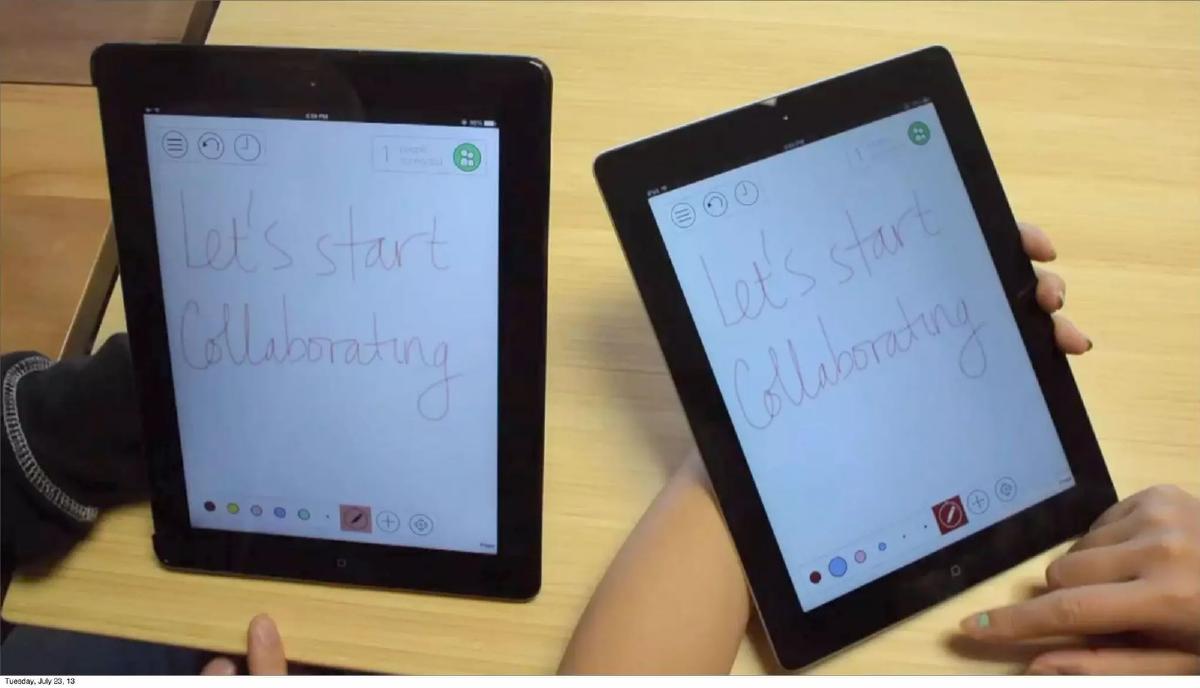
These slides are purely visual, showing the word "Hi!" being drawn on a tablet and then instantly appearing on a desktop, laptop, and multiple smartphones. In the early days of the mobile web, seamless real-time synchronization across different operating systems (iOS and Android) and form factors was a significant technical hurdle. These slides demonstrate that Greengar has solved the 'plumbing' of real-time data sync.
The Conclusion
Slide 13: The Goal
The final slide (Slide 13) contains a bold claim: "We already made 1 million. Let's talk about 1 billion!" It provides the contact email and the company logo (a green fish). Like the dollar sign slide earlier, this is high on ambition but low on detail. It is unclear if the '1 million' refers to revenue or a specific user milestone, though given the earlier mention of 8 million downloads, it likely refers to dollars. The '1 billion' target is the 'North Star' metric intended to excite venture capitalists looking for 'unicorn' scale.
What Works
Traction First: Leading with 8 million downloads is a powerful way to command attention. It proves the team can build things people want to install. · Visual Demonstration: Slides 11 and 12 do a great job of explaining a technical feature (cross-platform sync) without using a single word of jargon. · Clear Identity: The deck has a consistent aesthetic—black backgrounds, simple white text, and clear screenshots. It feels like a product-led company. · Social Proof: The inclusion of a Guinness World Record holder (Slide 7) adds a layer of 'cool factor' and professional validation that simple user numbers cannot.
What is Missing
The Ask: There is no slide detailing how much money they are raising, at what valuation, or what the milestones for the next 18 months are. · Business Model: Beyond the vague dollar signs on Slide 4, there is no explanation of how the company makes money. This is a critical flaw for a seed-stage pitch. · Market Analysis: There is no mention of the Total Addressable Market (TAM). Investors need to know if the 'collaborative drawing' space is big enough to support a billion-dollar company. · Competition: The deck ignores competitors. In 2008-2013, there were many whiteboard and collaboration apps. Greengar doesn't explain why they will win against incumbents or other startups. · Unit Economics: There is no mention of Customer Acquisition Cost (CAC) or Lifetime Value (LTV). While 8 million downloads are great, if they are all free users with no path to monetization, the business is not venture-scale.
What a Founder Should Copy
The Traction Hook: If you have a 'big number,' put it on Slide 2. Don't make investors wait until the end of the deck to find out you have millions of users. · Minimalist Design: This deck is easy to read. It doesn't clutter the slides with bullet points. It uses images to tell the story of the product's utility. · Global Context: If you have a distributed team, frame it as a strength (Slide 9). It shows you can source talent globally and operate efficiently across time zones. · The 'Show, Don't Tell' Approach: Instead of writing a paragraph about 'low-latency cross-platform synchronization,' Greengar just showed a 'Hi!' appearing on five screens at once. This is much more effective.
Frequently asked questions
- What is Greengar's primary product according to the deck?
- The primary product featured is 'Whiteboard Lite: Collaborative Drawing.' Slide 2 shows it as a free app in the App Store, and subsequent slides (8, 11, 12) demonstrate its core functionality: allowing multiple users to draw and share content in real-time across different devices.
- How much traction did Greengar have at the time of this pitch?
- The deck states on slide 2 that the app had already achieved 8 million downloads. The catalogue facts further note that by January 2013, the company surpassed 13 million downloads across its suite of approximately a dozen apps.
- Who are the founders of Greengar?
- As shown on slide 5, the leadership includes Thuy Truong (Co-Founder & CEO), a USC Computer Science graduate and former founder of Parallel Yogurt; Elliot Lee (Founder & CCO), a USC Computer Engineering graduate; and Long Trieu (Lead Developer), an alumnus of HCM City University of Technology.
- What is the business model mentioned in the slides?
- The deck is largely silent on a specific monetization strategy. Slide 4 shows floating dollar signs, which hints at revenue generation, and slide 13 mentions having 'already made 1 million,' but there are no details on whether this is through ads, in-app purchases, or subscriptions.
- Is there a specific funding request in the deck?
- No. The 13 slides provided do not include a 'The Ask' slide. There is no mention of the amount of capital being raised, the valuation, or the intended use of funds, which is a significant omission for a standard pitch deck.