GridCure’s 2013 deck is an artifact of the 'Big Data' era, focusing on the sheer volume of information generated by smart grids. With only 8 slides, the company relies heavily on high-level visuals and massive social proof, specifically citing $12M in contracts and a $105M pipeline. The deck effectively identifies the 'Current Pain'—a 1,000x to 100,000x increase in data—but provides almost no detail on how the software actually functions or how it generates revenue. It is a 'teaser' style deck designed to spark interest through large numbers and reputable team backgrounds rather than a compre…
Key takeaways
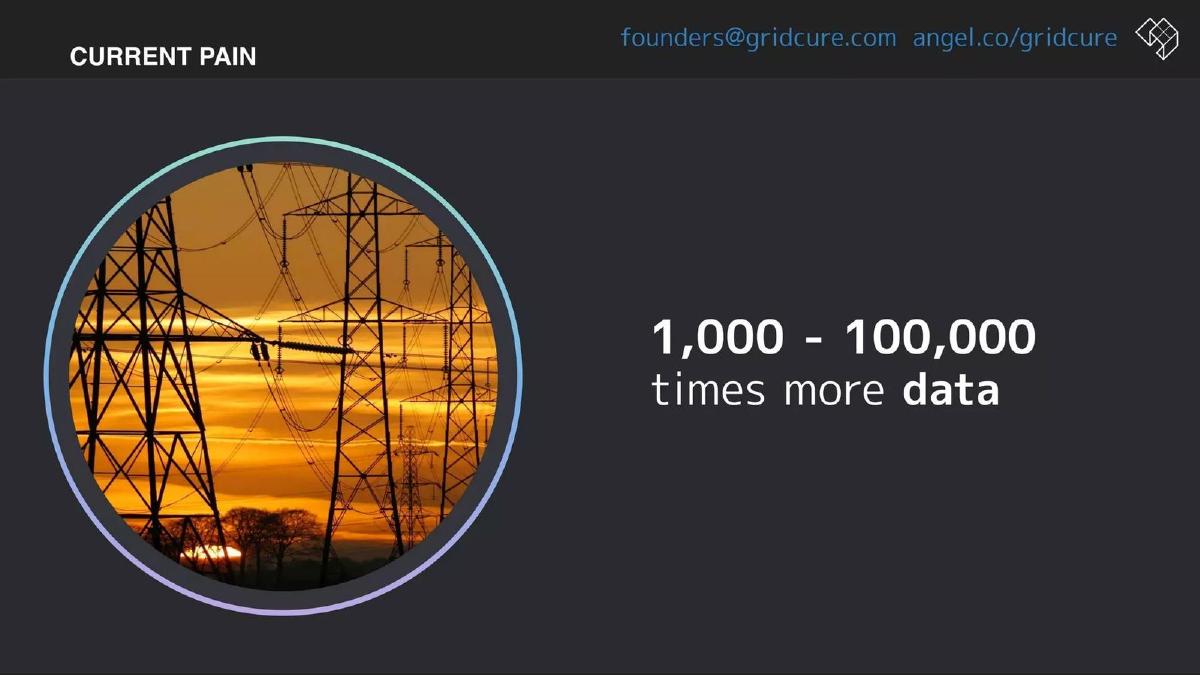
- The deck identifies a specific data explosion in the utility sector, citing a 1,000 to 100,000 times increase in data on Slide 2.
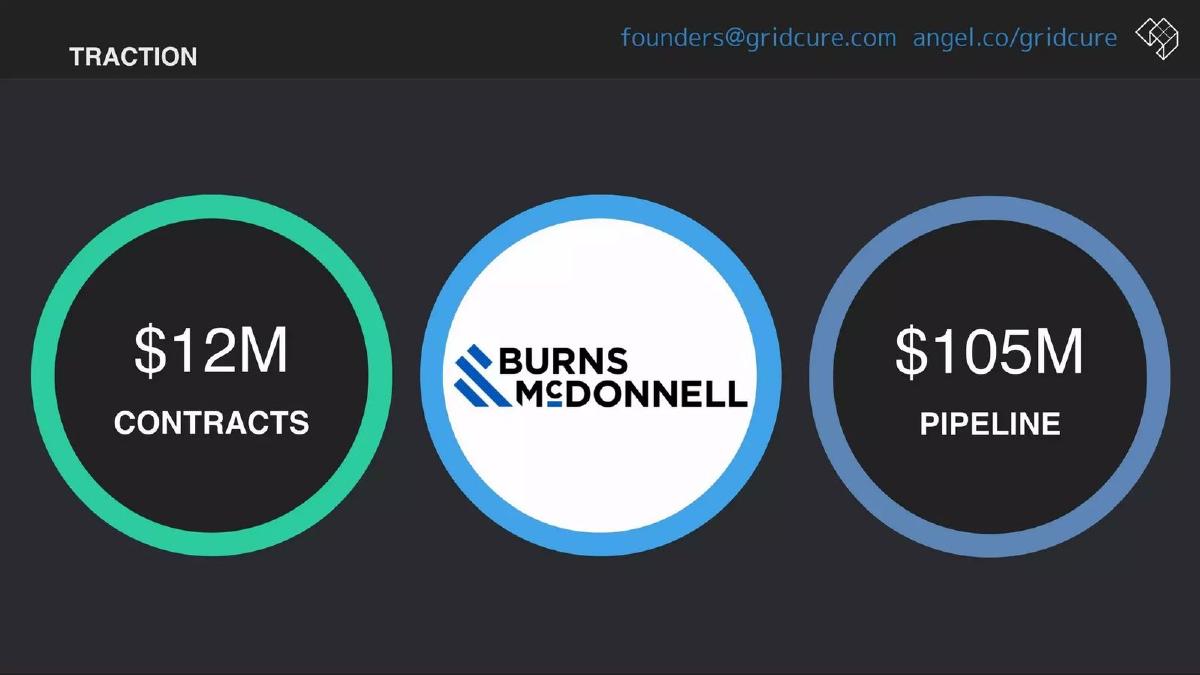
- GridCure claims significant early traction with $12M in contracts and a $105M pipeline on Slide 4.
- The company highlights a strategic partnership or client relationship with Burns & McDonnell on Slide 4.
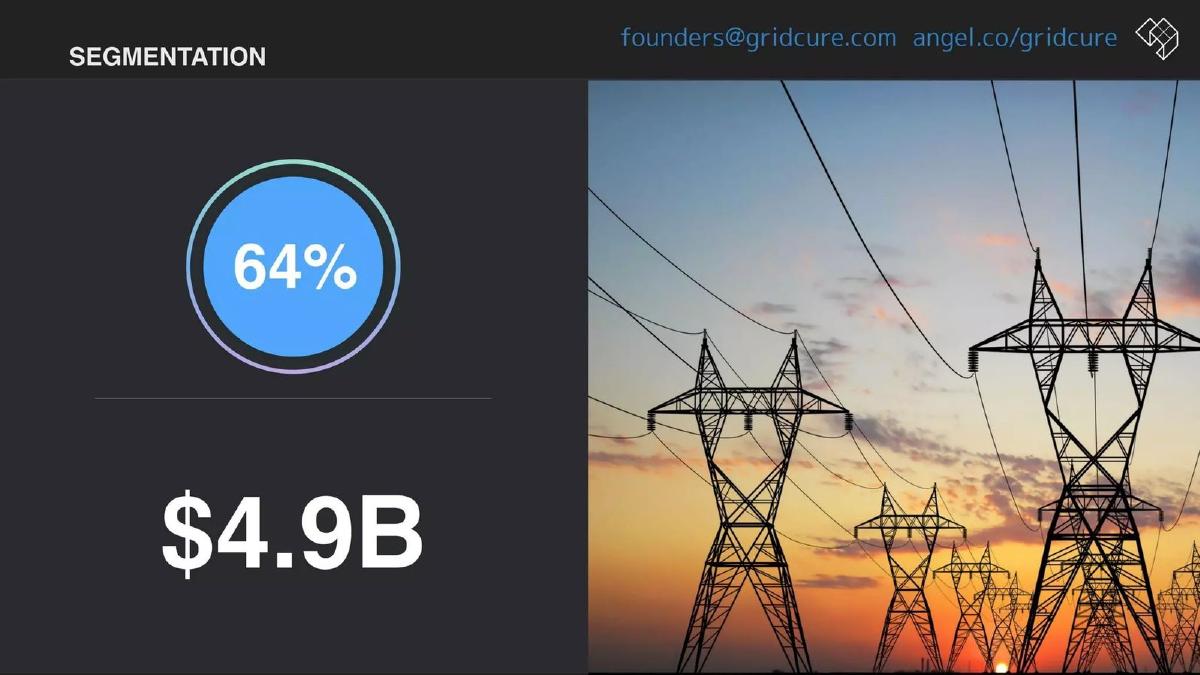
- Market segmentation is presented as a $4.9B opportunity on Slide 5, though the specific segment is not named.
- The team slide (Slide 6) emphasizes technical depth, including a Ph.D. in Applied Mathematics and experience at Apple and BC Hydro.
- The deck projects a massive $400B global market opportunity on Slide 7.
- There is a total absence of a business model, pricing strategy, or specific 'Ask' for capital within the slides.
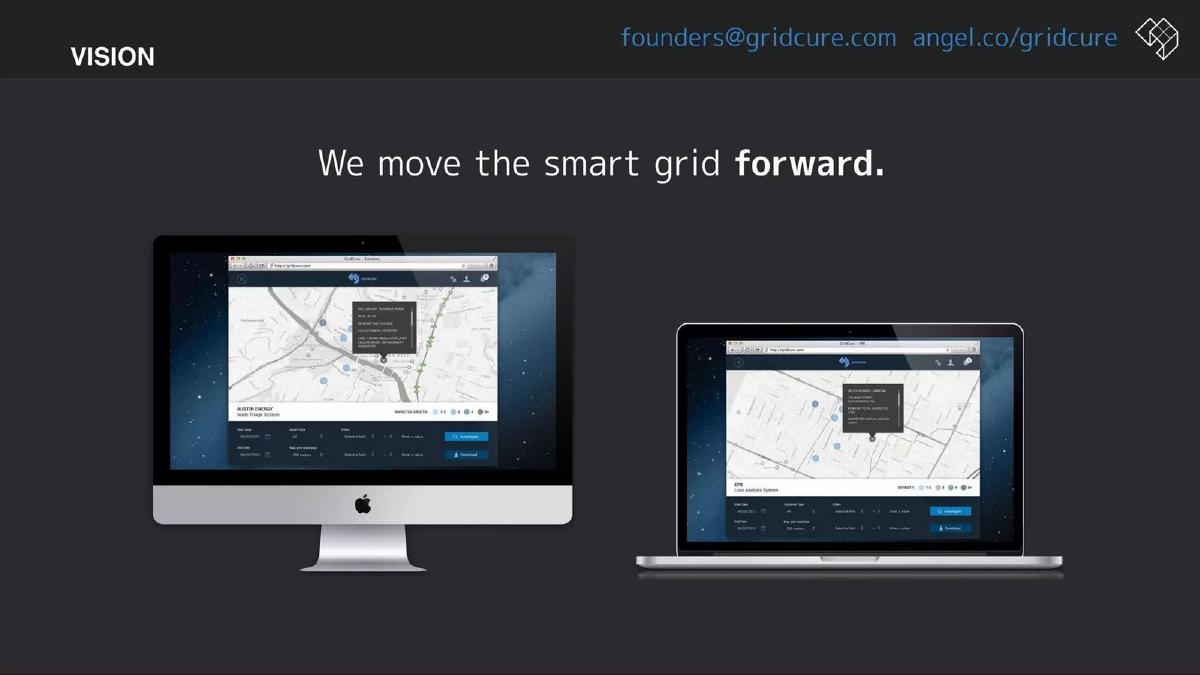
- The product is shown via two UI mockups on Slide 3, labeled as a 'Node Triage System' and 'Loss Analysis System.'
The 8-Slide Teaser: GridCure’s Minimalist Approach
GridCure’s pitch deck is a fascinating example of extreme information density reduction. In an era where many founders feel the need to include 20+ slides of technical diagrams and market research, GridCure opted for just eight. This deck was used in 2013, a time when 'Big Data' was the dominant buzzword in venture capital. The company’s goal was to bring that big data revolution to the power utility space, an industry traditionally slow to adopt new software technologies.
While the deck is visually clean, it operates as a 'teaser' deck. It is designed to be presented or read quickly, leaving the heavy lifting of due diligence to a follow-up meeting. For a startup that raised $95,000, this level of detail is typical of an early-stage accelerator pitch where the primary goal is to establish credibility and show a massive market opportunity.
Slides 1-2: The Hook and the Pain
Slide 1: Title Slide The deck opens with a dark, professional aesthetic. The logo is geometric and modern, and the tagline is clear: "Powerful Analytics for Grid Security." This immediately positions the company at the intersection of two high-value sectors: data analytics and infrastructure security.
Slide 2: Current Pain GridCure identifies the problem with a single, staggering statistic. They claim that utilities are facing "1,000 - 100,000 times more data." The visual of power lines at sunset provides context, but the text is the focus. By framing the problem as a data explosion, they justify the need for a 'Big Data' solution. However, the slide lacks a source for this figure, which is a common omission in early-stage decks that rely on industry-standard assumptions about smart meter rollouts.
Slides 3-4: The Vision and Traction
Slide 3: Vision The vision slide states, "We move the smart grid forward." This is accompanied by two product mockups on an iMac and a MacBook. The screens show a map-based interface. One is labeled "Austin Energy Node Triage System" and the other "EPB Loss Analysis System." These labels are crucial because they suggest the product is already being tested or used by specific, recognizable utility entities (Austin Energy and EPB). The UI looks clean, focusing on "Impacted Assets" and "Severity" levels, which implies a tool for operational efficiency and maintenance prioritization.
Slide 4: Traction This is the 'heavy hitter' slide of the deck. It contains three circles: "$12M Contracts," the logo for "Burns & McDonnell," and a "$105M Pipeline." For a company raising a sub-$100k round, a $12M contract figure is enormous. It suggests that GridCure had either secured a massive long-term master service agreement or was counting the total contract value of a pilot that had the potential to scale. The inclusion of Burns & McDonnell, a massive engineering firm, provides significant B2B social proof. If a firm of that size is working with a small startup, it validates the startup's technical capability.
Slides 5-7: Market and Team
Slide 5: Segmentation This slide is somewhat cryptic. It shows a "64%" graphic and a "$4.9B" figure next to an image of power lines. It does not explicitly state what the 64% represents—it could be market share of a specific type of utility, a growth rate, or a percentage of utilities facing a specific problem. The $4.9B likely represents their Serviceable Addressable Market (SAM), but without labels, the investor is forced to guess or ask for clarification.
Slide 6: Team The team slide is strong for a seed-stage company. It features four individuals with diverse backgrounds. Tagg Jefferson brings industry experience from BC Hydro. Kim Montgomery provides the academic rigor with a Ph.D. in Applied Mathematics, which is essential for a company claiming to solve complex grid analytics. Syed Aduham adds 'Big Tech' credibility with Apple and Infosys on his resume. Zack Milosevich rounds out the team with experience at Shaw Media and Canada Post. The mix of industry insiders and technical experts is a classic 'winning' team structure for an enterprise SaaS play.
Slide 7: Future The 'Future' slide is the 'Moonshot' slide. It displays a "$400B Global Market" over a world map. This represents the Total Addressable Market (TAM). While $400B is a massive number, it is common in utility pitches because the global infrastructure for electricity is one of the largest capital-expenditure categories in the world. This slide is meant to show that if GridCure wins, they win big.
Slide 8: Contact
Slide 8: Closing The deck ends as it began, with the logo and a contact email: "founder@gridcure.com." Interestingly, the email address changed from "founders@gridcure.com" (used in the header of previous slides) to the singular "founder" on the final slide. This is a minor consistency error but worth noting in a deck with so little text.
What Works in the GridCure Deck
Visual Consistency: The dark theme and minimalist layout make the deck feel modern and professional. It avoids the 'cluttered' look that plagues many technical pitches. · Social Proof: Naming Burns & McDonnell and showing mockups for Austin Energy and EPB does more to sell the company than a dozen slides of technical specifications would. It shows that the market has already said 'yes' to the product. · The Team: The combination of a Ph.D. in Math and a former BC Hydro employee is the perfect 'Founder-Market Fit' for this specific niche. · Focus on One Metric: By focusing on the '100,000x data' problem, they make the necessity of their tool feel inevitable.
What is Missing from the GridCure Deck
Business Model: There is zero mention of how GridCure makes money. Is it a per-meter SaaS fee? A percentage of energy saved? A flat licensing fee? For an investor, this is a glaring omission. · Competition: The utility analytics space is crowded with giants like GE, Siemens, and Oracle, as well as well-funded startups like C3.ai (which was already active in 2013). GridCure does not explain how they differ from these incumbents. · The 'Ask': The deck does not state how much money they are looking for or what they plan to do with the capital. While the catalogue says they raised $95,000, the deck itself doesn't mention a round size or milestones. · Technology Deep-Dive: For a company led by a Ph.D. in Applied Math, there is no explanation of the underlying algorithms or data processing techniques that make their 'Powerful Analytics' better than a standard database.
What a Founder Should Copy
The 'Traction Circle' Layout: Slide 4 is a great way to present big numbers. Using large, bold text for contracts and pipeline figures creates an immediate sense of momentum. · Minimalist Problem Definition: Instead of listing ten problems, GridCure listed one massive problem (the data explosion). This makes the pitch much easier to remember. · Strategic Use of Logos: If you have a pilot or a partnership with a major player, put their logo front and center. It acts as a proxy for trust. · Clean Team Bios: Listing only the most relevant 1-2 previous companies or degrees for each team member keeps the slide readable and impactful.
Final Analysis
GridCure’s deck is a product of its time—a lean, high-level pitch designed to capitalize on the Big Data trend. It succeeds in creating a sense of scale and professional credibility, but it fails to provide a roadmap for how that scale translates into a sustainable business. For a founder today, this deck serves as a reminder that while 'less is more' in terms of design, you still need to answer the fundamental questions of 'How do you make money?' and 'Why will you win against the giants?'
The $12M contract claim is the most compelling part of the deck, yet it is also the most mysterious. In the utility world, contracts are often contingent on long-term performance or regulatory approval. Without further detail, an experienced investor would view that number with healthy skepticism. However, as a tool to get a foot in the door, this 8-slide deck is remarkably efficient.
Frequently asked questions
- How much did GridCure raise with this deck?
- According to catalogue data, GridCure raised $95,000 in 2013. This is a relatively small amount, often consistent with an accelerator program or a very early pre-seed angel check, which explains why the deck is so brief and lacks detailed financial projections or a complex 'Ask' slide.
- What is the primary problem GridCure is solving?
- The deck identifies the 'Current Pain' as the overwhelming volume of data produced by modern power grids. Slide 2 notes that utilities are seeing 1,000 to 100,000 times more data than they previously handled, implying that existing legacy systems are unable to process or secure this information effectively.
- Who are the key members of the GridCure team?
- The team consists of Tagg Jefferson (BC Hydro, Simpa Networks), Kim Montgomery (Ph.D. Applied Mathematics), Syed Aduham (Apple, Infosys), and Zack Milosevich (Shaw Media, Canada Post). This combination of utility industry experience and high-level mathematics is a strong signal for a big data startup.
- What kind of traction did GridCure have at the time of this deck?
- Slide 4 claims $12M in contracts and a $105M pipeline. It also features the logo of Burns & McDonnell, a major engineering and construction firm in the utility space. However, the deck does not specify if these contracts are signed, binding, or multi-year agreements.
- What is missing from the GridCure pitch deck?
- The deck is missing several critical components: a business model (how they charge), a competitor analysis, a detailed technology explanation, a roadmap, and a specific funding ask. It functions more as a high-level vision statement than a full investment memorandum.