GRIN’s 11-slide deck is a masterclass in category positioning. Rather than competing as a marketplace where brands find influencers, GRIN positions itself as the essential SaaS infrastructure for e-commerce brands to manage existing relationships. The deck uses a high-level narrative that emphasizes the 'messy' reality of manual influencer management—relying on spreadsheets and fragmented tools—and offers a unified 'end-to-end' solution. With a heavy focus on integrations with platforms like Shopify and Magento, the deck targets the massive growth of direct-to-consumer (DTC) brands. Despite o…
Key takeaways
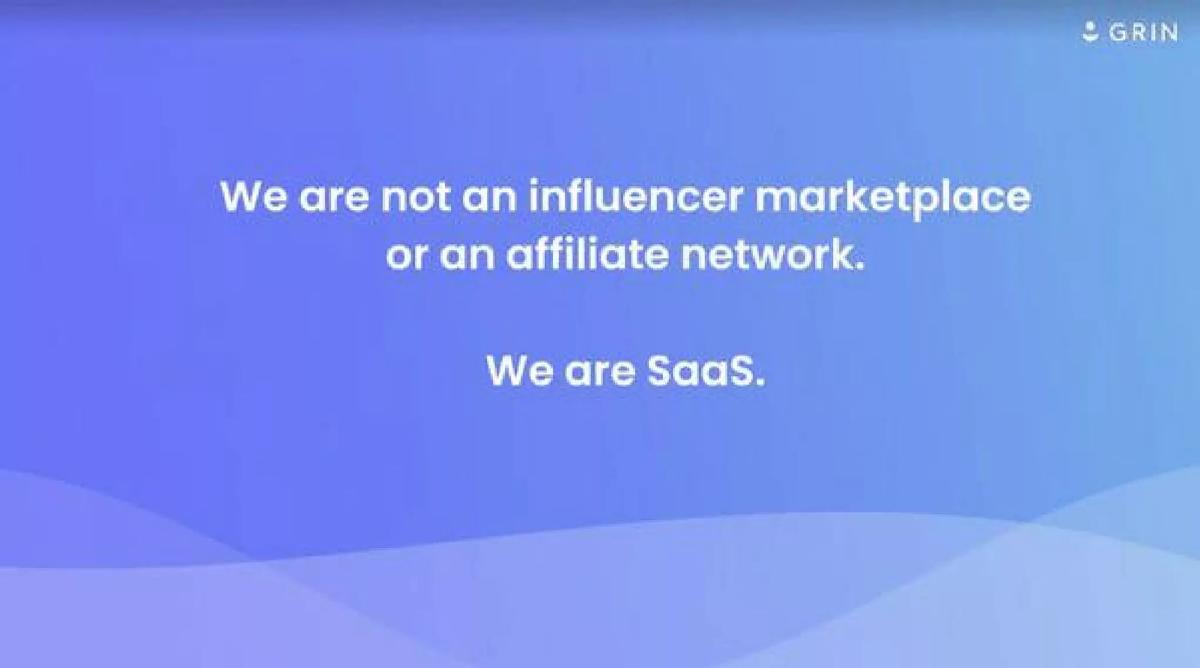
- GRIN explicitly distances itself from 'influencer marketplaces' to claim higher SaaS multiples (Slide 5).
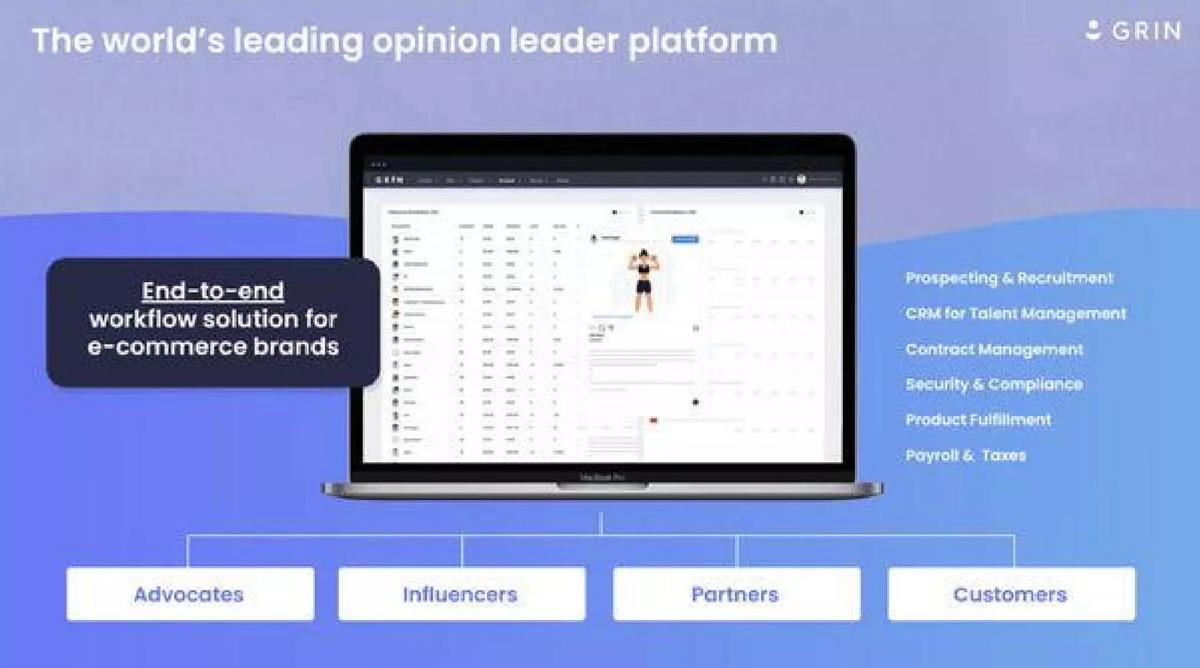
- The 'End-to-end workflow' includes CRM, contract management, payroll, and product fulfillment (Slide 2).
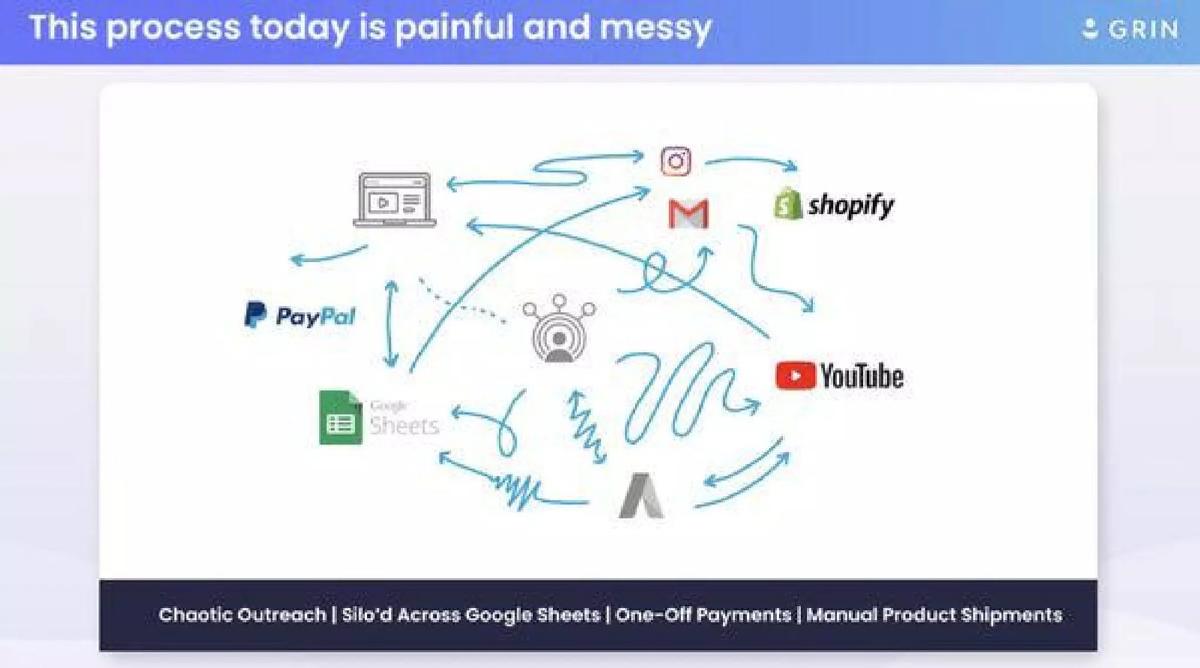
- The problem is visualized as a chaotic web of Google Sheets, PayPal, and manual shipments (Slide 3).
- Market timing is tied directly to Shopify surpassing 1,000,000 merchants in Q4 2019 (Slide 7).
- The platform supports a broad user base including advocates, influencers, partners, and customers (Slide 2).
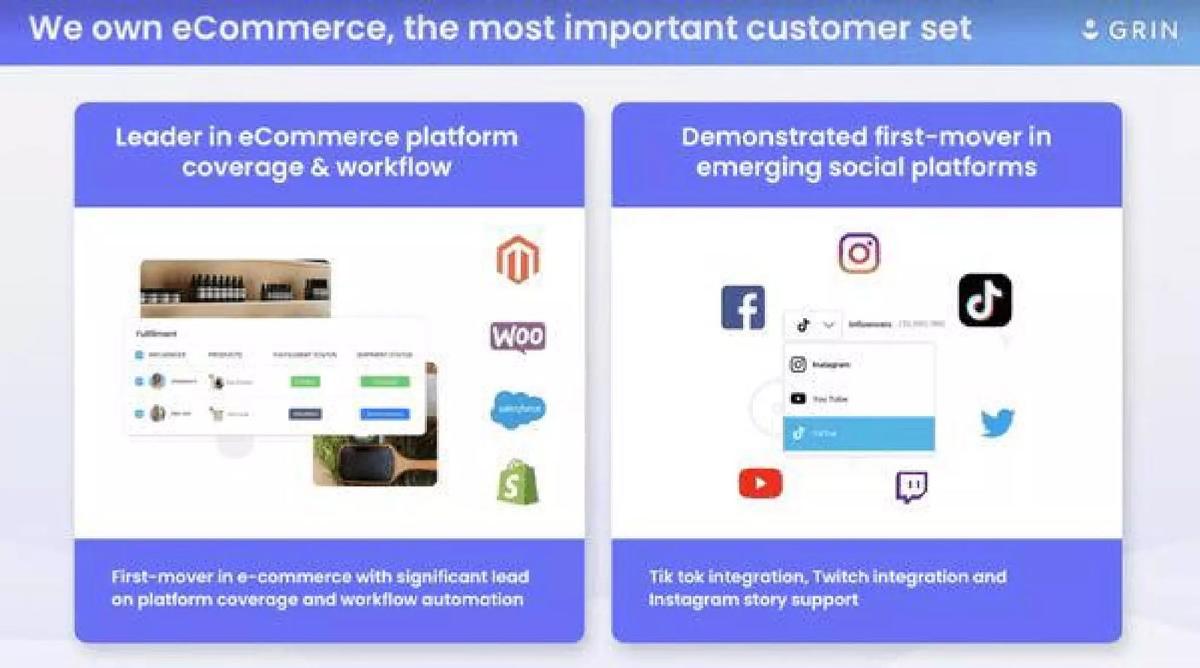
- Social platform coverage includes first-mover status on TikTok and Twitch integrations (Slide 6).
- The deck identifies agencies, media companies, and eSports as future growth verticals (Slide 9).
- The 'Use of Proceeds' focuses on Sales & Marketing, Product & Engineering, and 'Category Narrative' (Slide 10).
The Narrative Shift: From Marketplace to Infrastructure
GRIN’s pitch deck is a concise 11-slide presentation that focuses heavily on positioning and market timing. At the time of this deck, the influencer marketing space was crowded with 'marketplaces'—platforms that charged a commission to connect brands with creators. GRIN took a different path, positioning itself as the 'world's leading opinion leader platform' (Slide 2) and a pure SaaS play. This distinction is critical for investors who value the recurring revenue and stickiness of workflow software over the transactional nature of marketplaces.
Slide 1: Title and Visual Identity
The cover slide features a clean, modern aesthetic with a smartphone mockup and circular headshots of various individuals, presumably influencers or 'opinion leaders.' The GRIN logo is prominent. There is no tagline on this slide, relying instead on the visual cues of social connectivity and mobile-first interaction.
Slide 2: The Value Proposition
Slide 2 introduces the core product: an 'End-to-end workflow solution for e-commerce brands.' This slide is dense with functional information, listing six key pillars: Prospecting & Recruitment, CRM for Talent Management, Contract Management, Security & Compliance, Product Fulfillment, and Payroll & Taxes. Crucially, it shows that the platform serves four distinct groups: Advocates, Influencers, Partners, and Customers. This suggests a broader TAM (Total Addressable Market) than just 'influencer marketing.'
Slide 3: The Problem – Painful and Messy
The 'Problem' slide uses a chaotic diagram to show the current state of influencer management. It features logos for Instagram, Gmail, Shopify, YouTube, PayPal, and Google Sheets, all connected by tangled, messy arrows. The caption at the bottom summarizes the friction: 'Chaotic Outreach | Silo’d Across Google Sheets | One-Off Payments | Manual Product Shipments.' This slide effectively highlights the administrative burden that GRIN aims to automate.
Slide 4: The Solution – Incredibly Easy
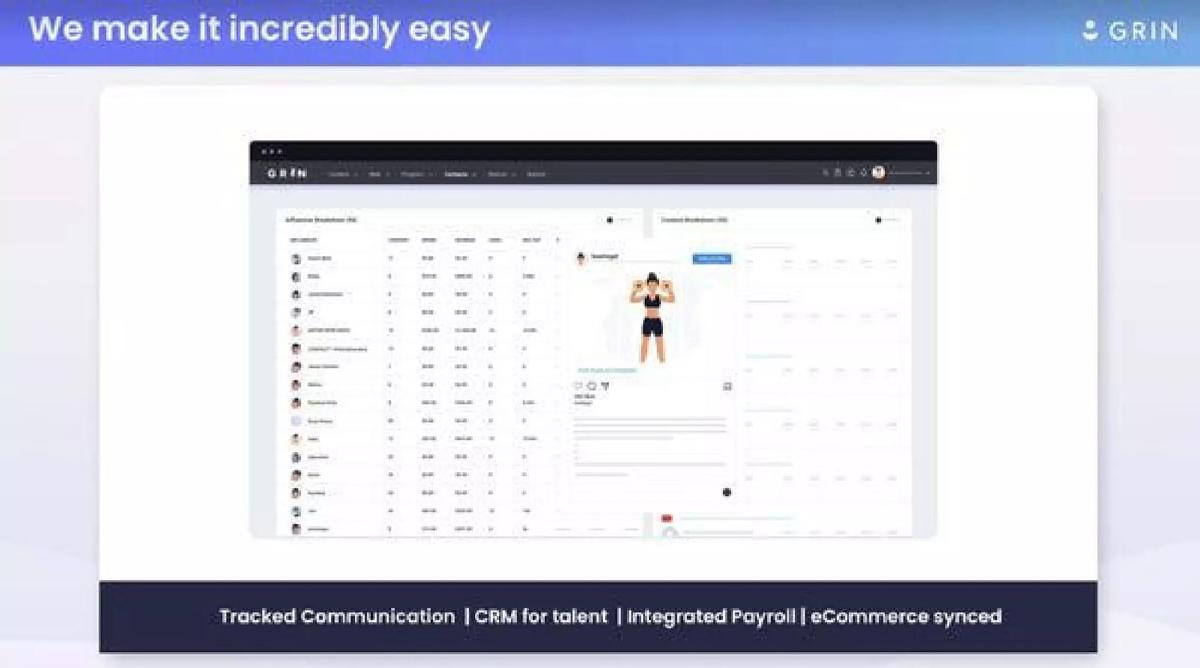
Contrasting the previous slide, Slide 4 shows a clean dashboard view of the GRIN platform. The caption emphasizes 'Tracked Communication | CRM for talent | Integrated Payroll | eCommerce synced.' By placing the product screenshot directly after the 'messy' slide, GRIN positions itself as the single source of truth that replaces a dozen disconnected tools.
Slide 5: The Definitive Positioning
This is perhaps the most important slide in the deck for a Series B investor. It contains only two sentences: 'We are not an influencer marketplace or an affiliate network. We are SaaS.' This is a bold move to distance the company from lower-margin competitors and signal that their business model is built on software subscriptions, which typically earn much higher valuation multiples.
Slide 6: Platform Coverage and First-Mover Advantage
Slide 6 focuses on integrations. It claims leadership in 'eCommerce platform coverage,' showing logos for Magento, WooCommerce, Salesforce, and Shopify. It also claims 'First-mover in emerging social platforms,' specifically citing TikTok and Twitch integrations and Instagram Story support. This demonstrates that GRIN is technically superior and faster to adapt to new social trends than its competitors.
Slide 7: Why Now? The Shopify Explosion
The 'Why Now' slide is anchored by a growth chart of Shopify merchants. It highlights that Shopify reached 1,000,000 merchants in Q4 2019. The logic is simple: as the number of e-commerce brands grows, the need for professional management software grows proportionally. The slide also notes that 'Consumers prefer small,' suggesting a shift toward the niche DTC brands that make up GRIN's core customer base.
Slide 8: Social Proof and Testimonials
GRIN provides two testimonials from high-growth brands: MVMT and Darn Good Yarn. Ethan Frame (Director of Influencer Marketing at MVMT) emphasizes the 'nuances' of the campaign process, while Keri O’Brien (Darn Good Yarn) highlights the visual functionality of the software. These quotes validate that the software solves real-world operational headaches for professional marketers.
Slide 9: Future Growth Verticals
To show the path to a billion-dollar valuation, Slide 9 lists 'untapped verticals' that can drive further scale. These include Agencies, Media Companies, Mobile Apps, and eSports/Gaming. This tells investors that while they are currently winning in e-commerce, the software is flexible enough to dominate other sectors that rely on creator relationships.
Slide 10: Financial Projections and Use of Proceeds
Slide 10 shows a bar chart titled 'Ending ARR by year,' with a goal of '$XXXM in ARR by 2024.' While the specific numbers are redacted in this public version, the trajectory is aggressively upward. The 'Use of Proceeds' is split into three categories: Sales & Marketing, Product & Engineering, and 'Category Narrative.' The latter is an interesting inclusion, suggesting that GRIN views marketing its specific 'way of working' as a key investment area.
Slide 11: Conclusion
The final slide is a 'Thank you' page featuring a grid of diverse faces, reinforcing the human element of the 'opinion leader' economy that the software manages.
What Works in the GRIN Deck
Clear Category Definition: The explicit 'We are SaaS' slide (Slide 5) is a powerful way to frame the investment opportunity and avoid being compared to lower-quality businesses. · Strong Macro Alignment: Tying the company's success to the growth of Shopify (Slide 7) makes the investment feel like a bet on the broader e-commerce trend, which is a very attractive narrative for VCs. · Workflow Focus: By listing specific features like 'Payroll & Taxes' and 'Product Fulfillment' (Slide 2), GRIN shows it isn't just a 'nice to have' marketing tool, but a core operational system.
What is Missing from the GRIN Deck
Team Slide: There is no mention of the founders (Brandon Brown, Brian Mechem, Ryan Brown) or their backgrounds in this 11-slide sequence. At Series B, investors want to see the leadership team that will scale the company to an IPO. · Unit Economics: The deck lacks data on CAC (Customer Acquisition Cost), LTV (Lifetime Value), or Churn. For a SaaS company, these metrics are vital to prove the efficiency of the business model. · Competitive Landscape: While they distance themselves from marketplaces, they don't address other SaaS competitors in the influencer management space. · The 'Ask': The deck does not specify how much capital is being raised or the terms of the round.
What a Founder Should Copy
The 'Messy' vs. 'Clean' Visual: Use a chaotic diagram of current manual processes (Slide 3) followed immediately by a clean product screenshot (Slide 4). It is the most effective way to communicate 'value' without using words. · The 'Why Now' Chart: Find a third-party platform that your product relies on (like Shopify, AWS, or Stripe) and show its growth. It provides external validation for your market's expansion. · Functional Pillars: Instead of just listing 'features,' group your product's capabilities into high-level business functions (Slide 2). This makes the product feel like a comprehensive solution rather than a feature set.
Frequently asked questions
- Why does GRIN emphasize that they are 'not a marketplace'?
- Marketplaces often suffer from 'leakage' and lower margins, whereas SaaS companies command higher valuation multiples and offer predictable recurring revenue. By stating 'We are SaaS' on Slide 5, GRIN tells investors that their value lies in the software utility and workflow management rather than just connecting two parties, which is a more defensible and scalable business model.
- How does GRIN demonstrate product-market fit in this deck?
- GRIN uses high-profile customer testimonials from brands like MVMT and Darn Good Yarn on Slide 8. These testimonials specifically highlight the 'nuances' of influencer marketing and the visual benefit of seeing all content in one place. Additionally, Slide 6 shows their deep integration with the entire e-commerce stack (Shopify, WooCommerce, Magento), proving they are embedded in the customer's existing workflow.
- What is the significance of the Shopify merchant graph on Slide 7?
- This is the 'Why Now' slide. By showing Shopify reaching 1,000,000 merchants by Q4 2019, GRIN is arguing that the market of potential customers (DTC brands) has reached a critical mass. This creates a massive demand for professional tools to manage the creator economy, which previously didn't exist at this scale.
- What are the major omissions in the GRIN pitch deck?
- The deck is notably missing a Team slide, which is unusual for a Series B pitch. It also lacks a detailed Competitor slide, specific historical financial data (revenue is redacted or shown as a generic bar chart on Slide 10), and a clear breakdown of the 'Ask' (the specific dollar amount being raised is not listed on the slides).
- What does GRIN mean by 'Category Narrative' in their use of proceeds?
- On Slide 10, 'Category Narrative' suggests that GRIN intended to spend capital on thought leadership and marketing to define the 'Influencer Marketing Software' category. This is a common strategy for companies trying to become the 'Salesforce' of their specific niche, moving the conversation away from individual features toward a new way of doing business.