GrindHub Revitalized is a productivity dashboard designed to integrate disparate third-party cloud services into a single interface. The deck identifies the core problem as cloud services 'rarely working together' and proposes a 'masterpiece' dashboard to unify them. The business model relies on a three-tiered monthly subscription plan ranging from $10 to $40, with the highest tier supporting up to 40 users. Early traction is highlighted by an alpha sign-up phase that secured over 400 users in two weeks. The company is seeking $400,000 in seed funding to execute a 2015 roadmap that includes a…
Key takeaways
- The company identifies a market gap where third-party cloud services fail to integrate effectively (Slide 2).
- The solution is described as 'one dashboard to rule all,' aiming to consolidate various SaaS tools (Slide 1).
- Pricing is structured into three tiers: $10 (1 user), $20 (20 users), and $40 (40 users) per month (Slide 5).
- Early traction included over 400 alpha users acquired within a two-week sign-up period (Slide 6).
- The 2015 timeline shows a progression from 360 alpha users in March to a target of 500 closed beta users in April (Slide 7).
- The deck explicitly asks for $400,000 in seed funding (Slide 8).
- The product onboarding process is simplified into three steps: sign in, connect accounts, and add users (Slide 4).
- The deck lacks a team slide, competitive analysis, and detailed financial projections beyond basic pricing.
GrindHub Revitalized: The Dashboard Consolidation Pitch
GrindHub Revitalized presents a pitch deck focused on the 'unification' of the SaaS ecosystem. The deck uses a minimalist text approach paired with full-bleed background images to communicate its value proposition, business model, and funding needs. The following is a slide-by-slide breakdown of the 8 slides provided.
Slide 1: Title Slide
The cover slide features the company name, GRINDHUB , in large white block lettering. The subtitle is 'one dashboard to rule all.' The background image shows a blurred open-plan office environment with several individuals working at laptops, suggesting a focus on productivity and the modern workplace. The branding is consistent with the yellow and black color scheme seen in the footer of subsequent slides.
Slide 2: The Problem
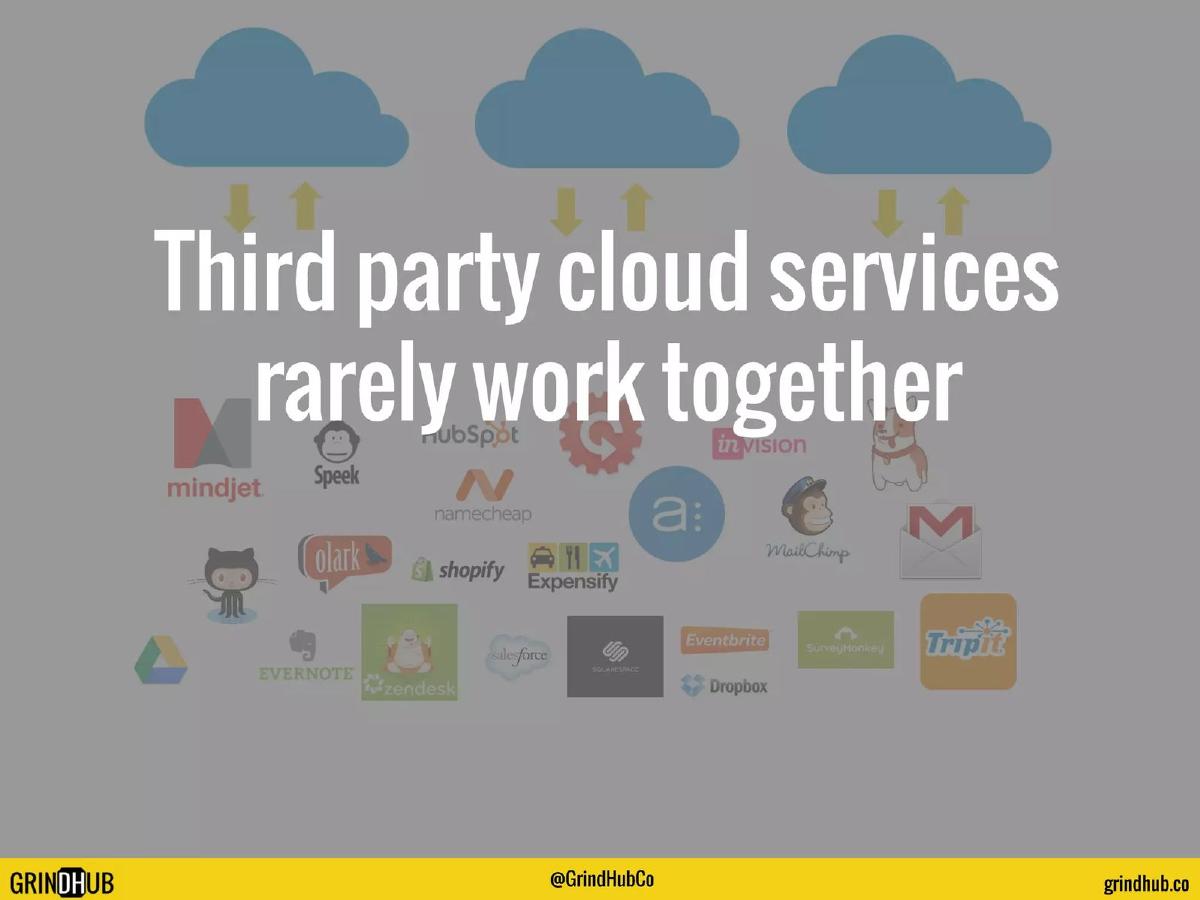
Slide 2 addresses the pain point: 'Third party cloud services rarely work together.' The slide features three cloud icons at the top with arrows pointing to a cluttered field of logos. Recognizable logos include Salesforce, Dropbox, MailChimp, GitHub, Evernote, Zendesk, Shopify, and Expensify . This slide visually represents the fragmentation of the modern software stack, implying that users are overwhelmed by the number of disconnected tools they must use daily.
Slide 3: The Solution
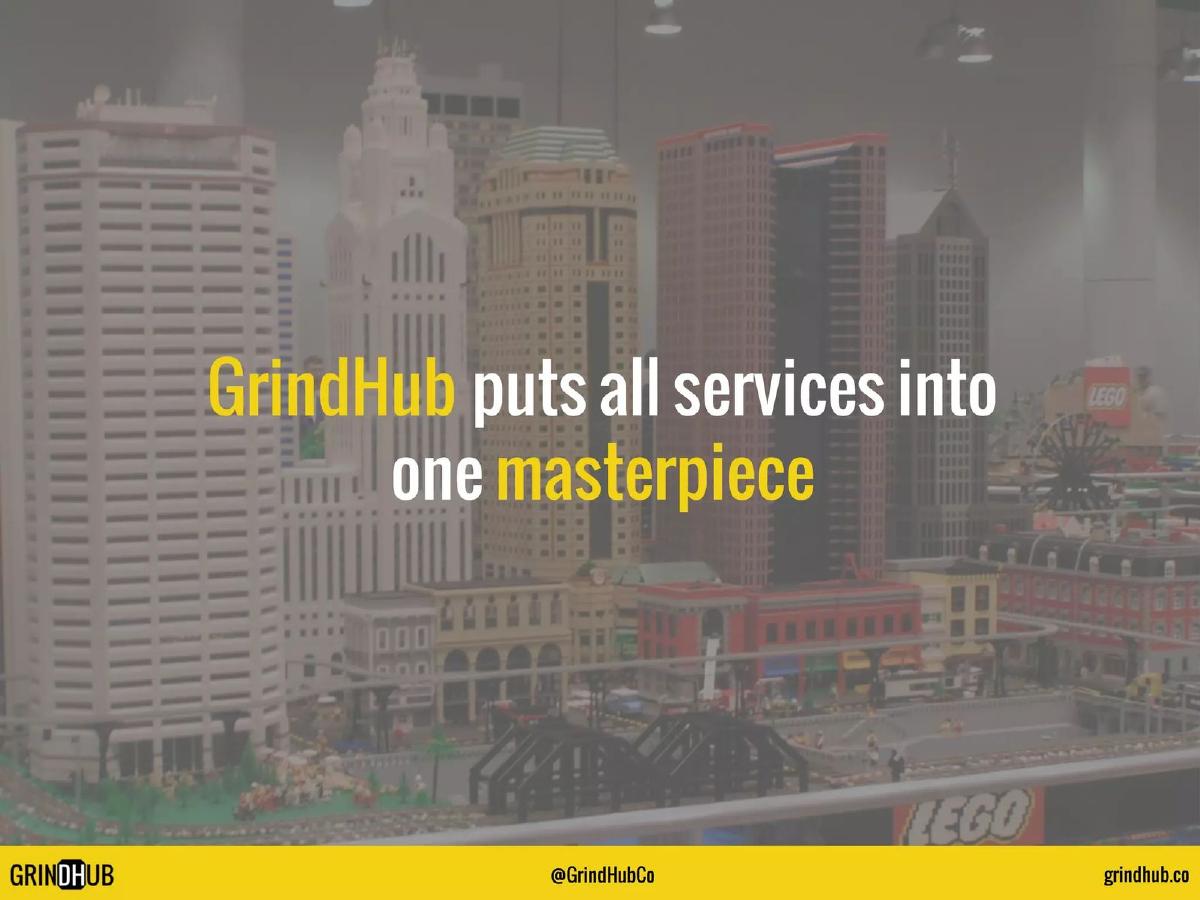
The solution is presented with the text: 'GrindHub puts all services into one masterpiece.' The background image is a Lego model of a city skyline. This metaphor suggests that GrindHub acts as the foundation or the 'glue' that allows disparate pieces (the various cloud services) to form a cohesive, functional whole. It reinforces the 'one dashboard' concept introduced on the title slide.
Slide 4: Product Onboarding
Slide 4, titled 'Steps for New Clients,' outlines a three-step user journey: 1. Sign in with email, 2. Connect accounts and add users, and 3. Get Stuff Done! The simplicity of this list is intended to show low friction for adoption. The background image is a modern interior with a staircase, which may be a metaphor for 'stepping up' productivity, though it lacks direct relevance to the software interface.
Slide 5: Business Model
This slide details the 'Monthly/Annual Subscription Plan.' It presents three distinct pricing tiers:
$10 per month: Up to 1 User, Limited Integrations. · $20 per month: Up to 20 Users, Unlimited Integrations. · $40 per month: Up to 40 Users; $30 for additional users, Unlimited Integrations.
The background image consists of piles of cash. The pricing structure is aggressive, particularly the $20 tier which allows for 20 users, suggesting a very low per-user cost compared to many SaaS platforms. The mention of '$30 for additional users' on the $40 tier suggests a transition to a more traditional per-seat model as the organization scales.
Slide 6: Traction and Visibility
Titled 'Get Market Visibility Quickly,' this slide is split into two sections. The left side, 'Early Stage Hype,' claims the company posted an alpha sign-up sheet for two weeks and secured over 400 alpha users from 30 clients. It notes sign-ups from accelerators, VCs, startups, and nonprofits, specifically mentioning support from 'DC Tech and DMV Startup.' The right side, 'Media Support,' lists local media publications and press releases at each stage. A progress bar shows the journey from Demo to Alpha, Public Beta, and finally Seed Funding.
Slide 7: 2015 Timeline
This slide provides a chronological roadmap for the year 2015, overlaid on a calendar interface. The milestones are:
Feb: Prototype (marked with a green check). · Mar: Alpha Testing - 20 users growing to 360 users (marked with a red X over the 20). · Apr: Closed Beta Run - 500 users . · May: Public Beta Launch. · Aug: Seed Round.
This slide is effective because it shows actual growth (360 users) and sets immediate, measurable goals for the coming months.
Slide 8: The Ask
The final slide in this set states the funding goal: 'Seeking $400,000 in funding.' The background image features characters from the Super Mario franchise collecting coins. While the amount is clear, the slide does not specify the equity offered, the valuation, or the specific allocation of the funds (e.g., hiring, marketing, or R&D).
What GrindHub Revitalized Does Well
The deck excels at identifying a relatable problem. Anyone working in a modern office understands the frustration of 'tab fatigue' and disconnected data. By using recognizable logos of major SaaS players, GrindHub immediately establishes the context of its market. The traction slide is also a highlight; providing a specific number of users (400) and a specific timeframe (two weeks) gives the pitch credibility that abstract claims lack.
The pricing slide is also very clear. Many early-stage decks hide their business model or remain vague about how they will make money. GrindHub explicitly states its tiers, which allows an investor to immediately begin modeling potential revenue based on the user growth targets mentioned in the timeline.
What Is Missing from the GrindHub Revitalized Deck
The most significant omission is a Team Slide . In a seed round, investors are primarily betting on the founders' ability to execute. Without knowing who is building the 'masterpiece,' it is difficult to assess the technical feasibility of the product. Integrating dozens of third-party APIs is a significant engineering challenge that requires a capable technical lead.
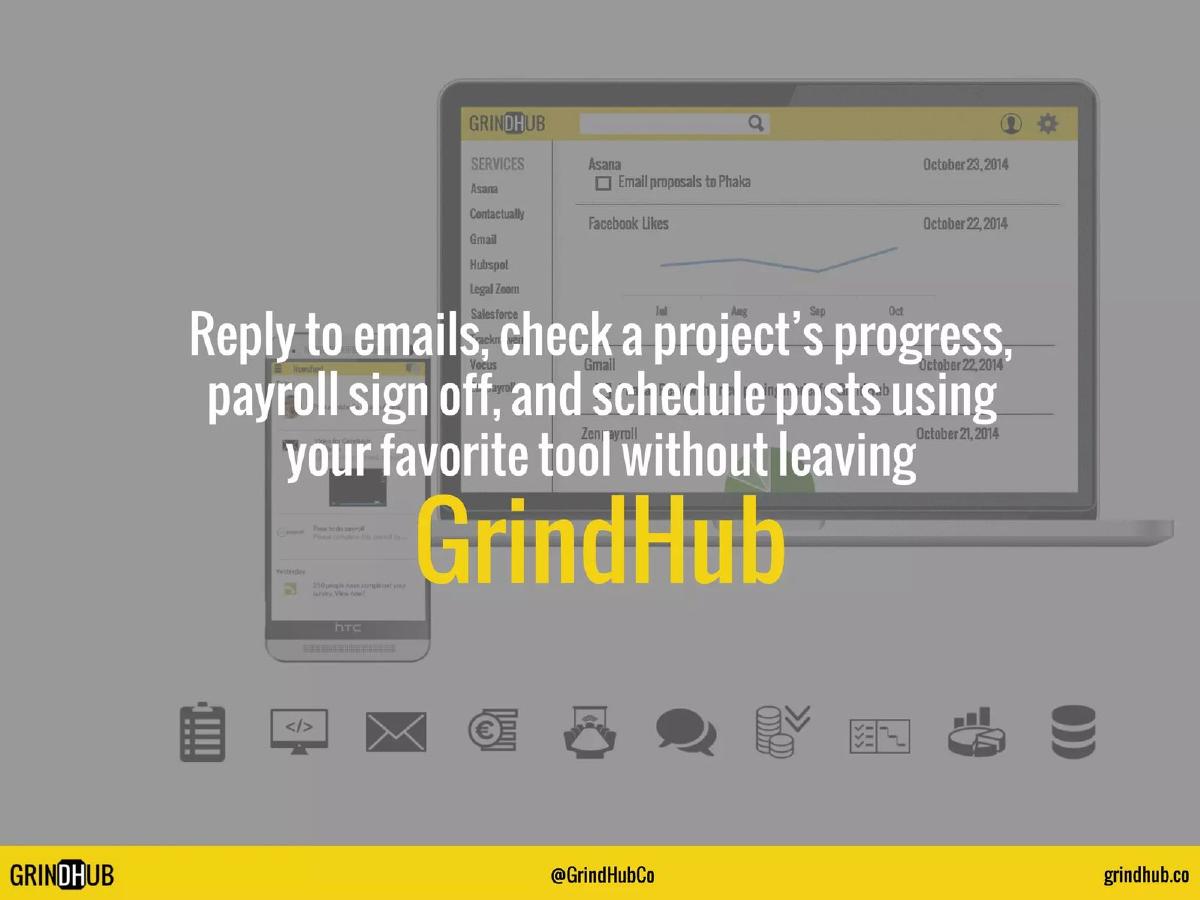
There is also no Competitive Analysis . GrindHub is entering a space occupied by heavyweights like Zapier, IFTTT, and various 'workplace OS' platforms like Notion or Monday.com. The deck fails to explain why a user would choose GrindHub over these established alternatives. Furthermore, there is no Product Demo or screenshot of the actual dashboard. For a company whose value proposition is a 'masterpiece' UI, the absence of visual proof of the software is a missed opportunity.
Founder Takeaways
Founders should note the effectiveness of the Timeline Slide (Slide 7) . By showing a progression from a prototype to a specific number of alpha users, and then projecting the next two steps, the company creates a sense of momentum. It moves the conversation from 'what we might do' to 'what we are already doing.'
However, founders should be cautious about the use of Pop Culture Imagery . While the Lego and Mario images are meant to be playful, they can sometimes detract from the professionalism of a $400,000 request. If using such imagery, it is vital to ensure the core data—metrics, team, and tech—is robust enough to carry the weight of the pitch. Finally, always include a clear 'Use of Funds' breakdown when asking for a specific dollar amount; investors want to know exactly how their $400,000 will help the company reach the next milestone.
Frequently asked questions
- What is the primary problem GrindHub aims to solve?
- According to Slide 2, the primary problem is that 'Third party cloud services rarely work together.' The deck displays logos for various services like Salesforce, Dropbox, MailChimp, and GitHub, suggesting that users struggle to manage data and workflows across these disconnected platforms. GrindHub positions itself as the unifying layer for these tools.
- How does GrindHub plan to generate revenue?
- Slide 5 outlines a Monthly/Annual Subscription Plan. There are three tiers: a $10/month plan for 1 user with limited integrations, a $20/month plan for up to 20 users with unlimited integrations, and a $40/month plan for up to 40 users. The $40 tier also mentions a $30 charge for additional users, indicating a per-seat expansion model for larger teams.
- What evidence of market traction is provided?
- Slide 6 and Slide 7 provide specific user metrics. The company claims to have had over 400 alpha users sign up within two weeks. The 2015 timeline shows growth from 20 users to 360 users in March, with a goal of reaching 500 users during a closed beta run in April. They also cite 'Media Support' and 'Early Stage Hype' from the DC Tech and DMV Startup communities.
- What is the specific funding request and its purpose?
- Slide 8 states the company is 'Seeking $400,000 in funding.' While the slide does not provide a detailed use-of-funds breakdown, the preceding timeline (Slide 7) suggests this capital is intended to support the transition from public beta launch in May to a full seed round close in August 2015.
- What critical information is missing from this deck?
- The deck is missing several standard venture components. There is no team slide introducing the founders or their technical expertise. There is no competitive landscape analysis to explain how GrindHub differs from existing integrators like Zapier or IFTTT. Additionally, there are no long-term financial forecasts or detailed technical explanations of how the integrations are maintained.