Green Flower Media's 18-slide Series A deck is a masterclass in vertical authority. By 2014, the company had already established a massive content moat, boasting over 1,500 hours of original video and 700+ experts under contract. The deck successfully transitions from a consumer-facing 'buzz' brand to a serious B2B and academic infrastructure play. They identify three distinct growth pillars: a direct-to-consumer subscription model, professional certificate programs for corporate training, and white-labeled higher education partnerships. While the financial projections are visually obscured i…
Key takeaways
- The company positions itself as a 'first mover' having launched in 2015 with a 10,000 sq ft production studio (Slide 2).
- Green Flower claims a massive content library of 1,500+ hours of original video content (Slide 5).
- The deck highlights a user base of 185,000 free members and 4,000+ paying members (Slide 5).
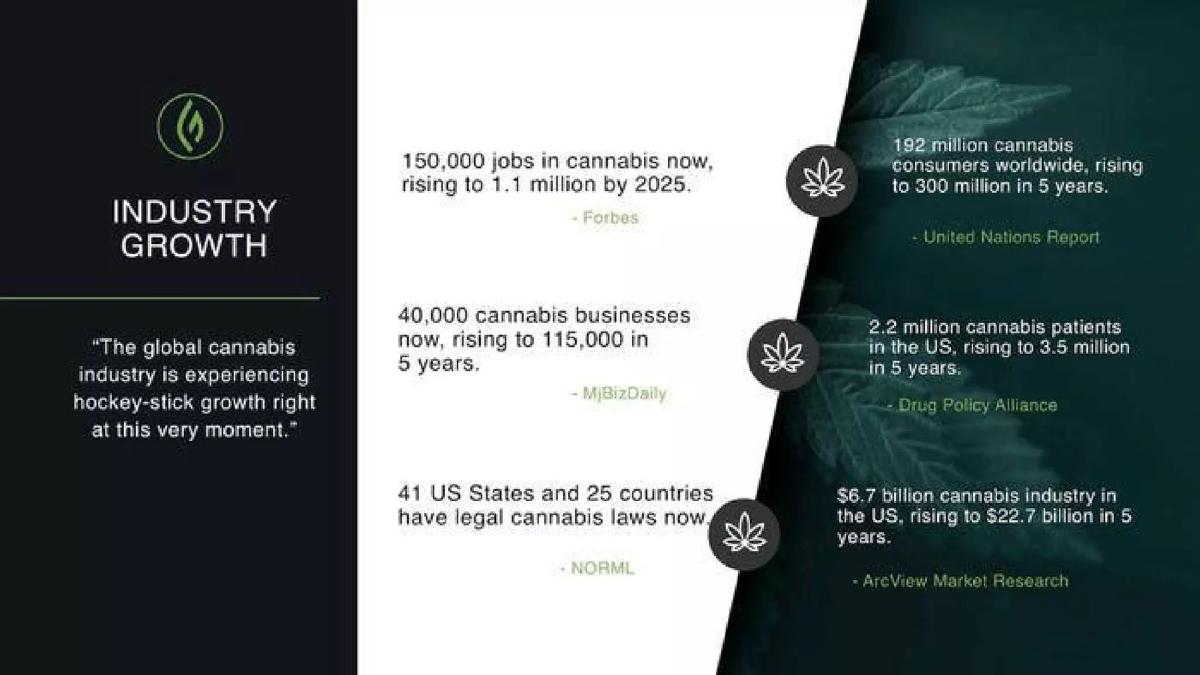
- Market growth is anchored by a Forbes projection of 1.1 million cannabis jobs by 2025 (Slide 3).
- The B2B strategy is validated by testimonials from industry leaders like GTI and Kiva Confections (Slide 11).
- The team slide emphasizes deep media experience, including a COO with 33 years in the entertainment industry (Slide 17).
- The 'Opportunity #3' focuses on the 5,400+ US schools, noting that fewer than 10 offer cannabis courses (Slide 13).
- The deck concludes with a specific $20 million Series A ask (Slide 16).
Introduction: The Vertical E-Learning Play
Green Flower Media’s Series A deck is a study in how to dominate a nascent but rapidly growing vertical. In 2014, the cannabis industry was transitioning from a gray market to a regulated corporate environment. Green Flower identified that the biggest bottleneck to this growth wasn't just regulation, but education. This deck positions the company not as a cannabis brand, but as a technology and media infrastructure company—the 'Lynda.com of cannabis.'
Slide 1: Title and Brand Identity
The opening slide is minimalist, featuring the company logo and the tagline 'Trusted Cannabis Education.' By using a dark, professional aesthetic and a clean green leaf logo, they immediately distance themselves from the 'stoner' tropes often associated with the industry, signaling to Series A investors that this is a serious business venture.
Slide 2: The 'About' and Infrastructure Slide
Slide 2 establishes the company's scale. It lists several key metrics: a launch date of 2015, 1,500+ hours of video, and 700+ experts under contract. Crucially, it mentions a 10,000 sq ft video production studio in Ventura, CA. This is a strategic inclusion; it tells investors that the company owns its production pipeline and has high barriers to entry for competitors who might try to replicate their content library.
Slide 3: The Macro Opportunity
This slide uses data from Forbes, MJBizDaily, and the United Nations to paint a picture of 'hockey-stick growth.' The most compelling figure is the projection of 1.1 million cannabis jobs by 2025 , up from 150,000. This sets the stage for their 'Academy' product—if there are a million new jobs, there is a massive need for standardized training.
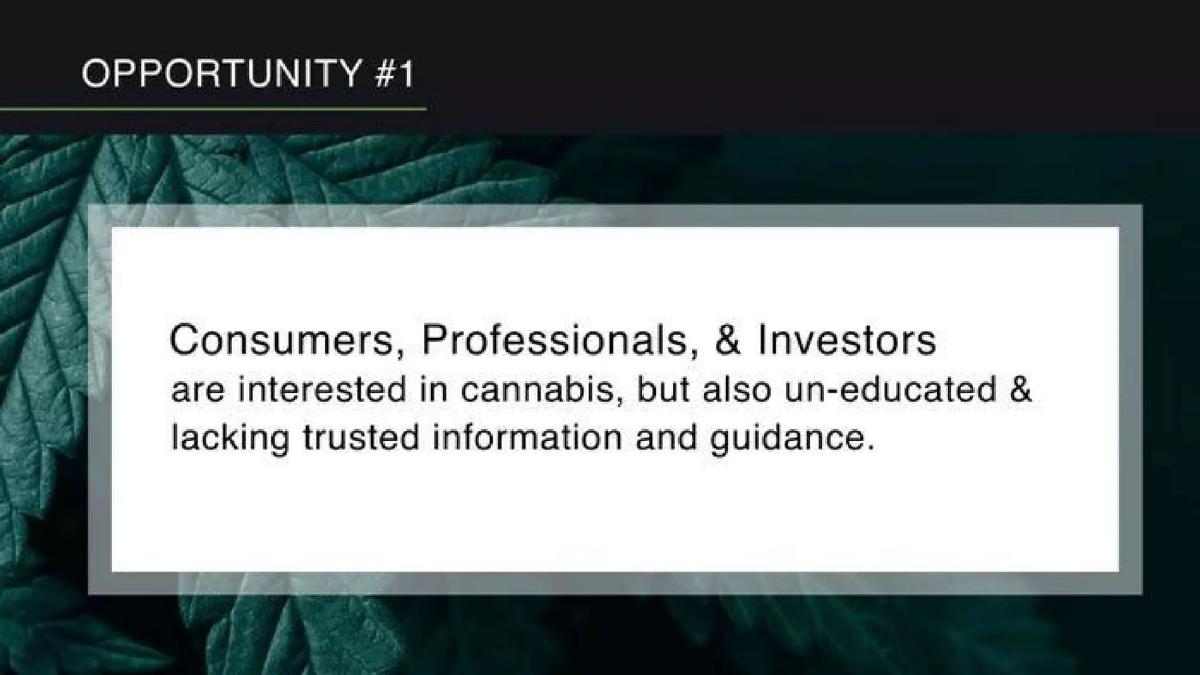
Slide 4: Opportunity #1 - The Information Gap
Slide 4 defines the problem: Consumers, Professionals, and Investors are interested but 'un-educated & lacking trusted information.' This is a classic 'Problem' slide that justifies the existence of a central authority in the space.
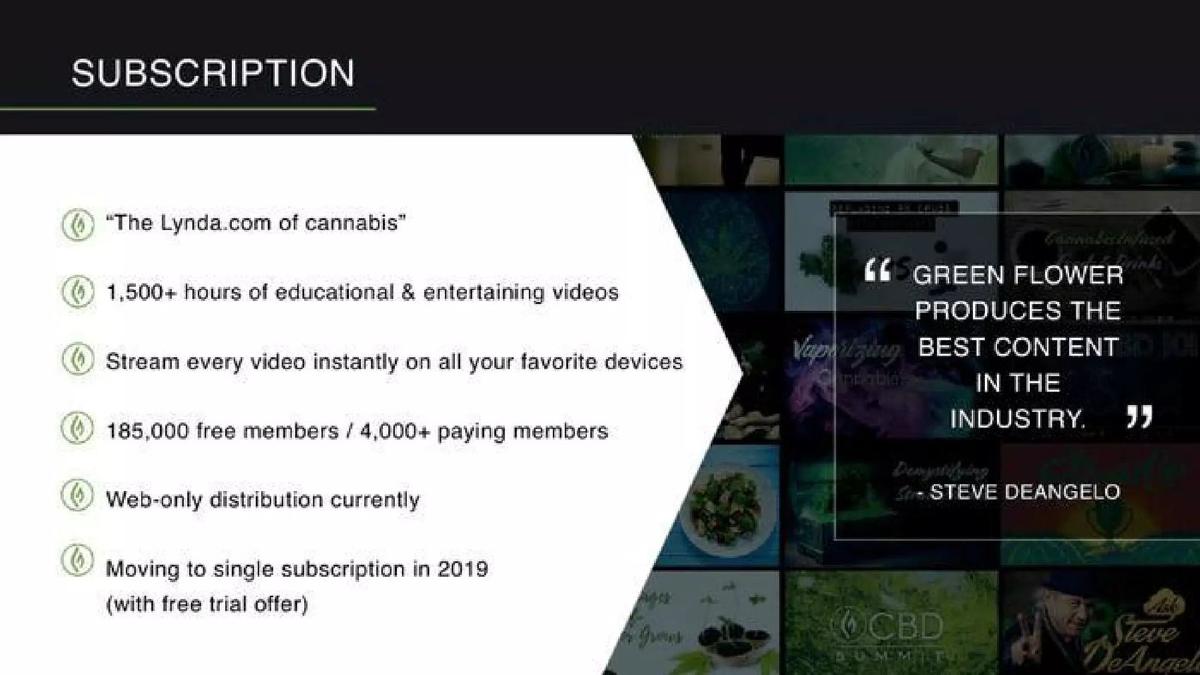
Slide 5: The B2C Subscription Model
Here, the deck reveals its current traction. With 185,000 free members and 4,000+ paying members , they have proven there is a willingness to pay for this content. The slide also notes a move to a 'single subscription in 2019,' suggesting a shift toward a more scalable SaaS-like recurring revenue model.
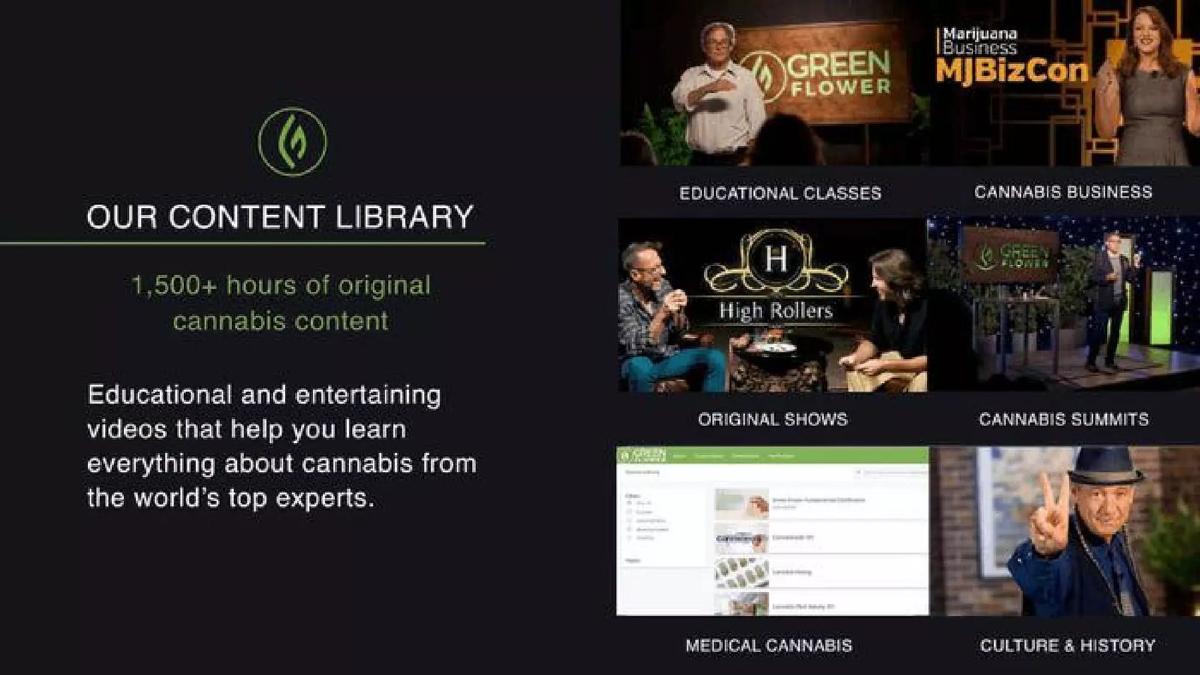
Slide 6: Content Depth
Slide 6 visually reinforces the library's breadth. It categorizes content into Educational Classes, Cannabis Business, Original Shows, Summits, Medical, and Culture. This variety suggests they are capturing the entire lifecycle of a cannabis enthusiast or professional, from 'how to roll' to 'how to invest.'
Slide 7: The Vision for Distribution
The vision slide is brief but ambitious. It targets major streaming platforms like Amazon Channels, Apple TV, and Roku . This indicates that Green Flower views itself as a media network, not just a website, aiming for 'lean-back' living room viewership to drive brand awareness.
Slide 8 & 9: Opportunity #2 - The Academy
These slides introduce the B2B 'Academy.' Slide 9 lists specific certificate programs: Extraction, Compliance & Regulations, Cultivation, and Patient Care. By focusing on high-stakes areas like compliance, Green Flower makes its product a 'must-have' for business owners rather than a 'nice-to-have' for hobbyists.
Slide 10 & 11: B2B Momentum and Validation
Slide 10 mentions that the Academy is built with LMS/e-commerce integration and that thousands of students have already enrolled. Slide 11 provides the 'social proof' necessary for a Series A, featuring quotes from GTI (Green Thumb Industries) and Kiva Confections. When a major MSO (Multi-State Operator) like GTI says they 'intend to outsource our entire training function to Green Flower,' the investment risk drops significantly.
Slide 12 & 13: Opportunity #3 - Higher Education
This is perhaps the most forward-looking part of the deck. Slide 13 notes that while there are 5,400+ schools in the US, less than 10 offer cannabis courses . Green Flower positions itself as the white-label partner that can help these institutions launch continuing education programs quickly, tapping into the massive higher-ed market.
Slide 14: Projections (The Blurred Slide)
Slide 14 contains the financial projections. While the specific numbers are blurred in this public version, the chart shows a steep upward trajectory through 2021. The 'Use of Funds' section is visible, listing head-count increases, content production, and marketing as the primary drivers for the capital.
Slide 15: Future Plans
The company looks toward international markets (Canada, UK, Latin America) and explicitly mentions acquisitions . This tells investors that the management team is thinking about consolidation and inorganic growth, which is common in Series A and B rounds.
Slide 16: The Ask
The deck concludes with a clear ask: $20mm Series A . It includes the CEO’s direct contact information, providing a clear call to action for the viewing investor.
Slide 17: The Leadership Team
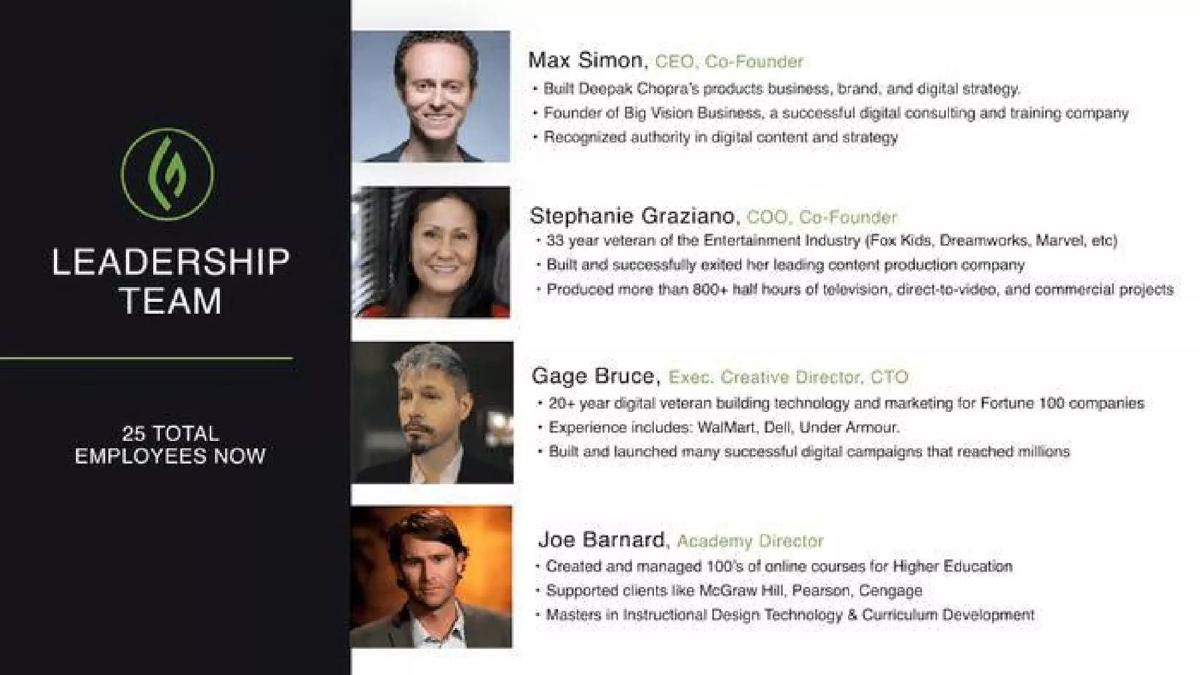
Placed near the end, the team slide is strong. Max Simon’s experience with Deepak Chopra suggests an ability to build 'wellness' brands, while Stephanie Graziano’s 33 years in Hollywood (Fox Kids, Marvel) validates the production quality claims made earlier in the deck. The inclusion of an Academy Director with a Masters in Instructional Design (Joe Barnard) proves they aren't just making videos, but building pedagogically sound curricula.
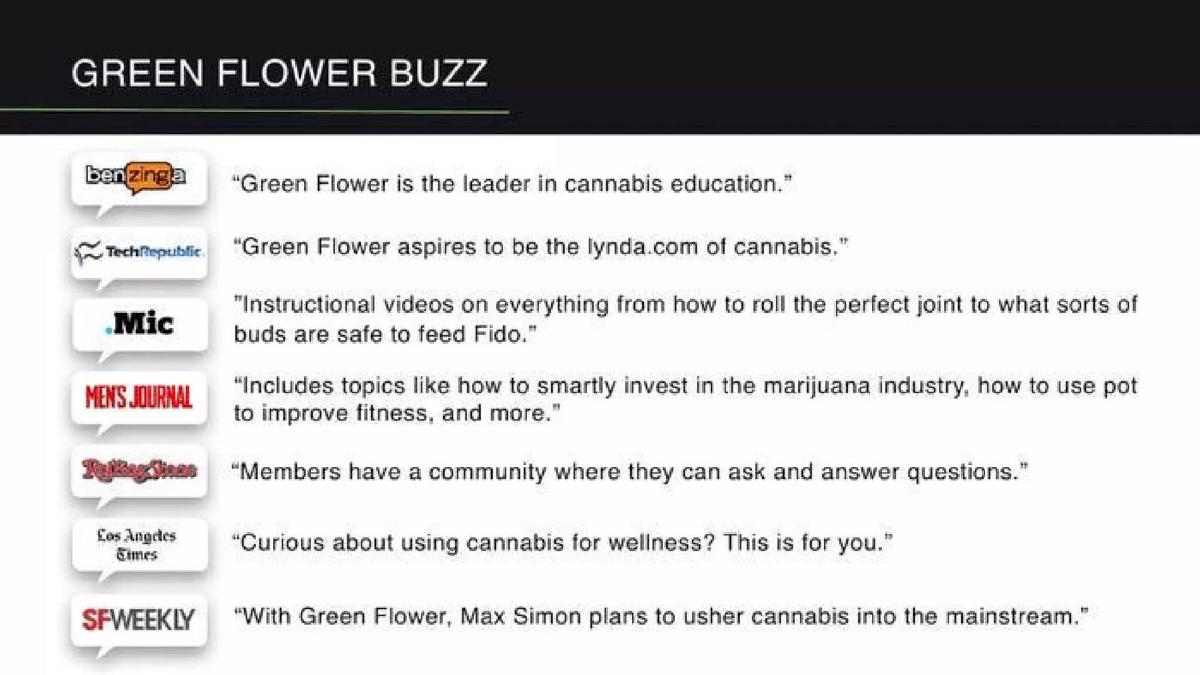
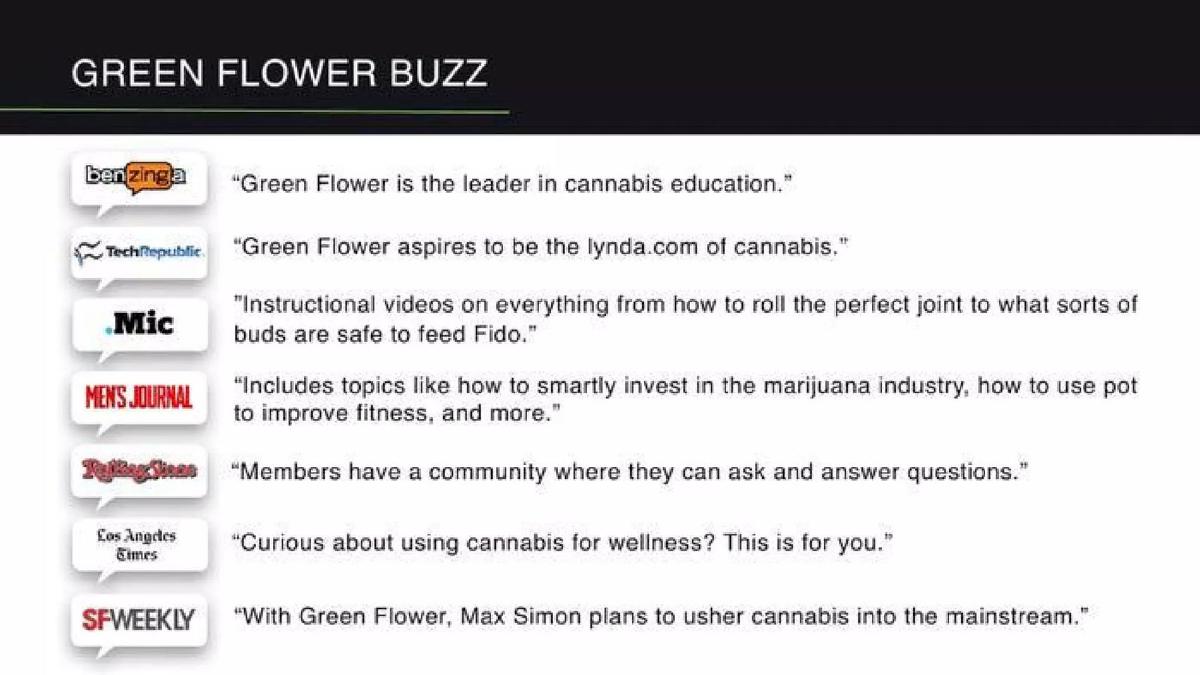
Slide 18: The 'Buzz' Slide
The final slide is a 'wall of logos' and quotes from Benzinga, Rolling Stone, and the LA Times. It serves as a final reminder that the brand is already recognized by the mainstream media, reducing the perceived risk of the 'cannabis' label.
What Works in This Deck
1. The 'Lynda.com' Comparison: By using a well-known successful exit (Lynda.com was acquired by LinkedIn for $1.5B) as a North Star, the founders instantly communicate their business model and potential upside without needing complex explanations.
2. Multi-Channel Revenue: The deck does a great job of showing how the same content library can be monetized three ways: B2C subscriptions, B2B corporate training, and Higher-Ed partnerships. This diversification is very attractive to Series A investors.
3. Infrastructure as a Moat: Emphasizing the 10,000 sq ft studio and 700+ experts makes the business look 'heavy' in a good way. It’s not just a website; it’s a production powerhouse that would be expensive and time-consuming for a competitor to replicate.
What Is Missing
1. Unit Economics: While they mention 4,000 paying members, the deck lacks data on Customer Acquisition Cost (CAC) or Lifetime Value (LTV). For a subscription business, these are critical metrics that investors would likely grill the founders on during the first meeting.
2. Competitive Landscape: The deck operates as if Green Flower is the only player in the space. While they claim 'first mover' status, a slide acknowledging other niche players or the threat of generalist platforms (like Coursera) adding cannabis content would have shown more strategic depth.
3. Regulatory Risk Mitigation: Operating in cannabis education involves navigating complex state-by-state laws. The deck mentions 'compliance' as a course topic, but it doesn't explain how the company itself stays compliant or handles the banking/payment processing hurdles common in the industry.
What a Founder Should Copy
1. The 'Opportunity' Framing: Instead of just one 'Problem' slide, Green Flower uses three 'Opportunity' slides to segment their growth. This is an excellent way to show a large Total Addressable Market (TAM) without using a single, unbelievable 'trillion-dollar' number.
2. High-Quality Visuals: The use of high-resolution stills from their own content (Slide 6 and 9) proves their production value. If you are a media or content company, your deck must look as good as your product.
3. Strategic Use of Testimonials: Don't just list logos; use specific quotes that address business pain points. The GTI quote on Slide 11 is perfect because it explicitly mentions 'outsourcing the entire training function,' which is a massive value proposition for a B2B service.
Conclusion
Green Flower Media’s deck succeeded because it framed a 'vice' industry through the lens of professional infrastructure and education. By focusing on the 'skills gap' and the corporate need for compliance, they turned a consumer content play into a high-stakes B2B necessity. The $20 million raise was a testament to the strength of their content moat and the clarity of their three-pillared growth strategy.
Frequently asked questions
- What is the primary business model for Green Flower Media?
- Green Flower Media operates a multi-pronged revenue model centered on e-learning. According to slide 5, they utilize a subscription model for consumers, which they planned to consolidate into a single subscription in 2019. Additionally, slides 9 and 13 detail B2B revenue streams through professional certificate programs for corporate training and partnerships with colleges and universities for continuing education.
- How does the company justify the $20 million Series A ask?
- The justification rests on market timing and infrastructure. Slide 3 points to a 'hockey-stick growth' phase in the global cannabis industry, specifically a jump from $6.7 billion to $22.7 billion in five years. By highlighting their 10,000 sq ft studio and 700+ experts (Slide 2), they argue they are the only player with the production capacity to meet this demand.
- Who are the key members of the leadership team?
- The leadership team (Slide 17) includes CEO Max Simon, who built Deepak Chopra’s products business; COO Stephanie Graziano, a 33-year entertainment veteran from Fox Kids and Dreamworks; CTO Gage Bruce, a veteran of Fortune 100 digital campaigns; and Academy Director Joe Barnard, who has a background in instructional design for McGraw Hill and Pearson.
- What is the 'skills gap' mentioned in the deck?
- Slide 8 identifies a critical shortage of trained professionals as the industry expands. With 150,000 current jobs rising to 1.1 million (Slide 3), Green Flower positions its 'Academy' as the solution to provide standardized training in cultivation, extraction, compliance, and patient care, which are currently not taught in traditional institutions.
- What are the company's plans for international expansion?
- Slide 15 outlines 'Future Plans' that include customizing certificate programs for international markets including Canada, Latin America, and the UK. They also explicitly mention a strategy for acquiring other education and media companies to consolidate the market and forming strategic partnerships with government bodies.