The BioTime investor presentation from July 2016 outlines the company's strategic focus on pluripotent stem cells (PSCs) and their application in regenerative medicine. As a publicly traded entity (NYSE MKT: BTX), the deck emphasizes clinical milestones over early-stage venture metrics. The presentation centers on two primary products: Renevia, targeting HIV-associated lipoatrophy, and OpRegen, targeting Dry Age-Related Macular Degeneration (Dry-AMD). By positioning regenerative medicine as the logical successor to the $75B recombinant DNA and $44B monoclonal antibody markets, BioTime attempt…
Key takeaways
- BioTime positions itself as a leader in the 'Regenerative Medicine Revolution,' trading under the ticker BTX (Slide 1).
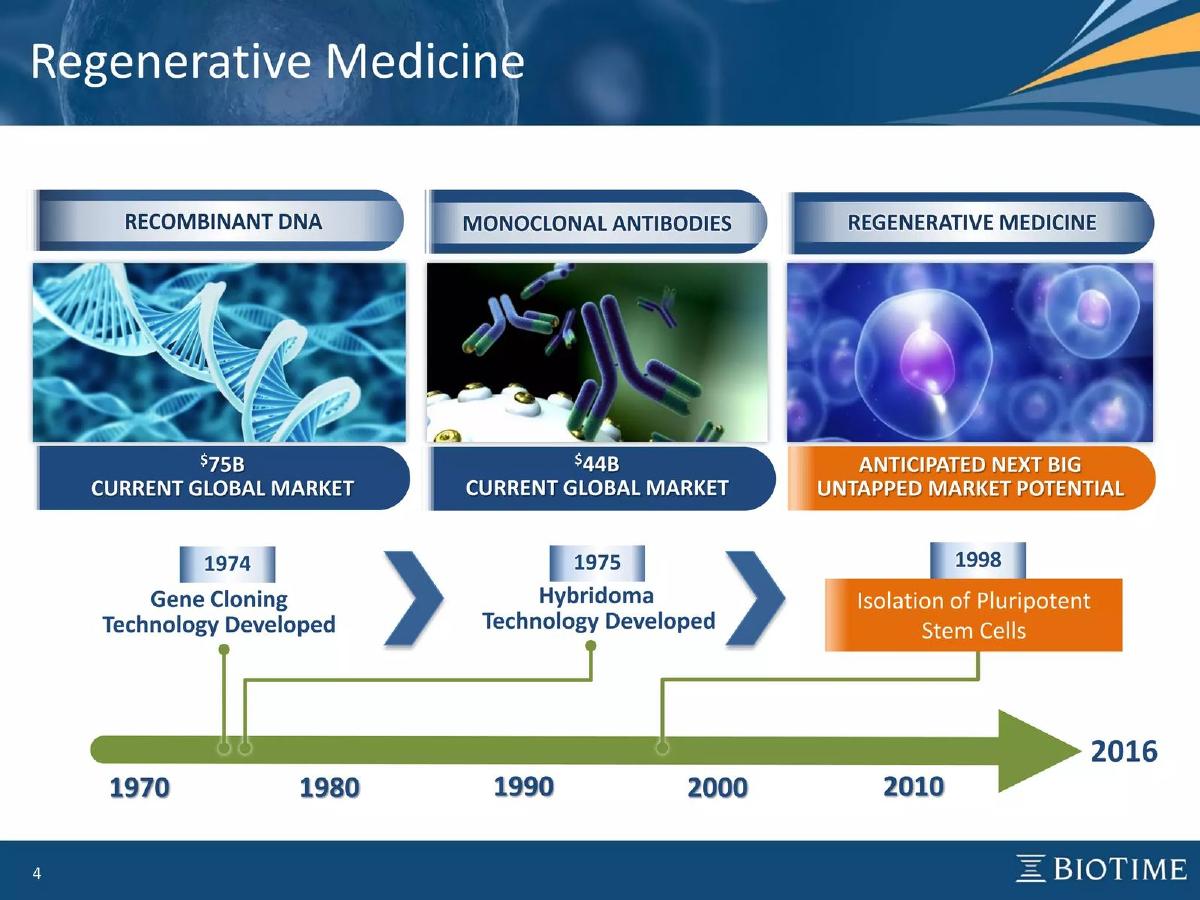
- The company identifies a massive market opportunity by comparing regenerative medicine to the $75B recombinant DNA and $44B monoclonal antibody markets (Slide 4).
- BioTime utilizes Pluripotent Stem Cells (PSCs) which can manufacture all human cell types on an industrial scale and propagate indefinitely (Slide 7).
- The Renevia trial is designed as a multicenter, randomized study with 25 completers in each group to support a CE Mark (Slide 10).
- Pre-clinical data for Renevia shows new lipocytes spreading across engraftment areas in nude mice at 6 months post-transplant (Slide 13).
- OpRegen has received FDA Fast-Track designation for the treatment of Dry Age-Related Macular Degeneration (Slide 16).
- The company projected filing for a CE mark for Renevia in 2Q 2017 and obtaining EU regulatory approval by 2H 2017 (Slide 19).
- OpRegen milestones included completing enrollment for Cohort 2 and seeking DSMB approval for Cohort 3 by 4Q 2016 (Slide 19).
BioTime Investor Presentation Overview
The July 2016 BioTime investor presentation is a technical, milestone-driven deck designed for the public markets. As a company listed on the NYSE MKT (ticker: BTX), the presentation skips the traditional 'problem/solution' narrative typical of seed-stage startups and instead focuses on clinical validation, regulatory pathways, and industrial scalability. The deck is structured to move from broad market potential to specific clinical data for its lead candidates, Renevia and OpRegen.
Slide 1: Title and Market Identity
The cover slide establishes BioTime's positioning: "Leading the Regenerative Medicine Revolution." It prominently features the NYSE MKT: BTX ticker symbol, signaling that this is a presentation for a publicly traded entity. The date, July 2016, provides a specific temporal context for the clinical milestones that follow.
Slide 4: The Evolution of Biotechnology
This slide provides the macro-economic justification for the company's existence. It presents a timeline of biotech breakthroughs, starting with Gene Cloning in 1974 (Recombinant DNA, $75B market) and Hybridoma Technology in 1975 (Monoclonal Antibodies, $44B market). By placing the 1998 isolation of Pluripotent Stem Cells at the end of this sequence, BioTime frames regenerative medicine as the next multi-billion dollar frontier. This is a classic 'market sizing by analogy' tactic, suggesting that just as DNA and antibodies created massive industries, stem cells are poised to do the same.
Slide 7: The Case for Pluripotent Stem Cells (PSCs)
BioTime uses this slide to differentiate its technology from adult stem cells. The slide lists several key advantages: the ability to manufacture "all" human cell types on an industrial scale, indefinite propagation from master cell banks, and uniformity of product and genotype. Crucially, it notes that no tissue sourcing is required for ongoing production and that their cells are NIH-approved. The visual aid shows the differentiation of PSCs into various types, including cardiac cells, dendritic cells, and osteochondral cells, emphasizing the platform nature of their technology.
Slide 10: Renevia Trial Design
Focusing on the lead product Renevia, this slide outlines a "Gateway" pivotal trial for HIV-associated Lipoatrophy (facial fat loss). The trial design is specific: multicenter, randomized, and controlled, with 25 completers per group. It defines the primary endpoint as an increase in skin thickness at 6 months via ultrasound. This slide is intended to give investors confidence in the rigor of the clinical process and the clarity of the path toward a CE Mark in Europe.
Slide 13: Pre-clinical Evidence for Renevia
To support the clinical trial design, slide 13 provides histological evidence from animal studies. It shows human SVF (stromal vascular fraction) cells transplanted into nude mice. The slide notes that at 3 months, new lipocytes are present, and by 6 months, these cells are spreading to form new tissue. This visual proof-of-concept serves to bridge the gap between the theoretical platform and the human clinical trials described in the previous slides.
Slide 16: OpRegen Mechanism of Action
The presentation shifts to OpRegen, a treatment for Dry Age-Related Macular Degeneration (Dry-AMD). The slide identifies Dry-AMD as the leading cause of blindness in people over 60. The proposed solution is an "off-the-shelf" one-time therapy where OpRegen cells are injected into the subretinal space to replace missing RPE cells. A major highlight on this slide is the "FDA Fast-Track designation," a significant regulatory milestone that reduces the perceived risk for investors.
Slide 19: Upcoming Milestones
This is arguably the most important slide for a public market investor. It provides a clear timeline for 2016 and 2017. For Renevia, it tracks enrollment completion (3Q '16), CE mark filing (2Q '17), and potential EU approval (2H '17). For OpRegen, it tracks cohort enrollment and DSMB (Data and Safety Monitoring Board) clearances. By providing these specific dates, BioTime creates a checklist against which its performance can be measured.
Slide 22: Contact and Corporate Location
The final slide repeats the ticker symbol and provides the company's headquarters address in Alameda, CA. It serves as a standard closing for a corporate presentation.
What BioTime Does Well
BioTime excels at framing its technology within the broader history of biotechnology. By comparing regenerative medicine to recombinant DNA and monoclonal antibodies, they provide a mental model for investors to understand the potential scale of the opportunity. The deck is also highly specific regarding clinical trial design and regulatory status. Mentioning "FDA Fast-Track designation" and "NIH-approved" cells provides third-party validation that is critical in the biotech sector.
The use of histological images (Slide 13) and anatomical diagrams (Slide 16) helps translate complex biological processes into understandable visual outcomes. Furthermore, the milestone slide (Slide 19) is exemplary in its clarity, giving investors a clear roadmap of what to expect over the next 18 months.
What is Missing from the Deck
While this is a strong clinical presentation, several elements are missing from the provided slides that a private market investor would typically expect:
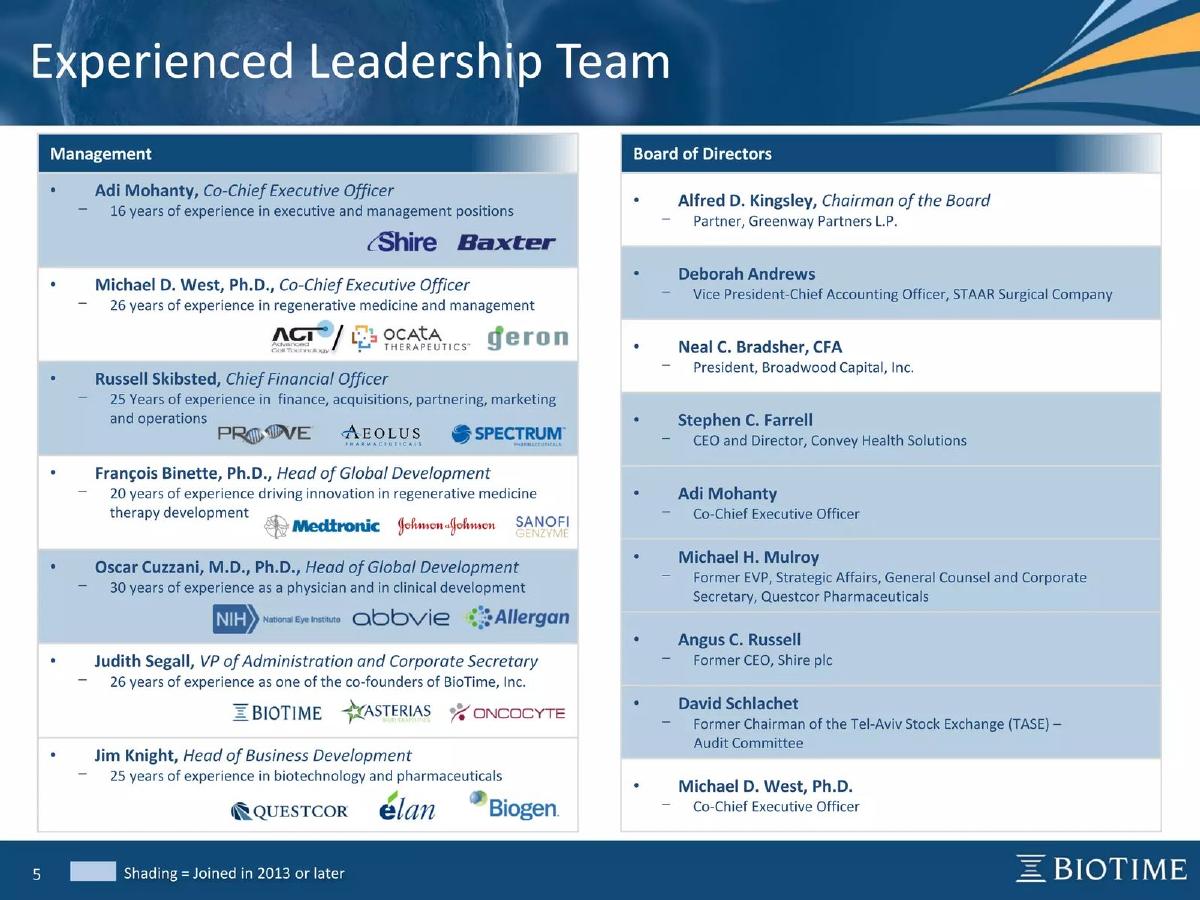
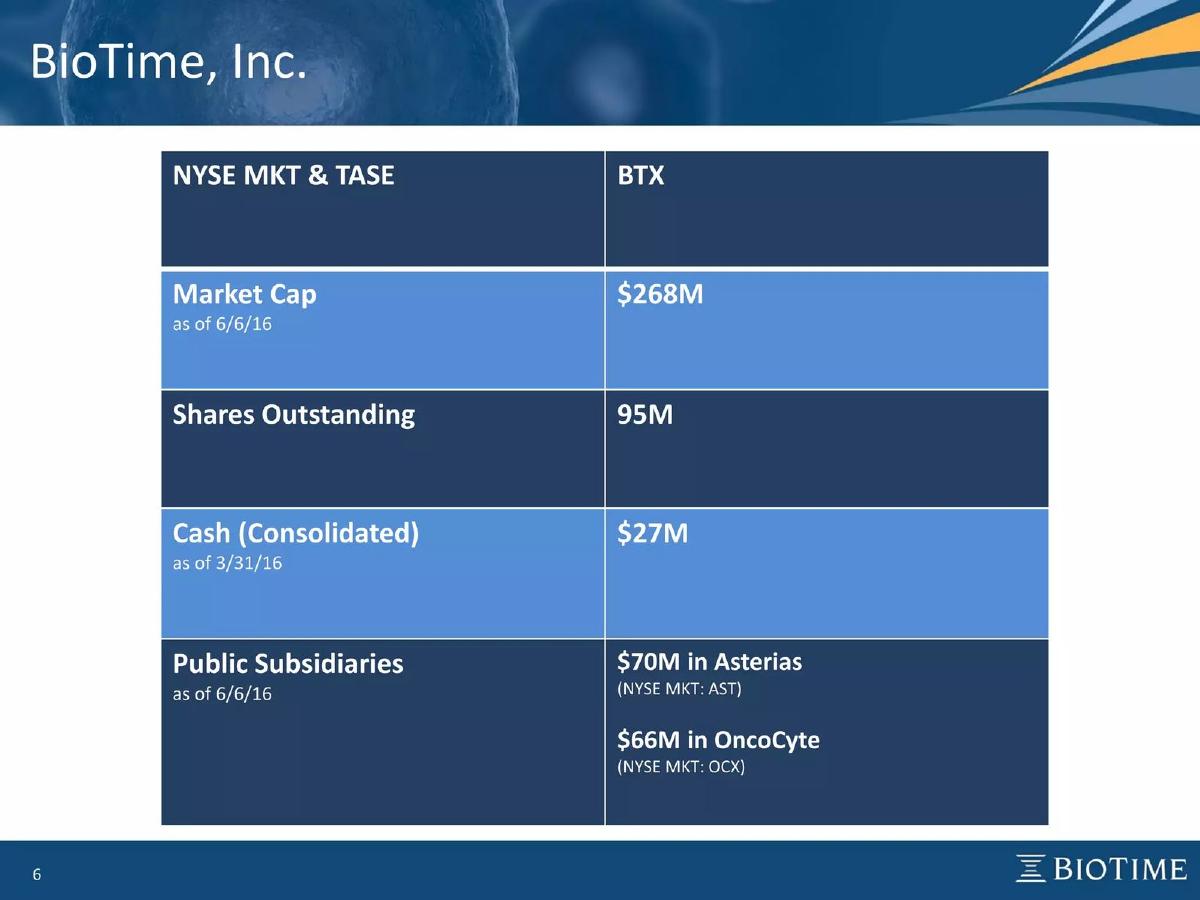
Management Team: There is no slide detailing the experience of the leadership team or scientific advisory board. In biotech, the pedigree of the scientists and the track record of the executives are paramount. · Financials and Burn Rate: As a public company, these are available in SEC filings, but their absence in the deck means the presentation does not address how long the current cash runway will last through the listed milestones. · Competitive Landscape: The deck assumes a vacuum. It does not mention other companies working on PSCs or alternative treatments for Dry-AMD and Lipoatrophy. · Intellectual Property: While the deck mentions "master cell banks," it does not explicitly detail the patent portfolio protecting these assets. · Unit Economics: There is no discussion of the cost of goods sold (COGS) for these "industrial-scale" cell therapies or the projected pricing model.
Lessons for Founders
Founders in the deep tech or biotech space can learn several lessons from the BioTime deck:
Use Analogies for Market Sizing: If you are creating a new category, compare it to established categories that investors already understand and value. BioTime’s use of the $75B DNA market is a prime example. · Be Specific About Trials: Don't just say you are "doing a study." Define the number of participants, the control group, and the primary/secondary endpoints. This shows professional rigor. · Highlight Regulatory Wins: Any interaction with the FDA or similar bodies (like Fast-Track designation) should be front and center. It is the most effective way to de-risk a technical project. · Create a Milestone Checklist: A clear, quarterly roadmap of upcoming catalysts (Slide 19) is essential for keeping investors engaged and providing a sense of momentum. · Visual Proof: Whenever possible, show the results of your technology (like the tissue growth in Slide 13) rather than just describing it in text.
Frequently asked questions
- What is BioTime's core technological advantage?
- BioTime focuses on Pluripotent Stem Cells (PSCs). According to slide 7, these cells allow for the industrial-scale manufacture of all human cell types. Unlike adult stem cells, BioTime’s clinical-grade master cell banks can propagate indefinitely, ensuring a uniform product and genotype without the need for constant tissue sourcing. The slide also notes that these cells are NIH-approved.
- What are the primary clinical targets mentioned in the deck?
- The deck highlights two main clinical programs. Renevia is targeted at HIV-associated lipoatrophy (facial fat loss), as shown on slide 10. OpRegen is a cell therapy designed to replace missing Retinal Pigment Epithelium (RPE) cells in patients with Dry Age-Related Macular Degeneration (Dry-AMD), which slide 16 identifies as a leading cause of blindness in people over 60.
- How does BioTime frame the market opportunity for regenerative medicine?
- Slide 4 uses a historical timeline to frame the opportunity. It places regenerative medicine as the next major wave following Recombinant DNA (1974, $75B market) and Monoclonal Antibodies (1975, $44B market). It classifies regenerative medicine as the 'anticipated next big untapped market potential' following the 1998 isolation of pluripotent stem cells.
- What was the regulatory status of BioTime's products in 2016?
- Slide 16 states that OpRegen had already received FDA Fast-Track designation. For Renevia, slide 10 indicates the trial was designed to support a CE Mark in Europe. The milestone chart on slide 19 projected filing for the CE mark in 2Q 2017 and initiating a pivotal trial in the US in 1H 2017.
- What specific trial metrics are provided for the Renevia program?
- Slide 10 details a multicenter, randomized, controlled trial for Renevia. The study aimed for 25 completers in both the treated and delayed treatment control groups. The primary endpoint was an increase in skin thickness measured by ultrasound at 6 months, while secondary endpoints included mid-face volume deficit scores and aesthetic improvement scales.