BioVie’s September 2020 investor deck is a clinical-heavy presentation focused on BIV201, a therapy for refractory ascites resulting from advanced liver cirrhosis. The company highlights that cirrhosis is the 11th leading cause of death in the US, with a 50% one-year survival rate for those with refractory ascites. The deck anchors its value proposition on Phase 2a trial results, where 4 of 6 patients saw a 50% or greater increase in time between paracentesis procedures. With US Orphan Drug designations and FDA Fast Track status, the company outlines a clear regulatory path toward a pivotal P…
Key takeaways
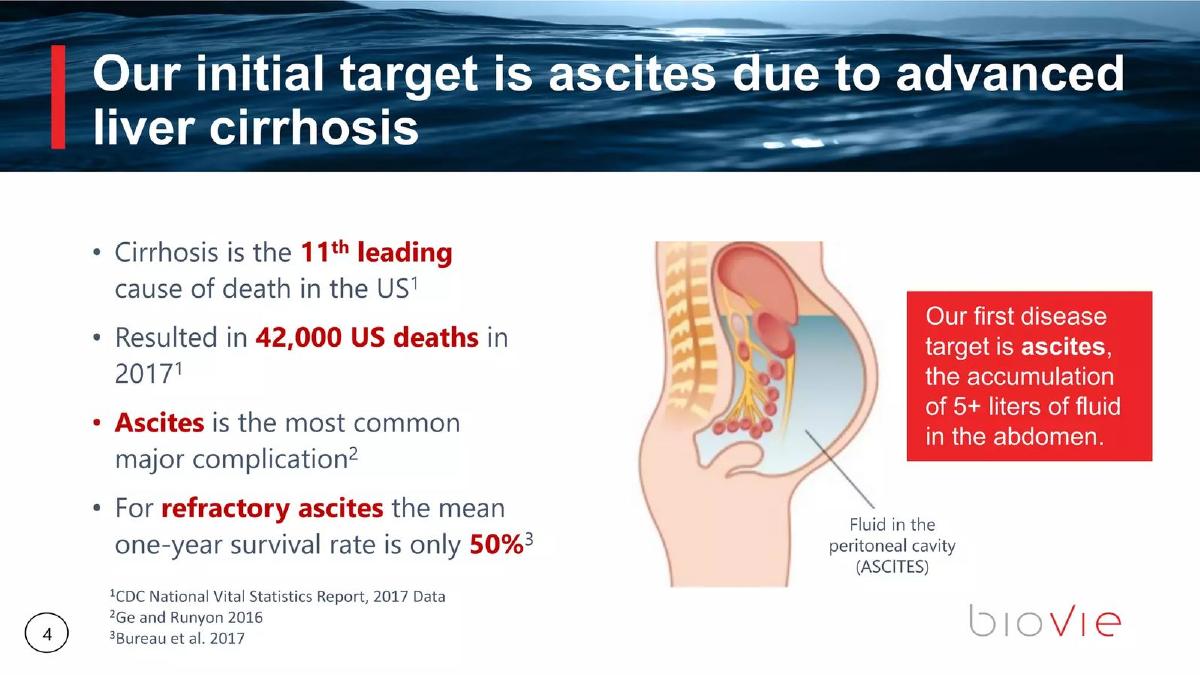
- Cirrhosis is cited as the 11th leading cause of death in the US, resulting in 42,000 deaths in 2017 (Slide 4).
- Refractory ascites carries a mean one-year survival rate of only 50% (Slide 4).
- Retrospective study results for continuous infusion terlipressin showed a 55% decrease in mean ascites fluid and a 47% improvement in renal function (Slide 10).
- Phase 2a trial results demonstrated that 4 of 6 patients achieved a 50% or greater increase in days until the next paracentesis (Slide 13).
- The planned US Phase 2 trial involves 24 patients, with 16 receiving BIV201 plus standard of care (Slide 16).
- BioVie holds US Orphan Drug designations for both ascites (Sept '16) and HRS (Nov '18), providing up to 7 years of market exclusivity (Slide 19).
- The company has secured FDA Fast Track status and intends to seek Breakthrough Therapy designation (Slide 19).
- The management team is led by CEO Terren Peizer, who has founded healthcare companies and managed over $1.2 billion in investments (Slide 22).
BioVie Investor Deck Analysis: September 2020
BioVie’s investor presentation from September 2020 serves as a technical and clinical roadmap for a company addressing high-mortality complications of liver disease. The deck is structured to move from the severity of the medical problem to the biological mechanism of the solution, followed by clinical validation and regulatory strategy. It is a standard biotech pitch that prioritizes data and intellectual property over traditional startup metrics like user growth or monthly recurring revenue.
Slide 1: Title and Positioning
The cover slide establishes a professional, clinical tone. It uses a high-resolution image of deep blue water, likely a metaphor for the fluid accumulation (ascites) the company treats. The subtitle, "Pioneering Therapies for Patients Suffering from Advanced Liver Cirrhosis," immediately identifies the therapeutic area. The date, September 2020, indicates this was a mid-pandemic update for investors.
Slide 4: The Problem - Advanced Liver Cirrhosis and Ascites
This slide defines the market need with stark statistics. It notes that cirrhosis is the 11th leading cause of death in the US, resulting in 42,000 deaths in 2017. The focus is narrowed to "ascites," described as the accumulation of 5+ liters of fluid in the abdomen. Crucially, the slide highlights that for patients with "refractory ascites," the mean one-year survival rate is only 50%. This establishes a high unmet medical need, which is a key driver for FDA fast-tracking and investor interest.
Slide 7: Therapeutic Goal and Mechanism of Action
BioVie explains how their therapy works through a biological mechanism of action (MOA). The slide illustrates how cirrhosis causes blood pooling and portal hypertension, leading to the activation of the RAAS signaling pathway, which causes the kidneys to retain salt and water. The therapy is intended to vasoconstrict the central region, restoring arterial blood volume and shutting down the RAAS pathway to halt fluid production. This technical explanation is vital for specialized biotech investors to understand the scientific feasibility of the drug.
Slide 10: Retrospective Study Results
Before presenting their own trial data, BioVie cites a 2015 retrospective study by P. Angeli, MD. The data shows that continuous infusion of terlipressin in 6 patients led to a 55% decrease in mean ascites fluid and a 47% improvement in renal function (serum creatinine). A footnote mentions that terlipressin is not currently available in the US, positioning BioVie to fill a specific geographic and regulatory gap.
Slide 13: Phase 2a Trial Results
This is a core validation slide. It presents results from BioVie's Phase 2a trial, specifically the timing of the next paracentesis (fluid withdrawal) procedure. A bar chart shows that 4 of 6 patients achieved a 50% or greater increase in the number of days between procedures while on BIV201 therapy. While the sample size (n=6) is small, the visual representation of the extended intervals for patients 102, 104, and 105 provides a clear "proof of concept" for the drug's efficacy.
Slide 16: Phase 2 & 3 Clinical Trial Plan
This slide outlines the forward-looking roadmap. The US Phase 2 trial is described as a 24-patient study (16 treatment, 8 control) with a primary endpoint of ascites-related complications over 180 days. The slide then jumps to the "pivotal" Phase 3 trial, which is planned to include 120 patients across 20 sites. This demonstrates a clear path to commercialization and identifies the specific milestones investors are funding.
Slide 19: IP Protection and FDA Status
For biotech companies, the "moat" is intellectual property and regulatory exclusivity. BioVie highlights its global patent estate for liquid terlipressin formulations. Significant value is placed on the US Orphan Drug designations for both ascites (2016) and HRS (2018), which provide 7 years of market exclusivity. The slide also confirms FDA Fast Track status and the intent to seek Breakthrough Therapy designation, both of which can accelerate the time to market.
Slide 22: Management Team
The leadership slide focuses on deep industry and financial experience. CEO Terren Peizer is highlighted for his history as an entrepreneur and financier, specifically mentioning his role in founding Catasys and managing Acuitas Group Holdings, which invested over $1.2 billion. President Jonathan Adams is credited with 30 years of biopharma experience, including the launch of Celebrex. The bios emphasize commercialization and financial management, suggesting the team is equipped for both clinical development and an eventual exit or scale-up.
Slide 25: Board of Directors
The board slide adds further institutional credibility. It features individuals with backgrounds at Samsung Global Strategy Group, Merck, McKinsey, Barclays, and Lehman Brothers. The inclusion of Jim Lang (CEO of EVERSANA) and Richard J. Berman (former Chairman of National Investment Managers) suggests a board with strong ties to both the pharmaceutical service industry and the capital markets.
What BioVie Does Well
BioVie excels at defining a clear, high-stakes medical problem and backing it with specific, albeit small-scale, data. The use of the Phase 2a results (Slide 13) is particularly effective because it uses a metric—days between procedures—that is easily understood by non-medical investors but remains clinically significant. The deck also does a thorough job of explaining the regulatory advantages (Orphan Drug, Fast Track) which are the primary value drivers in early-stage biotech. The management and board slides are exceptionally strong, showcasing a level of financial and strategic pedigree that exceeds many typical startups at this stage.
What is Missing from the Deck
The most notable omission is a specific financial "Ask." While the clinical plan is detailed, the deck does not state how much capital is being raised in this specific round or how that capital will be allocated across the Phase 2 and Phase 3 trials. There is also no mention of the competitive landscape beyond the note that terlipressin is unavailable in the US. Investors would likely want to know about other drugs in the pipeline for cirrhosis or alternative treatments like shunts. Finally, there is no discussion of the anticipated pricing or reimbursement strategy, which is a critical component of the eventual commercial success for an Orphan Drug.
What Other Founders Can Copy
Founders in technical or scientific fields should emulate BioVie’s "Mechanism of Action" slide (Slide 7). It uses a simple flow chart to explain a complex biological process, making the solution feel logical and inevitable. Additionally, the way BioVie anchors its value in regulatory milestones (Slide 19) is a masterclass in biotech positioning; by highlighting Orphan Drug status and Fast Track designations, they signal to investors that the FDA has already validated the importance of their work. Founders should also note the use of "Retrospective Data" (Slide 10) to build a case when their own internal data is still in the early stages; it shows that the general approach has worked before, reducing the perceived risk of the specific new formulation.
Frequently asked questions
- What is the primary medical condition BioVie is targeting?
- BioVie is targeting ascites, which is the accumulation of 5+ liters of fluid in the abdomen, caused by advanced liver cirrhosis. According to slide 4, cirrhosis was the 11th leading cause of death in the US in 2017, and refractory ascites has a very poor prognosis with only a 50% one-year survival rate.
- What clinical evidence does the deck provide for their therapy?
- The deck provides two main data points: a retrospective study from 2015 showing a 55% reduction in ascites fluid (Slide 10), and their own Phase 2a trial results. In the Phase 2a trial, 4 out of 6 patients experienced a 50% or greater increase in the time between fluid withdrawal procedures (Slide 13).
- What is the regulatory status of BioVie's lead candidate?
- As of September 2020, BioVie had secured US Orphan Drug designations for both ascites and Hepatorenal Syndrome (HRS), which grants 7 years of market exclusivity. They also have FDA Fast Track status and stated intentions to seek a Breakthrough Therapy designation (Slide 19).
- What does the clinical trial roadmap look like?
- Slide 16 outlines a US Phase 2 trial with 24 patients (16 treatment, 8 control) across 4-6 sites. Following this, the company plans a single pivotal US Phase 3 clinical trial involving approximately 120 patients at roughly 20 study sites, mirroring the Phase 2 design.
- Who are the key members of the leadership team?
- The team is led by CEO and Chairman Terren Peizer, an entrepreneur and financier who founded Catasys and NeurMedix. President and COO Jonathan Adams brings 30 years of biopharma experience, including work on the global launch of Celebrex at Searle Pharma (Slide 22).