Bitdharma LLC’s 2018 Series A deck attempts to position the company as a comprehensive blockchain solution for Small and Medium Businesses (SMBs). The deck identifies significant friction points in traditional finance, such as high assessment costs and a lack of transparency for investors. Bitdharma proposes a multi-faceted platform covering automatic tokenization, exchange services, and business management via dApps. While the revenue model shows a transition from service-based income (mining and contracts) to platform-based income (staking and exchange fees), the deck lacks critical details…
Key takeaways
- The deck identifies 'The cliff to get into the stock market' as a primary pain point for SMBs on Slide 2.
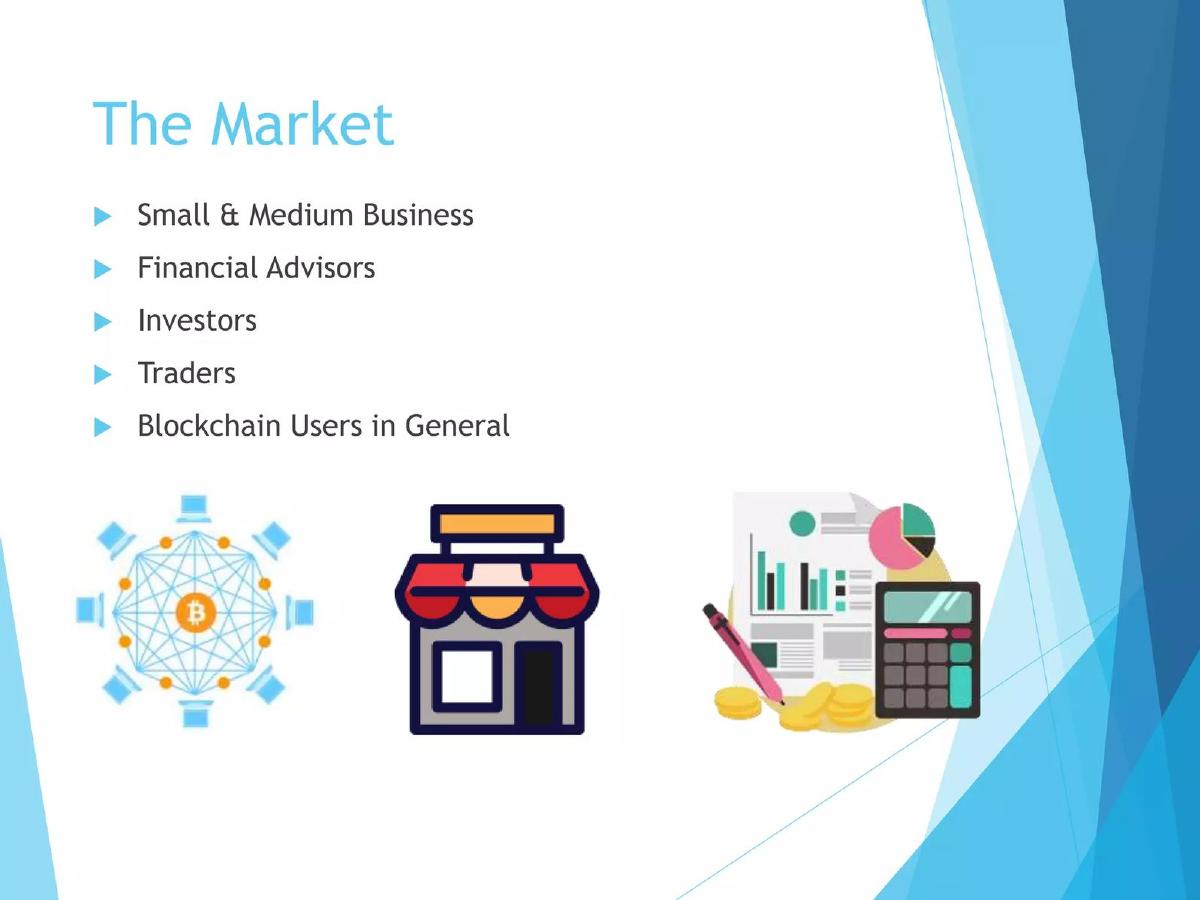
- Bitdharma targets a broad audience including Financial Advisors, Traders, and general Blockchain Users on Slide 3.
- A competitive matrix on Slide 4 claims Bitdharma is the only player offering a full suite including Financial Assessments and Legacy Banking with Crypto.
- The revenue model distinguishes between 'Actual Income' like mining and 'Future Income' like Sensei utility tokens on Slide 5.
- Financial projections on Slide 6 show a growth trajectory aiming for approximately 14,000,000 in total revenue by 2023.
- Exchange fees are projected to be the largest revenue contributor by 2023, surpassing development contracts and staking on Slide 6.
- The deck omits a team slide, failing to establish the technical or financial credibility of the founders.
- There is no specific 'Ask' slide in the provided sequence, leaving the desired investment amount and valuation unknown.
Bitdharma LLC: The 2018 Blockchain SMB Vision
The Bitdharma LLC pitch deck, dated August 20, 2018, represents a specific era of blockchain enthusiasm where founders sought to apply decentralized ledger technology to every facet of traditional business management. This teardown examines the six provided slides of their 12-slide deck, focusing on their attempt to bridge the gap between small businesses and institutional-grade financial markets.
Slide 1: Title and Branding
The cover slide introduces the Bitdharma logo—a stylized, multi-colored globe-like structure composed of blocks, likely symbolizing the blockchain. The text is minimal, stating 'Investor Pitch Deck' and the date '08/20/2018'. While clean, it provides no immediate value proposition or industry taglines, requiring the investor to move to the next slide to understand the company's purpose.
Slide 2: The Problem Statement
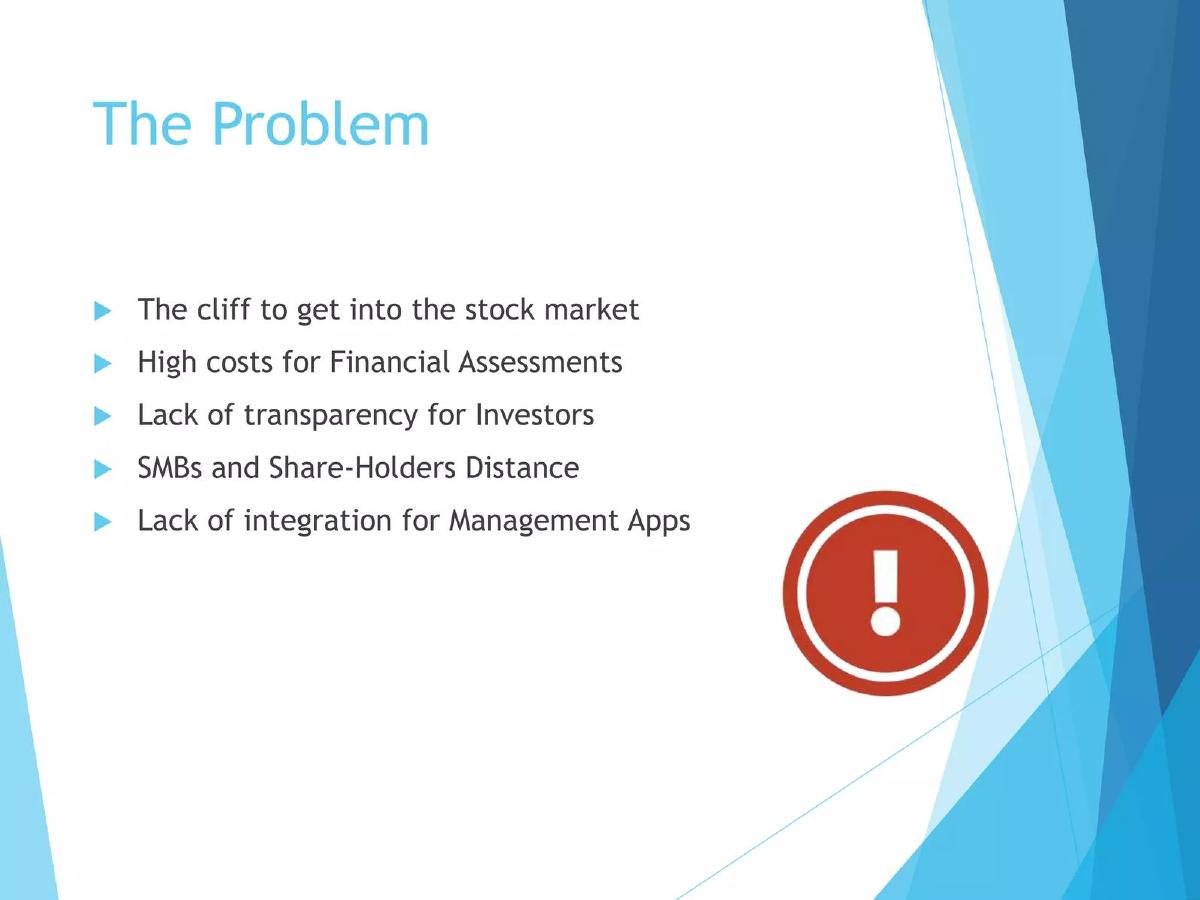
Slide 2, titled 'The Problem,' uses a bulleted list to outline the friction points Bitdharma intends to address. The primary issue cited is 'The cliff to get into the stock market,' suggesting that SMBs find public listing or formal equity markets inaccessible. Other points include:
High costs for Financial Assessments. · Lack of transparency for Investors. · SMBs and Share-Holders Distance. · Lack of integration for Management Apps.
The slide uses a large red exclamation mark icon to emphasize urgency. However, it lacks data to quantify these 'high costs' or the size of the 'cliff,' relying instead on general industry pain points.
Slide 3: Target Market Segments
Slide 3, 'The Market,' identifies five key stakeholders: Small & Medium Business, Financial Advisors, Investors, Traders, and Blockchain Users in General. The inclusion of 'Blockchain Users in General' suggests a broad, perhaps overly ambitious, target audience. The slide is visually supported by three icons: a network diagram with a Bitcoin symbol, a storefront, and a calculator with financial charts. Like the previous slide, this one lacks specific Total Addressable Market (TAM) or Serviceable Obtainable Market (SOM) figures, which are standard for a Series A pitch.
Slide 4: Competitive Analysis Matrix
The 'Competitive Analysis' slide uses a check-mark grid to compare Bitdharma dApps against Waves, Monaize, Binance, Crowdfunding & Incubators, and SAP. The categories for comparison are:
Automatic Tokenization · Exchange Platform · Financial Assessments · Legacy Banking with Crypto · Funding projects and business · Business Management with dApps
According to the chart, Bitdharma is the only entity that provides a 'Yes' in every category. Notably, it positions itself against SAP by claiming SAP has 'No yet' [sic] for business management with dApps. This slide attempts to show Bitdharma as a 'super-app' for business, though it does not explain how a startup can realistically compete with the deep feature sets of established giants like SAP or the liquidity of Binance simultaneously.
Slide 5: The Evolving Revenue Model
Slide 5, 'Revenue Model,' is one of the more detailed slides, splitting income into two categories: 'Actual Income' and 'Future Income.'
Mining Sells and Technical Service. · Course Credits. · Trading Signals and Cryptofund Management. · Software development contracts.
Exchange Fee on the CSCwe platform. · Advertising on the Business Management dApps. · Sensei utility tokens income by staking.
This slide reveals that at the time of the pitch, the company was operating more as a service-based consultancy and mining operation rather than a pure-play product company. The 'Future Income' section outlines the transition to a platform-based model.
Slide 6: Financial Projections (2019-2023)
The final provided slide, 'Financial Projection,' features a bar chart showing revenue growth over five years. The Y-axis ranges from 0 to 16,000,000. The projections are as follows:
2019: Total revenue appears to be under 1,000,000. · 2020: Revenue grows to approximately 2,000,000. · 2021: Revenue reaches roughly 4,000,000. · 2022: Revenue climbs to over 6,000,000. · 2023: Revenue peaks at nearly 14,000,000.
The chart is color-coded to show the contribution of three sources: Exchange Fee (light blue), Development Contracts (dark blue), and Sensei Tokens Staking (green). By 2023, the 'Exchange Fee' is clearly the dominant projected revenue driver, accounting for approximately 8,000,000 of the total. This indicates that the company's long-term viability is heavily dependent on the success and volume of its proprietary exchange platform.
What Works in This Deck
The deck follows a logical flow, moving from the problem to the market and then to the solution's competitive standing. The distinction between current and future revenue is an honest touch, showing that the company has a functioning (albeit service-based) business while they build their platform. The financial chart is clear and easy to read, providing a specific target for investors to evaluate.
What Is Missing
For a Series A deck, there are significant omissions. First, there is no Team Slide . In the crypto and fintech space, the pedigree of the founders and their regulatory/technical experience is paramount. Second, there is no Product Slide showing the actual interface of the 'Business Management dApps' or the 'CSCwe platform.' Third, the Ask is missing; an investor does not know how much money Bitdharma is seeking or what the valuation expectations are. Finally, there is a lack of Traction Data . While they mention 'Actual Income,' they do not provide specific historical figures for 2017 or early 2018 to validate the starting point of their 2019 projections.
Founder Takeaways
Founders should note the importance of a clear revenue transition plan. Bitdharma successfully shows how they move from 'mining and contracts' to 'fees and staking.' However, founders should avoid the 'everything to everyone' trap seen in the competitive analysis. Claiming to beat SAP at business management and Binance at exchanges in a single platform is a red flag for most seasoned investors unless backed by extraordinary technical proof or massive existing user numbers. Always include a slide on the 'Ask' and the 'Team' to ensure the deck is actionable for a VC.
Frequently asked questions
- What is the primary problem Bitdharma aims to solve?
- According to Slide 2, Bitdharma focuses on the high barriers to entry for the stock market, specifically for Small and Medium Businesses (SMBs). They cite high costs for financial assessments, a lack of transparency for investors, and a disconnect between shareholders and SMBs as core issues. They also point to a lack of integration for current management applications as a hurdle for these businesses.
- How does Bitdharma plan to generate revenue in the future?
- Slide 5 outlines a transition from current service-based income to platform-based revenue. Future income streams include exchange fees on the 'CSCwe platform,' advertising within their Business Management dApps, and income generated through the staking of 'Sensei utility tokens.' This indicates a shift toward a scalable software-as-a-service and transaction-based ecosystem.
- Who are Bitdharma's main competitors according to the deck?
- Slide 4 lists Waves, Monaize, Binance, SAP, and general Crowdfunding/Incubators as competitors. The deck claims that while these entities handle specific niches like tokenization (Waves) or legacy banking (Monaize), only Bitdharma offers a comprehensive solution including financial assessments and business management with dApps.
- What are the financial expectations for the company by 2023?
- Slide 6 presents a bar chart showing aggressive growth. By 2023, the company projects total revenue to reach nearly 14,000,000. The largest portion of this, roughly 8,000,000, is expected to come from exchange fees, followed by development contracts and Sensei token staking.
- What critical information is missing from this pitch deck?
- The deck is missing several fundamental components required for a Series A round. There is no team slide to verify the founders' expertise, no slide detailing the technology stack or security protocols, and no 'Ask' slide specifying how much capital is being raised or how it will be allocated. Additionally, there are no details on user acquisition costs or current traction metrics.