Finteum’s 2019 presentation at CordaCon outlines a specialized financial market designed for interbank intraday borrowing. The company identifies a specific inefficiency in the banking sector: the high cost of maintaining large liquidity buffers for daily cash flow volatility. By utilizing R3’s Corda distributed ledger technology, Finteum aims to allow banks to borrow and lend cash for periods of hours rather than days, significantly reducing required capital reserves. The deck emphasizes a 'bank-only' customer model to avoid disintermediation and leverages a team with deep institutional expe…
Key takeaways
- Finteum defines its mission as creating a global financial market for interbank intraday borrowing (Slide 1).
- The startup identifies itself as a pre-seed company with a team boasting experience from UBS, Barclays, and Deutsche Bank (Slide 3).
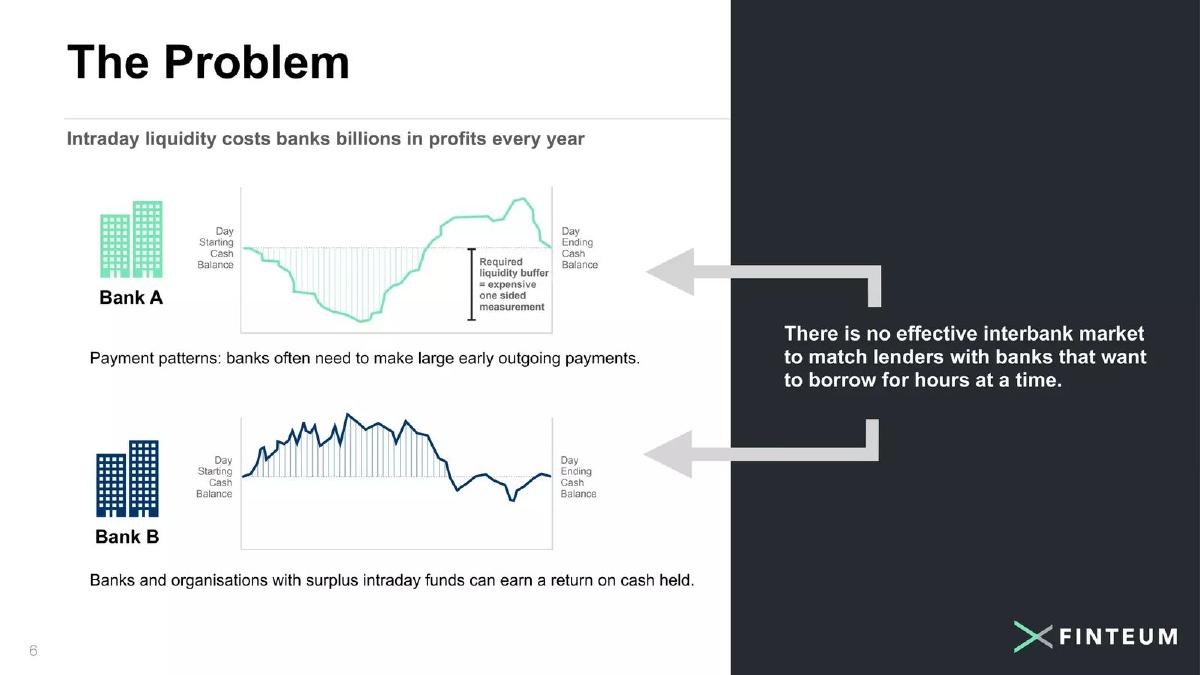
- The core value proposition is reducing the 'expensive' required liquidity buffer for banks through intraday borrowing and repayment (Slide 7).
- Finteum explicitly states it only wants banks as customers to maintain settlement and market liquidity (Slide 9).
- The business model relies on acting as a Multilateral Trading Facility (MTF) or MTF partner (Slide 9).
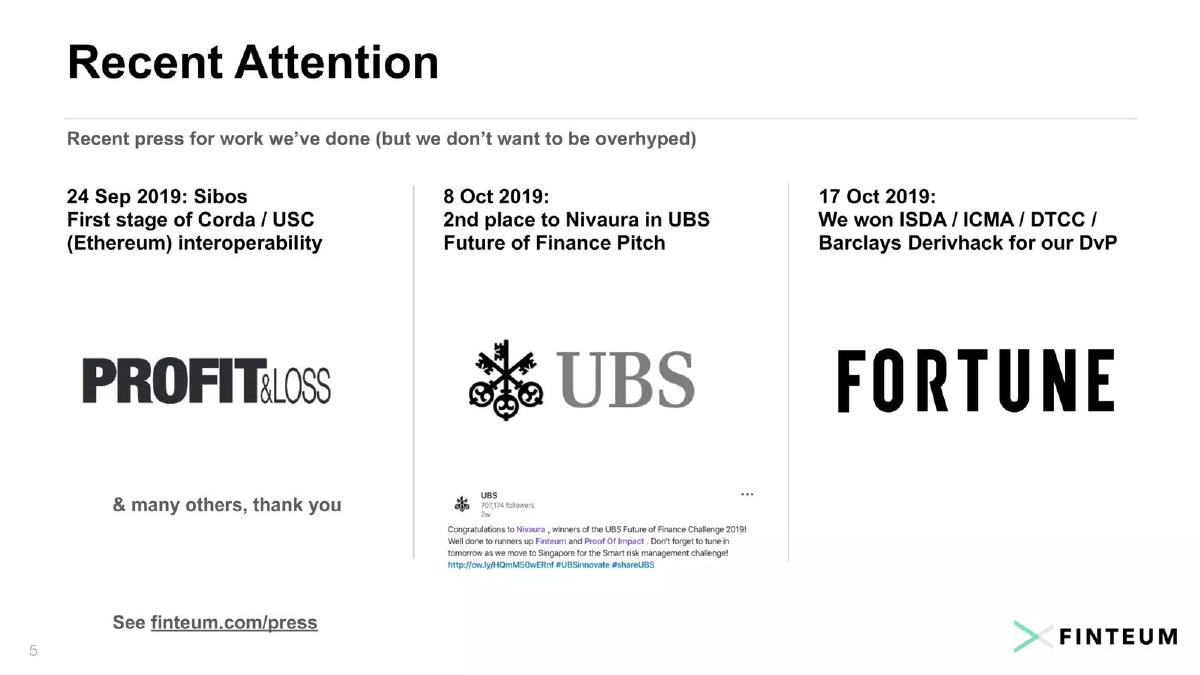
- The deck highlights early validation through awards from ISDA, ICMA, DTCC, and Barclays (Slide 5).
- The technology is built on a distributed ledger, specifically R3's Corda platform (Slide 7).
- The deck omits standard fundraising details such as the specific amount being raised, valuation, or detailed financial projections.
Finteum: A Technical Deep Dive into Intraday Liquidity
The Finteum deck, presented at CordaCon in October 2019, is less of a traditional 'pitch' to VCs and more of a strategic roadmap for institutional partners. Operating in the highly complex world of interbank treasury, the company uses this presentation to establish credibility, define a narrow but high-value problem, and showcase their technical progress on the Corda ledger.
Slide 1: Title and Mission
The cover slide is functional and minimalist. It establishes the date (24 October 2019) and the venue (CordaCon 2019). The most important element here is the sub-headline: 'Finteum is creating a global financial market for interbank intraday borrowing.' This immediately identifies the company as a B2B fintech focused on a specific niche of the capital markets. The presence of the R3 and Corda logos signals a deep integration with that specific blockchain ecosystem.
Slide 3: Team and Pre-Seed Status
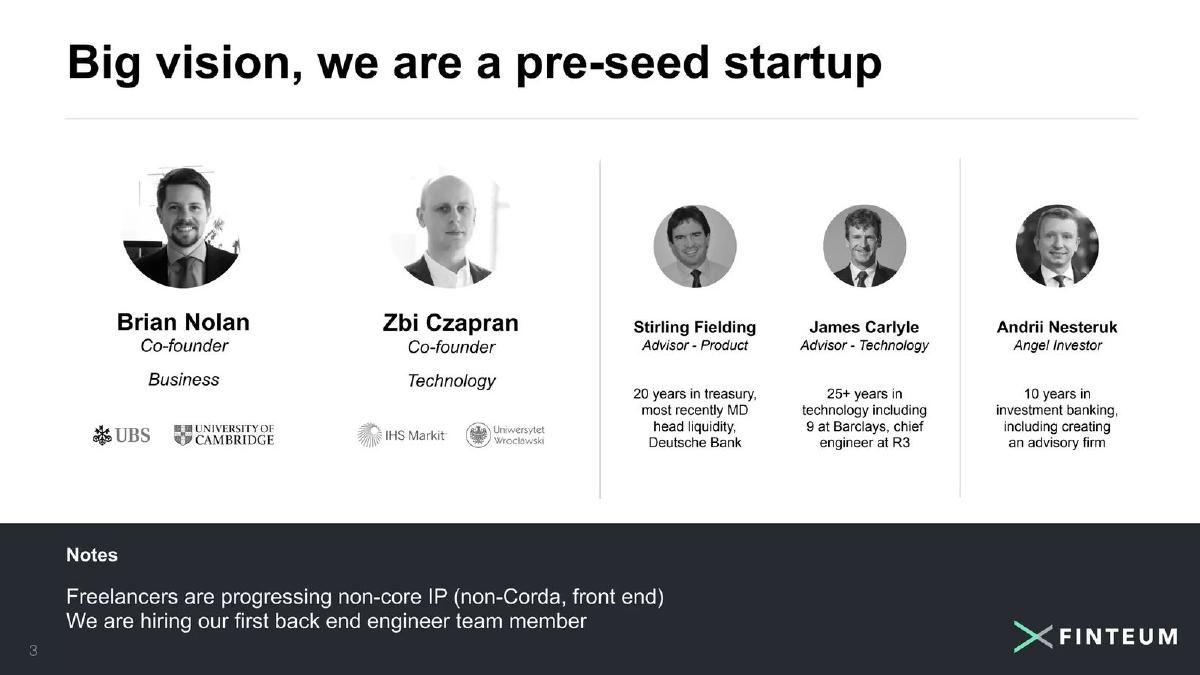
Slide 3 is titled 'Big vision, we are a pre-seed startup.' This is a rare moment of extreme transparency regarding company stage. The slide is split between the core team and advisors. Brian Nolan (Co-founder, Business) is linked to UBS and the University of Cambridge. Zbi Czapran (Co-founder, Technology) is linked to IHS Markit. The advisors are heavy hitters: Stirling Fielding (ex-MD Head of Liquidity at Deutsche Bank) and James Carlyle (ex-Chief Engineer at R3 and Barclays). The notes at the bottom mention they are hiring their first back-end engineer, confirming the early-stage nature of the venture. This slide is designed to prove that while the company is small, the people involved understand the plumbing of global finance.
Slide 5: Recent Attention and Validation
This slide serves as the 'Traction' section, though for a pre-seed institutional startup, traction is measured in industry recognition rather than revenue. It lists three key milestones from late 2019: 1) Interoperability work between Corda and Ethereum (USC) at Sibos, 2) 2nd place in the UBS Future of Finance Pitch, and 3) winning the 'ISDA / ICMA / DTCC / Barclays Derivhack for our DvP.' The inclusion of the Fortune and UBS logos provides social proof. The founders add a humble note: '(but we don’t want to be overhyped),' which aligns with the conservative culture of institutional banking.
Slide 7: The Problem and Solution (Platform and Technology)
Slide 7 is the most critical slide for understanding the business case. It uses two charts to compare 'Before Intraday Borrowing' and 'After Intraday Borrowing.' In the 'Before' scenario, Bank A has a volatile cash balance and must maintain a large, 'expensive' liquidity buffer to ensure they don't go below zero. In the 'After' scenario, the bank borrows cash during a dip and repays it once their balance recovers. This results in a 'Lower required buffer.' The slide also shows a screenshot of the 'Finteum Platform ('Alpha' version built),' proving that the product exists beyond just a whitepaper. The value proposition is clear: capital efficiency for large financial institutions.
Slide 9: Business Model and Rationale
Finteum takes a firm stance on its market position: 'We want to have banks as our customers (only banks).' This is a strategic choice to avoid the 'all-to-all' platform trap where a lack of liquidity kills the marketplace. By focusing on banks, they ensure that the participants have the necessary settlement infrastructure. The slide describes their role as an 'MTF, or MTF Partner' (Multilateral Trading Facility). It also lists 'Client Success Examples,' such as a pension fund earning 10bps on uninvested cash or a prime brokerage client earning 50bps during year-end market dislocations. This slide explains the 'who' and the 'why,' but notably lacks the 'how much' regarding Finteum's own revenue.
Slide 11: Product Demo
Slide 11 is a simple placeholder for a demo, showing two overlapping screenshots of the trading interface. The UI appears professional, following the 'dark mode' aesthetic common in modern trading terminals (like Bloomberg or Reuters). It shows currency pairs (GBP/USD, EUR/USD, USD/JPY) and order books, reinforcing that this is a functional trading tool, not just a conceptual DLT project.
Slide 13: Conclusion
The deck ends as it began, with a 'Thank you to R3!' and the CordaCon branding. It repeats the platform screenshots, leaving the audience with the image of a finished, professional product. There is no 'Ask' slide in this version of the deck, which suggests this specific iteration was intended for a public conference presentation rather than a private investor meeting.
What Finteum Does Well
Finteum excels at problem definition . In the world of DLT, many startups struggle to find a 'killer app' that actually requires a ledger. Finteum identifies a specific, high-cost problem (liquidity buffers) that is perfectly suited for the instant settlement capabilities of a distributed ledger. By focusing on the 'intraday' aspect, they are creating a market that largely didn't exist in a digitized, liquid form before.
The team composition is another strength. For a pre-seed company, having advisors who were Managing Directors at Deutsche Bank or Chief Engineers at Barclays is a major signal to both investors and potential bank customers. It suggests the company won't be tripped up by the complex regulatory and technical requirements of the banking industry.
What is Missing from the Deck
Because this was a conference presentation, it omits several standard fundraising elements:
The Ask: There is no mention of how much capital the company is seeking or what the milestones for the next round will be. · Financial Projections: There are no slides detailing the expected volume of trades or the projected revenue for Finteum over the next 3-5 years. · Competitor Analysis: The deck mentions that 'all-to-all' platforms struggle, but it doesn't name specific competitors or explain how Finteum will defend its moat against established players like ICAP or newer fintechs. · Regulatory Roadmap: Operating as an MTF requires significant regulatory licensing (like FCA in the UK). The deck doesn't outline where they are in the application process.
Founder's Guide: What to Copy
Use the 'Before vs. After' Visual: Slide 7 is a masterclass in explaining a complex financial concept. Instead of using text to explain liquidity buffers, the founders used a simple line graph to show the 'dip' and how their product fills it. Any founder solving a technical efficiency problem should use this format.
Be Explicit About Your Customer: Finteum’s 'only banks' rule is a strong strategic signal. It shows they have done the market research and understand that trying to be everything to everyone (all-to-all) is a recipe for failure in the interbank space. Founders should not be afraid to 'narrow the funnel' if it increases the likelihood of success within a specific niche.
Leverage Ecosystem Branding: If you are building on a specific platform (like Corda, AWS, or Salesforce), lean into it. Finteum used the CordaCon stage to align their brand with a much larger, established entity (R3), which provides immediate technical credibility to a pre-seed team.
Frequently asked questions
- What specific problem does Finteum solve for banks?
- Finteum addresses the high cost of liquidity buffers. Banks currently maintain large amounts of idle cash to cover intraday payment volatility. By creating a market for intraday borrowing, Finteum allows banks to borrow cash for just a few hours to cover peaks and repay it the same day, thereby lowering the total capital they must hold in reserve.
- Why does Finteum use distributed ledger technology (DLT)?
- The deck cites 'Distributed Ledger Benefits' on Slide 7 as the mechanism for delivering value. In the context of interbank markets, DLT enables near-instant settlement and a shared 'source of truth' for transactions, which is critical for borrowing and repaying funds within the same business day.
- Who is the target customer for this platform?
- Finteum is exclusive in its targeting. Slide 9 explicitly states, 'We want to have banks as our customers (only banks).' The rationale is that 'all-to-all' platforms struggle in this niche, and they need banks to provide the necessary settlement infrastructure and market liquidity.
- What is the background of the founding team?
- The team has significant institutional pedigree. Co-founder Brian Nolan comes from UBS, and the advisory board includes Stirling Fielding (20 years in treasury, ex-Deutsche Bank) and James Carlyle (25+ years in tech, ex-Barclays and R3). This suggests a team built for regulatory and institutional navigation.
- Is there a clear revenue model in the deck?
- No, the deck does not explicitly state its fee structure or commission rates. It mentions acting as an MTF (Multilateral Trading Facility) and provides examples of how bank clients (like pension funds) might earn 10-50bps, but it does not detail Finteum's specific take-rate or subscription fees.