BlazeFund presents a platform aimed at the then-emerging equity crowdfunding market, specifically targeting the gap between friends-and-family rounds and institutional venture capital. The deck emphasizes a 'two-step patent-pending process' designed to reduce investor risk by splitting commitments into two halves, with the second half triggered only upon milestone achievement. While the deck provides a highly detailed technical workflow of the investment lifecycle—including secondary market resale logic—it suffers from significant omissions common in early-concept decks. There is no mention o…
Key takeaways
- The company identifies a market gap where only 1,000 deals are funded by VCs out of 1 million annual US business formations (Slide 3).
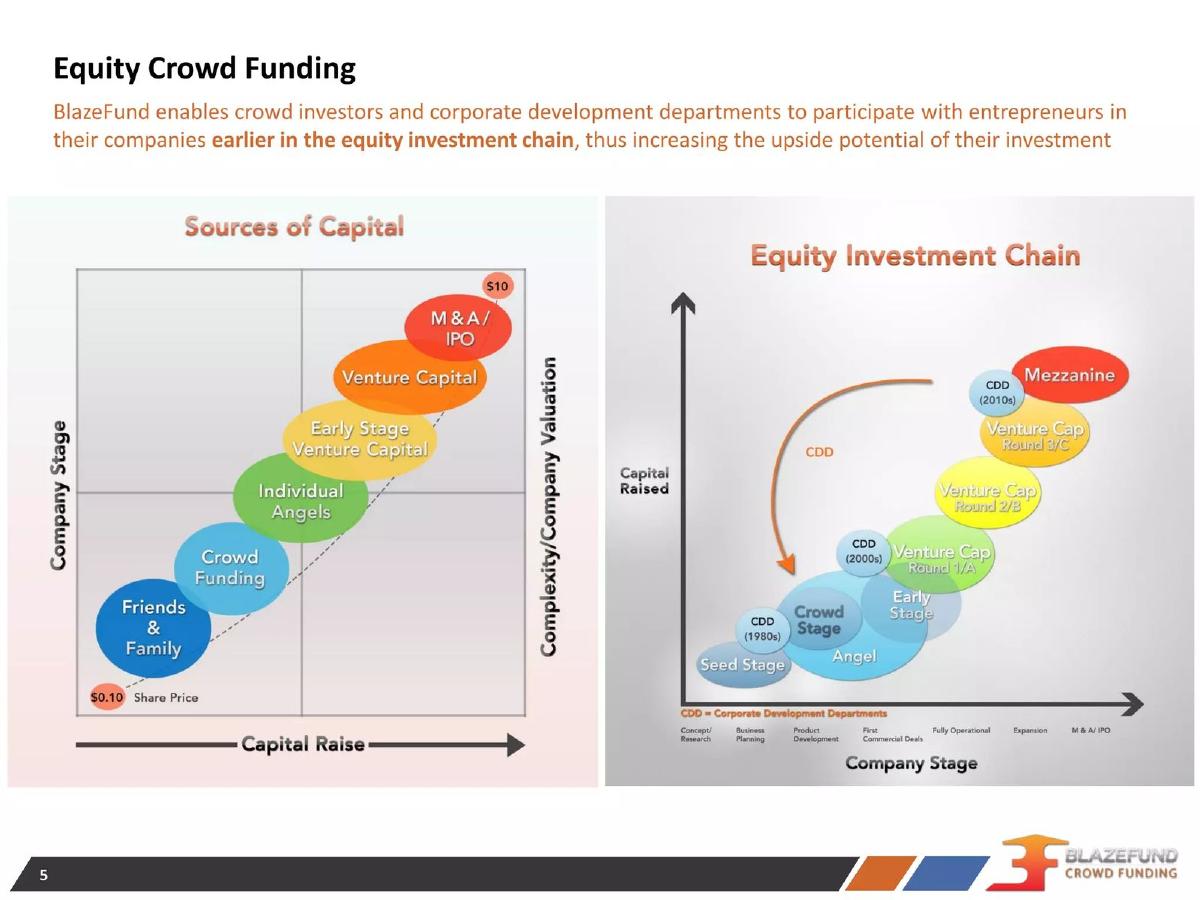
- BlazeFund positions crowdfunding as a bridge between Friends & Family and Individual Angels, starting at a $0.10 share price (Slide 5).
- The core value proposition is a two-step investment mechanism that splits crowd exposure into two halves, dependent on milestone accomplishment (Slide 15).
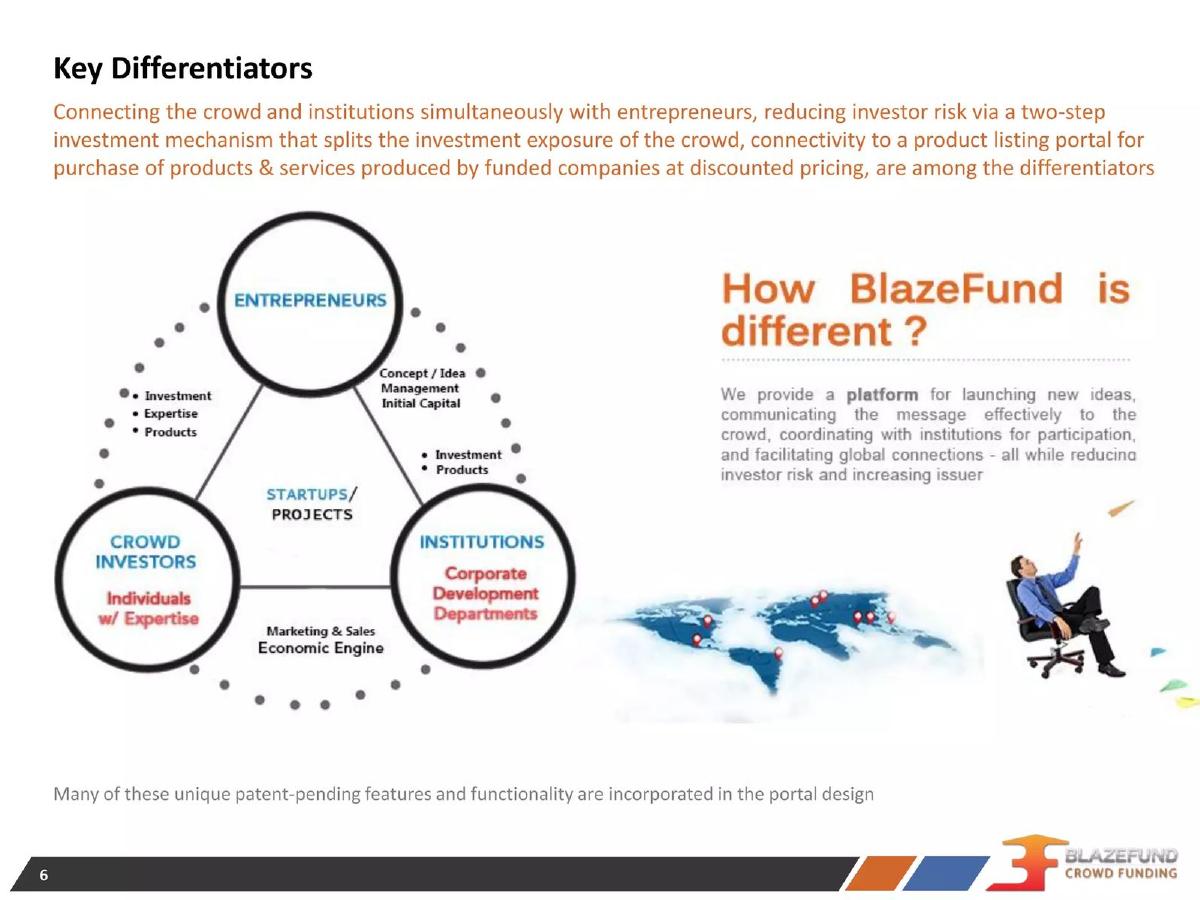
- The platform intends to integrate Corporate Development Departments (CDD) to validate technology while the crowd gauges market acceptance (Slide 7).
- A complex 26-step process flow diagram details the entire lifecycle from registration to shareholder divestment (Slide 13).
- The deck mentions a 'Product Listing Portal' where investors can purchase products from funded companies at discounted prices (Slide 15).
- The marketing strategy relies on partnerships with seed firms and economic development agencies rather than direct-to-consumer acquisition (Slide 9).
- The deck lacks a team slide, financial projections, and a specific funding 'ask' in the provided sequence.
Slide-by-Slide Analysis
Slide 1: Title and Contact
The cover slide introduces BlazeFund as an 'Equity Crowd Funding Portal.' The subtitle highlights a 'two-step patent-pending process' aimed at reducing investor risk. Contact information for Aaron Sanders in Boston, MA is provided. The imagery uses standard corporate stock photos (whiteboards, charts, handshakes), which establishes a professional but generic tone. The inclusion of 'Confidential' suggests this was intended for private viewing by potential partners or investors.
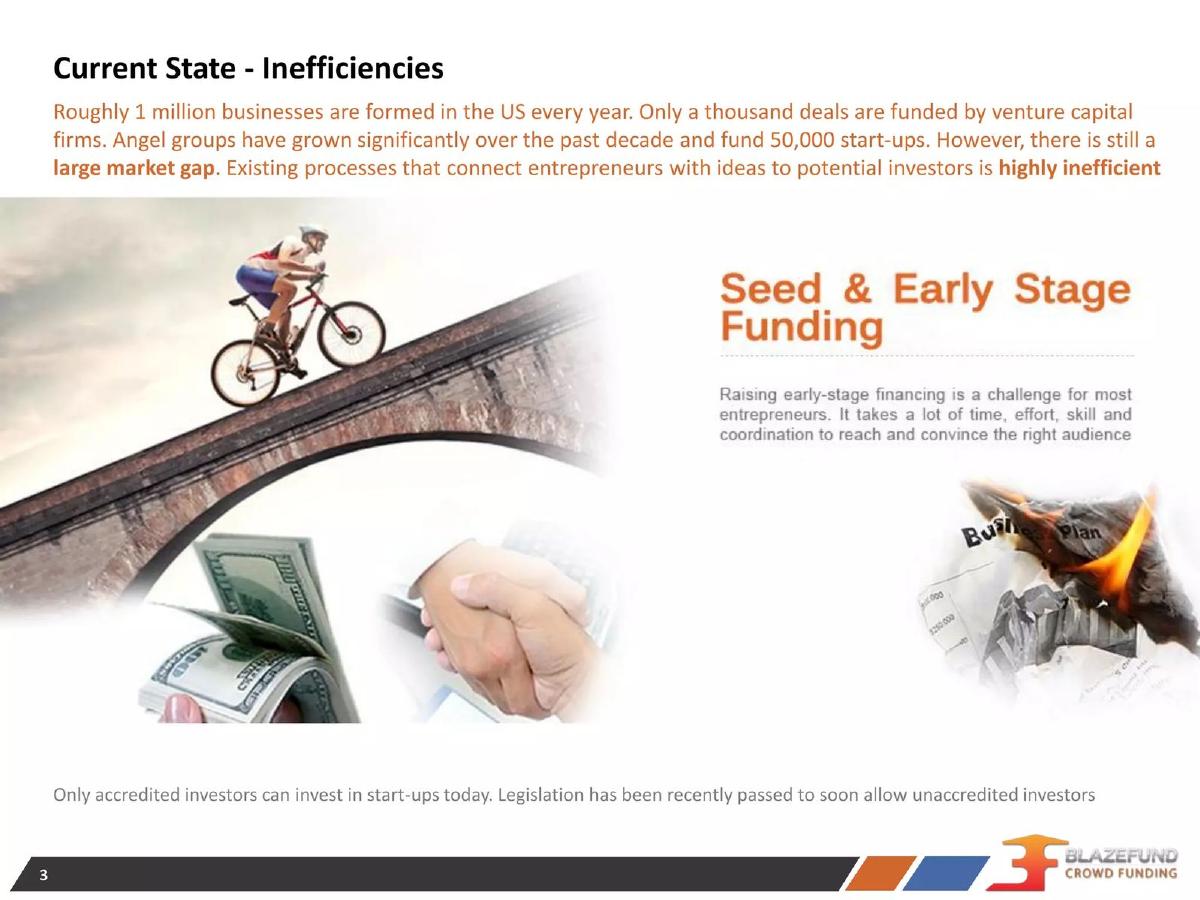
Slide 3: Current State - Inefficiencies
This slide sets the stage by citing a massive disparity in funding: 1 million businesses formed annually versus only 1,000 VC deals and 50,000 angel deals. The text explicitly identifies a 'large market gap' and labels existing processes as 'highly inefficient.' A note at the bottom references pending legislation to allow unaccredited investors, dating this deck to the period around the 2012 JOBS Act. The visuals—a cyclist on a steep bridge and a burning business plan—are somewhat melodramatic but clearly communicate the 'struggle' of early-stage fundraising.
Slide 5: Equity Crowd Funding Positioning
BlazeFund uses two charts to position itself in the capital stack. The left chart places 'Crowd Funding' between 'Friends & Family' and 'Individual Angels,' suggesting a share price entry point of $0.10. The right chart, titled 'Equity Investment Chain,' shows how BlazeFund intends to involve Corporate Development Departments (CDD) much earlier in the company lifecycle than traditional models. This slide is critical because it defines the company’s target niche: the gap where companies are too big for friends but too small for established angel groups.
Slide 7: Market & Customers
The slide identifies three target segments: entrepreneurs, crowd investors, and institutions. It introduces a unique 'validation' theory: the crowd acts as a gauge for market acceptance, while institutional investors validate the technology and feasibility. This dual-validation model is presented as a way to produce 'greater good' by creating a sustainable economic engine. The slide is heavy on aspirational language but light on the specific incentives that would drive institutions to participate in such a low-level portal.
Slide 9: Marketing & Sales
Rather than a traditional marketing funnel, BlazeFund focuses on B2B partnerships. They list angel groups, venture firms, and economic development agencies as their primary sources for deal flow. The slide also mentions 'partnerships in developing economies' to launch local versions of the portal. The imagery of a crowded presentation hall suggests a reliance on event-based marketing and physical presence, which may be at odds with the scalable nature of a digital portal.
Slide 11: How It Works
This slide provides a high-level six-step workflow for investors: Register, Select Company, Confirm Investment, Communicate with Company, Purchase Products, and Transact Investment. Step 5 ('Purchase Products') is a notable differentiator, suggesting the platform is not just for equity but also for consumer engagement. The footer reiterates the strategy of partnering with seed firms to maintain deal flow, suggesting BlazeFund sees itself as a secondary layer for existing investment networks.
Slide 13: Process Flow (The 'Patent-Pending' Logic)
This is the most technical slide in the deck, featuring a complex flow chart labeled 'FIG. 2A,' likely taken directly from a patent application. It details the logic of milestone-based funding, including 'Round 1' and 'Round 2' triggers, escrow payments, and shareholder resale logic. It covers the 'After Lock-in Period' divestment process. While impressive in its thoroughness, the complexity of this chart might be overwhelming for a standard pitch, though it serves to prove that the founders have deeply considered the legal and operational mechanics of the platform.
Slide 15: BlazeFund Portal Design
The final slide summarizes eight key features of the portal. Highlights include the 'two-step investment mechanism' (splitting exposure 50/50), 'due diligence by the crowd/analysts,' and a 'built-in dividend policy' redeemable for products. Several items are marked with an asterisk denoting 'patent-pending feature/functionality.' This slide serves as a summary of the product's unique selling points, emphasizing risk reduction and issuer accountability.
What BlazeFund Does Well
Specific Problem Identification: The deck does an excellent job of quantifying the 'funding gap' on Slide 3. By using the 1,000-to-1-million ratio, they create a compelling narrative of a massive, underserved market. This is a classic 'size of the prize' argument that resonates with investors.
Structural Innovation: The 'two-step' investment process (Slide 15) is a genuine attempt to solve the primary criticism of equity crowdfunding: the high risk of fraud or mismanagement in early-stage companies. By withholding half the capital until milestones are met, BlazeFund offers a governance model that mimics sophisticated VC terms for the retail investor.
Ecosystem Thinking: The inclusion of a 'Product Listing Portal' (Slide 11 and 15) shows a sophisticated understanding of the 'crowd' part of crowdfunding. They aren't just looking for capital; they are looking to turn investors into early adopters and customers, which adds value to the entrepreneurs beyond just the cash.
What is Missing from the Deck
The Team: In the provided 8 slides, there is no mention of the founders' backgrounds, their experience in fintech, or their regulatory expertise. In a space as heavily regulated as equity crowdfunding, the 'who' is often more important than the 'what.'
Business Model: The deck never explains how BlazeFund makes money. Do they take a percentage of the funds raised? A listing fee? A carry on the investments? A subscription fee from the institutions? Without a revenue model, this is a product concept, not a business plan.
Traction and Roadmap: There is no mention of the current state of the software. Is there a beta? Are there any signed LOIs from the 'economic development agencies' mentioned on Slide 9? The deck lacks a timeline for launch or specific milestones for the company itself.
The Ask: The deck does not state how much money the company is looking to raise, what the valuation is, or how the funds will be used. This makes it feel more like a general 'presentation' (as titled) than a fundraising pitch deck.
Founder's Guide: What to Copy and What to Avoid
Copy the 'Market Gap' Visualization: Slide 5 is a masterclass in positioning. If you are launching a new financial product, clearly showing where you sit in the 'complexity vs. capital' matrix helps investors immediately categorize your business. It removes ambiguity about who your competitors are.
Avoid the 'Wall of Text' Flowcharts: While Slide 13 is great for a technical appendix or a due diligence room, it is too dense for a live pitch. A founder should simplify this into a 3-step graphic for the main deck and keep the 'FIG 2A' version for when an investor asks, 'But how does the escrow actually trigger?'
Copy the 'Dual Validation' Concept: The idea on Slide 7 that different types of investors provide different types of value (market vs. technical validation) is a very strong selling point for entrepreneurs. Highlighting how your platform attracts diverse expertise is a great way to build a 'moat' around your marketplace.
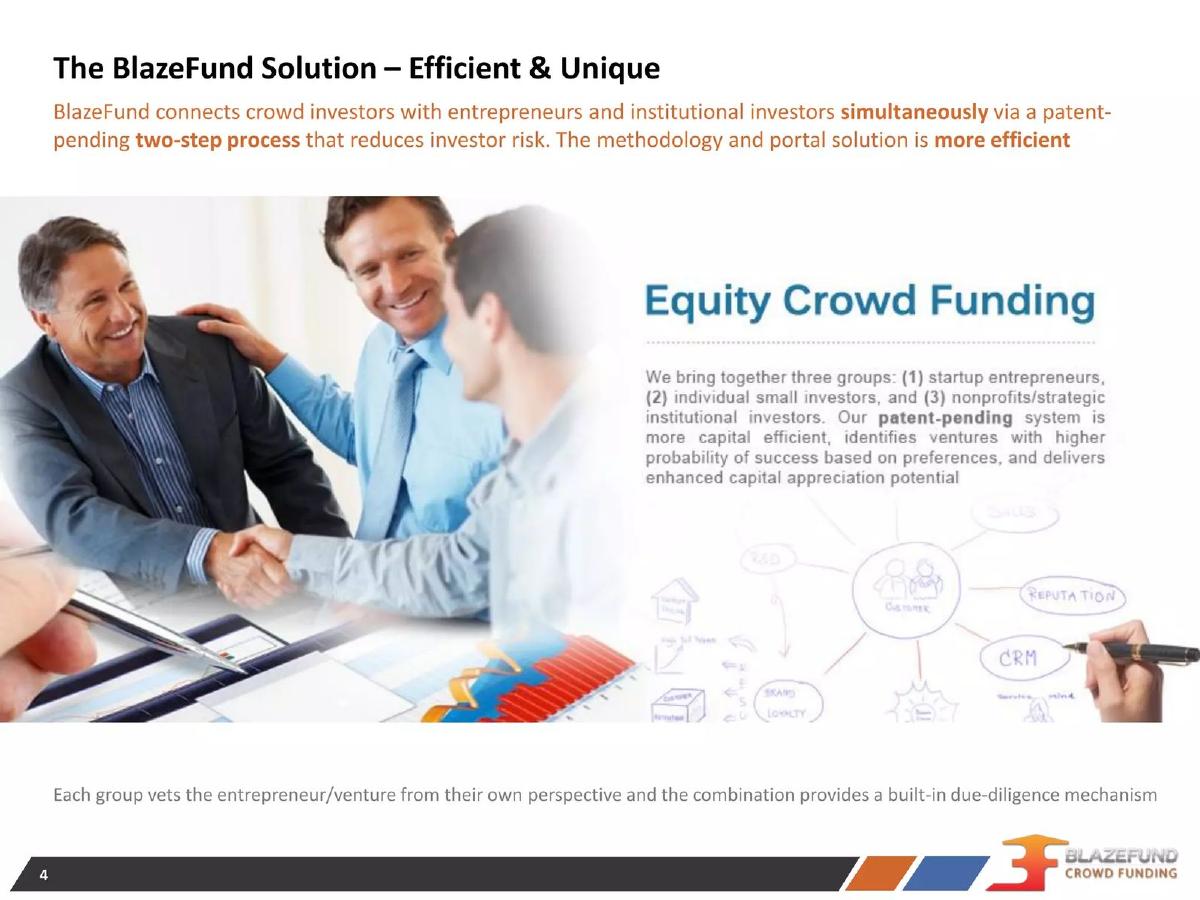
Avoid Generic Imagery: The stock photos of people shaking hands and looking at charts (Slides 1, 7, and 9) add no value. In a modern deck, these should be replaced with actual screenshots of the portal or photos of the actual team and their partner offices. Generic visuals make a startup look like a 'paper company' rather than a real business.
Frequently asked questions
- What is BlazeFund's 'two-step' investment process?
- As detailed on Slide 15, the process splits a crowd investor's exposure into two halves. The first half is committed upfront, while the second half is triggered automatically only after the company reaches specific milestones and receives a favorable vote from Round 1 investors. This is presented as a patent-pending feature intended to increase issuer accountability and reduce risk for the individual investor.
- Who are the target customers for this platform?
- BlazeFund identifies three primary groups on Slide 7: entrepreneurs seeking capital, crowd investors (including unaccredited individuals once legislation allows), and institutional investors or corporate development departments. The strategy is to have the crowd provide market validation while institutions provide technical validation of the startups listed on the portal.
- How does BlazeFund plan to acquire deal flow?
- According to Slide 9 and Slide 11, the company does not plan to source all deals independently. Instead, they aim to partner with angel groups, early-stage venture firms, and economic development agencies. They also mention forming partnerships in developing economies to establish a physical presence for local versions of the portal.
- What is the 'Product Listing Portal' mentioned in the deck?
- Slide 15 describes a planned feature where companies funded through BlazeFund can list their products and services for sale. Crowd investors would receive preferential discounted pricing and could potentially redeem 'dividends' or 'credits' against these purchases, creating a closed-loop ecosystem between the investors and the startups.
- Does the deck provide evidence of existing traction?
- No. The provided slides focus entirely on the theoretical 'Current State' of the market and the 'How It Works' mechanics of the platform. There are no slides showing current user numbers, signed partnerships, or successful pilot funding rounds. It appears to be a conceptual or pre-launch deck.