BizMallUG presents a compelling 'Business-in-a-Box' model designed to empower Ugandan entrepreneurs by providing them with the tools, training, and proprietary formulations needed to start micro-manufacturing businesses. The deck highlights a unique 'Formulation Advantage,' where a single expert-developed product concept can be sold to over 200 independent buyers, ensuring near-zero marginal costs and no inventory depletion. With a Total Addressable Market estimated at UGX 90 Billion, the company targets a Serviceable Obtainable Market of 180-900 entrepreneurs annually in the near term. The d…
Key takeaways
- The business model relies on selling proprietary formulations to 200+ buyers each to achieve scale without inventory depletion (Slide 3).
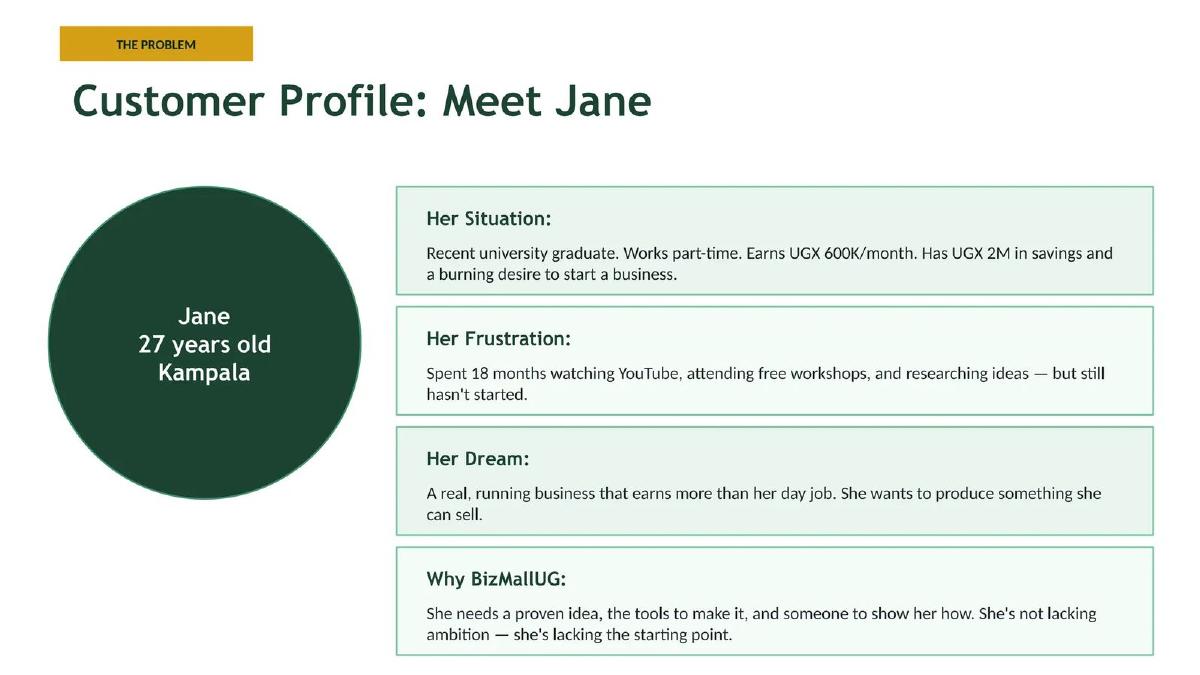
- The target customer is exemplified by 'Jane,' a 27-year-old in Kampala with UGX 2M in savings but lacking a starting point (Slide 2).
- Total Addressable Market is valued at UGX 90 Billion, representing ~60,000 new entrepreneurs per year in Uganda (Slide 4).
- Competitive moats include IP-protected recipes, a physical training facility in Kampala, and a growing alumni network (Slide 5).
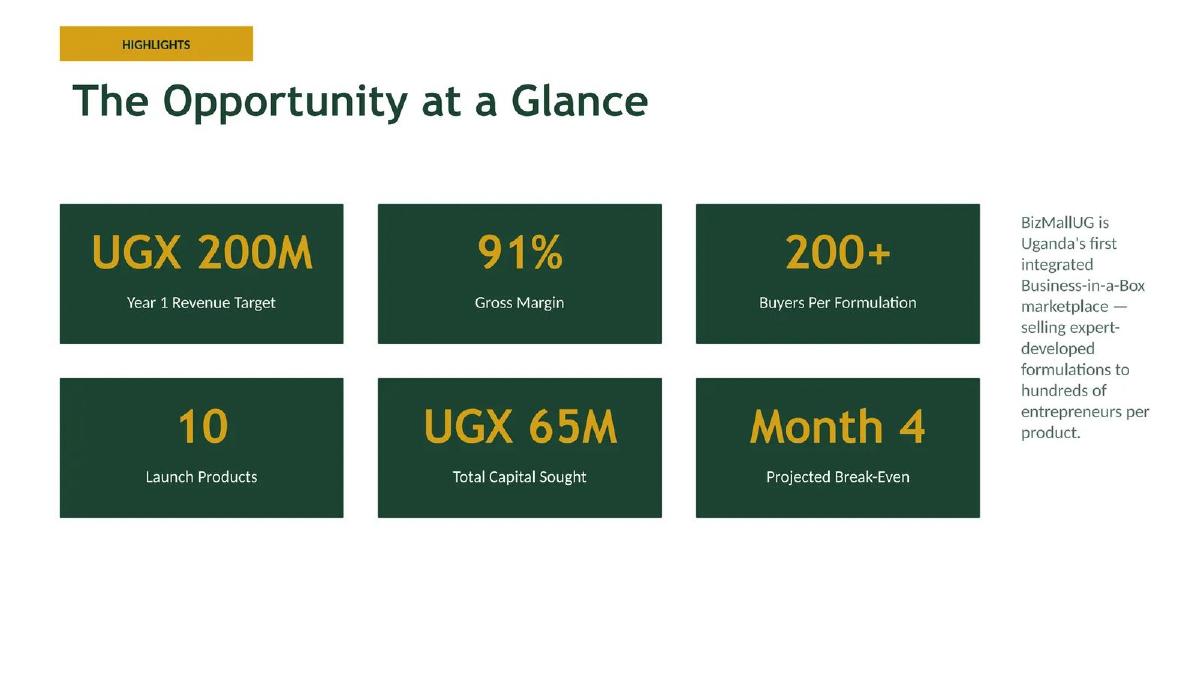
- Revenue is projected to reach UGX 25.5M by December 2027, with a break-even point anticipated in Month 4 (Slide 9).
- The operational setup includes specialized rooms for food processing and chemical manufacturing training (Slide 7).
- Expansion plans target Kenya, Tanzania, and Rwanda by Year 4, aiming for a Series A round (Slide 10).
- The deck lists Hon. Katabaazi Francis as a Strategic Advisor but omits detailed bios for the executive leadership team (Slide 8).
BizMallUG: A Deep Dive into Micro-Manufacturing Enablement
BizMallUG presents a specialized business model tailored for the Ugandan economic landscape. The deck, dated 2026, focuses on the concept of 'Business-in-a-Box' solutions. Unlike traditional franchises that require high capital and ongoing royalties, BizMallUG sells the 'ingredients' of a business—formulations, training, and tools—to aspiring entrepreneurs. The core value proposition is the democratization of manufacturing, allowing individuals with limited capital to produce consumer goods locally.
Slide 1: Title and Vision
The cover slide introduces BizMallUG with the tagline 'Democratizing Entrepreneurship in Uganda.' It identifies Kalema Andrew Victor as the Founder & General Manager. The date 2026 suggests this is a forward-looking pitch, likely prepared for a pre-launch or early-expansion funding round. The visual theme uses dark green and gold, establishing a professional, grounded tone. The 'Business in a Box' icon reinforces the central product offering.
Slide 2: The Problem - Customer Profile: Meet Jane
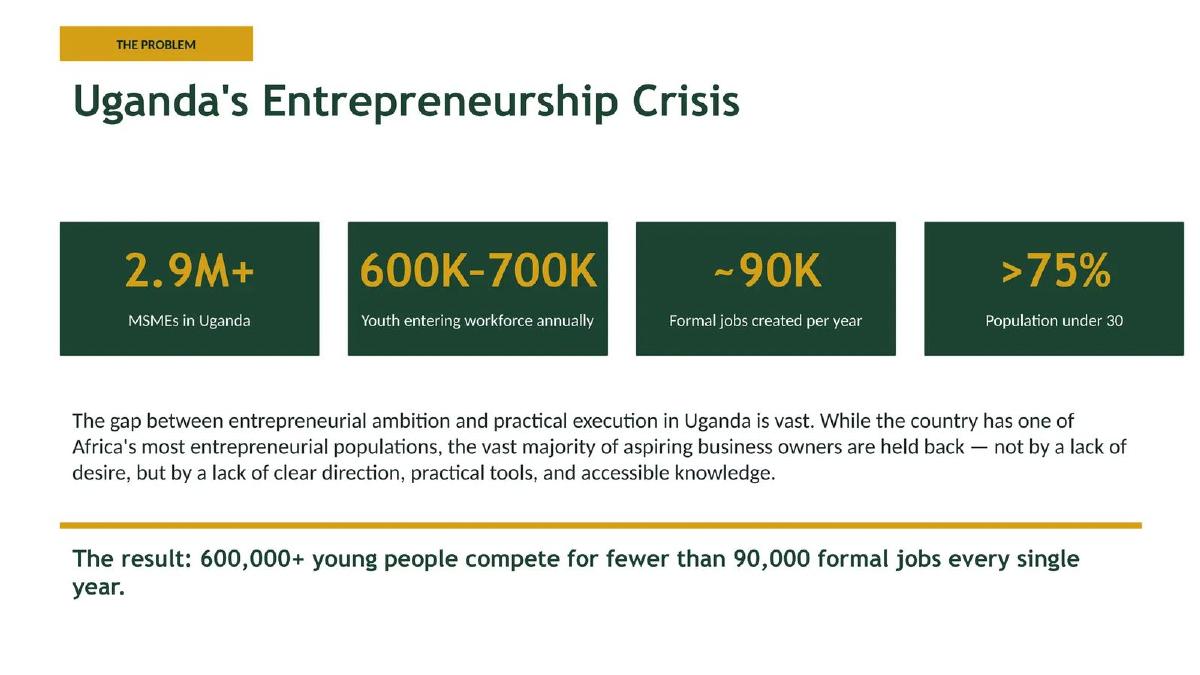
Slide 2 uses a persona, 'Jane,' to illustrate the target market. Jane is a 27-year-old university graduate in Kampala earning UGX 600K/month with UGX 2M in savings. Her frustration is common: she has spent 18 months researching but hasn't started. The slide identifies the gap not as a lack of ambition, but a lack of a 'starting point.' This slide effectively humanizes the market data by showing exactly who the buyer is and what their financial constraints are.
Slide 3: The Formulation Advantage
This slide introduces the 'Key Insight' of the business. BizMallUG develops one expert formulation and sells it to 200+ independent entrepreneurs. The slide claims three primary benefits: No inventory depletion (the IP is sold repeatedly), No exclusivity conflicts (buyers operate in different local markets), and Marginal cost near zero . This is the most important slide for an investor, as it explains how the company achieves software-like margins in a physical goods sector.
Slide 4: Total Addressable Market (TAM)
The market sizing slide breaks down the opportunity in Uganda. The TAM is cited as ~60,000 new entrepreneurs per year, valued at UGX 90 Billion . The SAM (Serviceable Addressable Market) narrows this to 18,000 product-based entrepreneurs seeking structured solutions, valued at UGX 27 Billion. The SOM (Serviceable Obtainable Market) is a conservative 180-900 entrepreneurs per year, representing UGX 0.27B to 1.35B in near-term revenue. A footer note mentions that East Africa expansion (Kenya, Tanzania, Rwanda) opens a 'multi-billion UGX opportunity' by Year 4.
Slide 5: Our Competitive Moat
Slide 5 outlines four pillars of defense: Proprietary Formulations (IP-protected recipes), First-Mover Advantage (no current integrated competitors), Training Infrastructure (a physical facility in Kampala), and Customer Community (an alumni network for referrals). The mention of 'years to develop and validate' the recipes suggests a significant barrier to entry for copycats.
Slide 6: Formulation-Based Sales Multiplication
This slide reiterates the sales model with more granular numbers. It posits that 10 products sold to 200+ buyers each results in 2,000+ customer interactions . It further suggests that with 5+ iterations per product, the library grows to 50+ formulations. The emphasis remains on the 'Near-Zero Marginal Cost,' highlighting that once a formulation is developed, selling it to the 200th buyer costs nothing additional.
Slide 7: Kampala Training HQ
The operations slide details the physical assets. The HQ includes an Administrative Office, a Food Processing Training Room (for peanut butter, wines, juices), a Chemical Manufacturing Room (for soap and detergent), a Conference Room seating 30, and a Store/Display Room. A note at the bottom indicates plans for satellite centers in Gulu, Mbarara, and Jinja by Year 3 to extend reach without full facility replication.
Slide 8: Advisors & Support Network
This slide lists the external support system. It features Hon. Katabaazi Francis as a Strategic Advisor (MBA, MSc Marketing & Logistics). It also mentions 'Industry Experts' for product validation, 'Digital Marketing Advisors' for TikTok and Facebook growth, and 'Business Development Counsellors' for financial management. While these categories are well-defined, the slide lacks the names and specific track records of the people in the latter three categories.
Slide 9: Year 1 Monthly Revenue Ramp (2027)
The financial slide shows a growth curve for 2027. Revenue starts at roughly UGX 7.5M in January and climbs to UGX 25.5M by December. The slide explicitly marks Month 4 as the break-even point. The text attributes this ramp to the release of product variants and the activation of institutional partnerships.
Slide 10: Growth & Exit Strategy
The final slide provides a timeline from 2026 to 2029+. 2026 is the launch of 10 products; 2027 targets 25+ formulations and UGX 200M revenue ; 2028 targets the first satellite center and UGX 300M revenue ; 2029+ focuses on East Africa expansion and a Series A round. The 'Potential Exit Pathways' include Strategic Acquisition, Private Equity, or a Management Buyout.
What Works in the BizMallUG Deck
The deck excels at explaining a non-traditional business model in simple terms. By comparing their IP (formulations) to a product that can be sold indefinitely with 'near-zero marginal cost,' they successfully frame a manufacturing business as a scalable platform. The use of a specific customer persona (Jane) is a strong choice, as it immediately clarifies the price point and the level of sophistication required for the end-user. The operational slide (Slide 7) is also highly effective; it proves that this isn't just a theoretical idea but a business requiring specific, tangible infrastructure that the company has already planned or built.
What is Missing from the BizMallUG Deck
The most glaring omission is a comprehensive Team Slide . While the founder is mentioned on the cover and an advisor is listed on Slide 8, there is no information on the core team's experience in chemistry, manufacturing, or scaling a startup. For a business built on 'proprietary formulations,' the credentials of the chemist or product developer are critical. Additionally, the deck lacks Unit Economics for the 'Business-in-a-Box' itself. We know Jane has UGX 2M in savings, but we don't know exactly how much the kit costs, what the company's margin is on that kit, or what the ongoing revenue stream (if any) looks like after the initial sale. Finally, there is no Specific Ask . The deck mentions a Series A in 2029, but it does not state how much capital is being raised right now or how those funds will be allocated.
What You Should Copy for Your Own Pitch
Founders should emulate the 'Key Insight' structure found on Slide 3. Many startups struggle to explain why their model is scalable; BizMallUG does this perfectly by highlighting the 'Formulation Advantage.' They take a complex concept and boil it down to three checkmarks that an investor can easily digest. Another strong element is the Market Tiering on Slide 4. Instead of just giving one giant, unrealistic number, they break it down from TAM to a very realistic near-term SOM (180-900 entrepreneurs). This builds credibility by showing the founders have a grounded understanding of their immediate reach. Lastly, the Operational Infrastructure slide is a great way to show 'readiness to scale' by detailing the specific rooms and functions of their headquarters.
Frequently asked questions
- What exactly is a 'Business-in-a-Box' in this context?
- For BizMallUG, it refers to a complete package that includes a proprietary product formulation (like soap or peanut butter), the necessary tools to manufacture it, and the training required to run the business. According to Slide 2, it is designed for individuals who have ambition and some savings but lack a 'proven idea' or the technical know-how to begin production.
- How does the company avoid market saturation if they sell the same idea to 200 people?
- Slide 3 and Slide 6 address this through 'No Exclusivity Conflicts.' The company argues that because each buyer operates in their own specific neighborhood, city, or region, there is no direct market conflict. The scale of the micro-economy allows for hundreds of independent operators to function without depleting the opportunity for others.
- What are the primary product categories BizMallUG supports?
- Slide 7 details the physical infrastructure, which reveals the product focus. The facility includes a 'Food Processing Training Room' for items like peanut butter, wines, juices, and preserved goods, and a 'Chemical Manufacturing Room' equipped for soap, detergent, and household chemical training. These represent the '10 launch products' mentioned elsewhere in the deck.
- What is the financial outlook for the first year of operations?
- Slide 9 shows a 'Year 1 Monthly Revenue Ramp' for 2027. It projects starting the year at approximately UGX 7.5M in monthly revenue and growing steadily to UGX 25.5M by December. Crucially, the slide claims the business will reach its break-even point by the fourth month of operation.
- What is the long-term exit strategy for investors?
- Slide 10 outlines three potential pathways: a Strategic Acquisition by regional SME development platforms, Private Equity investment as the business reaches a UGX 500M+ revenue run rate, or a Founder-led Management Buyout. The timeline suggests these milestones are targeted for 2029 and beyond, following expansion into East Africa.