Datagen’s 2022 Series B deck is a masterclass in technical positioning within the computer vision (CV) sector. By identifying manual data collection and labeling as the primary bottleneck in AI development, the company presents its synthetic data platform not just as a tool, but as a structural necessity for the industry. The deck leans heavily on high-fidelity visual evidence and academic pedigree, featuring an advisory board of world-renowned professors. While the deck is light on traditional financial metrics or a specific 'ask' slide, it compensates with deep technical specifications of i…
Key takeaways
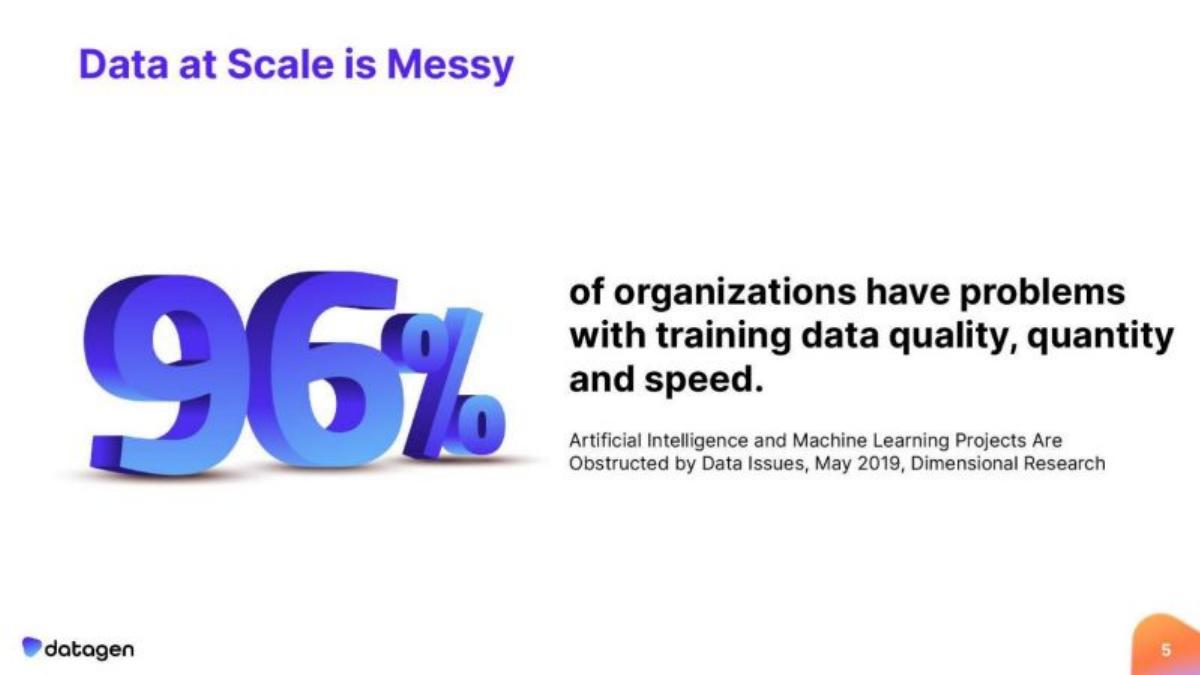
- The company identifies that 96% of organizations struggle with training data quality, quantity, and speed (Slide 5).
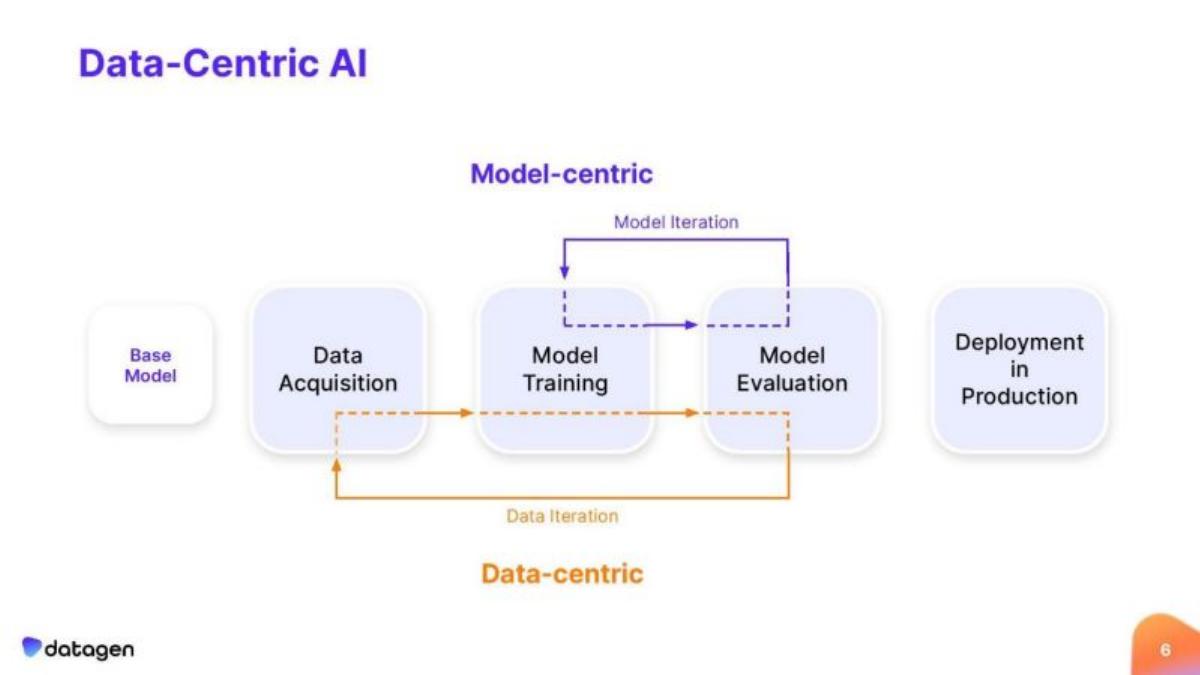
- Datagen positions itself as a 'Data-centric AI' solution, focusing on data iteration rather than just model iteration (Slide 6).
- The platform offers granular control over synthetic data, including identity, facial expressions, and lighting (Slide 11).
- The deck highlights a massive shift toward synthetic data, citing Gartner's prediction that it will overshadow real data by 2030 (Slide 7).
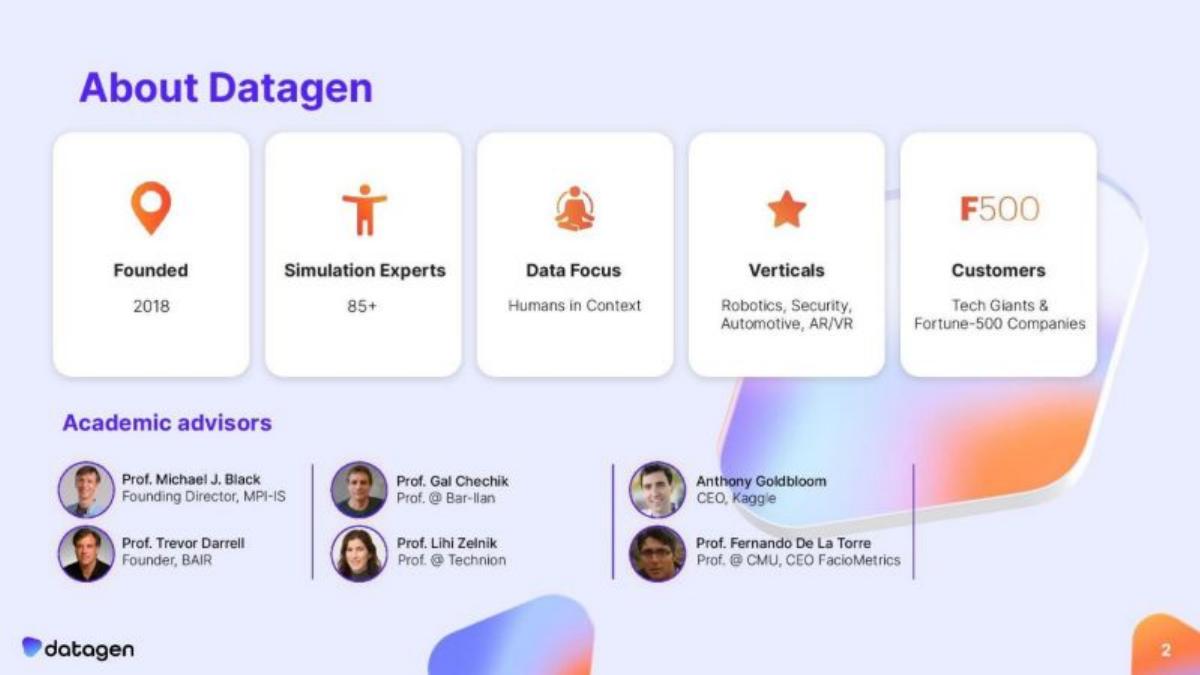
- Academic credibility is a core pillar, with six high-profile advisors from institutions like MPI-IS, BAIR, and CMU (Slide 2).
- The product is segmented into specific domains: Faces, Humans in Context, and a 'Coming Soon' Objects in Context category (Slide 10).
- The platform provides both visual modalities (RGB, Infrared, Depth) and textual modalities (3D/2D Keypoints in JSON) for CV tasks (Slide 12).
- Target verticals are clearly defined as Automotive, Robotics, Security, Retail, Industrial, and the Metaverse (Slide 3).
Executive Summary
Datagen’s Series B deck is a 19-slide presentation that focuses on the transition from real-world data to synthetic data in the Computer Vision (CV) space. Raised in 2022, the $50M round was led by NewView Capital with participation from existing investors. The deck is highly visual, using the product's own output—high-fidelity synthetic humans—to demonstrate value. It moves from a broad industry problem (the data bottleneck) to specific technical solutions (Faces and Humans in Context generators).
Slide 1: Title Slide
The opening slide introduces the brand and the mission statement: "Simulating the World for Production AI." The design is clean, utilizing 3D abstract shapes that mirror the company's focus on 3D simulation and computer graphics.
Slide 2: About Datagen
This slide establishes the company's scale and credibility. It notes that Datagen was founded in 2018 and employs 85+ simulation experts . The customer base is described as "Tech Giants & Fortune-500 Companies" across verticals like Robotics, Security, Automotive, and AR/VR. Crucially, it lists six academic advisors, including the CEO of Kaggle and professors from top-tier AI research institutions, which is a vital trust signal for a Series B deep-tech company.
Slide 3: Market Context
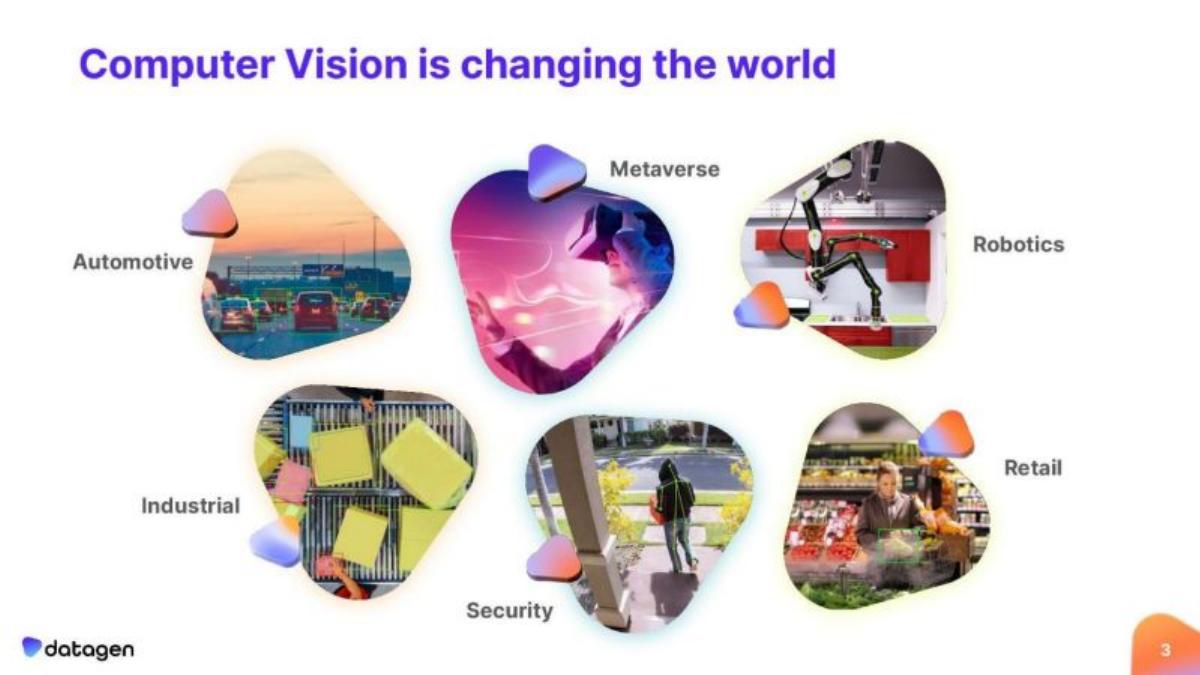
Titled "Computer Vision is changing the world," this slide uses a collage of images to show CV applications in Automotive, Metaverse, Robotics, Industrial, Security, and Retail. It sets the stage for the breadth of the market Datagen intends to serve.
Slide 4: The Problem - The Data Bottleneck
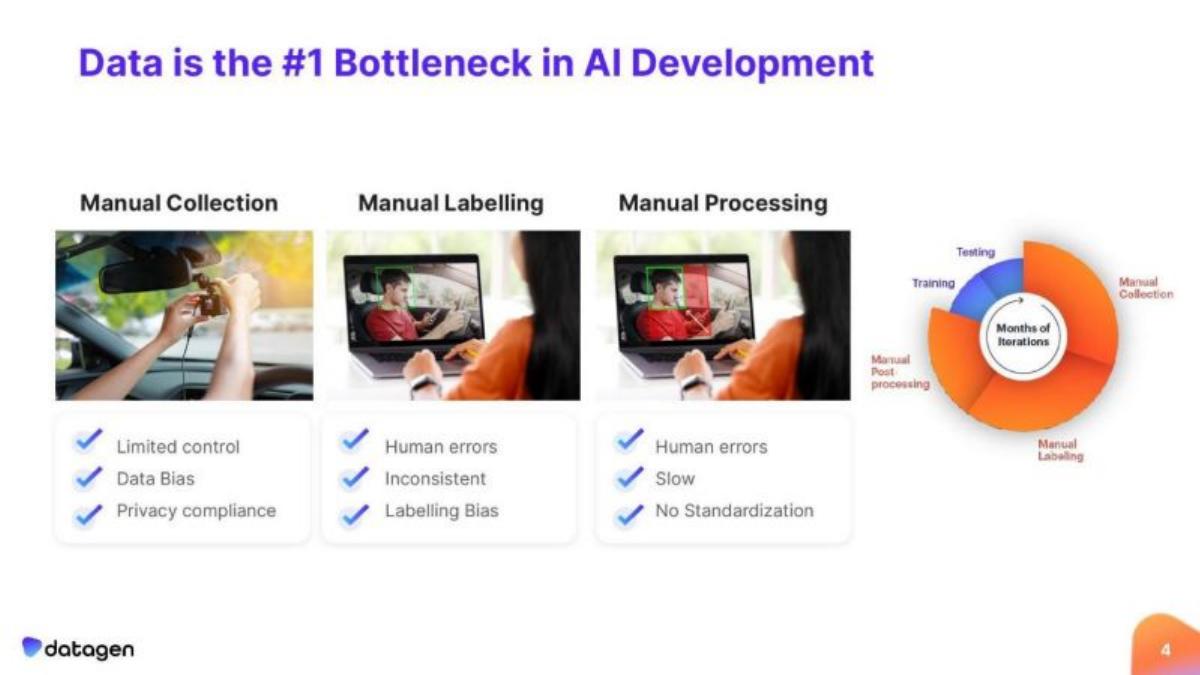
This is the core 'Why' slide. It identifies three stages of the current bottleneck: Manual Collection, Manual Labelling, and Manual Processing. It lists the downsides of these manual steps: limited control, data bias, privacy compliance issues, human errors, and lack of standardization. A circular graphic on the right illustrates that these "Months of Iterations" are a recurring drag on development.
Slide 5: Quantifying the Pain
Datagen uses a massive 96% figure to highlight that nearly all organizations have problems with training data quality, quantity, and speed. The data is attributed to a 2019 report by Dimensional Research, providing external validation for the problem identified on the previous slide.
Slide 6: The Paradigm Shift - Data-Centric AI
This slide illustrates the move from "Model-centric" (iterating on the code) to "Data-centric" (iterating on the data). It suggests that the most significant gains in AI performance now come from improving the data fed into the model, which is Datagen’s primary value proposition.
Slide 7: The Future is Synthetic
Citing Gartner, this slide features a graph showing synthetic data completely overshadowing real data by 2030. It lists five benefits of synthetic data: free of human error, 2D/3D ground truth, granular control, large scale, and free of privacy concerns. This slide justifies the long-term venture scale of the business.
Slide 8: The Data Generation Platform
This is the first look at the actual software. It shows a cloud-based, self-service interface. Key features highlighted are Self-service, Large scale data generation, Granular control, and Domain specific capabilities. The screenshots show a user adjusting parameters for a human face and a vehicle interior.
Slide 9: Platform Benefits
This slide reinforces the quality of the output. It claims "High visual domain realism" and "Pixel perfect & 3D ground truth." It uses a multi-layered image to show how the platform generates not just the image, but the underlying metadata (depth maps, segmentation) that humans usually have to label by hand.
Slide 10: Product Roadmap
Datagen categorizes its generators into three buckets: Faces, Humans in Context (HIC), and Objects in Context (marked as "Coming soon"). This shows the company's current strength in human simulation while signaling a path toward becoming a general-purpose synthetic data provider.
Slide 11 & 12: The Faces Generator
These slides dive deep into the technical capabilities of the face simulation. Slide 11 lists the parameters users can control: identity (age, gender, ethnicity), scene (lighting, background), eye gaze, facial expressions, and even accessories or facial hair. Slide 12 showcases the output modalities, including Textual Modalities (3D/2D Keypoints in JSON) and Visual Modalities (RGB, Infrared, Depth, Normal, and Semantic Segmentation) . This level of detail is aimed squarely at the CV Engineer persona.
Slide 13: Humans in Context (HIC)
This slide introduces the four primary domains for HIC: In-Cabin Automotive, Smart Office, Home Security, and XR/Metaverse. It uses high-quality renders to prove that the simulation can handle complex environments beyond just isolated faces.
Slide 14, 15, 16, 17: Domain Deep Dives
Each of these slides focuses on a specific vertical. Slide 14 covers Automotive, mentioning Driver Monitoring Systems (DMS) and Occupant Monitoring Systems (OMS). Slide 15 covers Home Security, focusing on entrance monitoring and package delivery. Slide 16 and 17 provide visual galleries for Smart Office and XR/Metaverse (specifically hand tracking). These slides serve as a portfolio, proving the platform's versatility.
Slide 18 & 19: Conclusion
The deck ends with a simple "Thank you" slide and a final slide promoting the source library. There is no explicit "Ask" slide or financial summary in this version of the presentation.
What Works Well
Visual Proof: The deck uses the product's own output as the primary visual element. For a company selling high-fidelity simulation, the quality of the slides themselves acts as a product demo. · Persona Alignment: The inclusion of specific data formats (JSON, .exr, .png) and technical tasks (Landmark detection, Head pose estimation) speaks directly to the technical buyers (CV Engineers) who will use the platform. · The 'Data-Centric' Narrative: By aligning with the industry-wide shift toward data-centric AI (popularized by figures like Andrew Ng), Datagen positions itself as a leader in a modern movement rather than just a niche tool provider. · Academic Moat: The advisory board is exceptionally strong for a startup, providing the necessary scientific 'weight' to back up claims of "pixel-perfect" accuracy.
What is Missing
Financial Metrics: There is no mention of Annual Recurring Revenue (ARR), growth rates, or contract sizes. While common in Series B decks for high-growth tech, its absence makes it hard to judge the business's commercial traction. · Competitive Landscape: The deck does not address other synthetic data players or internal 'build vs. buy' arguments that many large tech companies face. · The Ask: The deck lacks a slide detailing how much capital is being raised and how it will be deployed (e.g., R&D, sales expansion, new domain development). · Case Studies: While it lists "Tech Giants" as customers, it doesn't provide a specific case study showing how a customer improved their model's accuracy or reduced costs by using Datagen.
Founder's Lessons
Sell the Bottleneck: If your product solves a process problem, quantify that problem. Datagen's use of the "96%" statistic and the "Months of Iterations" graphic makes the pain point feel urgent and universal. · Segment Your Product: Instead of saying "we simulate everything," Datagen breaks its product into logical modules (Faces, HIC, Objects). This makes a complex technical platform easier for an investor to digest. · Leverage Authority: If you are in a deep-tech space, your advisors are as important as your team. Listing specific professors and their affiliations builds immediate trust in the underlying technology. · Show, Don't Just Tell: For any visual or generative AI product, the deck is the first test of quality. Datagen's high-resolution, sophisticated renders do more to sell the platform than any bullet point could.
Frequently asked questions
- What is the primary problem Datagen is solving?
- Datagen addresses the 'Data Bottleneck' in AI development. According to Slide 4, manual collection and labeling are slow, prone to human error, and suffer from data bias and privacy compliance issues. Slide 5 reinforces this by citing research that 96% of organizations face these specific hurdles when trying to scale AI projects.
- How does Datagen differentiate its technology from traditional data collection?
- The deck emphasizes 'Granular Control' and '2D/3D Ground Truth.' Unlike real-world photos which require manual, imperfect labeling, Datagen’s synthetic data is generated with 'pixel perfect' labels automatically. Slide 9 notes that their data is high-fidelity, scalable, consistent, and fully privacy-compliant because it does not use real human subjects.
- Who are the key people behind Datagen?
- While the founders aren't detailed on a specific slide, Slide 2 highlights a team of 85+ simulation experts and a heavy-hitting academic advisory board. This includes Prof. Michael J. Black (MPI-IS), Prof. Trevor Darrell (BAIR), and Anthony Goldbloom (CEO of Kaggle), signaling deep roots in the machine learning research community.
- What specific use cases does the deck highlight?
- The deck focuses on 'Humans in Context' (HIC). Slide 13 and 14 detail In-Cabin Automotive (Driver Monitoring Systems), Home Security (package delivery/suspicious activity), Smart Office environments, and XR/Metaverse applications. They also showcase a specialized 'Faces Generator' for tasks like landmark detection and head pose estimation.
- Is there any financial information or a funding ask in the deck?
- No. This specific version of the deck omits revenue figures, growth metrics, burn rate, and the specific terms of the Series B round. It functions primarily as a technical and vision-oriented deck to establish the platform's necessity in the AI stack rather than a financial performance report.