Datamolino’s 2014 deck is a study in visual simplicity, focusing on the core utility of 'processing invoices without retyping.' The presentation avoids dense text, opting instead for a high-level conceptual solution slide and detailed product screenshots that illustrate the platform's ability to extract data from physical documents into a digital dashboard. With a team boasting significant experience in legal advisory, IT solutions, and SME accounting, the deck establishes credibility through human capital rather than complex financial modeling. While the deck lacks explicit market size data…
Key takeaways
- The core value proposition is summarized in a single, four-word sentence on Slide 1: 'Process invoices without retyping.'
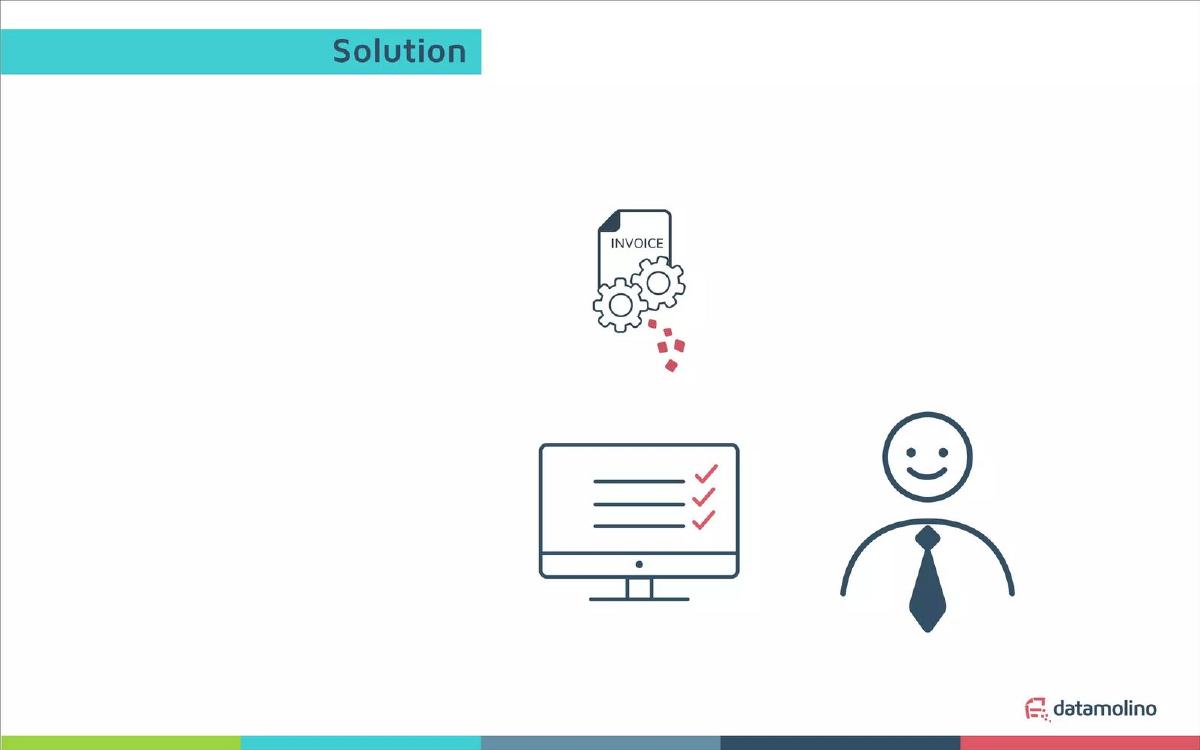
- Slide 2 uses basic iconography to explain the technical solution, moving from a physical invoice to automated processing and finally a human-verified output.
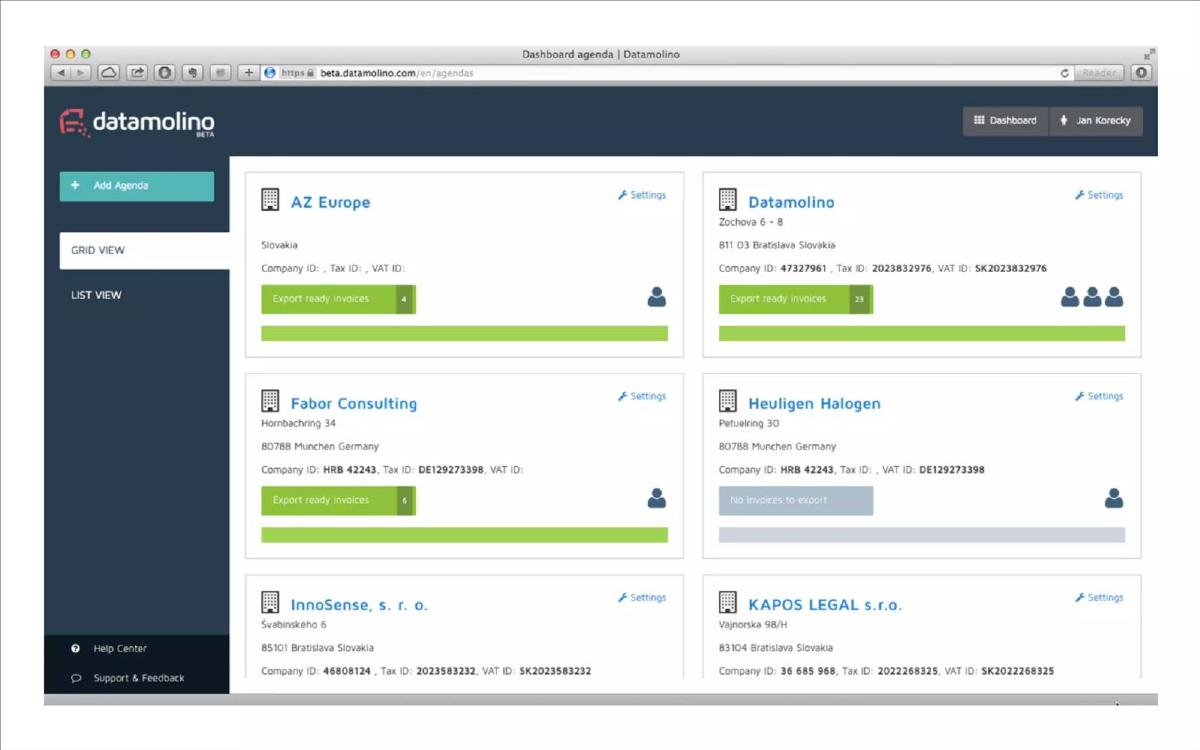
- Product validation is showcased through Slide 3 and Slide 4, which display a functional beta dashboard managing multiple European entities like 'AZ Europe' and 'Fabor Consulting.'
- The team slide (Slide 5) emphasizes tenure, with the four core members each claiming between 10 and 15 years of relevant professional experience.
- Strategic partnerships are highlighted as a core pillar of the business model on Slide 6, alongside standard SaaS recurring fees.
- The roadmap on Slide 7 indicates the company received €500,000 in funding in February 2014, following their time in the Wayra accelerator.
- The company projected reaching a 'break even' point by May 2015, as shown on the final roadmap slide.
- The deck omits standard fundraising slides such as a detailed competitive landscape, total addressable market (TAM) analysis, and specific unit economics.
Datamolino Pitch Deck Analysis
The Datamolino deck from 2014 is a lean, product-centric presentation. It avoids the common pitfall of over-explaining the 'why' and instead focuses heavily on the 'how' and the 'who.' In an era where fintech and accounting automation were beginning to gain significant venture capital interest, Datamolino positioned itself as a utility-first tool designed to eliminate the most tedious part of the accounting cycle: manual data entry.
Slide 1: Title Slide
The deck opens with a clean logo and a very specific sub-headline: "Process invoices without retyping." This is an excellent example of a functional value proposition. It doesn't use buzzwords like "synergy" or "disruption." Instead, it identifies a specific pain point (retyping) and offers a specific result (processing). For an investor, this immediately categorizes the company as a B2B productivity tool.
Slide 2: The Solution
Slide 2 is entirely visual. It uses three icons to represent the workflow: a document being processed by gears, a computer screen with a checklist, and a smiling professional. This slide communicates that the technology handles the heavy lifting of data extraction, while the human remains in the loop for final verification. It suggests a high degree of automation without claiming to be a 'black box' that requires no oversight—a realistic stance for 2014-era OCR (Optical Character Recognition) technology.
Slide 3: Dashboard Overview
This slide provides a screenshot of the "Dashboard agenda." It shows the platform in a beta state, managing multiple client accounts including AZ Europe, Datamolino, Fabor Consulting, Heuligen Halogen, InnoSense, s.r.o., and KAPOS LEGAL s.r.o. The dashboard displays specific data points like Company ID, Tax ID, and VAT ID. Crucially, it shows the status of "Export ready invoices," demonstrating that the software is not just a viewer but a bridge to other systems. The presence of Slovakian and German addresses indicates an early focus on the European market.
Slide 4: Purchase Invoice Detail
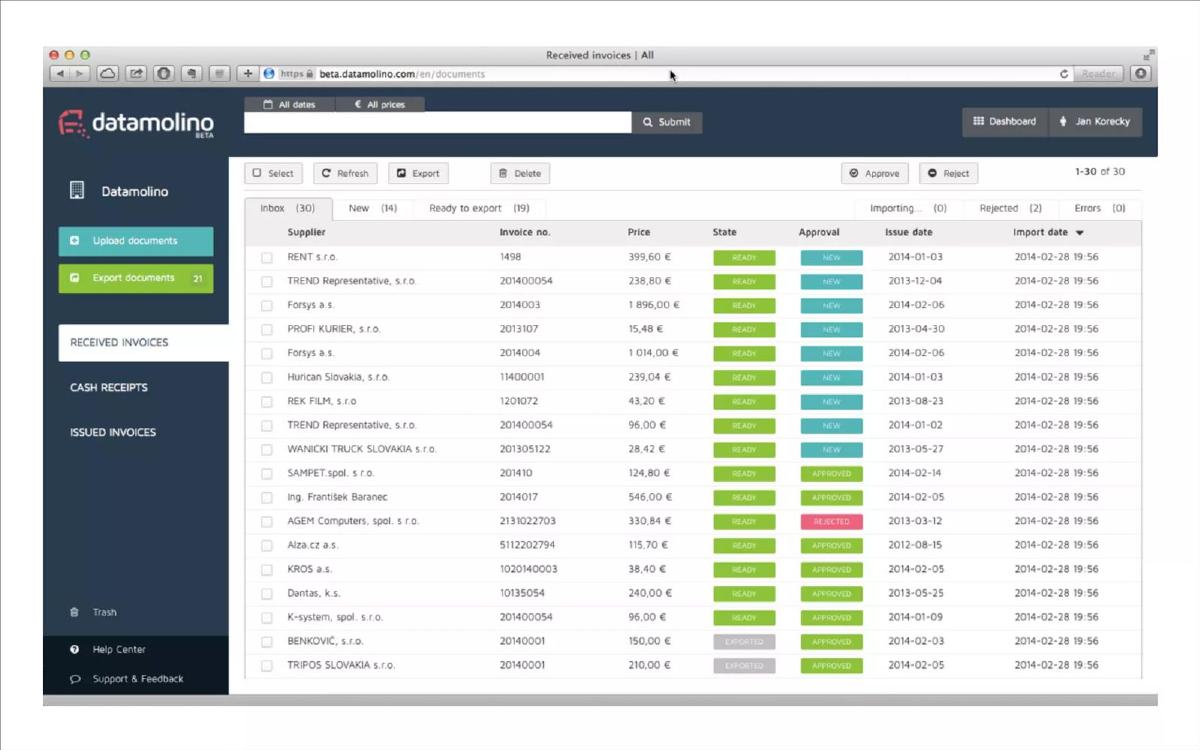
Slide 4 dives deeper into the product UI, showing how an invoice from Alza.sk is processed. The screen is split between the original document image and the extracted data fields (Invoice number, Supplier, Tax IDs, and a summary table for Net/VAT/Total). The 'Approved' stamp in the top right corner reinforces the workflow mentioned in Slide 2. This slide is vital for proving the product's accuracy and user interface maturity.
Slide 5: Team and Advisory Board
The team slide is one of the strongest in the deck due to the stated years of experience. Andrej Glezl (CEO) brings 12 years of international advisory experience and a Harvard Law background. Jan Korecky (COO) has 10 years in legal and tech advisory. Ivan Debnar (CTO) is noted as the founder of zoznam.sk with 15 years in IT. Martin Vician (CFO) adds 10 years of SME accounting expertise. The advisory board is equally impressive, featuring Peter Gabriz (Anthemis Group) , Jan Seliga (TMF Group) , and Kenneth Ryan (KPMG) . This suggests the company has strong ties to the very industries (accounting and finance) they are trying to sell into.
Slide 6: Business Model
Datamolino outlines a simple two-pillar revenue strategy. The first is SaaS recurring fees , which is standard for the industry. The second is Partners / software integrations . This second pillar is critical for an invoice processing tool; by integrating with accounting software (like Xero or Sage), Datamolino can acquire customers at a lower cost through the partner's app marketplace or direct referrals.
Slide 7: Roadmap
The final slide in this set is a timeline spanning 2013 to 2015. It marks key milestones: Wayra acceleration in July 2013, a €500,000 funding round in February 2014, and a product launch in May 2014. The roadmap looks forward to expansion into "two markets" by November 2014 and reaching "break even" by May 2015. This timeline gives investors a clear sense of the company's velocity and their fiscal responsibility regarding the path to profitability.
What Works in This Deck
The primary strength of this deck is its clarity of purpose . By Slide 4, any viewer understands exactly what the product does, what it looks like, and who is building it. The use of actual product screenshots rather than conceptual mockups builds significant trust. Furthermore, the team slide doesn't just list names; it lists years of experience and specific domains, which is a powerful way to signal 'founder-market fit' in a technical and regulated space like accounting.
What is Missing
While the product and team are well-represented, the deck is missing several components usually required for a Series A or late Seed round. There is no Market Size analysis; investors want to know if this is a $100M opportunity or a $10B opportunity. There is also a lack of Competitive Analysis . In 2014, companies like Receipt Bank (now Dext) and Hubdoc were already active; Datamolino does not explain how its extraction technology or pricing differs from these incumbents. Finally, the 'Ask' is missing from these slides. While the roadmap mentions a previous €500k round, it does not state how much they are currently raising or what the specific use of funds will be.
Founder Takeaways
Lead with the product: If your software is functional, show it. Datamolino uses two high-resolution screenshots to do the talking, which is more effective than five slides of bullet points. · Quantify experience: Don't just say your team is "experienced." State the number of years. Seeing "15 years" or "12 years" next to a founder's name provides immediate context for their seniority. · Define the workflow: For B2B tools, showing how the product fits into a user's day (Slide 2) is essential. Investors need to see that you understand the operational reality of your customers. · Be transparent with the roadmap: Including a 'break even' goal on a roadmap (Slide 7) shows a level of financial maturity that is often missing in early-stage decks. It signals that the founders are focused on building a sustainable business, not just burning cash.
Frequently asked questions
- What is the primary problem Datamolino is solving?
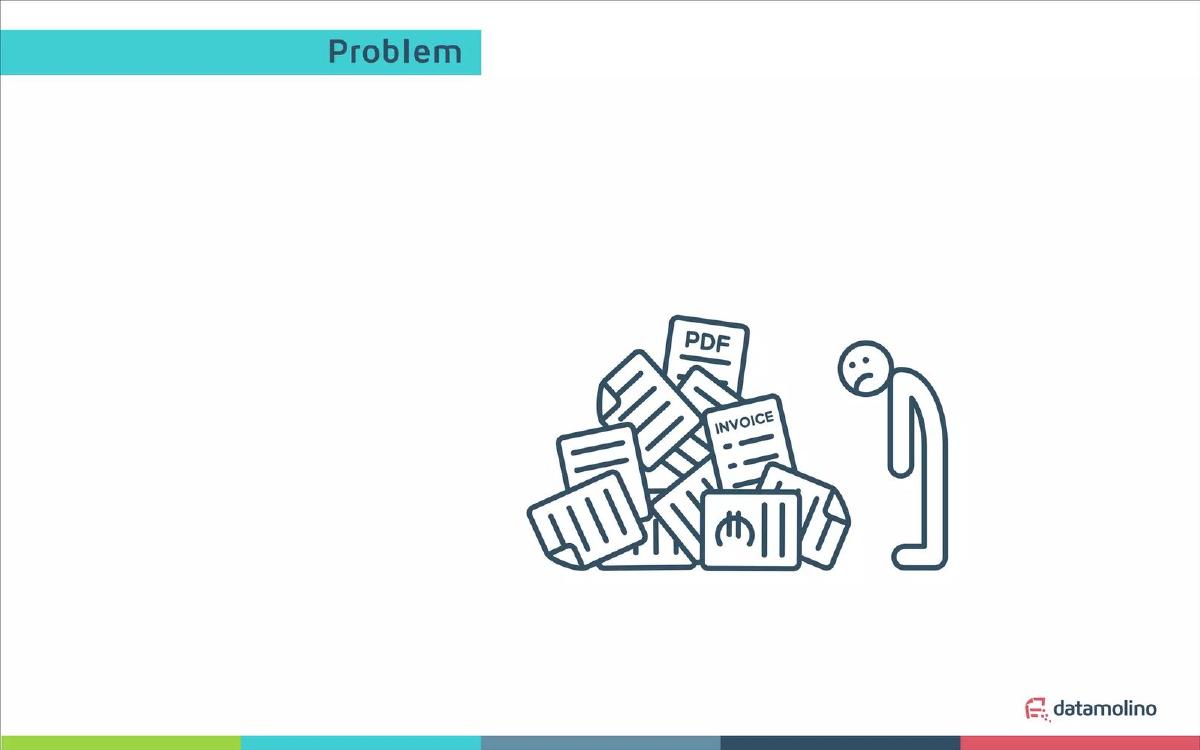
- Based on Slide 1 and Slide 2, Datamolino targets the manual inefficiency of data entry in accounting. Their solution automates the extraction of data from invoices, removing the need for 'retyping' information into accounting software. This is visualized as a transition from a raw document through a 'gears' processing icon into a digital checklist for the user.
- How does Datamolino generate revenue?
- According to Slide 6, the business model is two-pronged. First, they employ a standard SaaS model based on recurring fees. Second, they leverage 'Partners' and 'software integrations' as a distribution and revenue channel, likely targeting accounting software providers or firms that can bundle the tool into their existing workflows.
- What is the professional background of the founding team?
- The team, shown on Slide 5, consists of Andrej Glezl (CEO, Harvard Law, 12 years experience), Jan Korecky (COO, legal/tech advisory, 10 years), Ivan Debnar (CTO, founder of zoznam.sk, 15 years), and Martin Vician (CFO, SME accounting, 10 years). The advisory board includes representatives from Anthemis Group, TMF Group, and KPMG.
- What was the company's financial status at the time of this deck?
- Slide 7 shows that Datamolino was in its 'Validation' phase in 2014. They had secured €500,000 in funding in February 2014 and had launched their product by May 2014. The roadmap indicates they were operating in two markets by November 2014 and were aiming for break-even status by May 2015.
- What key information is missing from this pitch deck?
- The provided slides lack a 'Market Size' slide (TAM/SAM/SOM), a 'Competition' slide comparing them to other OCR or accounting tools, and a specific 'Ask' slide detailing how much new capital they are seeking. Additionally, there are no detailed financial projections or customer acquisition cost (CAC) metrics included in these seven slides.