Davai’s pitch deck is a study in extreme minimalism, utilizing a consistent green-and-white aesthetic to pitch a 'real-time local newsfeed.' The deck identifies a specific gap in the market—the lack of a mobile hub for connecting with one's immediate surroundings—but stops short of providing technical specifications, revenue models, or team biographies. Instead, it frames the venture as an early-stage project in need of 'FounderFuel' and an 'Incubator environment.' While the deck successfully communicates a clear, singular vision, it lacks the data-driven evidence or competitive analysis requ…
Key takeaways
- The company defines its product as 'Real-time local newsfeeds' on the title slide (Slide 1).
- The core problem identified is the absence of a 'mobile hub for directly connecting with one’s surroundings' (Slide 2).
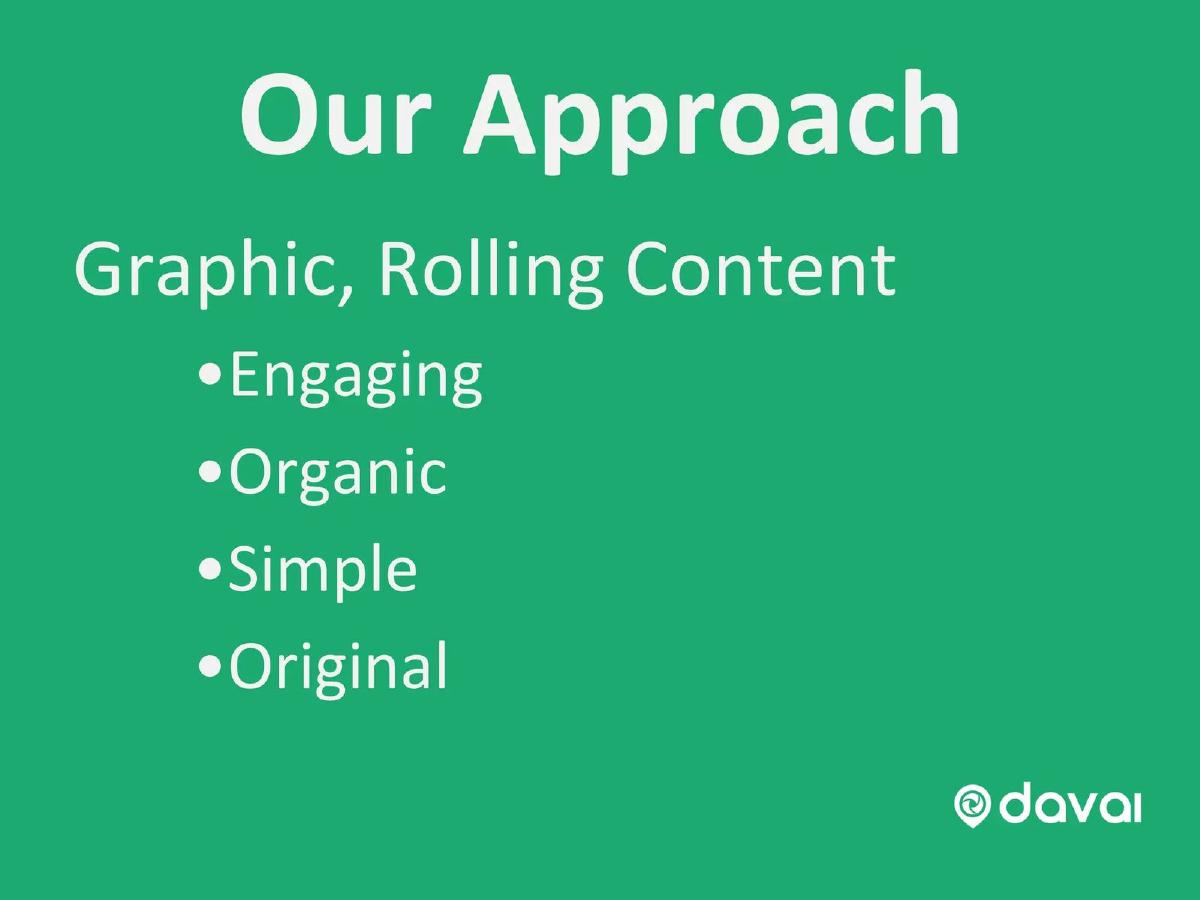
- The product strategy relies on 'Graphic, Rolling Content' that is described as engaging, organic, simple, and original (Slide 3).
- Current traction is limited to 'Developing beta' and 'Gathering testers,' with no specific user counts provided (Slide 4).
- The founders openly acknowledge the 'Chicken and egg' problem regarding user acquisition as a primary barrier (Slide 5).
- Competition is viewed through the lens of user friction, specifically the difficulty of 'Changing sharing platform' (Slide 5).
- The 'Ask' is not for a specific dollar amount, but for 'FounderFuel,' 'Incubator environment,' and 'Mentorship' (Slide 6).
- The deck omits a team slide, financial projections, and a business model within the provided pages.
Davai Pitch Deck Analysis
The Davai pitch deck is a minimalist presentation that prioritizes a clean aesthetic and high-level conceptual clarity over data density. With a consistent green background and white text, the deck attempts to sell a vision of hyper-local connectivity. It is clearly designed for an audience of incubator managers or early-stage mentors rather than institutional investors looking for a return-on-investment profile.
Slide 1: Title and Tagline
The opening slide introduces the brand 'Davai' with a location-pin-style logo containing a swirl icon. The tagline is 'Real-time local newsfeeds.' This is a strong start because it immediately tells the reader what the product is. There is no ambiguity about the sector (social/news) or the utility (local/real-time).
Slide 2: The Opportunity
Slide 2 identifies the market gap: 'No mobile hub for directly connecting with one’s surroundings.' This is a classic 'problem' slide, though it is framed as an 'opportunity.' It suggests that while we have global social networks, we lack a dedicated tool for the immediate physical vicinity. The phrasing is broad, which allows for a wide range of product iterations but lacks a specific 'why now' catalyst.
Slide 3: Our Approach
This slide outlines the product philosophy. The core mechanism is 'Graphic, Rolling Content.' The founders list four pillars: Engaging, Organic, Simple, and Original. While these are positive attributes, they are descriptors rather than features. A founder should note that 'Simple' and 'Original' are often at odds in UX design, and without a mockup, these words remain abstract.
Slide 4: So Far (Traction)
The traction slide is qualitative rather than quantitative. It lists 'Developing beta,' 'Gathering testers,' 'Growing followers,' and 'Tracking sign ups & conversion.' The omission of actual numbers (e.g., '500 beta signups' or '20% weekly growth') suggests that the company is in the very earliest days of its lifecycle. For an incubator pitch, this level of honesty is acceptable, but for a funding round, the lack of data would be a significant red flag.
Slide 5: Barriers
It is rare to see a slide explicitly titled 'Barriers' in a pitch deck, as most founders prefer to frame these as 'Challenges we have overcome.' Davai identifies the 'Chicken and egg' problem of user acquisition and the difficulty of 'Changing sharing platform' for users. This shows a high degree of self-awareness regarding the network effect required for a local newsfeed to succeed. However, the slide does not offer a solution to these barriers, which leaves the investor wondering how the team plans to scale.
Slide 6: What We Need (The Ask)
The final slide in the provided sequence clarifies the purpose of the deck. The company is seeking 'FounderFuel,' which is a Montreal-based startup accelerator. They are looking for an 'Incubator environment' and 'Mentorship' from 'People invested in us.' By naming a specific program, the deck becomes a targeted application. It is not asking for a $500k seed check; it is asking for a seat in a program that provides the foundation for such a check later.
What Works in the Davai Deck
The primary strength of this deck is its clarity of vision . Within six slides, the reader knows exactly what Davai wants to build and what stage they are at. The minimalist design prevents the reader from getting bogged down in unnecessary details, which is effective for a quick-fire pitch competition or an initial application screen. The branding is consistent, which suggests a level of care in how the product will eventually look and feel.
Furthermore, the honesty regarding competition and barriers is refreshing. By acknowledging that it is hard to get users to switch platforms, the founders signal to mentors that they are not naive about the social media landscape. This builds a level of trust that is essential in an incubator setting where the 'coachability' of the founders is a key selection criterion.
What is Missing from the Davai Deck
The most glaring omission is the Team Slide . In early-stage investing, the 'who' is often more important than the 'what.' Without knowing if the founders have a technical background, previous exits, or local news experience, it is impossible to judge their ability to execute on the 'Graphic, Rolling Content' vision. Even for an incubator, the pedigree of the team is a primary filter.
Additionally, there are no Product Mockups . For a product described as 'Graphic' and 'Simple,' showing the interface is mandatory. A single screenshot of the 'rolling content' would have done more work than the four bullet points on Slide 3. Without visuals, the investor is left to imagine the app, and their imagination may not align with the founders' intent.
Finally, there is no Business Model . While the deck focuses on the 'what' and the 'how,' it completely ignores the 'how much.' Even a speculative slide on local advertising or premium features for local businesses would have helped ground the project as a viable business rather than just a social experiment.
What a Founder Should Copy
The One-Sentence Value Prop: 'Real-time local newsfeeds' is a perfect example of how to describe a complex product in four words. · Consistent Visual Identity: The use of a single primary color and a clean, sans-serif font makes the deck feel professional despite its lack of content. · Targeted Ask: If you are applying to an accelerator, name the accelerator in the deck. It shows the deck wasn't just blasted out to 100 different people. · Problem Framing: Identifying the 'mobile hub for surroundings' as a missing piece of the digital landscape is a compelling way to frame a market opportunity.
Final Verdict
The Davai deck is a 'Phase 0' document. It is designed to get a foot in the door of an accelerator, not to close a funding round. It succeeds in communicating a brand and a problem, but it fails to provide the evidence of execution (team, tech, data) that would be required for a professional investment. Founders should look to this deck as a template for conceptual brevity , but must ensure they add the missing layers of team expertise and product visualization before showing it to anyone with a checkbook.
Frequently asked questions
- What stage of funding is Davai seeking according to this deck?
- Davai does not specify a dollar amount or a valuation. Instead, Slide 6 explicitly asks for 'FounderFuel' and an 'Incubator environment.' This indicates the company is at the pre-seed or idea stage, looking for an accelerator program rather than a traditional venture capital investment. The focus is on mentorship and environment over raw capital.
- How does Davai plan to differentiate itself from existing social media?
- The deck suggests a focus on 'Graphic, Rolling Content' that is 'Organic' and 'Simple' (Slide 3). The primary differentiator is the hyper-local focus, aiming to be a 'mobile hub' for a user's immediate surroundings (Slide 2). However, the deck does not provide specific feature sets or UI examples to show how this differs from platforms like Nextdoor or Instagram.
- What is the current status of the Davai product?
- According to Slide 4 ('So Far'), the company is currently in the process of 'Developing beta' and 'Gathering testers.' They are also 'Tracking sign ups & conversion,' though no specific data points, percentages, or raw numbers are shared in the slides provided. This suggests the product is not yet fully launched to the public.
- What are the biggest risks identified by the founders?
- The founders identify two main 'Barriers' on Slide 5. First is the 'Chicken and egg' problem of getting enough users to make the newsfeed valuable. Second is the competitive challenge of 'Changing sharing platform,' acknowledging that users are already habituated to other apps and moving their content or attention is a significant hurdle.
- Is there a clear business model or path to revenue in the deck?
- No. The provided slides contain no mention of advertising, subscriptions, data licensing, or any other monetization strategy. The deck is focused entirely on the product concept and the need for an incubator to help develop the venture. This is common for very early-stage accelerator pitches but would be a major omission for a Seed or Series A deck.