Daylight’s Series A deck is a masterclass in demonstrating enterprise traction through specific, high-impact use cases. By positioning itself within the 'Hyperautomation Ecosystem,' the company moves beyond simple form-building to address complex legacy system integration. The deck relies heavily on validated ROI metrics from Tier-1 clients like TD Bank and Allianz, showing a projected 3.3x ARR growth and 150% net revenue retention. While the visual design is functional rather than flashy, the narrative clearly articulates the shift from 'inside-out' IT projects to 'outside-in' digital transf…
Key takeaways
- Daylight positions itself as a solution for 'Hyperautomation,' a trend identified by Gartner as a top strategic technology trend for 2020 (Slide 3).
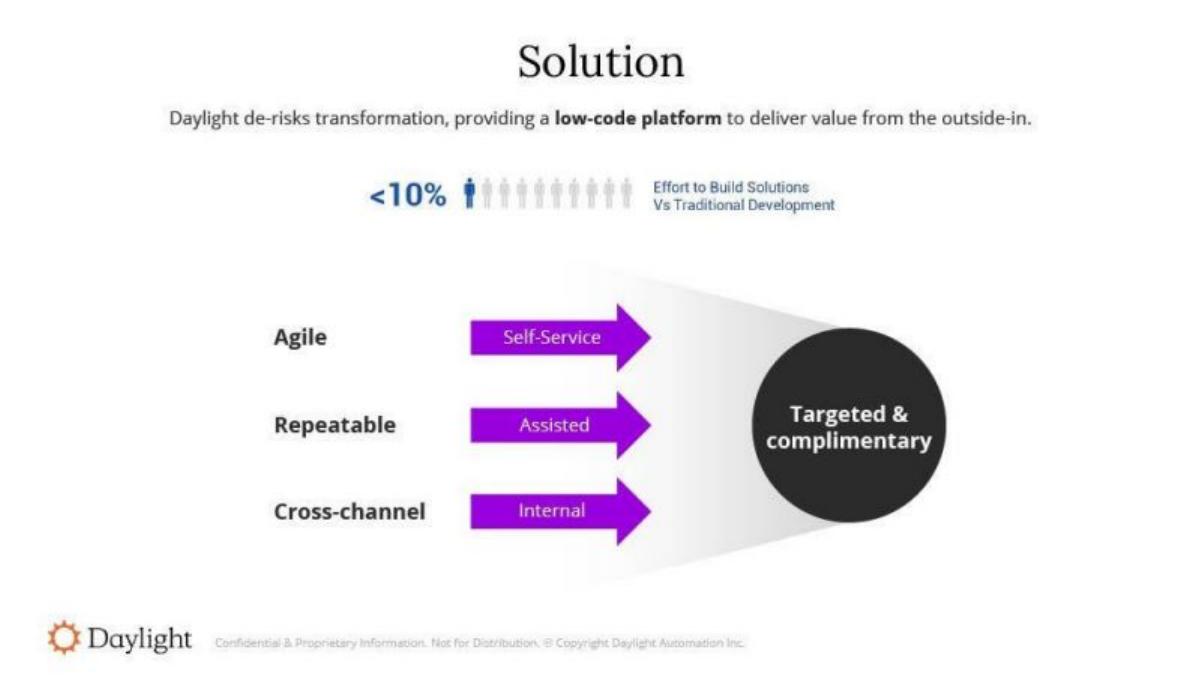
- The platform claims to reduce the effort to build solutions by over 90% compared to traditional development (Slide 5).
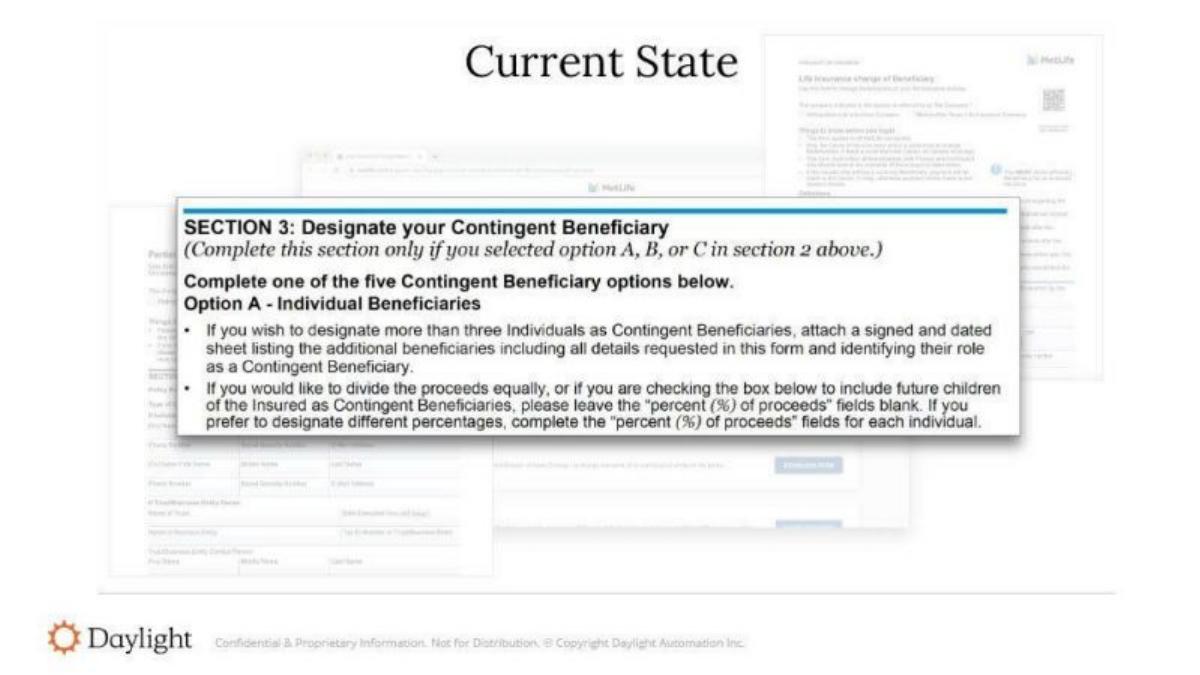
- The deck uses a 'Current State' vs. 'Future State' comparison to visualize the transition from complex PDFs to streamlined digital experiences (Slides 6-7).
- Proven ROI is a core theme, with TD Bank reportedly seeing ROI on their platform subscription in just 4 months (Slide 10).
- Financial performance is strong, citing >3.3x projected ARR growth and 150% retained revenue for the 2021 fiscal year to date (Slide 12).
- The business model is described as 'SaaS with a twist,' utilizing a metered approach where revenue scales with client submission growth (Slide 13).
- The team slide highlights deep industry experience with leaders formerly at InterfaceWare, Think Research, and ApplePie Capital (Slide 14).
- Market sizing targets a massive opportunity, with the Low-Code Application Platforms market projected to reach ~$60B by 2028 (Slide 15).
The Narrative: From Paper to Hyperautomation
Daylight’s pitch deck for their Series A round is a clinical, data-driven presentation designed to appeal to institutional investors. The company, which operates in the enterprise software space, raised $123M in 2021. The deck’s primary objective is to demonstrate that Daylight is not just a form-builder, but a critical layer in the enterprise 'Hyperautomation' stack. By focusing on high-stakes industries like banking and insurance, Daylight positions its software as an essential service rather than a discretionary tool.
Slides 1-2: The Vision and Evolution
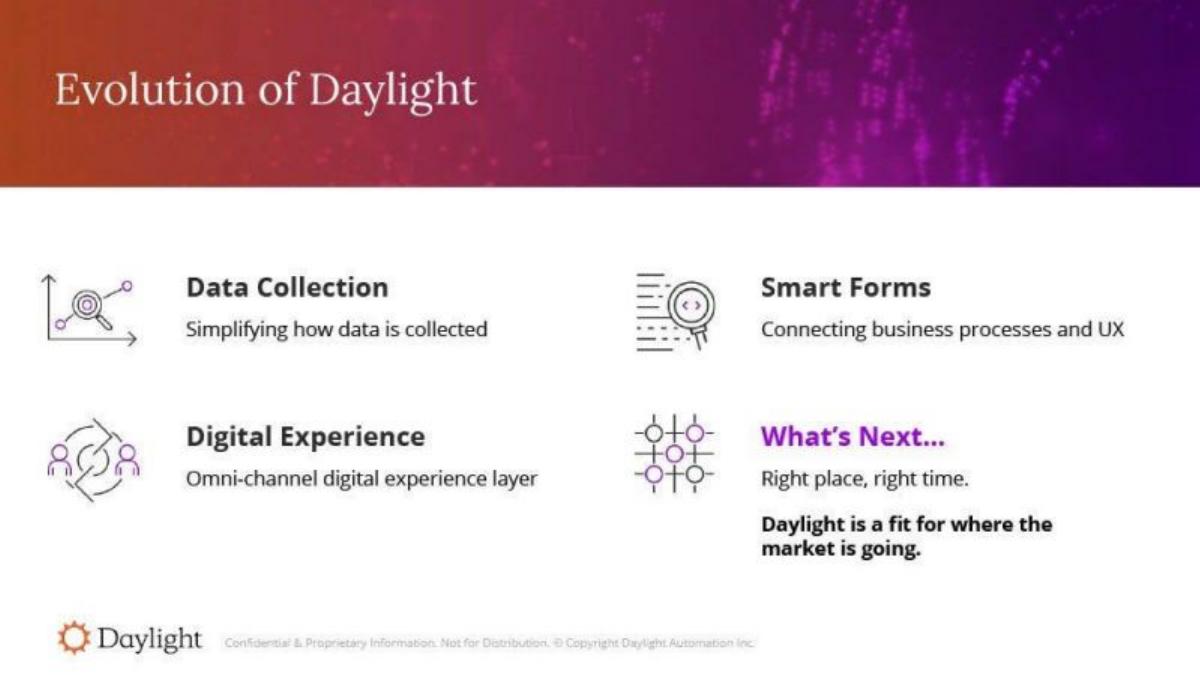
The deck opens with a clear mission statement on Slide 1 : "Making capturing and exchanging data as simple as having a conversation." This sets the stage for a user-experience-first approach to enterprise data. Slide 2 , titled "Evolution of Daylight," provides a brief history of the product's journey from simple data collection and smart forms to a comprehensive "omni-channel digital experience layer." The slide concludes with the assertion that Daylight is "a fit for where the market is going," signaling a forward-looking investment opportunity.
Slides 3-5: Market Context and The Solution
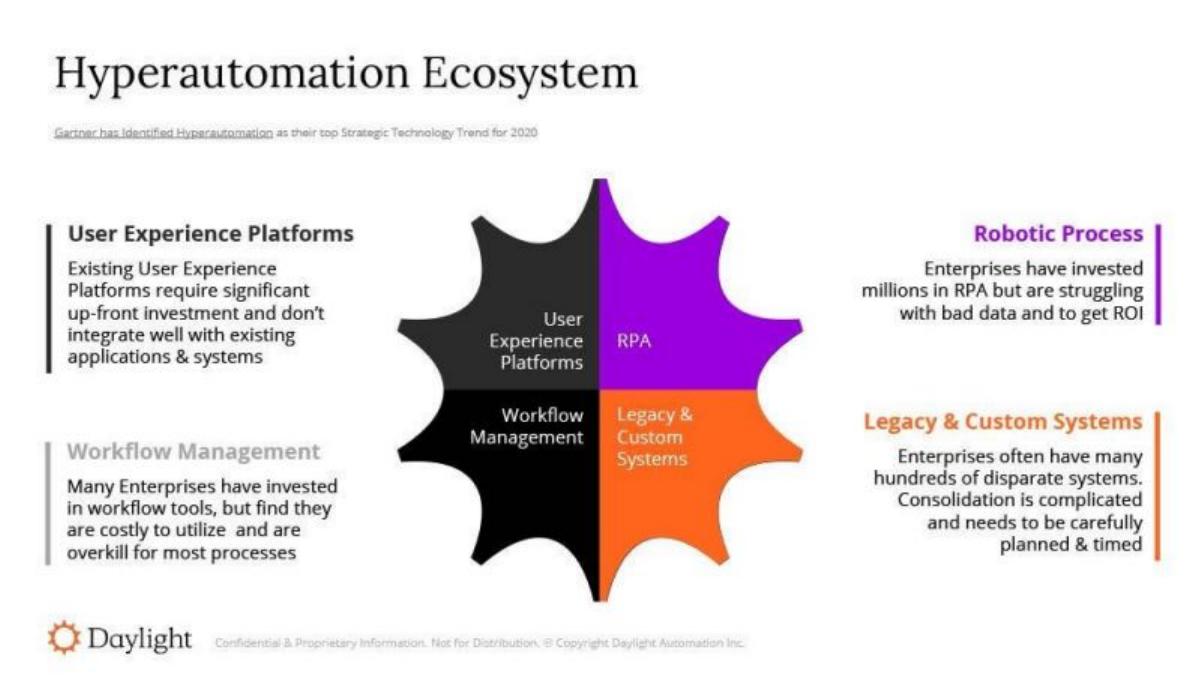
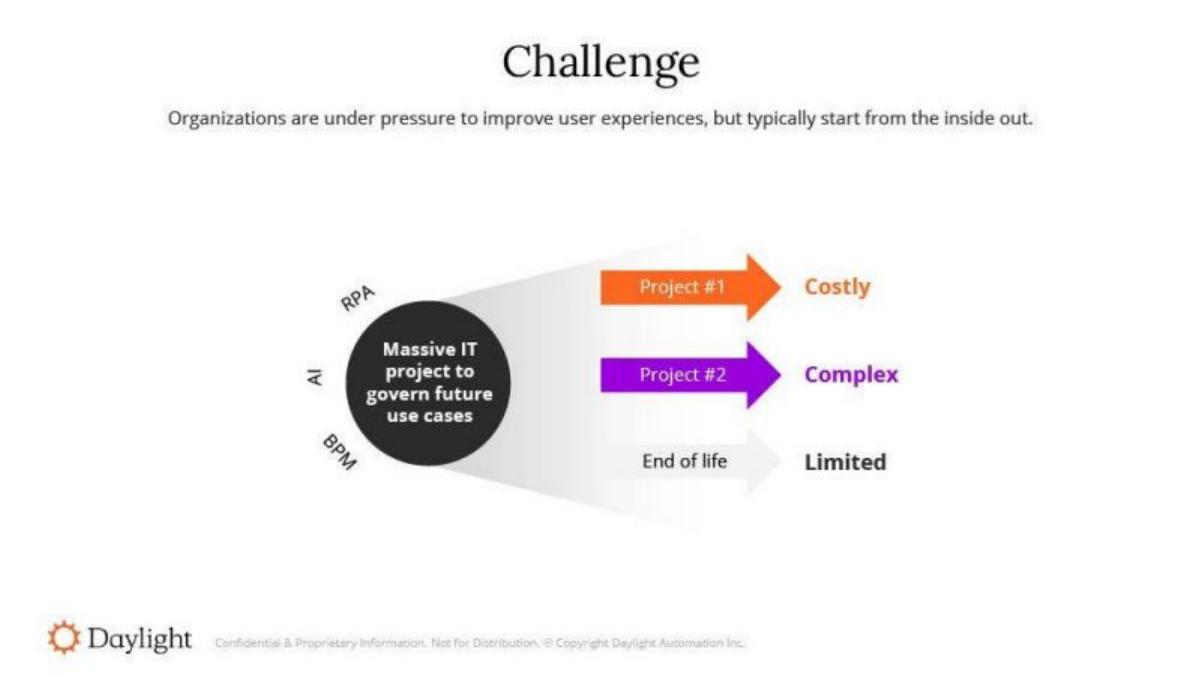
Slide 3 introduces the "Hyperautomation Ecosystem." It cites Gartner’s identification of Hyperautomation as a top technology trend for 2020. The slide categorizes the current landscape into four quadrants: User Experience Platforms, RPA, Workflow Management, and Legacy & Custom Systems. Daylight positions itself as the bridge between these often-siloed categories. Slide 4 defines the "Challenge": organizations are pressured to improve UX but often start with "massive IT projects" that are costly, complex, and limited. Slide 5 presents Daylight as the "Solution," a low-code platform that reduces the effort to build solutions to "<10%" of traditional development costs. It emphasizes an "outside-in" approach that is agile, repeatable, and cross-channel.
Slides 6-8: Product Visualization
To make the abstract concept of "low-code automation" tangible, Slide 6 shows the "Current State"—a dense, confusing MetLife life insurance beneficiary form. Slide 7 shows the "Future State," where that same PDF is transformed into a clean, digital web experience. This is a classic "Before and After" tactic that clearly illustrates the product's utility. Slide 8 provides a glimpse into the backend, titled "Low Code, Business Managed." It shows a visual workflow builder, reinforcing the claim that business users, not just IT departments, can manage these processes.
Slides 9-11: Traction and Social Proof
Slide 9 lists "Broad Use Cases" across business units like Wealth Management, Lending, and HR, suggesting a high ceiling for market penetration. Slide 10 is perhaps the most impactful slide in the deck, titled "Example Use Cases." It provides hard metrics for three major clients: TD Bank Group (37,500 person-hours saved per year), Allianz Global Assistance (83% reduction in training), and Loblaw/Shoppers Drug (1.5M+ transactions in the first two months). Slide 11 adds a qualitative layer with a testimonial from Barb Pap at Manulife, who notes that Daylight allowed them to reimagine and build experiences in just 78 days.
Slides 12-13: Financial Performance and Business Model
The "Executive Summary" on Slide 12 reveals impressive growth figures: >3.3x projected ARR growth and 150% Retained Revenue for the 2021 fiscal year to date. A footnote mentions that their 2020 Seed round was led by Golden Ventures with participation from Bessemer Venture Partners. Slide 13 explains the "Background & Model." Daylight uses a metered SaaS model, which they describe as "Land and expand explode." A chart showing "Sample Banking Client Submission Growth" illustrates how revenue scales as the client processes more data through the platform, making the service "stickier" over time.
Slides 14-15: Team and Market Size
Slide 14 introduces the "Executive Team": Art Harrison (CGO), Ryan Kimber (CEO), and Natasha Lala (COO). Their pedigrees include leadership roles at InterfaceWare, Think Research, and OANDA, providing the "founder-market fit" necessary for a Series A. Slide 15 addresses "Market Size," noting that nearly $500B is spent annually on enterprise software development. It includes a table projecting the "Global Market for Hyperautomation Components" to reach $90B by 2028 , with Low-Code Application Platforms making up the largest share at ~$60B.
Slides 16-20: Deep Dive Use Cases
The final section of the deck ( Slides 16-19 ) consists of detailed case studies. Slide 16 focuses on a Real Estate lending process that saved 50,000 people hours per year. Slide 17 covers financial institution transfers, noting an 88% reduction in errors. Slides 18 and 19 detail processes for Guaranteed Investment Certificates and flu shot registrations, highlighting features like RPA integration and data encryption. These slides serve as an appendix of sorts, providing the granular detail that technical or operations-focused investors would require during due diligence. Slide 20 is a promotional slide for the source of the deck, bestpitchdeck.com.
What Daylight Does Well
Quantifiable ROI: The deck is relentless in its use of hard numbers. Saving 37,500 hours for a bank is a metric that any CFO can understand and value. · Clarity of Transition: The use of the MetLife form to show the "Before and After" (Slides 6-7) is the most effective way to explain a complex software product. It removes all ambiguity about what the software actually does. · Alignment of Incentives: By highlighting their metered SaaS model (Slide 13), Daylight shows investors that their revenue growth is tied directly to their customers' success and usage, which is a highly attractive trait for enterprise software.
What is Missing
The Ask: There is no slide stating how much money Daylight is raising in this specific round or how they plan to spend it (e.g., hiring, R&D, international expansion). · Competitive Landscape: While they mention the "Hyperautomation Ecosystem," they do not name specific competitors like Unqork, Appian, or ServiceNow. A slide explaining their unique moat against these giants would have been beneficial. · Product Roadmap: The deck focuses heavily on what has already been built and achieved. It lacks a vision for the product's technical evolution over the next 3-5 years.
What Other Founders Should Copy
The Use Case Slide Format: Slide 10 is a perfect template for showing traction. It groups clients by logo, names the specific process automated, and provides three distinct, high-impact metrics for each. · Market Positioning: Instead of calling themselves a "form builder," Daylight attached themselves to a high-growth analyst trend ("Hyperautomation"). Founders should identify the "category" their company belongs to and use analyst data (like Gartner or Grand View Research) to validate the market's size. · Focus on Retention: Highlighting 150% retained revenue (Slide 12) is the strongest possible signal of product-market fit in SaaS. If you have a net revenue retention (NRR) over 120%, it should be a centerpiece of your deck.
Frequently asked questions
- What is Daylight's primary value proposition?
- Daylight focuses on making data capture and exchange as simple as a conversation. It provides a low-code platform that allows enterprises to replace legacy, paper-based, or PDF-heavy processes with 'Smart Forms' and digital experiences. According to slide 5, this approach 'de-risks transformation' by delivering value from the 'outside-in' rather than through massive, multi-year internal IT overhauls.
- How does Daylight generate revenue?
- Daylight utilizes a metered SaaS model, which they refer to as 'SaaS with a twist' on slide 13. This model aligns their revenue with the ROI of their clients; as client submission volume grows, Daylight’s revenue increases. This 'land and expand' strategy is supported by their 150% retained revenue metric, indicating significant organic growth within their existing customer base.
- Who are Daylight's key customers and what results have they seen?
- The deck identifies several high-profile enterprise clients including TD Bank Group, Allianz Global Assistance, Loblaw/Shoppers Drug, and Manulife. Slide 10 notes that TD Bank saved 37,500 person-hours per year, while Allianz saw an 83% reduction in training time. Manulife reported reimagining and building new customer experiences in just 78 days (Slide 11).
- What market trends is Daylight capitalizing on?
- Daylight is positioning itself within the 'Hyperautomation' trend. On slide 15, they cite Grand View Research data showing that the global market for hyperautomation components—specifically low-code platforms, RPA, and digital experience platforms—is expected to grow from approximately $21B in 2019 to $90B by 2028.
- What is missing from the Daylight pitch deck?
- The deck is notably missing a specific 'Ask' slide detailing how much capital they are seeking and how it will be allocated. It also lacks a dedicated competition slide, though it indirectly references competitors by positioning itself against 'Legacy & Custom Systems' and traditional 'Workflow Management' tools on slide 3. There is also no detailed product roadmap beyond the 'What's Next' teaser on slide 2.