Datelytics presents a vision for a 'full-service, analytical dating app' that leverages a user's entire social footprint—from Facebook to OpenTable—to optimize matches and date planning. The deck identifies a fragmented market where no single player owns the 'entire dating experience.' While the concept of using 'big data' for romance is clear, the execution in the deck is hampered by vague revenue drivers (including a 'top secret code' for advertisers) and a lack of specific team biographies despite an 'Amazing Team' transition slide. The company seeks $400,000 in capital, but provides no ro…
Key takeaways
- The deck identifies a market gap where existing apps fail to provide the 'entire dating experience' (Slide 3).
- Market size is cited at $1.049 billion in annual revenue from online dating, with 54 million single Americans (Slide 4).
- The product relies on extracting data from a wide array of third-party platforms, including Yelp, OpenTable, and Groupon (Slide 7).
- A unique feature is the 'Step 3' display of date activities that a match will like, including a direct purchase option (Slide 8).
- The business model is built on a freemium structure intended to drive 'word-of-mouth marketing' and 'growth hacking' (Slide 12).
- Revenue drivers are split between premium user boosts and a 'top secret code' for advertiser deals (Slide 13).
- The company is seeking $400,000 in capital, though the specific use of funds is not detailed in the provided slides (Slide 15).
- The deck lacks a formal team slide with names or credentials, despite having a transition slide titled 'Amazing Team' (Slide 14).
Executive Summary: The Data-Driven Matchmaker
Datelytics enters a crowded dating market with a pitch centered on the consolidation of the 'dating experience.' The deck argues that while many apps exist, none handle the end-to-end process of matching based on real-world interests and subsequently booking the date itself. By integrating with a user's broader digital footprint—social media, dining habits, and shopping preferences—Datelytics aims to remove the guesswork from romance. However, the deck is light on technical specifics and heavy on high-level concepts, leaving potential investors to wonder about the feasibility of such deep API integrations and the privacy implications therein.
Slide 1: Title and Branding
The cover slide introduces Datelytics with the tagline 'Revolutionizing the Date World.' It features a lifestyle image of a couple and badges indicating the app is 'Coming Soon' on the Apple App Store and Google Play. Contact information for Brandon T. Luong and an AngelList URL are provided, establishing the primary point of contact for the venture.
Slides 2-3: The Problem Statement
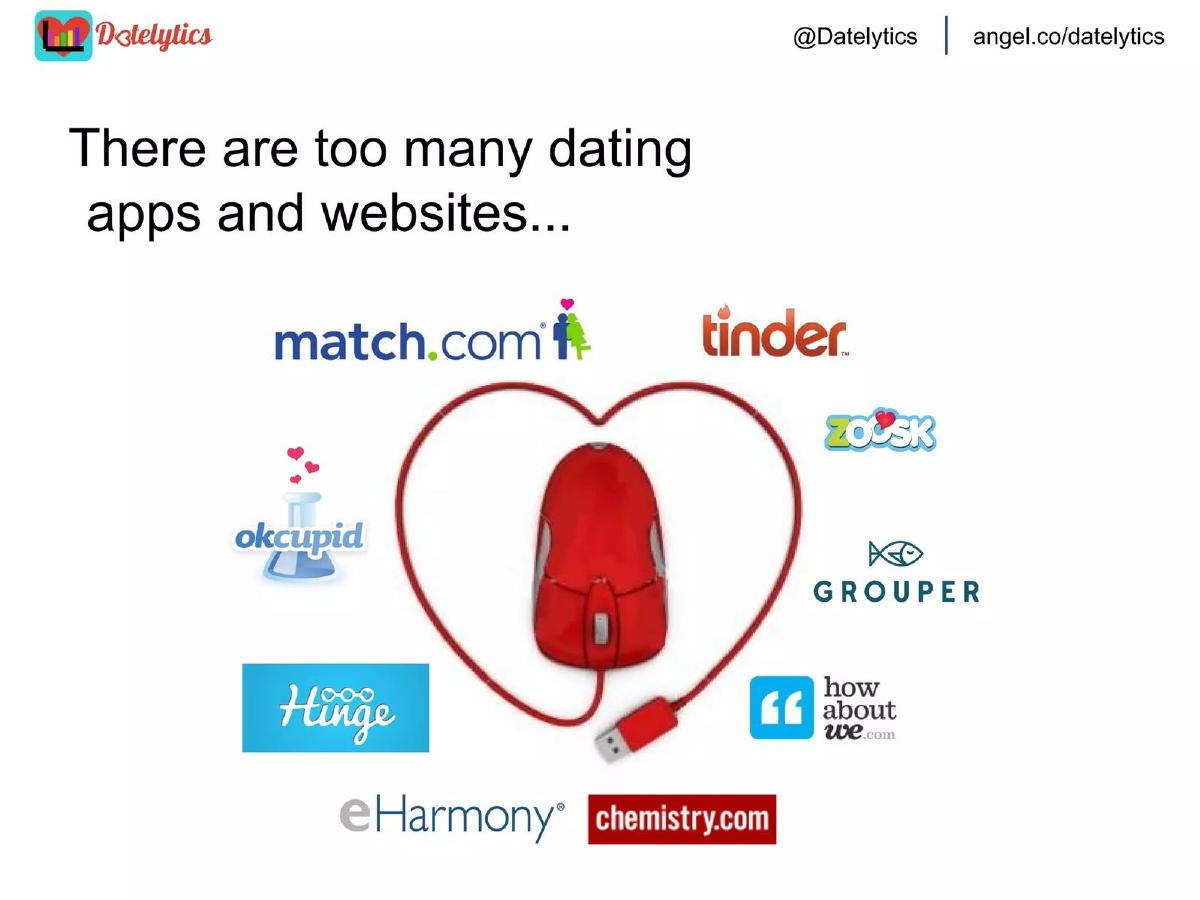
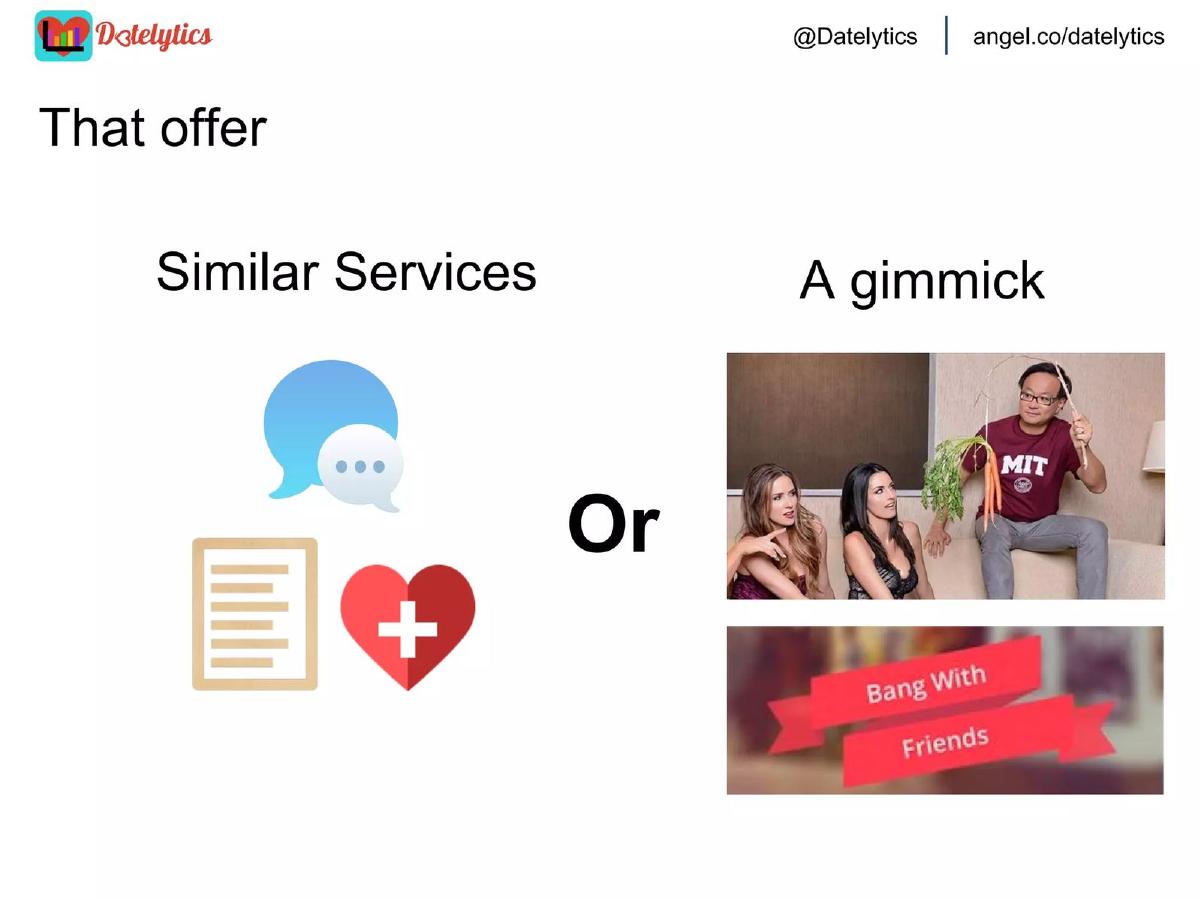
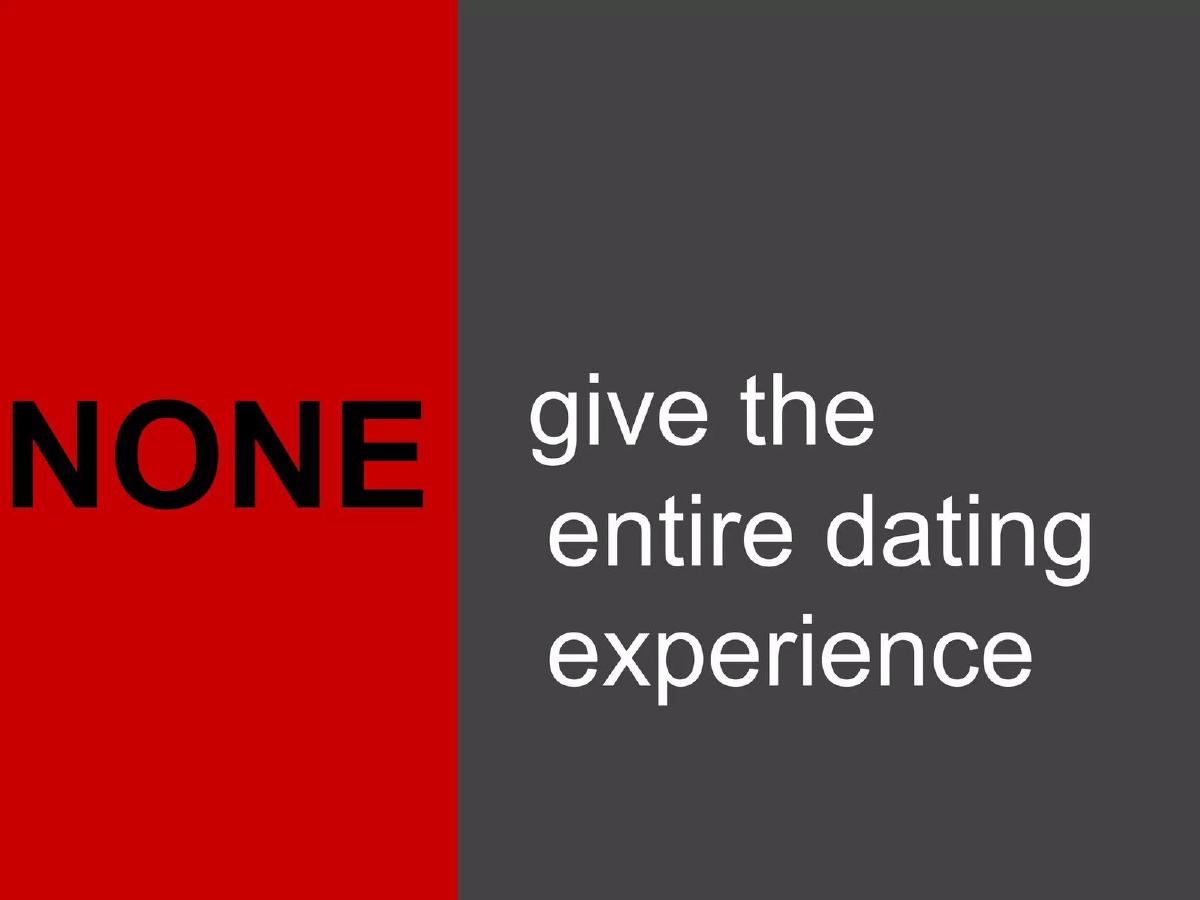
Slide 2 lists several major competitors, including Match.com, Tinder, OkCupid, and Hinge, under the header 'There are too many dating apps and websites...' Slide 3 delivers the punchline: 'NONE give the entire dating experience.' This sets up the narrative that the market is fragmented and focused only on the initial match, rather than the successful execution of a date.
Slide 4: Market Validation
Using data from 'Statistic Brain,' this slide provides three key metrics: 54 million single Americans, $1.049 billion in annual online dating revenue, and the fact that 64% of users prioritize common interests. The slide uses a background image of three young women, which feels more like stock photography than a targeted demographic analysis, but the numbers successfully establish a billion-dollar market opportunity.
Slide 5: The 'Big Data' Angle
Referencing 'Dachis Group,' the deck claims that social media contributes to 'big data' and provides 'insights to individuals in seconds.' This slide attempts to bridge the gap between social media usage and the dating experience, though it remains vague on how exactly Datelytics transforms this raw data into actionable dating insights.
Slide 6: The Solution
This slide formally defines Datelytics as a 'Full-service, analytical dating app that utilizes users’ social networks to match ideal candidates and offer best date activity.' The visual shows the app icon on three different smartphone models, emphasizing a mobile-first approach.
Slides 7-8: The User Journey
Slide 7 outlines 'Step 1,' which involves signing in with various social networks (Facebook, Twitter, Pinterest, etc.) and utility accounts (Yelp, OpenTable, Groupon). The goal is to 'extract the info.' Slide 8 jumps to 'Step 3,' showing a mockup of a 'Date Activities' screen where a user can purchase salsa lessons (notably taught by 'world-renowd Brandon T. Luong') with a 50% discount. The '¡Compra!' button suggests a focus on the transaction of the date itself as a core feature.
Slides 9-11: Competitive Advantages
After a transition slide (Slide 9), Slide 10 uses Mario and Luigi imagery to represent 'collecting on your purchases,' implying a rewards or cashback system for users who book dates through the app. Slide 11 reinforces the 'real data' advantage by displaying a collage of dozens of social media icons, suggesting the breadth of data Datelytics intends to scrape or integrate.
Slides 12-13: The Business Model
Slide 12 defines the model as 'Freemium,' citing the need to attract 'brand advocates' and 'growth hack' through word-of-mouth. Slide 13, 'Other Revenue Drivers,' mentions 'Premium Users' who need an 'extra boost' and 'Advertisers.' The mention of a 'top secret code' for advertiser deals is a curious choice for a pitch deck, as investors generally prefer transparency over mystery regarding revenue mechanics.
Slides 14-15: Team and The Ask
Slide 14 is a transition slide titled 'Amazing Team,' but it is not followed by a slide detailing who the team members are or what they have achieved. This is a significant gap in the narrative. The deck concludes on Slide 15 with a clear ask: 'Raising 400,000 Capital' set against a background of hundred-dollar bills. There is no breakdown of how this $400,000 will be spent or what the valuation of the round is.
What Datelytics Does Well
The deck identifies a genuine pain point in the dating market: the 'what do we actually do?' phase of a new relationship. By positioning the app as a 'full-service' solution that handles both the match and the activity, Datelytics creates a clear differentiation from 'swipe-only' apps. The integration of commerce (buying date activities) provides a more direct path to revenue than simple subscription models, which is an attractive proposition for investors looking for diversified income streams.
What is Missing from the Deck
The most critical missing element is the team biography. An 'Amazing Team' slide with no names or experience is a red flag for investors who bet on people as much as ideas. Furthermore, the deck lacks a 'Use of Funds' slide. Asking for $400,000 without explaining if it goes toward engineering, marketing, or legal (especially given the data-scraping nature of the product) is a missed opportunity. There is also no mention of the technical hurdles involved in integrating with so many third-party APIs (Yelp, OpenTable, etc.) or how the company plans to navigate the privacy concerns inherent in 'extracting info' from a user's entire social life.
Founder's Guide: What to Copy and What to Avoid
Copy the clear problem/solution bridge. Datelytics does a good job of showing exactly how the problem (fragmented experience) leads to their specific solution (integrated matching and booking). The three-step user flow is simple and easy to digest.
Avoid the 'Top Secret' approach. Never tell an investor that your revenue driver is a 'top secret code.' It suggests a lack of a real plan or an unwillingness to be transparent. Avoid using copyrighted imagery. Using Nintendo's Mario and Luigi (Slide 10) to explain a business concept looks unprofessional and raises intellectual property concerns. Finally, never skip the team details. If you include a transition slide for the team, the very next slide must prove why that team is the right one to win the market.
Frequently asked questions
- What is the core value proposition of Datelytics?
- Datelytics positions itself as a 'full-service, analytical dating app.' Unlike traditional apps that rely on user-inputted profiles, Datelytics claims to utilize a user's existing social networks and accounts (like Facebook, Twitter, Yelp, and OpenTable) to extract real data. This information is then used to match 'ideal candidates' and suggest specific date activities that both parties are likely to enjoy based on their digital history.
- How does Datelytics plan to make money?
- The company employs a freemium business model. Revenue is generated through two primary channels: 'Premium Users' who pay for an 'extra boost' or help, and 'Advertisers.' Interestingly, the deck mentions a 'top secret code' used for displaying advertiser deals, suggesting a proprietary or non-standard method for integrating commerce into the dating experience, specifically through the purchase of date activities.
- What market data does the deck provide to support the opportunity?
- The deck cites 'Statistic Brain' to highlight three key figures: there are 54 million single Americans, the online dating industry generates $1.049 billion in annual revenue, and 64% of users claim that common interests are the most important factor in a match. This data is used to justify the need for a service that focuses on shared interests derived from social data.
- What are the biggest omissions in the Datelytics pitch deck?
- The most glaring omission is the lack of a detailed team slide; while there is a header for an 'Amazing Team,' no names, photos, or backgrounds are provided in the sequence. Additionally, the deck lacks a 'Use of Funds' breakdown for the $400,000 ask, a roadmap for product development, and any mention of unit economics or customer acquisition costs.
- Is there evidence of a working product or traction?
- The deck shows mockups of the app on various mobile devices and describes a three-step user flow. However, the cover slide notes the app is 'Coming Soon' on the App Store and Google Play. There are no slides showing current user numbers, engagement metrics, or pilot results, indicating the company is likely in the pre-launch or very early seed stage.