Picnic’s 10-slide deck is a masterclass in capital efficiency and traction-led storytelling. Founded in 2017 and pivoting in 2018, the company reached a $2m annual run rate by its second year of the new product, having raised only £160k in seed capital. The deck focuses heavily on the 'Social Display' category—repurposing engaging social media ad formats like Stories and Posts for use on mobile web publishers. With a clear focus on the UK and US markets, the deck uses a 'profitable since launch' narrative to justify a £1m ask for global expansion. While it lacks a dedicated team slide or deta…
Key takeaways
- The company achieved a $2m annual run rate by the end of the product's second year (Slide 1).
- Picnic reported a 1300% increase in annual revenue over a three-year period (Slide 1).
- The 'Social Display' product was a pivot executed in late 2018 (Slide 1).
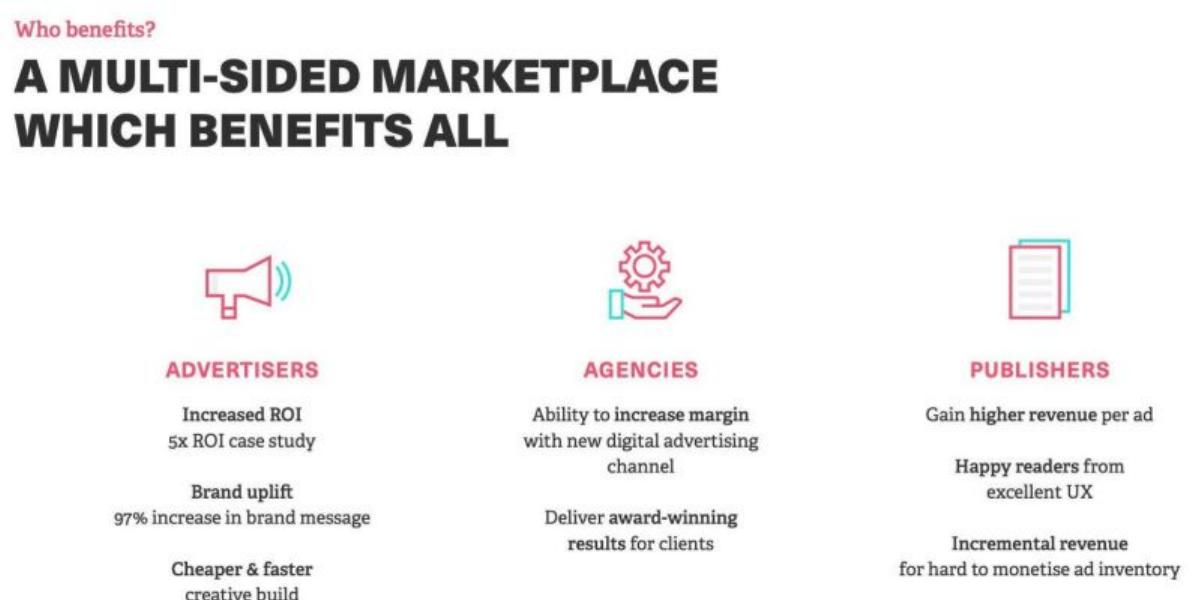
- A case study claims a 5x ROI for advertisers and a 97% increase in brand message uplift (Slide 5).
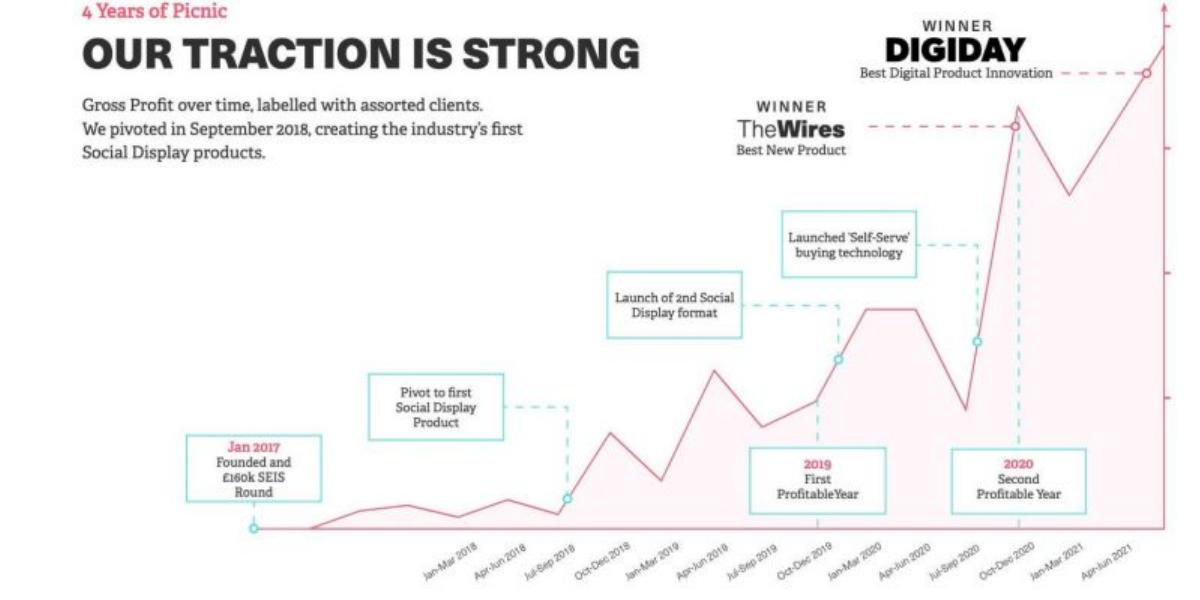
- The company was profitable in both 2019 and 2020 (Slide 6).
- Picnic identifies a £31B market opportunity in non-Facebook mobile digital display in the USA (Slide 7).
- The technology relies on Google AMP to ensure ad delivery is as fast as Instagram (Slide 8).
- The £1m funding ask is split: 50% for international expansion, 35% for R&D, and 15% for publisher solutions (Slide 9).
Executive Summary: The Pivot to Social Display
Picnic’s pitch deck for their 2021 Series A round is a lean, 10-slide presentation that prioritizes financial results and market positioning over narrative fluff. The company, Picnic Media Limited, defines itself as a digital advertising network. The core thesis is simple: the mobile web's display advertising experience is broken, and the solution lies in porting the engaging formats of social media (Stories, carousels) to the open web. Having reached a $2m run rate on just £160k of initial capital, the deck leans heavily into the 'efficiency' narrative to attract Series A investors.
Slide 1: About Picnic
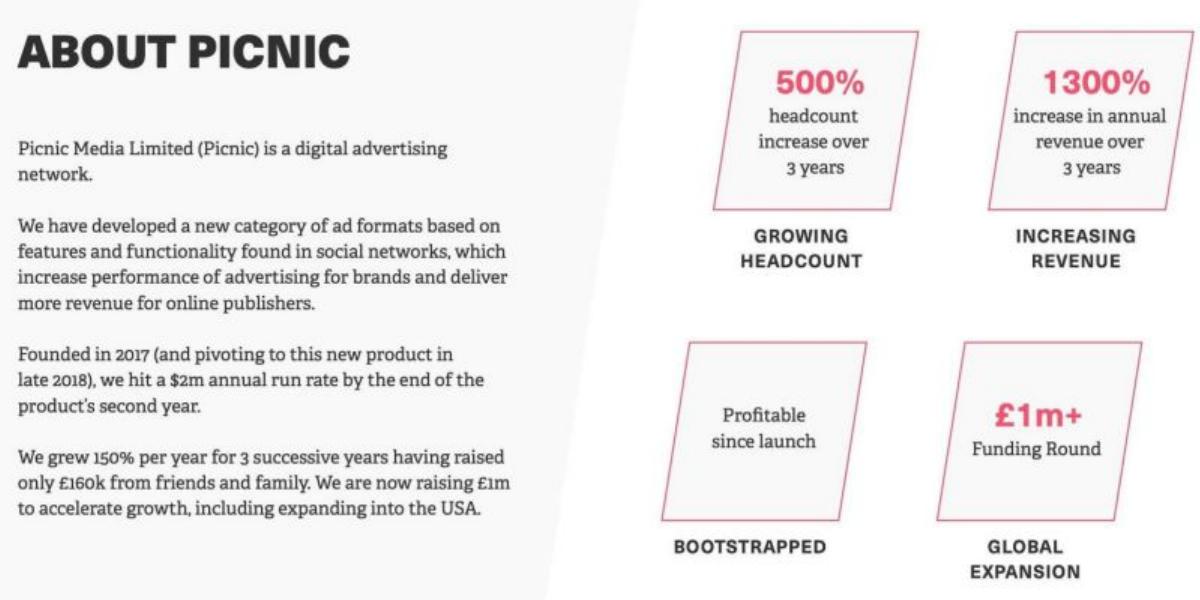
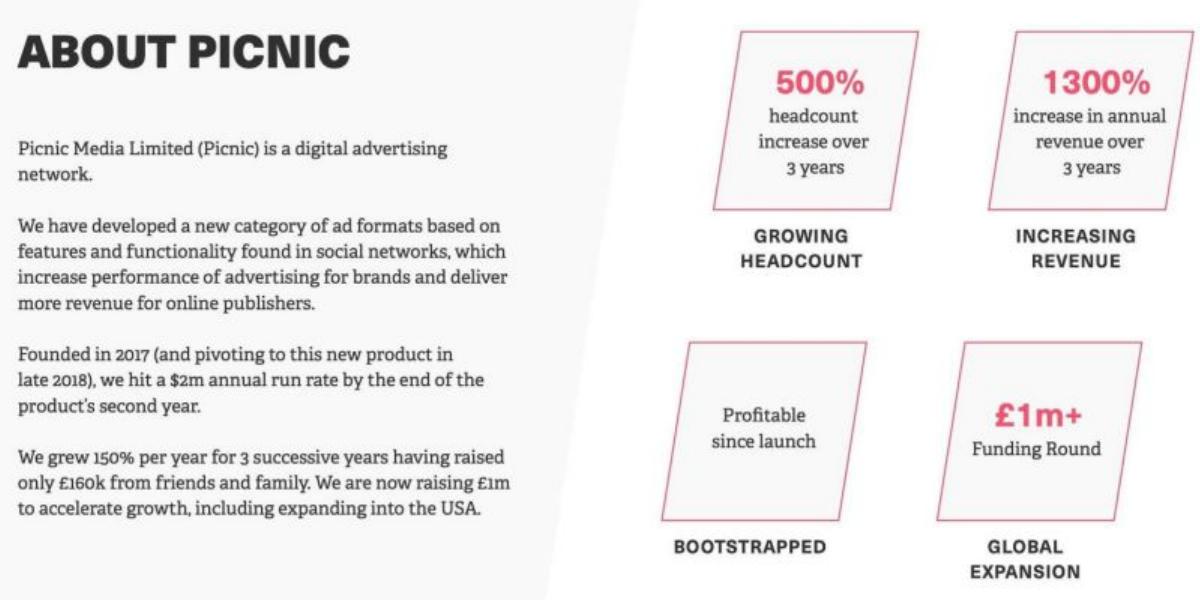
The deck opens with a high-impact summary of the business. It establishes Picnic as a digital advertising network founded in 2017, with a critical pivot to its current product in late 2018. The slide lists four major achievements: a 500% headcount increase , a 1300% increase in annual revenue over three years, a $2m annual run rate reached by the end of year two, and the fact that they have been profitable since launch . The slide also notes they are raising £1m to accelerate growth and expand into the USA.
Slide 2: The Problem
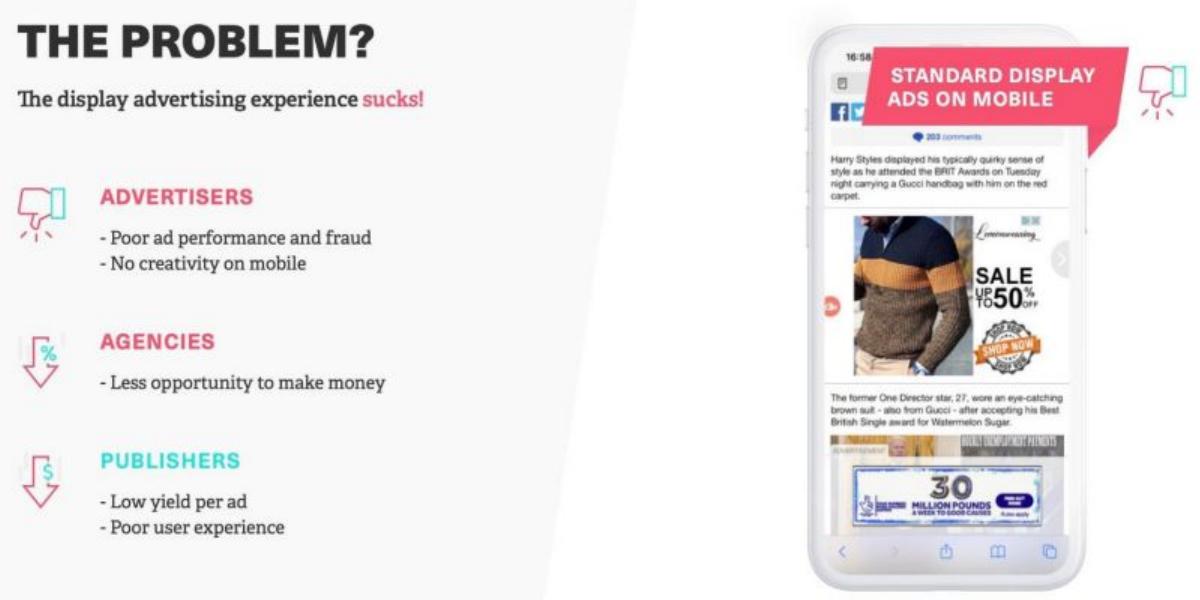
Slide 2 identifies the pain points for three distinct stakeholders in the advertising ecosystem. For Advertisers , the problem is poor performance, fraud, and a lack of creativity on mobile. For Agencies , there is less opportunity to generate margin. For Publishers , the issues are low yield per ad and a poor user experience for their readers. The slide uses a visual of a 'standard' mobile display ad with a 'thumbs down' icon to emphasize the 'sucking' experience of current mobile ads.
Slide 3: Picnic's Solution
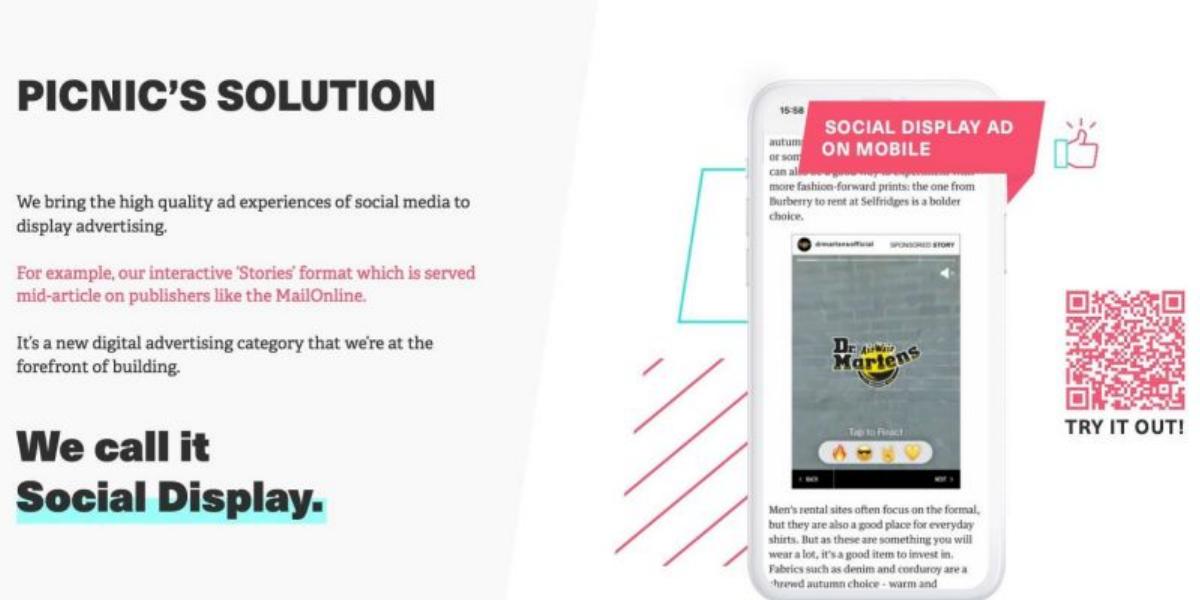
The solution is branded as 'Social Display.' Picnic brings the high-quality ad experiences of social media to standard display advertising. The slide highlights their interactive 'Stories' format, which is served mid-article on publishers like the MailOnline. A QR code is provided with the call to action 'TRY IT OUT!', allowing investors to experience the ad format on their own devices. This is a tactical move to prove the 'high quality' claim immediately.
Slide 4: The Marketplace
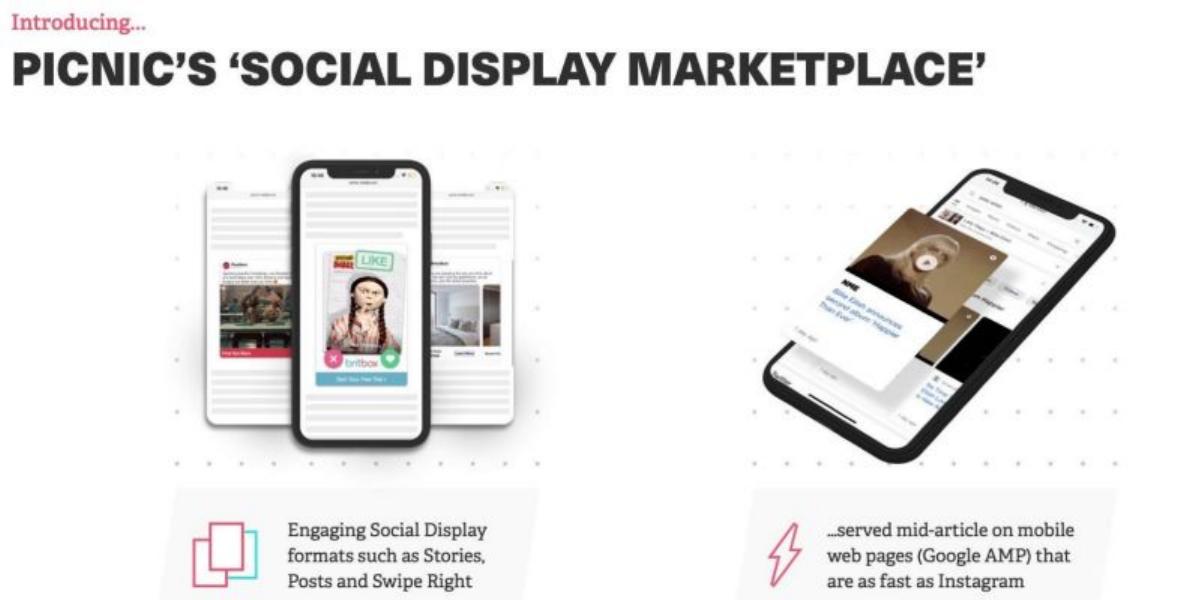
This slide introduces the 'Social Display Marketplace.' It clarifies the technical delivery: ads are served on mobile web pages using Google AMP . The value proposition here is speed; Picnic claims their ads are 'as fast as Instagram.' The slide lists formats including Stories, Posts, and 'Swipe Right,' positioning the product as a bridge between social media creative and the broader internet.
Slide 5: A Multi-Sided Marketplace
Slide 5 details the benefits for each participant. Advertisers see a 5x ROI (based on a case study) and a 97% increase in brand message uplift. Agencies gain the ability to increase margins and deliver 'award-winning results.' Publishers receive higher revenue per ad and 'happy readers' due to the improved user experience. This slide serves to validate the business model by showing how Picnic solves the problems identified on Slide 2.
Slide 6: Traction and Milestones
The traction slide features a line graph of Gross Profit over time from January 2017 to June 2021. It clearly marks the September 2018 pivot. Post-pivot, the graph shows significant growth, with callouts for the 'First Profitable Year' in 2019 and 'Second Profitable Year' in 2020. It also notes the launch of their 'Self-Serve' buying technology and two industry awards: The Wires 'Best New Product' and Digiday 'Best Digital Product Innovation.'
Slide 7: Market Opportunity
Picnic quantifies its target market using a nested circle visualization. In the UK, they identify a £10B mobile digital display market, with their specific opportunity at £93M (3% of the available market). In the USA, the mobile digital display market is £78B with a 13% 5-year CAGR. Picnic targets a £930M opportunity in the US, representing 3% of the non-Facebook mobile digital display market. This slide justifies the focus on US expansion mentioned in the ask.
Slide 8: The Competition
The competitive landscape is presented as a Venn diagram. Picnic places itself at the center of three circles: High Impact Display Advertising Marketplaces (Teads, TripleLift), Social Display Formats (Spaceback, Polar), and User Friendly Inventory . The slide claims Picnic is the 'only product where every ad is served on Google AMP,' which they describe as a 'substantial moat' ensuring a slick user experience.
Slide 9: The Ask
The final content slide details the £1m fundraising goal . The funds are split: 50% for International Expansion, 35% for R&D, and 15% for the Publisher Solution. To provide exit context, the slide lists 'Recent, Relevant Acquisitions': TripleLift (acquired by Vista Equity Partners for £1.4B) and Liftoff (Blackstone took a majority stake for £400m). A 24-month timeline for expansion is provided, starting with a NYC launch in 6 months and ending with a 'Rest of World' (RoW) launch in 24 months.
Slide 10: BestPitchDeck.com Promo
The final slide is a promotional graphic for the source of the deck, bestpitchdeck.com, and does not contain company-specific information.
What Picnic Does Well
The Picnic deck is exceptionally strong on proof of concept and financial discipline . By highlighting that they reached a $2m run rate with only £160k in seed funding, they signal to investors that they are efficient operators. The use of a QR code to 'Try It Out' is a brilliant way to bypass the difficulty of explaining 'interactivity' in a static PDF. Furthermore, the traction graph is honest; it shows the dip and flatline before the pivot, which builds credibility for the subsequent growth curve. They also do a great job of 'de-risking' the investment by showing they are already profitable, which is rare for a Series A pitch.
What is Missing from the Picnic Deck
The most glaring omission is the Team Slide . In a Series A round, the 'who' is often as important as the 'what.' There is no information on the founders' backgrounds, their experience in ad-tech, or the composition of the engineering team. Additionally, while they mention 'Publishers like MailOnline,' the deck lacks a Logo Slide showing the breadth of their network. Investors would also likely want to see Unit Economics —specifically, the take-rate of the marketplace and the Customer Acquisition Cost (CAC) for new advertisers versus the Lifetime Value (LTV).
What Other Founders Should Copy
Founders should emulate Picnic’s 'Problem-Solution-Benefit' flow. They don't just say what the product does; they explain exactly how it makes money for every person in the value chain (Advertisers, Agencies, Publishers). The Market Opportunity slide is also a great template: it doesn't just claim a 'Trillion Dollar Market'; it narrows the focus to a realistic 3% 'serviceable' segment of a specific niche (non-Facebook mobile display). Finally, the 'Recent, Relevant Acquisitions' section on the Ask slide is a smart way to anchor the company’s potential valuation in the minds of investors by pointing to billion-dollar exits in the same category.
Frequently asked questions
- What is Picnic's core product?
- Picnic operates a 'Social Display Marketplace.' They take high-quality, interactive ad formats typically found on social media—such as Stories, Posts, and 'Swipe Right' features—and serve them mid-article on mobile web pages. According to Slide 4, these are delivered via Google AMP to ensure the loading speed matches the user experience of native social media apps.
- How much did Picnic raise and what was the purpose?
- According to Slide 9, Picnic sought £1m. The primary objective for this capital was international expansion, which accounted for 50% of the allocation. Specifically, the timeline on Slide 9 outlines a launch in New York City within 6 months and a West Coast launch within 18 months. The remaining funds were earmarked for R&D (35%) and their publisher solution (15%).
- What evidence of market traction does the deck provide?
- The deck provides a gross profit growth chart on Slide 6. It shows consistent upward movement from the pivot in September 2018 through April-June 2021. Key milestones include reaching profitability in 2019 and 2020, and winning industry awards such as 'The Wires Best New Product' and 'Digiday Best Digital Product Innovation.'
- Who are Picnic's main competitors?
- Slide 8 maps the competitive landscape. Picnic positions itself at the intersection of 'High Impact Display Advertising Marketplaces' (competitors like Teads, JustPremium, TripleLift, and Kargo) and 'Social Display Formats' (competitors like Spaceback and Polar). Picnic claims its 'moat' is being the only product where every ad is served on Google AMP for a 'user-friendly' experience.
- What is missing from this pitch deck?
- The most notable omission is a team slide. There is no mention of the founders, their backgrounds, or the current headcount beyond a mention of a '500% headcount increase' on Slide 1. Additionally, the deck lacks a detailed breakdown of unit economics, churn rates, or a specific list of current publishing partners, though it mentions MailOnline as an example.