Pilgrim Soul’s pitch deck is a masterclass in niche positioning. By targeting the 'Creative Class'—a demographic backed by World Economic Forum data—the company moves cannabis away from stoner stereotypes and into the realm of professional productivity. The deck highlights significant early traction, reporting $5.8M in revenue within the first 15 months and a database of 250,000 users. Its strategy relies on a '360-degree tool set' that includes proprietary live resin blends, physical journals, and digital content. While the deck excels at brand storytelling and SEO dominance, it lacks tradit…
Key takeaways
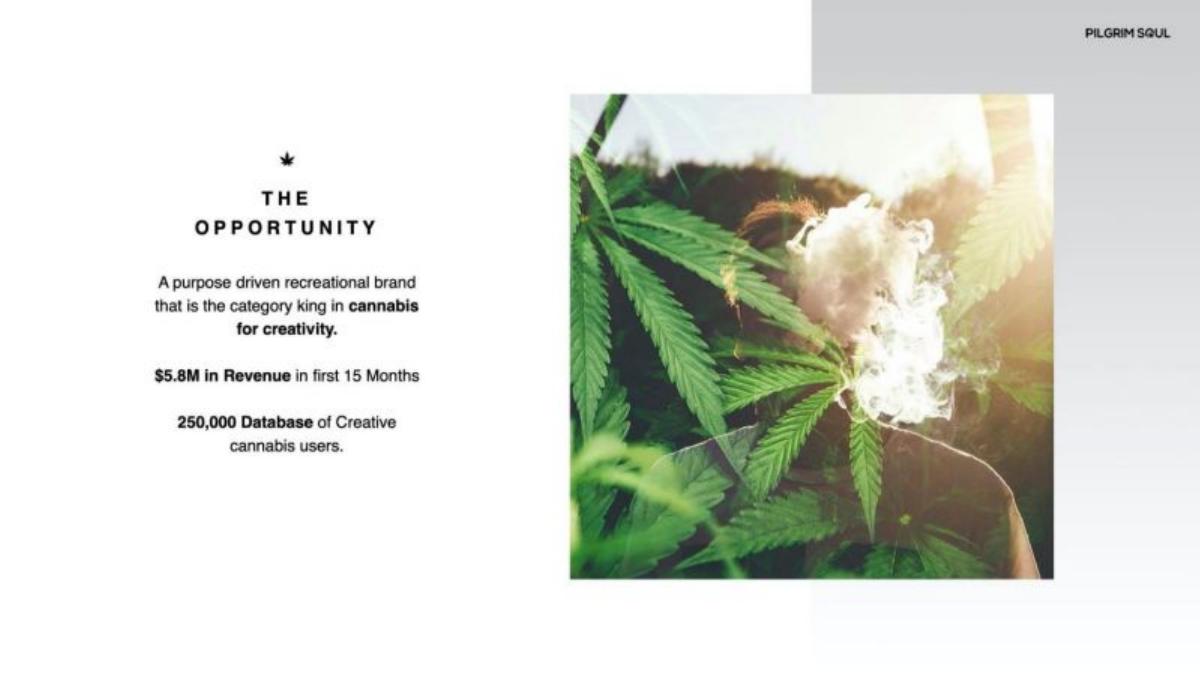
- The company reported $5.8M in revenue within its first 15 months of operation (Slide 2).
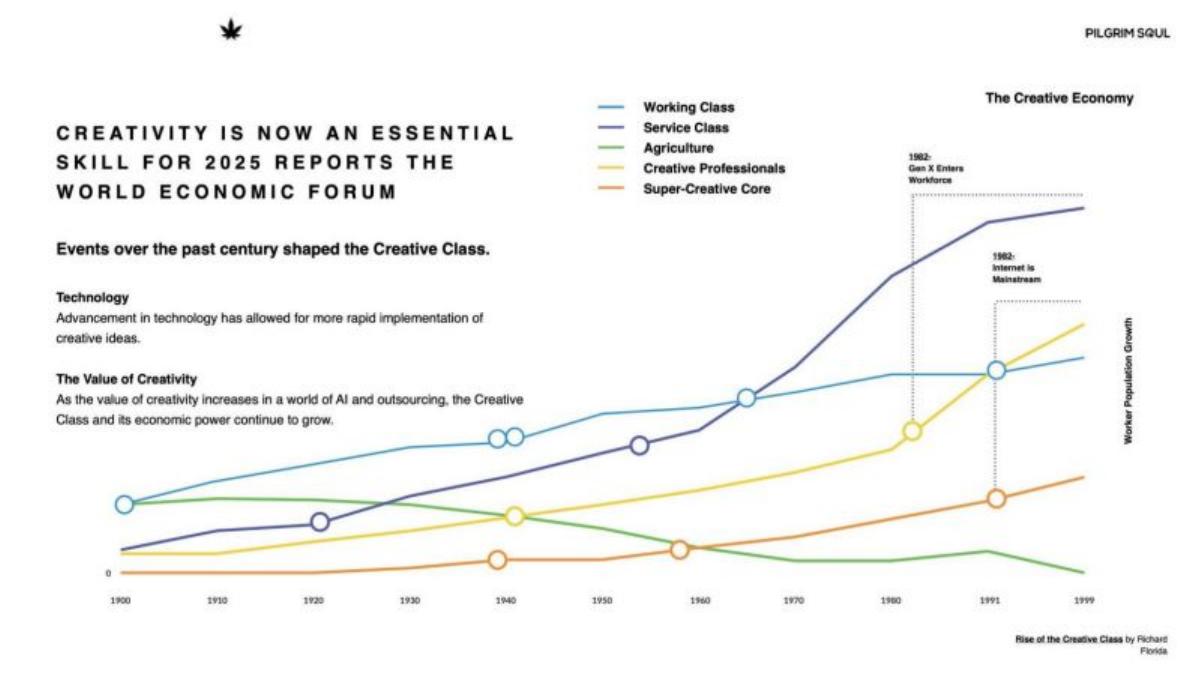
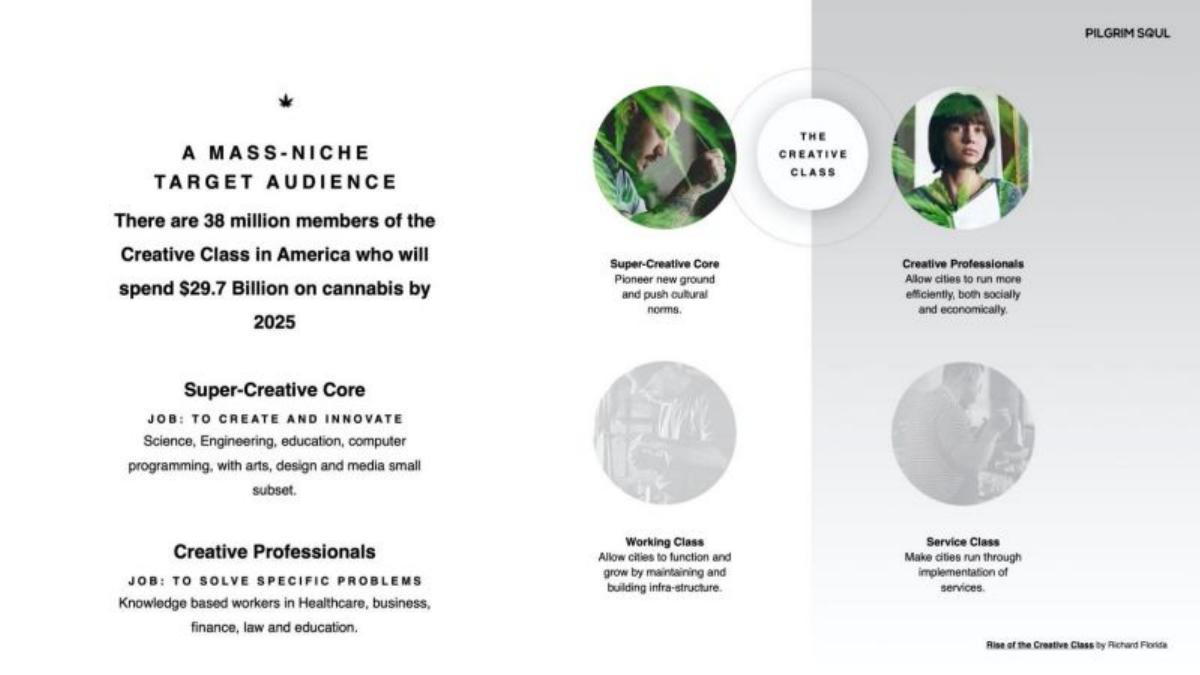
- Pilgrim Soul identifies its target market as the 'Creative Class,' citing a World Economic Forum report that creativity is an essential skill for 2025 (Slide 3).
- The brand maintains a database of 250,000 creative cannabis users to drive direct-to-consumer engagement (Slide 2).
- Product differentiation is built on four proprietary live resin blends: Creative Awareness, Creative Imagination, Creative Focus, and Creative Reflection (Slide 6).
- The company claims #1 SEO rankings for high-intent keywords like 'Best marijuana for creativity' and 'Creative cannabis strains' (Slide 7).
- The business model extends beyond cannabis into merchandise, featuring a 'Creative Thinking Journal' with celebrity collaborations like Martin Lawrence (Slide 10).
- Expansion plans include a licensable national brand model with partnerships across 10+ states including California, Florida, and Illinois (Slide 11).
- The marketing strategy relies on a mix of targeted social advertising, retail budtender engagement, and press/influencer endorsements (Slide 12).
The Pitch: Cannabis as a Performance Enhancer
Pilgrim Soul’s deck is a departure from the typical 'green rush' presentations that focus on cultivation yields or dispensary footprints. Instead, this is a brand-first play. The company positions itself as the 'Category King' for a specific use case: creativity. By narrowing the focus, they move away from competing on price-per-gram and instead compete on psychological utility. The deck, used to raise $2M in 2022, leans heavily on the idea that the 'Creative Class' is an underserved but massive market segment.
Slide 1-2: The Hook and The Numbers
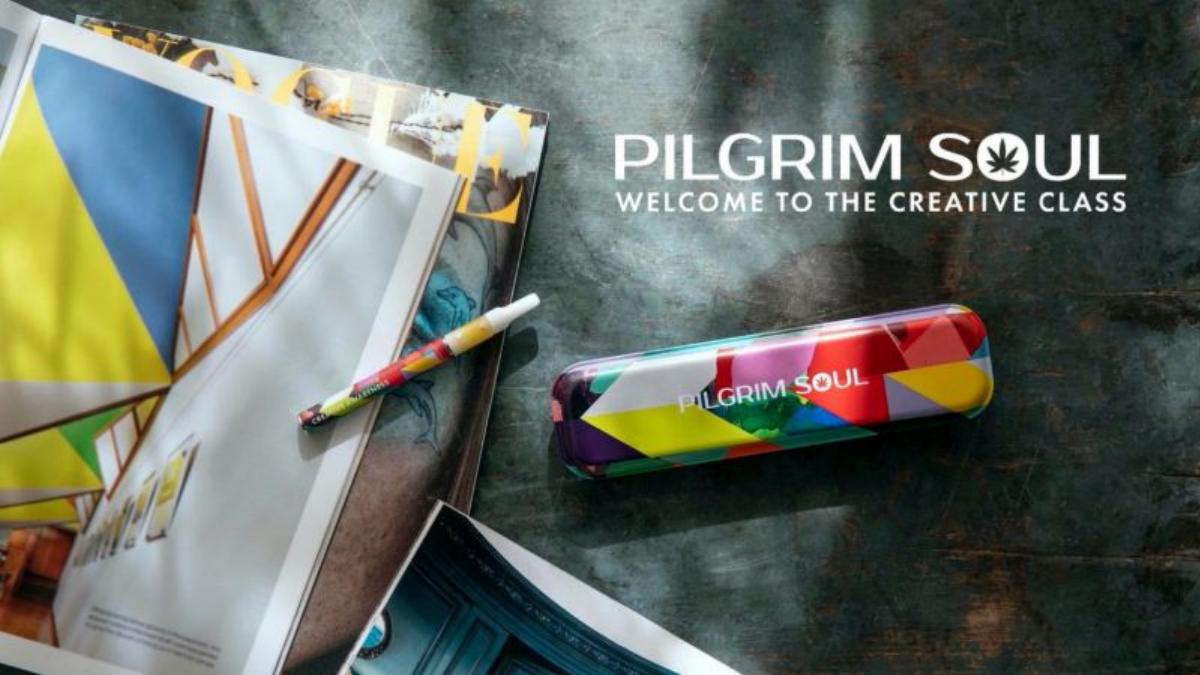
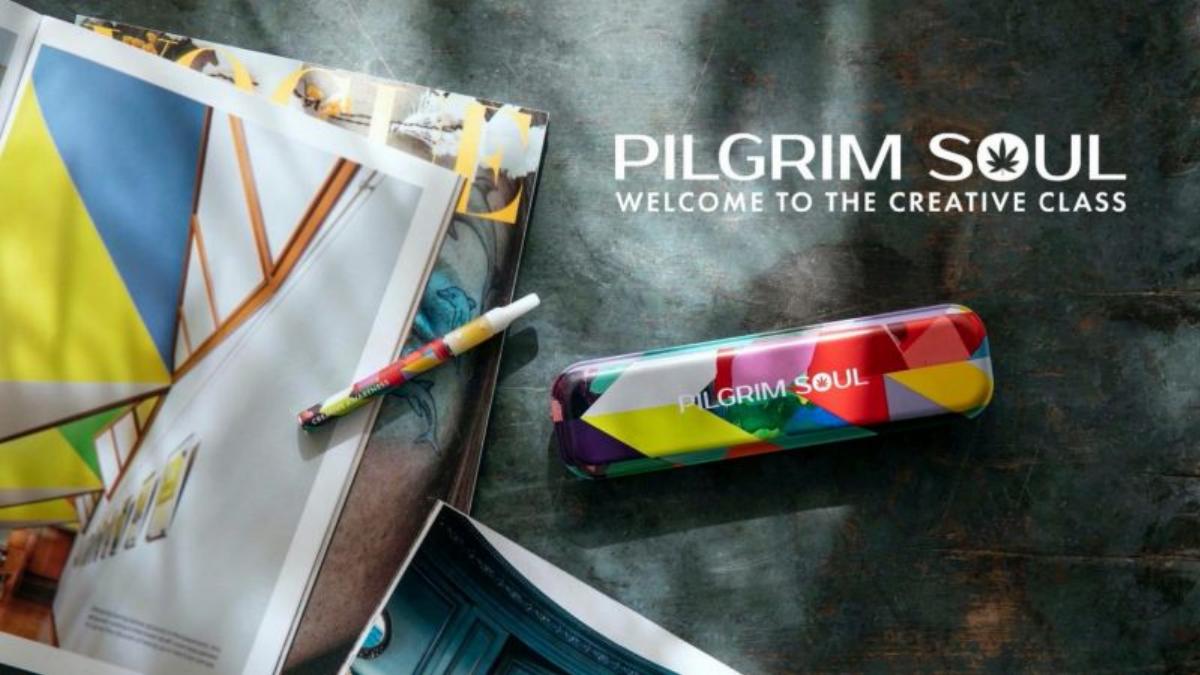
The cover slide sets a high-end, lifestyle tone with the tagline 'Welcome to the Creative Class.' It features clean, colorful product design that looks more like a tech accessory or a high-end stationery brand than a traditional cannabis product. Slide 2 immediately follows up with hard evidence to prevent the brand from seeming like 'all fluff.' It states the company earned $5.8M in Revenue in the first 15 months and has built a 250,000 Database of Creative cannabis users . This is a powerful opening; it proves that the 'creative' niche is not just a theory but a revenue-generating reality.
Slide 3-5: Establishing the Macro Need
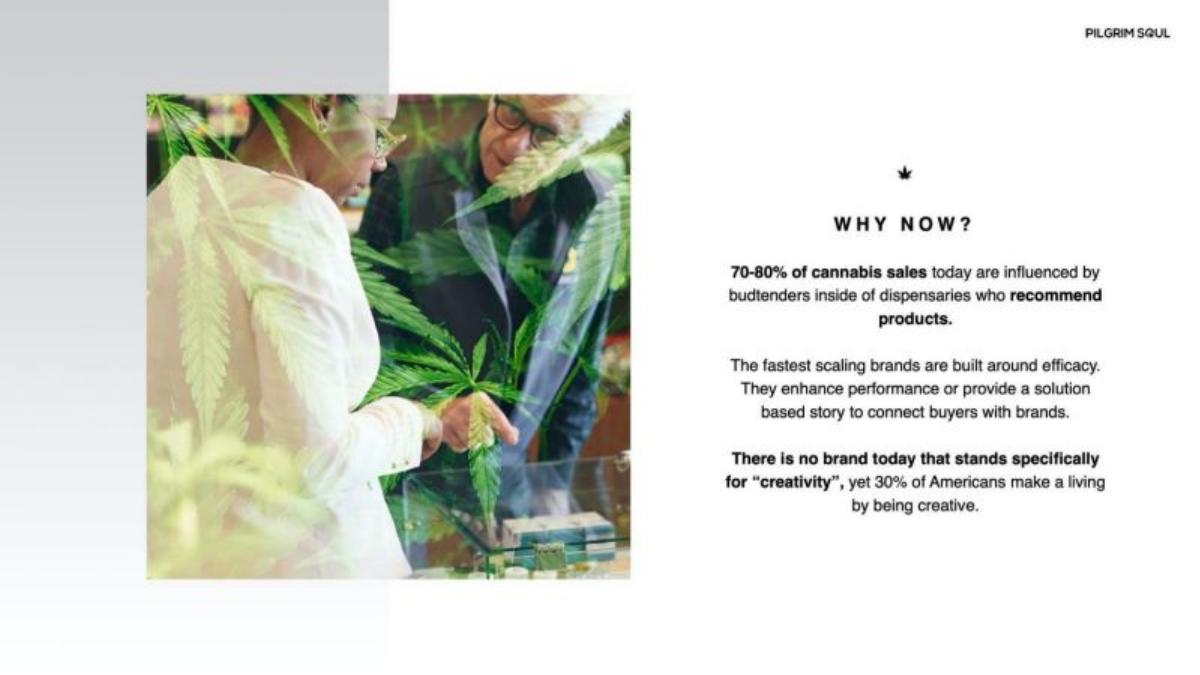
Slide 3 uses a chart from Richard Florida’s 'Rise of the Creative Class' to show the worker population growth of creative professionals and the 'Super-Creative Core' from 1900 to 1999. It anchors the business in a global trend, citing the World Economic Forum's report that creativity is an essential skill for 2025. This 'Why Now' argument is bolstered by Slide 4 , which features 'Titans of the Creative Class.' By quoting Steve Jobs ('relaxed and creative'), Carl Sagan ('serenity and insight'), Lady Gaga, and Martha Stewart, the deck successfully aligns cannabis with high-achieving, respectable figures. Slide 5 breaks down the science, or at least the perceived benefits, of how cannabis enhances thinking through 'Enhanced Imagination,' 'Hyper Focus,' 'Empathetic Understanding,' and 'Pattern Recognition.'
Slide 6-8: The Product and Authority
Slide 6 introduces the 'Exclusive Live Resin Blends.' Rather than naming products 'OG Kush' or 'Blue Dream,' Pilgrim Soul uses functional names: Creative Awareness (No. 001), Creative Imagination (No. 002), Creative Focus (No. 003), and Creative Reflection (No. 004) . Each blend is mapped to specific moods like 'Uplifted' or 'Euphoric' using a proprietary 3-strain formula. Slide 7 highlights their 'Expert Content' strategy. The brand isn't just selling oil; they are selling information. The slide lists 18 different SEO rankings where they hold the #1 or #2 spot for terms like 'Journal while high' and 'Creative cannabis strains.' This demonstrates a low-cost customer acquisition strategy that competitors would find difficult to replicate. Slide 8 summarizes their '360° Creative Tool Set,' which includes the blends, a 'Creativity Curriculum,' and a sharing platform.
Slide 9-10: Cultural Integration and Merchandise
Slide 9 features a quote from Nobel Prize-winning poet William Butler Yeats, from whose poem 'The Pilgrim' the company takes its name. This adds a layer of intellectual depth rarely seen in the industry. Slide 10 showcases their 'Creative Thinking Journal: Martin Lawrence Edition.' This is a critical slide because it proves the brand's ability to cross over into mainstream retail and celebrity culture. The journal, which explicitly says 'Please use this journal while you are high,' leverages Lawrence's 21 Million Social Followers to expand the brand's reach beyond the dispensary.
Slide 11-12: Scaling and Marketing
Slide 11 addresses the 'How.' Cannabis is notoriously difficult to scale due to state-by-state regulations. Pilgrim Soul’s solution is to build a 'Licensable National Cannabis Brand.' The map shows a rollout plan starting with California in Q3 2021 and expanding to states like Florida (Q1 2023), Illinois (Q2 2023), and Michigan (Q4 2022). By focusing on the IP and branding while partnering with local cultivators, they aim for a capital-light expansion. Slide 12 outlines the marketing mix: targeted social ads (FB/Insta/Snap), retail budtender engagement, and influencer endorsements. This multi-channel approach is designed to create a '360-degree' brand experience.
What Pilgrim Soul Does Well
The deck is exceptionally strong at differentiation . In a crowded market, they have claimed a specific psychological territory (creativity) and backed it up with both cultural 'titans' and modern economic data. The SEO dominance shown on Slide 7 is a standout metric; it proves they own the digital conversation around their niche. Furthermore, the revenue-to-time ratio ($5.8M in 15 months) is impressive for a Seed-stage company, suggesting strong product-market fit. The visual design of the deck itself reflects the 'Creative Class' it seeks to serve—it is professional, artistic, and uncluttered.
What is Missing from the Deck
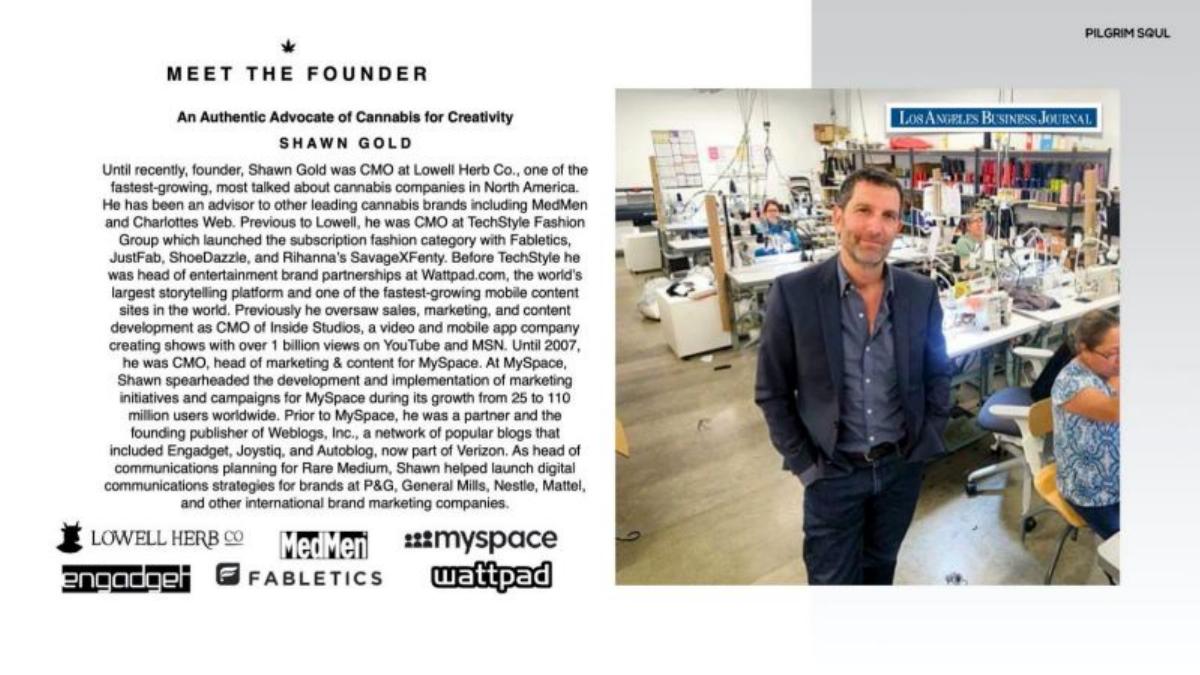
Despite the strong branding, the 13 slides provided omit several key investor requirements. There is no Team Slide in this selection, which is a major gap for a Seed round where the founders' background in cannabis or CPG is vital. There is also no 'The Ask' slide ; while we know from the catalogue they raised $2M, the deck doesn't specify the terms or how that capital will be allocated (e.g., % to marketing vs. % to R&D). Additionally, there are no unit economics . While we see total revenue, we don't see the margins on the live resin blends versus the journals, nor do we see the Customer Acquisition Cost (CAC) or Lifetime Value (LTV) of those 250,000 users.
Founder's Teardown: What to Copy
Lead with Traction: If you have millions in revenue, put it on Slide 2. It buys you the right to be 'visionary' in the later slides. · Own a Use Case: Don't just be 'the best cannabis.' Be the 'cannabis for [Specific Activity].' It makes your marketing and SEO much more efficient. · Use Macro Trends: Aligning your startup with a World Economic Forum report or a major economic shift (like the rise of the Creative Class) makes your success seem inevitable rather than accidental. · Show, Don't Just Tell, Authority: Listing specific #1 SEO rankings is much more convincing than simply saying 'we have a great content strategy.' · Diversify Revenue Streams: Showing that the brand can sell non-cannabis products (like journals) proves the strength of the IP and provides a pathway to national sales that aren't restricted by drug laws.
Frequently asked questions
- What is Pilgrim Soul's core product offering?
- Pilgrim Soul offers a '360-degree creative tool set.' This includes four exclusive live resin cannabis blends (Awareness, Imagination, Focus, and Reflection), physical products like the 'Creative Thinking Journal,' and expert digital content designed to position the brand as an authority on cannabis-enhanced creativity.
- How does the company justify its focus on creativity?
- The deck uses macroeconomic data from the World Economic Forum and Richard Florida’s 'Rise of the Creative Class' to show that creative professionals are the fastest-growing economic segment. They argue that as AI and outsourcing increase, the value of human creativity—and tools that enhance it—will grow.
- What kind of traction has Pilgrim Soul achieved?
- The company shows strong early-stage performance, generating $5.8M in revenue in its first 15 months. They have also built a proprietary database of 250,000 users and achieved top SEO rankings for numerous creativity-related cannabis search terms, providing a significant moat against competitors.
- What is the company's expansion strategy?
- Pilgrim Soul is building a 'licensable national cannabis brand.' Instead of owning cultivation in every state, they establish partnerships with multi-state cultivators, manufacturers, and distributors to scale their branded content and merchandise alongside their specific cannabis formulas.
- Who are the 'Titans of the Creative Class' mentioned in the deck?
- The deck uses historical and modern figures to destigmatize cannabis use among professionals. It quotes Steve Jobs, Carl Sagan, Lady Gaga, and Martha Stewart, all of whom have publicly discussed the positive impact of cannabis on their creative or professional lives.