Pictofy is a specialized marketplace designed to streamline the delivery of professional event photography to attendees in real-time. The product utilizes a Wi-Fi-enabled SD card to bridge the gap between a DSLR camera and a cloud-based platform, where face recognition AI sorts images for end-users. Their business model relies on a dual-revenue stream: a subscription fee for event organizers and a 15% commission on individual photo sales from photographers. Seeking $150,000, the company allocates the majority of funds to marketing and operations. While the deck provides a clear technical work…
Key takeaways
- The product workflow relies on a physical 'SD card with Wi-Fi network' to move images from camera to cloud (Slide 2).
- Pictofy utilizes face recognition AI to categorize photos within its mobile marketplace (Slide 2).
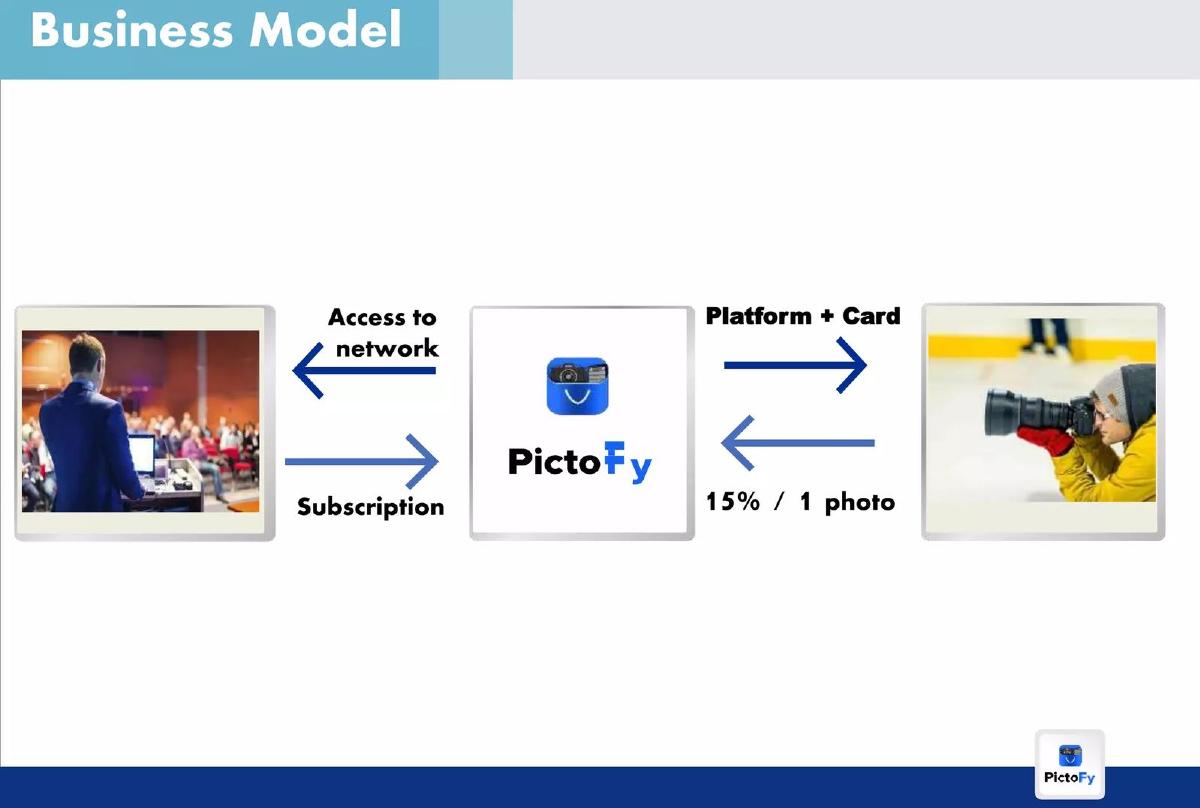
- The business model charges a 15% commission per photo sale to photographers and a subscription fee to event organizers (Slide 3).
- Competitive positioning distinguishes Pictofy from personal storage like Dropbox and stock marketplaces like Shutterstock (Slide 4).
- The startup is seeking a $150,000 investment for operations, development, and marketing (Slide 5).
- Marketing is the largest planned expense at $60,000, followed by $50,000 for operational costs (Slide 5).
- The mobile application features a 'Backup' function allowing users to create folders and filter by username or time (Slides 7-8).
- The deck completely omits a team slide, providing no information on the founders' backgrounds or technical expertise.
Slide-by-Slide Analysis
Slide 1: Title and Branding
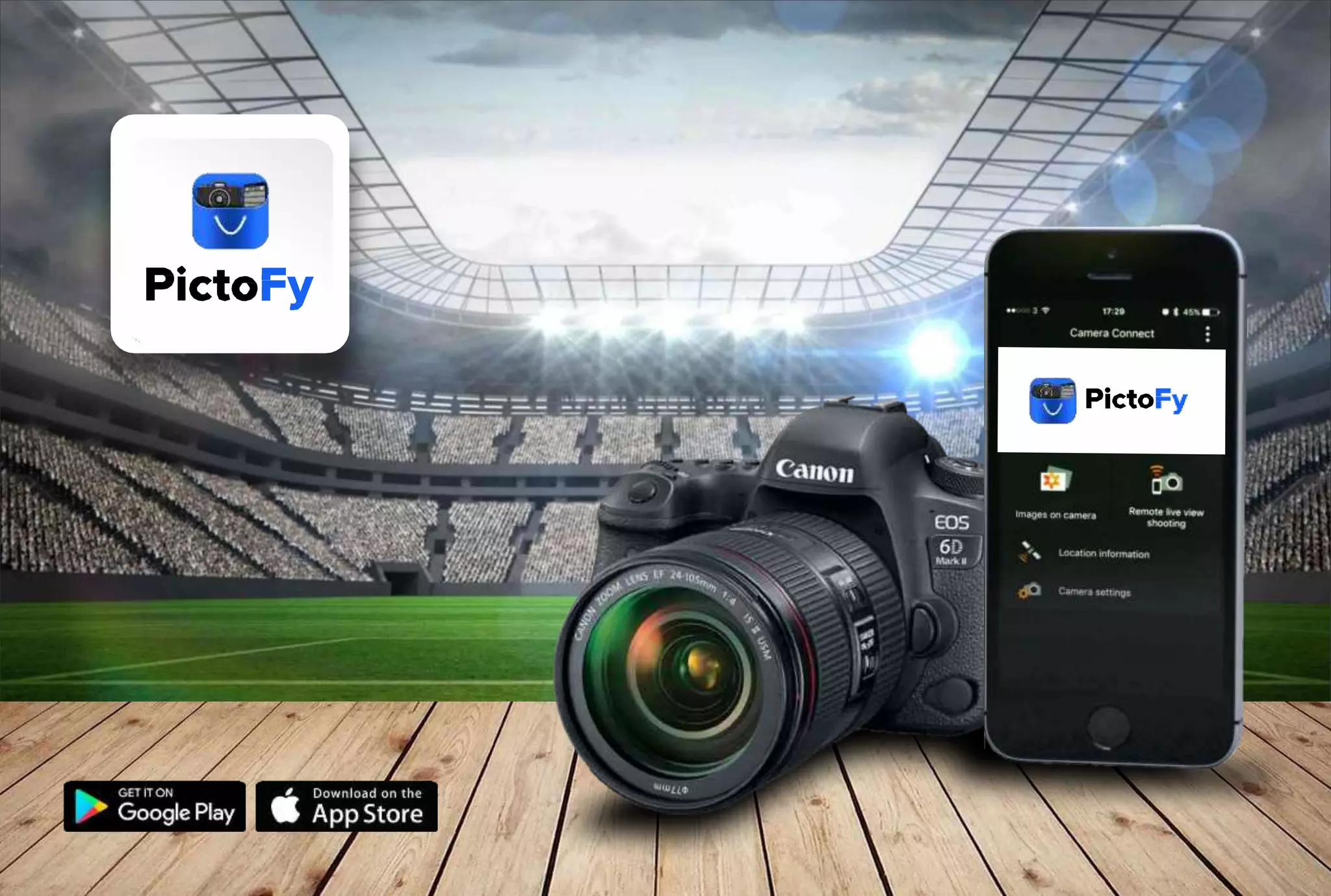
The cover slide features the Pictofy logo, which incorporates a camera icon inside a shopping bag, signaling a marketplace for photography. The background image is a professional sports stadium, suggesting a target use case for large-scale events. A DSLR camera (Canon EOS 6D Mark II) is shown next to a smartphone displaying the Pictofy app interface. App store badges for Google Play and the Apple App Store are present, indicating the product is live or ready for distribution.
Slide 2: Product Workflow
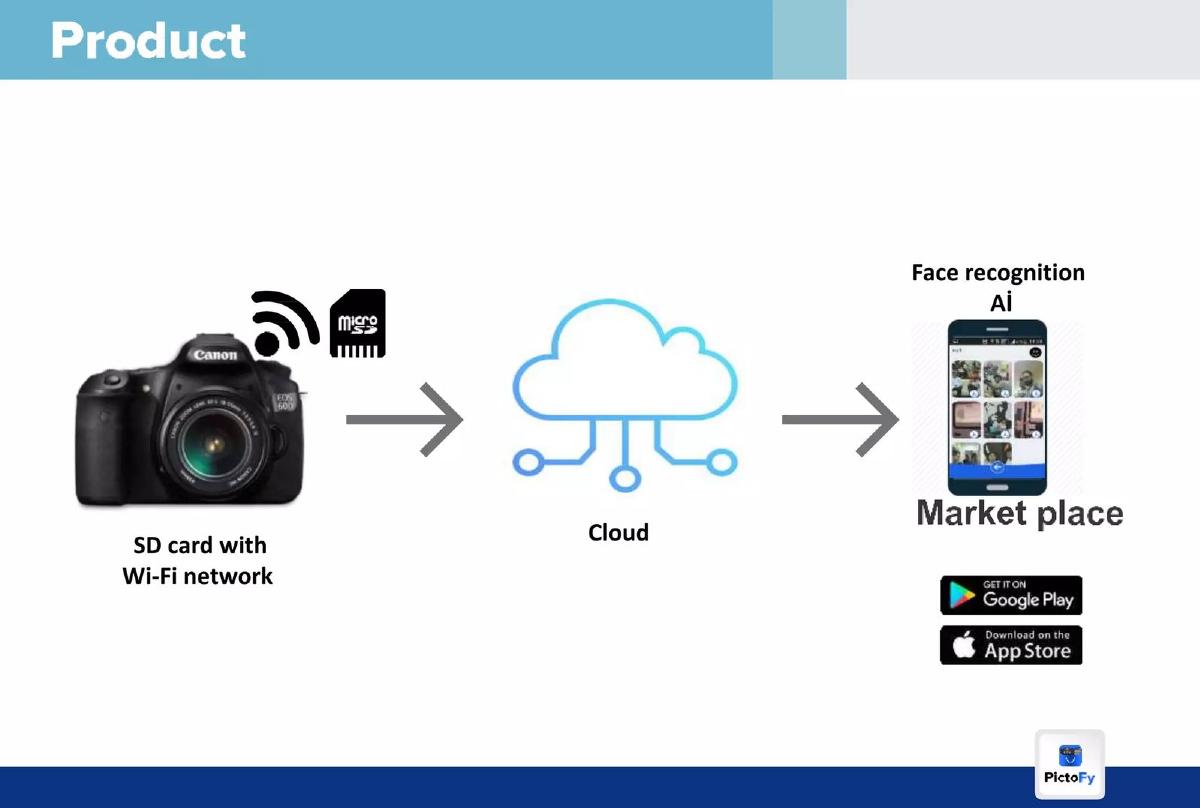
This slide illustrates the technical pipeline. It starts with a "SD card with Wi-Fi network" inserted into a camera. An arrow points to a "Cloud" icon, which then leads to a smartphone interface labeled "Market place." The slide explicitly mentions "Face recognition Ai" as the mechanism for organizing photos within the app. This is a crucial technical detail, as it explains how attendees find their specific photos among thousands taken at an event.
Slide 3: Business Model
Pictofy presents a B2B2C model. On the left, an event organizer (represented by a speaker at a podium) pays a "Subscription" in exchange for "Access to network." In the center is the Pictofy platform. On the right, a professional photographer receives the "Platform + Card" and in return, Pictofy takes a "15% / 1 photo" cut of sales. This indicates the platform facilitates the transaction and handles the distribution hardware.
Slide 4: JTBD & Competitive Advantage
Using a Jobs-to-be-Done (JTBD) framework, the slide positions Pictofy at the center of three overlapping circles. "Personal gallery" includes Dropbox and Google Photos. "Market place" includes Shutterstock and Imagekind. "Real time file sharing" is represented by wireless icons. The slide argues that while these competitors solve parts of the problem, only Pictofy combines real-time sharing with a commercial marketplace for personal event photos.
Slide 5: Investment Ask
The company is seeking "150 K" in total investment. A donut chart breaks this down into three categories: "Marketing" at $60,000 , "Operational costs" at $50,000 , and "Product Development" at $40,000 . The relatively low ask and the high percentage allocated to marketing suggest a seed-stage company looking to prove its go-to-market strategy rather than build core technology from scratch.
Slide 6: Call to Action
This slide serves as a contact page. It encourages users to "Download & Sign up for FREE right now." It lists social media handles ( @pic2fy ) and a phone number with a +994 country code, which corresponds to Azerbaijan. This provides a geographical context for the startup's headquarters or initial target market.
Slide 7: Backup Interface (App Screenshot)
Labeled "Backup," this slide shows three screens from the mobile app. The UI includes an "Uploading" and "Gallery" toggle. Users can "Select or Create Folder," with a sample folder named "Testing" visible. The interface appears to be an early-stage Android build, evidenced by the status bar icons and the "null" text in the header, which suggests a placeholder or unpopulated data field in the UI.
Slide 8: Filtering and Discovery (App Screenshot)
Continuing the "Backup" theme, this slide shows a gallery of photos featuring people at an event. A "Filter" modal is shown with options to "Sort by username," "Folder create time," or "Folder Name." This reinforces the utility of the AI face recognition mentioned earlier, allowing users to quickly navigate large sets of event imagery to find specific individuals.
What Pictofy Does Well
The deck is highly visual and avoids the common mistake of over-explaining technical details with walls of text. By using a simple flow chart on Slide 2, the founders clearly communicate a complex hardware-to-software process. The business model on Slide 3 is also commendable for its clarity; it identifies exactly who pays, what they get, and what the platform's take-rate is. Many early-stage decks struggle to define their commission structure so explicitly.
Furthermore, the competitive positioning on Slide 4 is effective. Instead of a standard checkmark grid, the Venn diagram approach helps investors understand the specific niche Pictofy occupies—specifically, the intersection of real-time delivery and commercialization, which general-purpose storage apps like Dropbox do not address.
What is Missing from the Deck
The most glaring omission is a Team Slide . In a seed-round investment of $150,000, investors are primarily betting on the founders. Without bios, photos, or a list of previous accomplishments, there is no way to verify if the team has the technical capability to manage AI and hardware integration or the industry connections to sign up event organizers.
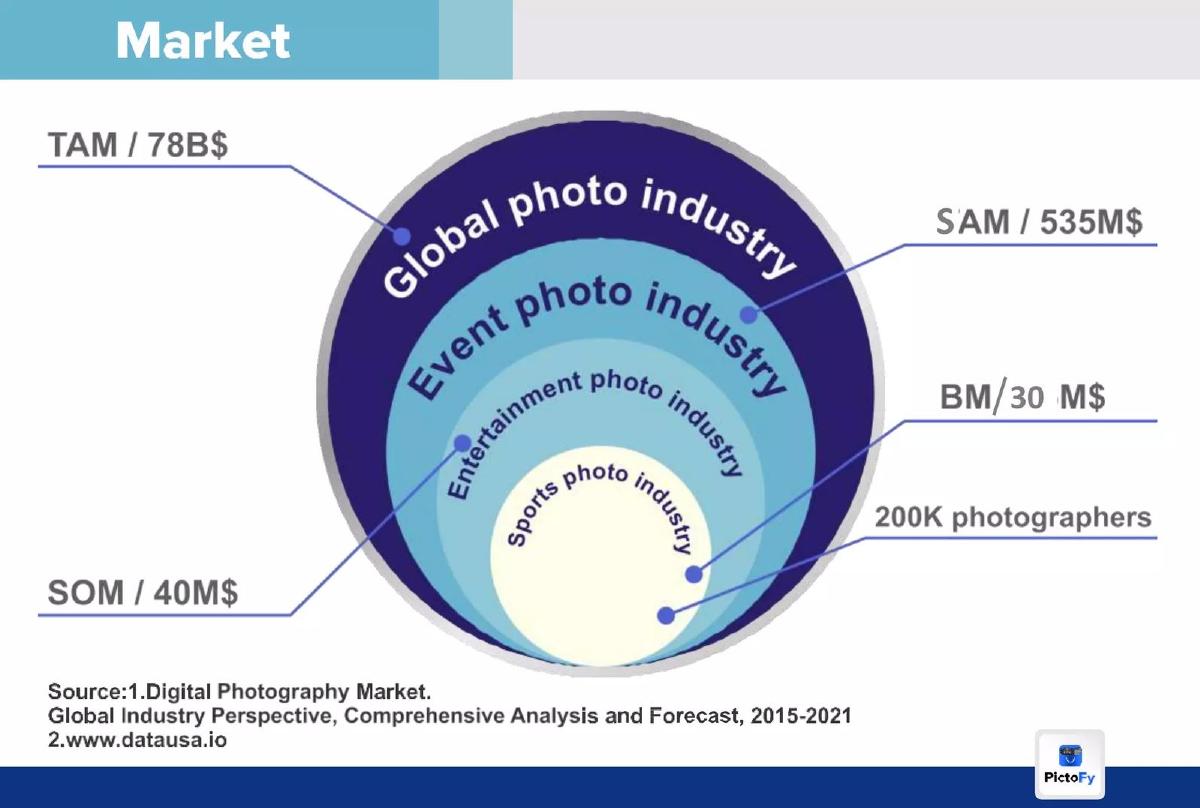
There is also a total lack of Market Size (TAM/SAM/SOM) data. While the stadium imagery implies a large market, the deck does not quantify how many professional events occur annually or what the total spend on event photography is. Without these figures, the $150,000 ask feels arbitrary because the potential return on investment is uncalculated.
Finally, the Traction slide is missing. The app screenshots on Slides 7 and 8 show "null" values and "Testing" folders, which suggests the product may still be in a beta or prototype phase. A slide showing how many photographers have signed up or how many photos have been sold to date would significantly strengthen the pitch.
Founder's Guide: What to Copy
Clear Revenue Flow: Founders should emulate Slide 3. It uses simple icons and arrows to show the flow of value and money. It answers the 'How do you make money?' question in five seconds.
Hardware-Software Visualization: If your startup involves a physical component (like an SD card), Slide 2 is a great template. It doesn't get bogged down in Wi-Fi protocols or API documentation; it simply shows the journey of the data from the device to the user's hand.
Specific Use of Funds: Slide 5 is a good example of how to present an ask. Rather than just saying 'we need money for growth,' breaking it down into specific buckets (Marketing, Ops, Dev) with dollar amounts gives investors a clear picture of the company's immediate priorities.
Final Analyst Thoughts
Pictofy identifies a genuine friction point in the event industry: the delay between a photo being taken and an attendee receiving it. The use of Wi-Fi SD cards is a clever way to retrofit existing professional gear without requiring photographers to buy new cameras. However, the deck feels incomplete. To move from a 'project' to a 'venture,' the founders need to address the missing team and market data. The presence of 'null' in the app screenshots also suggests that the software requires more polish before it is ready for the $60,000 marketing push they are requesting.
Frequently asked questions
- What is the core technology behind Pictofy?
- Pictofy uses a hardware-software hybrid approach. According to Slide 2, the process begins with a Wi-Fi-enabled SD card inserted into a DSLR camera. This card transmits photos to the Pictofy cloud, where face recognition AI processes the images. The final output is a mobile marketplace where users can find and purchase photos of themselves.
- How does Pictofy make money?
- The business model shown on Slide 3 is two-sided. On the event side, organizers pay a 'Subscription' for 'Access to network.' On the photographer side, the platform provides the 'Platform + Card' and takes a '15% / 1 photo' commission on sales made through the marketplace.
- Who are Pictofy's main competitors?
- Slide 4 categorizes competitors into three groups: Personal Gallery (Dropbox, Google Photos), Real-time file sharing (AirDrop/generic wireless icons), and Marketplaces (Shutterstock, Imagekind). Pictofy claims to sit at the intersection of all three, offering real-time sharing specifically for a marketplace environment.
- What is the investment ask and how will it be used?
- As stated on Slide 5, Pictofy is seeking $150,000. The allocation is broken down into $60,000 for Marketing, $50,000 for Operational costs, and $40,000 for Product Development. This suggests a heavy focus on user acquisition and platform maintenance rather than heavy R&D.
- What critical information is missing from the Pictofy deck?
- The deck is missing several standard venture components. There is no 'Team' slide to validate the founders, no 'Market Size' (TAM/SAM/SOM) slide to show the opportunity scale, and no 'Traction' slide to prove current user numbers or revenue. Additionally, there is no timeline or roadmap for future development.