Pillar's 15-slide pitch deck successfully secured $5.5M in Seed funding by framing student loan debt as a massive, growing psychological and financial burden. The deck identifies a $1.6 trillion market opportunity and proposes a simple B2C subscription model ($5/month) to provide personalized repayment recommendations. While the deck lacks specific current traction metrics, it compensates with a highly experienced team from top-tier tech firms like Google, Uber, and DoorDash. The narrative relies heavily on product screenshots to demonstrate a 'friendly' UI that contrasts with the jargon-heav…
Key takeaways
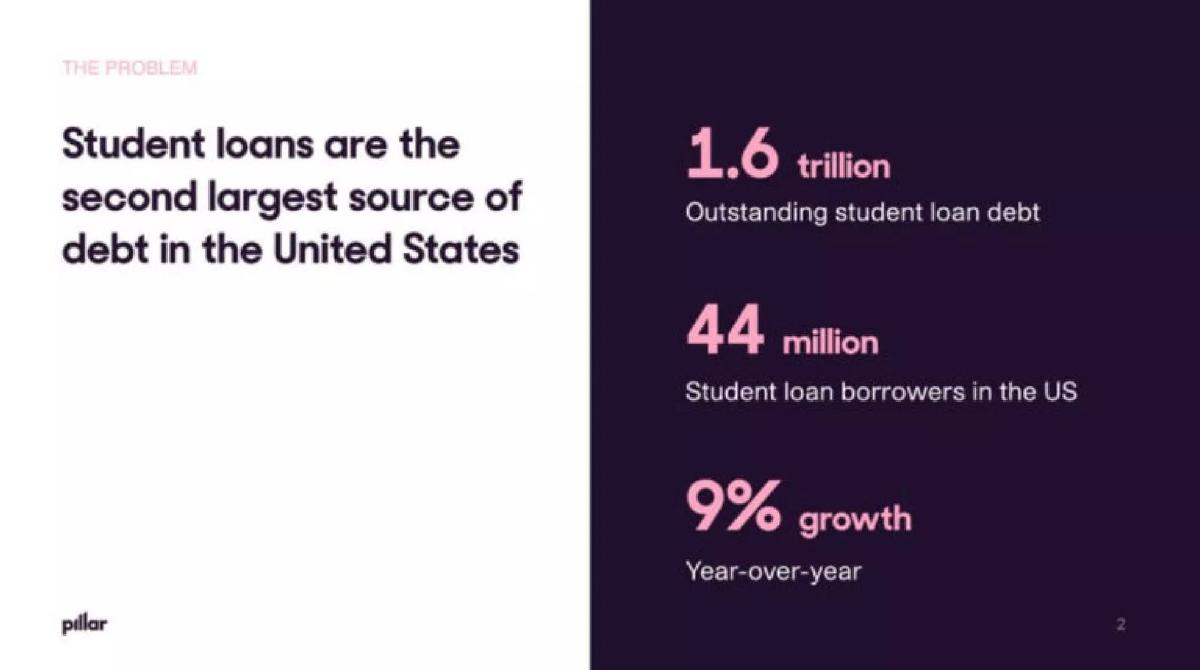
- The deck identifies a $1.6 trillion outstanding student loan debt market with 9% year-over-year growth on Slide 2.
- Pillar proposes a direct-to-consumer (B2C) subscription model charging $5 per month, aiming for $120M in yearly revenue at 2M users as shown on Slide 9.
- The competitive analysis on Slide 8 positions Pillar as the only 'Full coverage' personalized B2C solution compared to B2B benefit providers or simple 'Round Up' apps.
- Growth strategy relies on organic channels, with 40% of new users currently signing up via referrals and word-of-mouth according to Slide 10.
- The business roadmap on Slide 11 outlines a path to $150M+ revenue and 3M users by 2022 through expansion into adjacent financial markets.
- The team slide (Slide 13) and pedigree slide (Slide 14) highlight experience from major tech companies including Google, Uber, DoorDash, and Klarna.
- The deck emphasizes 'optimistic interface and friendly language' as a key differentiator to reduce user stress on Slide 7.
- There is no specific 'Ask' slide detailing how the $5.5M will be allocated or the specific terms of the round.
Introduction
Pillar entered the FinTech space with a clear mission: to simplify the student loan repayment process. This 15-slide pitch deck was used to secure $5.5 million in Seed funding. The presentation is notable for its clean design, focus on user psychology, and a straightforward monetization strategy in a market often dominated by complex B2B integrations. By targeting the individual borrower directly, Pillar sought to build a brand around financial wellness and clarity.
The Problem and Market Opportunity (Slides 1-3)
Slide 1 introduces the brand with the tagline "Simplifying the student loan repayment process." The aesthetic is minimalist, using a high-contrast purple and pink palette that carries through the entire deck. Slide 2 immediately establishes the scale of the problem using three key figures: $1.6 trillion in outstanding student loan debt, 44 million borrowers in the US, and 9% growth year-over-year. By framing student loans as the "second largest source of debt in the United States," Pillar establishes a massive Total Addressable Market (TAM).
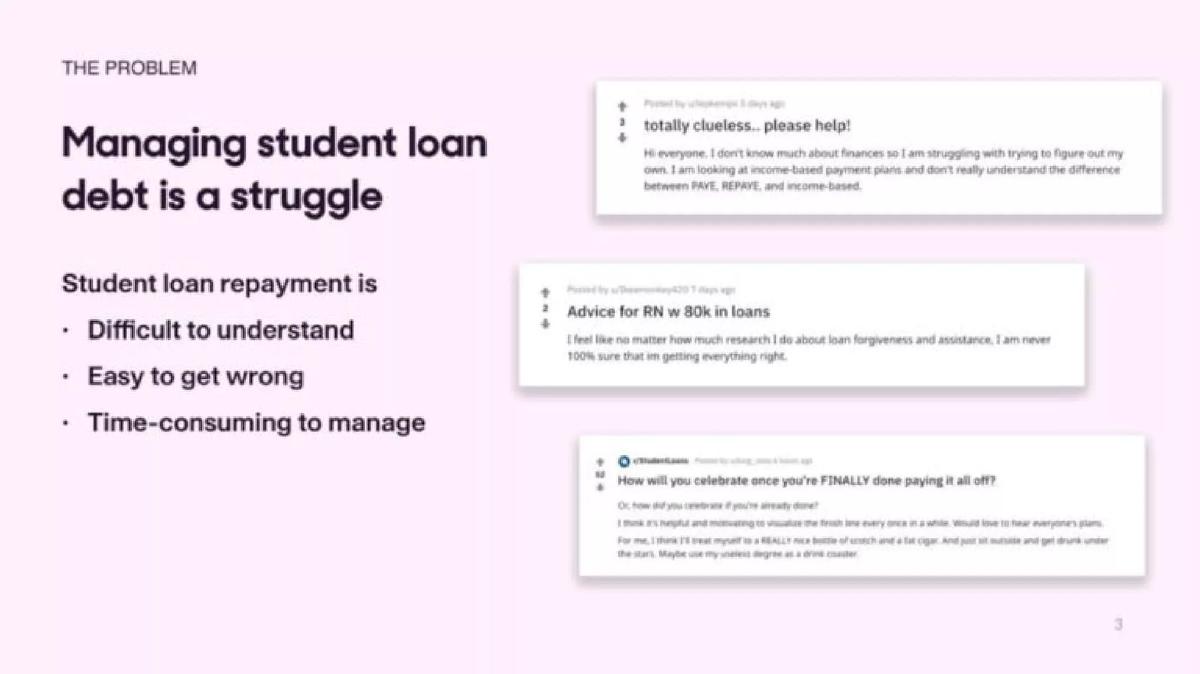
Slide 3 shifts from macro-economics to user sentiment. It uses screenshots from Reddit to illustrate that managing debt is a "struggle." The slide lists three pain points: the process is "Difficult to understand," "Easy to get wrong," and "Time-consuming to manage." This qualitative approach helps investors empathize with the end-user before the solution is presented.
The Solution and Product Experience (Slides 4-7)
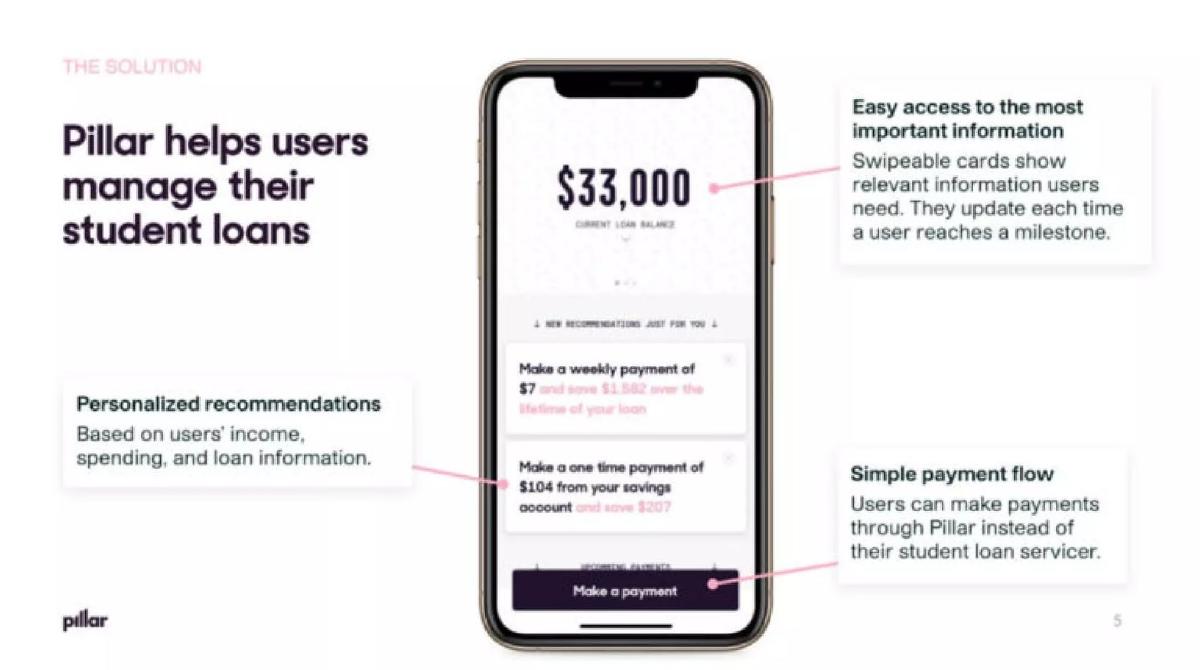
Slide 4 serves as a transition, featuring a lifestyle image and the claim that "Pillar gives people confidence they’re paying back their student loans the right way." This emphasizes the emotional value proposition over technical features. Slide 5 provides the first look at the mobile interface. It highlights "Personalized recommendations" based on income and spending, "Easy access" via swipeable cards, and a "Simple payment flow" that allows users to pay through Pillar instead of their loan servicer.
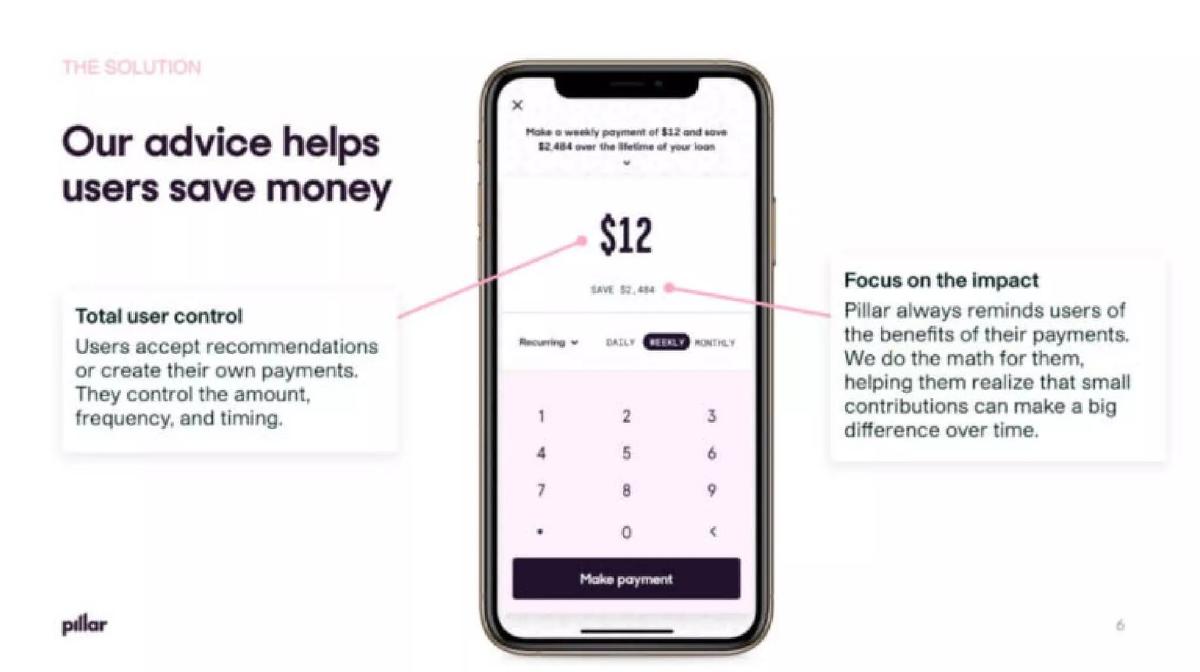
Slide 6 focuses on the financial impact of the advice. It shows a UI where a user can make a $12 payment and see that it will "save $2,484 over the lifetime" of the loan. This 'math-for-you' approach is designed to encourage small, frequent contributions. Slide 7 reinforces the brand voice, describing an "Optimistic interface & friendly language" that avoids industry jargon. It mentions "Achievable, incremental milestones" to help users maintain momentum, further leaning into the behavioral psychology aspect of the product.
Competition and Business Model (Slides 8-9)
Slide 8 is a standard competition matrix. Pillar compares itself to four categories: HR Benefit Providers (e.g., Student Loan Genius), "Round Up" Apps (e.g., Chipper), Financial Literacy Tools (e.g., Summer), and Content Providers (e.g., Student Loan Hero). Pillar claims the unique position of being the only "B2C" player with "Full coverage" and "Personalized" advice. Interestingly, it lists its company focus as "Product / Brand / Technology," contrasting with competitors focused on "Sales" or "Marketing."
Slide 9 details the business model. It is exceptionally simple: 2M Users x $5 Monthly Fee x 12 Months = $120M Yearly Revenue. The slide notes that at 2 million users, Pillar would have captured "just 4% of the student loan market." This math is designed to show that a significant business can be built even with a small market share, provided the B2C subscription model holds.
Growth and Roadmap (Slides 10-12)
Slide 10 discusses user acquisition. It identifies three channels: Social Media (FB, IG, Reddit, Twitter), Referrals & WOM (stating that 40% of new users sign up organically ), and Content & Influencers . The reliance on organic growth is a key signal for Seed investors looking for product-market fit. Slide 11 presents the "Business Roadmap" from 2019 to 2022. The 2020 goals include proving "LTV exceeds CAC" and reaching 100k users ($6M revenue) . By 2022, they aim to "Expand" into a "one-stop shop" for other financial areas, targeting 3M users and $150M+ revenue .
Slide 12 is a high-impact 'vision' slide. It features a large graphic stating, "We can save borrowers over $12,000,000,000 by 2022." This translates the company's success directly into social impact, which is a common theme in modern FinTech pitches.
Team and Pedigree (Slides 13-15)
Slide 13 introduces the eight-person team, led by Michael Bloch (CEO) and Gilad Kahala (CTO) . While the slide lacks individual bios, Slide 14 compensates by showing a grid of logos representing "Where we've worked." The list is impressive, including DoorDash, Google, Uber, American Express, Fiverr, Klarna, and Blue Apron . This 'logo soup' is a powerful way to signal that the team has the experience to scale a high-growth consumer technology company. Slide 15 is a simple closing slide with the CEO's contact email.
What Works in the Pillar Deck
Clarity of Monetization: The $5/month subscription model is easy to understand and avoids the complexities of lead generation or B2B sales cycles. · Psychological Angle: By focusing on 'confidence' and 'friendly language,' Pillar identifies a gap in the market—most financial tools are stressful or jargon-heavy. · Strong Pedigree: The team's background at companies like Uber, Google, and Klarna provides immediate credibility for a Seed-stage startup. · Visual Product Demonstration: The use of clean, annotated mobile screenshots (Slides 5-7) makes the product feel real and ready for market.
What is Missing from the Pillar Deck
Current Traction Data: While the deck mentions 40% organic sign-ups, it does not state the absolute number of current users or the current Monthly Recurring Revenue (MRR). · Unit Economics: Slide 11 mentions proving that LTV exceeds CAC as a future goal for 2020, meaning the founders likely didn't have these metrics yet when raising the Seed round. · The Ask: The deck does not specify how much money is being raised or what the specific milestones for the funding round are (though we know from external data it was $5.5M). · Regulatory/Compliance Details: Managing payments and loan data involves significant regulatory hurdles; the deck does not address how Pillar handles these complexities.
Founder's Playbook: What to Copy
The 'Math of Success' Slide: Slide 9 is a masterclass in simplifying a business model. By showing that a massive revenue goal requires only a small percentage of the market, you make the investment feel less risky. · Qualitative Problem Validation: Using Reddit screenshots (Slide 3) is a low-cost, high-impact way to prove that people are actively complaining about the problem you are solving. · Pedigree over Paragraphs: If your team has worked at famous companies, use a logo grid (Slide 14) rather than long text bios. It is faster for investors to scan and more impressive. · Impact-First Vision: Ending with a massive number representing the value saved for users (Slide 12) leaves investors with a sense of the company's potential scale and social utility.
Frequently asked questions
- What is Pillar's primary business model?
- Pillar operates on a B2C subscription model. As detailed on Slide 9, the company charges users a $5 monthly fee. The deck projects that capturing just 4% of the student loan market (2 million users) would result in $120 million in annual revenue. This distinguishes them from competitors who often use B2B or B2B2C models.
- How does Pillar differentiate itself from other student loan apps?
- According to the competition matrix on Slide 8, Pillar differentiates itself by being a personalized, full-coverage B2C platform focused on product, brand, and technology. It contrasts itself against 'Round Up' apps like Chipper (which have limited scope) and HR benefit providers like Tuition.io (which are B2B-focused and lack personalization).
- What are the projected growth milestones for the company?
- Slide 11 outlines a four-stage roadmap: Prove Concept (2019), Go-to-Market (2020) targeting 100k users and $6M revenue, Scale (2021) targeting 500k users and $30M revenue, and Expand (2022) targeting 3M users and $150M+ revenue. The expansion phase includes becoming a 'one-stop shop' for other financial areas.
- What is the background of the founding team?
- The team consists of eight members shown on Slide 13, led by CEO Michael Bloch and CTO Gilad Kahala. Slide 14 highlights their collective professional pedigree, featuring logos from high-growth tech and finance companies such as DoorDash, Google, Uber, American Express, Fiverr, and Klarna.
- Does the deck provide evidence of current traction?
- The deck is light on hard traction metrics. Slide 10 mentions that 40% of new users sign up organically through referrals and word-of-mouth, but it does not state the total number of current users. The roadmap on Slide 11 suggests the 'Public launch' was scheduled for Q4 2019, indicating this deck was likely used for a pre-launch or very early-stage Seed round.