Coinleap’s pitch deck is a concise, 9-slide presentation from early 2015 that attempts to bridge the gap between traditional finance and digital currency. Positioned as the 'PayPal of Digital Currency,' the company targets both merchants and consumers with features like SMS payments and debit card integration. At the time of the deck's creation, the startup reported modest traction with 70+ users and a soft beta launch. The revenue model relies on a 1% merchant fee and a $1.00 monthly premium membership. Seeking a $100,000 equity investment, the deck highlights a lean, three-person technical…
Key takeaways
- The company uses a high-level analogy, calling itself 'The PayPal of Digital Currency' on slide 1.
- Market opportunity is defined by billions in market cap and a 'Billion+' people waiting for SMS and debit solutions on slide 2.
- Traction is minimal, citing 70+ users and 9 Play Store reviews as of February 20, 2015, on slide 3.
- The revenue model consists of a 1% flat fee for merchants and a $1.00 monthly premium consumer membership on slide 6.
- The team is entirely technical, consisting of two mobile developers and one founder/creator on slide 7.
- Coinleap identifies Bitpay and Coinbase as primary competitors, noting their existing merchant and consumer services on slide 8.
- The startup is seeking a $100,000 equity investment to cover marketing, hiring, server costs, and regulatory compliance on slide 9.
- The founder claims 10 years of experience in payment solutions on slide 5, though specific company names are not listed.
Coinleap Pitch Deck Teardown
The Coinleap pitch deck is a 9-slide document that serves as a snapshot of the cryptocurrency landscape in early 2015. At this time, Bitcoin was beginning to see broader interest, but user experience remained a significant hurdle. Coinleap enters the fray with a pitch centered on simplicity and familiarity, using the 'PayPal of Digital Currency' as its guiding light. The deck is utilitarian, relying on bulleted lists and a consistent hexagonal background, but it lacks the visual storytelling or deep data analysis found in modern Series A decks. It is a classic pre-seed or seed-stage presentation focused on a small team and an early-stage product.
Slide 1: Title Slide
The cover slide introduces the brand name, Coinleap, alongside a cube-based logo. The subtitle, 'Digital Currency for everyone,' establishes the mission of mass adoption. Below this, three keywords—'Simple. Secure. Fun.'—attempt to define the brand personality. The most important element on this slide is the tagline at the bottom: 'The PayPal of Digital Currency.' This is a standard 'X for Y' pitch strategy designed to give investors an immediate mental model of the business: a user-friendly layer on top of a complex financial technology.
Slide 2: Market and Opportunity
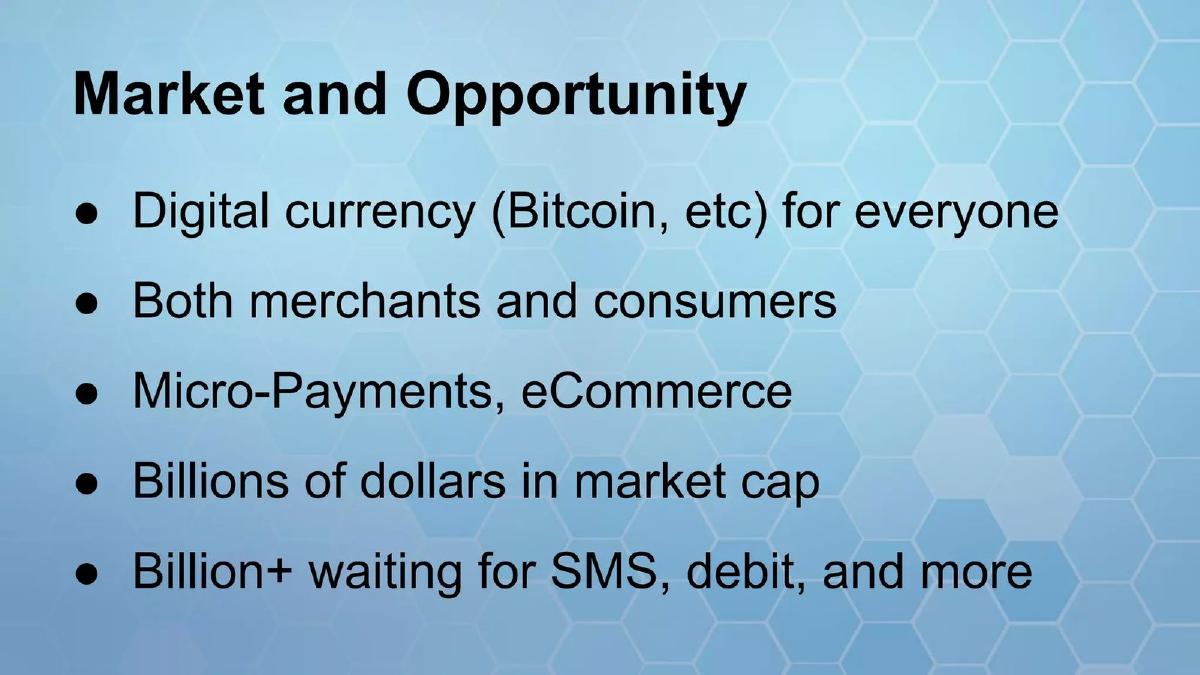
This slide outlines the broad strokes of the crypto market. It mentions 'Digital currency (Bitcoin, etc)' and targets both merchants and consumers. The slide highlights 'Micro-Payments' and 'eCommerce' as the primary use cases. While it claims 'Billions of dollars in market cap,' it does not provide a specific Total Addressable Market (TAM) figure for the payment processing sector itself. The final bullet point, 'Billion+ waiting for SMS, debit, and more,' suggests a global ambition, likely targeting unbanked or underbanked populations who rely on mobile-first financial tools.
Slide 3: Milestones - Traction
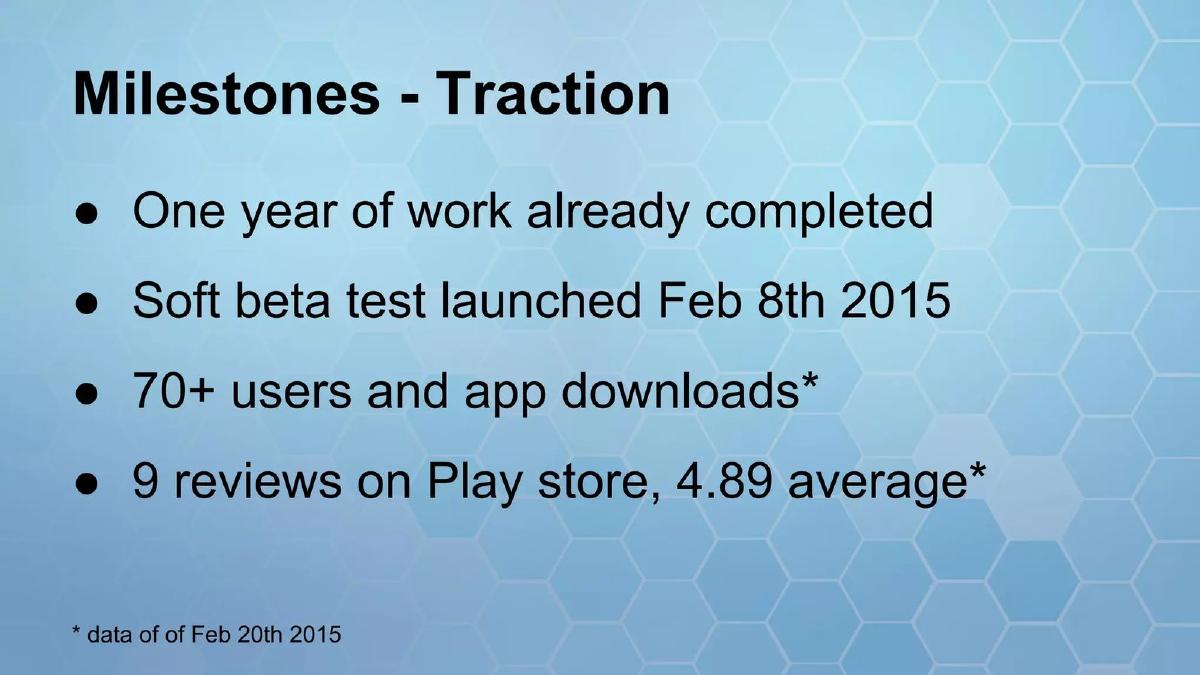
Slide 3 provides a specific snapshot of the company's progress as of February 20, 2015. The founders note that one year of work has already been completed. The 'Soft beta test' had only been live for 12 days (launched Feb 8th) at the time of the data point. The metrics are modest: 70+ users and app downloads, and 9 reviews on the Play Store with a 4.89 average. While these numbers are small, they demonstrate that a functional product exists in the wild, which is a critical hurdle for early-stage investors.
Slide 4: Problems
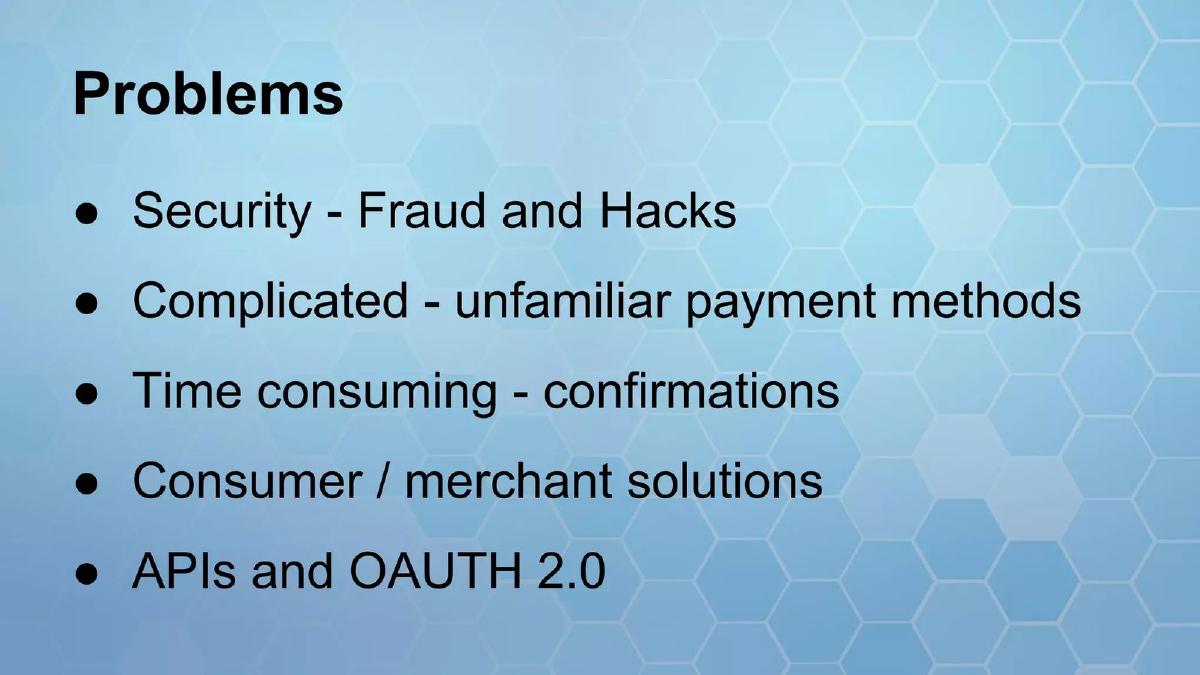
The problem slide identifies four friction points in the 2015 crypto ecosystem: security (fraud and hacks), complexity (unfamiliar payment methods), time (slow confirmations), and a lack of integrated consumer/merchant solutions. The mention of 'APIs and OAUTH 2.0' as a problem is slightly ambiguous; it likely refers to the lack of standardized, secure authorization protocols in the crypto space at that time, making it difficult for third-party apps to interact with wallets safely.
Slide 5: Solutions - Why Coinleap
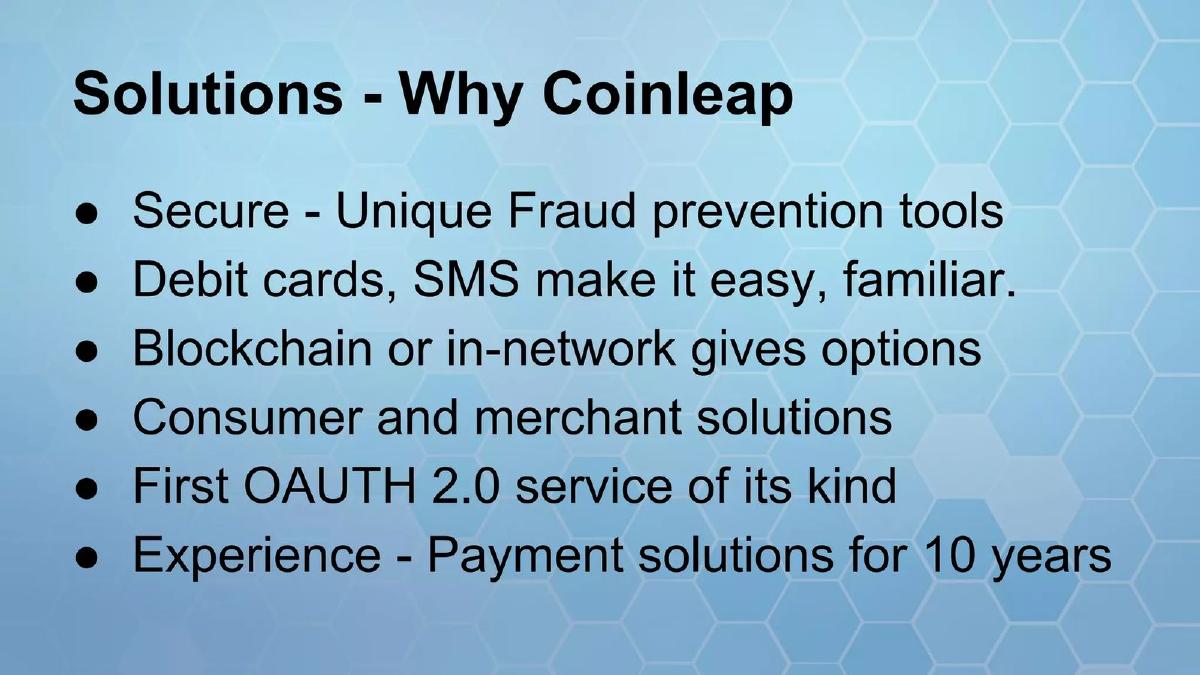
Coinleap presents its solutions as a direct response to the problems listed on the previous slide. They claim 'Unique Fraud prevention tools' and the use of 'Debit cards' and 'SMS' to provide familiarity. The slide mentions 'Blockchain or in-network' options, suggesting that they may process some transactions off-chain to solve the 'time-consuming' problem of blockchain confirmations. They also claim to be the 'First OAUTH 2.0 service of its kind' in the space. Crucially, the slide adds a 'Experience' bullet, stating the team has 10 years of experience in payment solutions, though it does not specify where that experience was gained.
Slide 6: Revenue
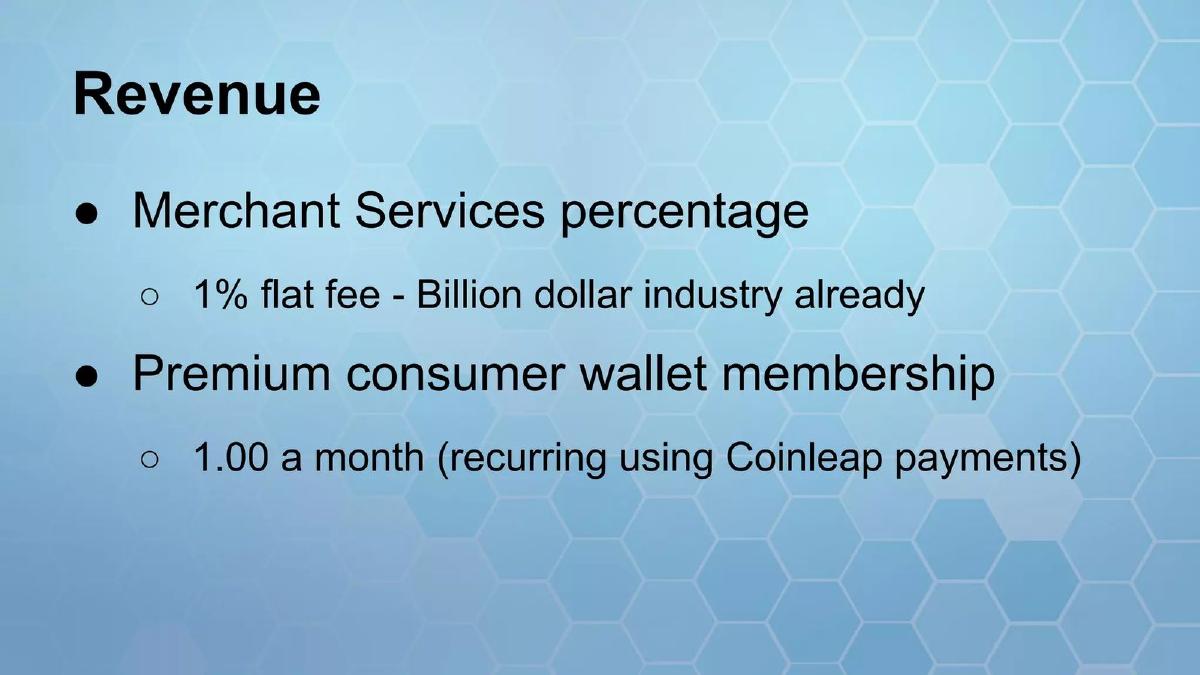
The revenue model is straightforward and follows industry standards for payment processors. For merchants, Coinleap charges a '1% flat fee.' For consumers, they offer a 'Premium consumer wallet membership' for '$1.00 a month.' The deck notes that this membership fee is recurring and processed using Coinleap's own payment rails. This dual-sided monetization strategy targets both the transaction volume of businesses and the loyalty of individual users.
Slide 7: Team
The team slide lists three individuals. Matías Elorriaga is credited with 'Android and iOS' development, and Hoang Nguyen is listed for 'iOS.' Shane Miller is identified as the 'Founder and Creator.' The team appears to be heavily weighted toward mobile development, which aligns with the 'SMS' and 'app download' focus mentioned earlier in the deck. However, the slide lacks professional bios, past company logos, or educational backgrounds, which are typically used to build credibility with investors.
Slide 8: Competition
Coinleap identifies Bitpay and Coinbase as its primary competitors. The slide acknowledges that these companies already offer many of the features Coinleap is touting, such as fraud prevention, merchant solutions, and OAUTH 2.0. By listing these competitors, Coinleap shows it is aware of the market leaders, but the slide fails to explicitly state how Coinleap will win against these much better-funded incumbents. The inclusion of Bitpay and Coinbase serves more as a validation of the market than a roadmap for differentiation.
Slide 9: Investment
The final slide contains the 'ask.' The company is currently self-funded with approximately $10,000. They are seeking a '$100K equity investment.' The use of funds is broken down into four categories: marketing, hiring more developers, server scaling, and regulatory compliance for merchant services. A $100,000 ask is relatively small for a fintech startup, suggesting this was intended as a very early pre-seed round to move from beta to a full market launch.
What Coinleap Does Well
The deck is remarkably concise. In just 9 slides, it covers the essential bases of a pitch: problem, solution, traction, team, and the ask. The use of the 'PayPal' analogy is a strong choice for a 2015 audience that might have been skeptical or confused by the technicalities of Bitcoin. By anchoring the product in familiar terms like 'SMS' and 'Debit cards,' the founders successfully move the conversation away from cryptography and toward utility. The inclusion of a specific date for their traction metrics (Feb 20th, 2015) also shows a level of honesty and transparency regarding their early stage.
What is Missing from the Deck
The most glaring omission is a deep dive into the 'Unique Fraud prevention tools' mentioned on slide 5. In fintech, and especially in crypto, security is a primary concern for investors. Simply stating that the tools are unique without explaining the mechanism or the advantage over competitors is a missed opportunity. Additionally, the team slide is very thin. While it lists roles, it provides no evidence of the '10 years of experience' claimed elsewhere. Investors generally want to see a track record of success or relevant industry experience. Finally, the competition slide identifies the 'who' but not the 'how.' There is no 'X vs. Y' feature matrix or a clear statement on why a merchant would choose Coinleap over a giant like Coinbase.
What a Founder Should Copy
Founders should emulate the clarity of the revenue slide. It avoids jargon and presents two clear, understandable ways the company makes money. The 'Milestones' slide is also a good template for very early-stage startups; even if your numbers are small (like 70 users), presenting them clearly shows that you are measuring progress and have a live product. Lastly, the 'Use of Funds' on the final slide is specific. Rather than saying 'Growth,' the founders specify 'Regulations to start merchant services,' which shows they have thought about the specific legal hurdles inherent in their industry.
Frequently asked questions
- What is Coinleap's core value proposition?
- Coinleap aims to make digital currency 'Simple. Secure. Fun.' by acting as an intermediary similar to PayPal. According to slide 5, they offer unique fraud prevention tools and familiar interfaces like debit cards and SMS to lower the barrier to entry for both consumers and merchants who find existing crypto methods too complicated or time-consuming.
- How does Coinleap plan to generate revenue?
- As detailed on slide 6, the business model is two-fold. First, they charge a 1% flat fee for merchant services. Second, they offer a 'Premium consumer wallet membership' priced at $1.00 per month, which is processed as a recurring payment through their own system. This suggests a focus on high-volume, low-cost transactions.
- What was the state of the product when this deck was released?
- The product was in an early beta phase. Slide 3 notes that a 'Soft beta test' launched on February 8, 2015. By February 20, 2015, the company had over 70 users and app downloads, with 9 reviews on the Google Play Store maintaining a 4.89-star average. One year of development work had been completed prior to this launch.
- Who are the competitors mentioned in the deck?
- Slide 8 lists two major incumbents: Bitpay and Coinbase. The deck acknowledges that Bitpay offers merchant payments, fraud prevention, and SMS features, while Coinbase offers consumer wallets and merchant solutions. Coinleap attempts to differentiate by highlighting its own OAUTH 2.0 service and specific fraud prevention tools.
- What is the specific fundraising ask and use of funds?
- On slide 9, Coinleap discloses they are currently self-funded with approximately $10,000. They are seeking a $100,000 equity investment. The funds are earmarked for four areas: marketing and advertising, hiring additional developers, server scaling costs, and navigating the regulations required to start merchant services.