CodeSignal’s 17-slide deck is structured as a logical progression from market failure to technological solution and, finally, to explosive growth. The narrative centers on the 'Cost of Resumes,' citing that 79% of resumes are rejected at the top of the funnel and 71% of technical phone interviews end in rejection (Slide 6). The deck effectively transitions from these pain points to a product walkthrough that highlights support for 75+ coding languages (Slide 10) and a standardized 'Coding Score' (Slide 11). The final section provides heavy-hitting traction metrics, including 4x year-over-year…
Key takeaways
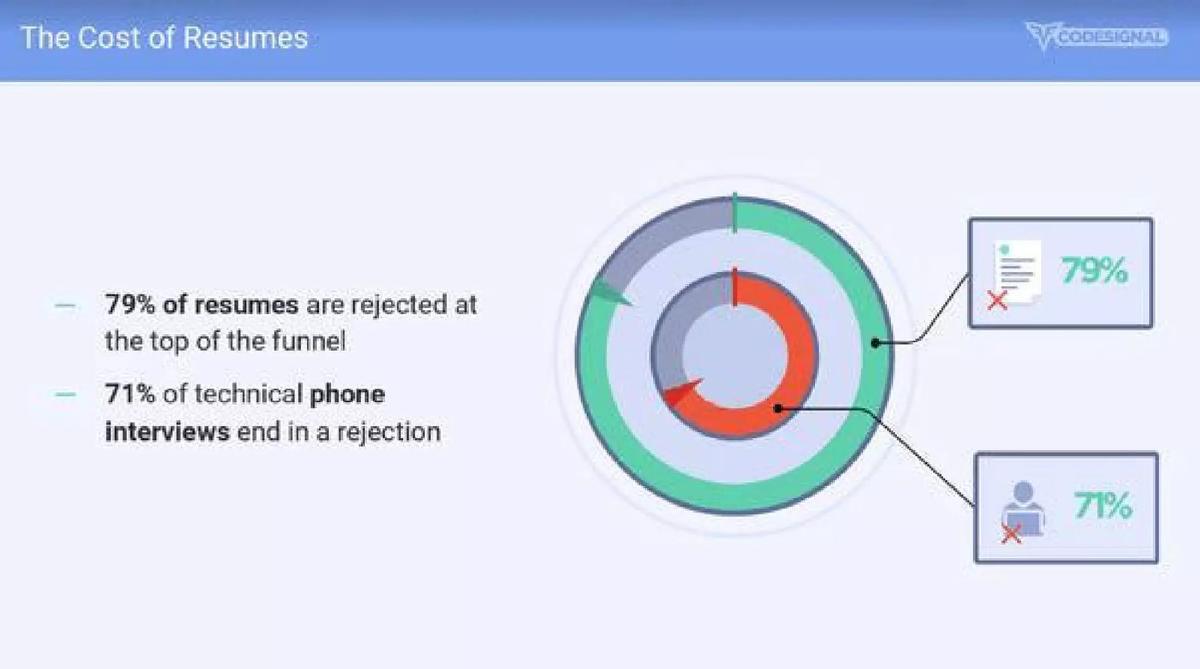
- The deck identifies a massive inefficiency in hiring, noting that 79% of resumes are rejected immediately (Slide 6).
- CodeSignal positions itself as a 'Flight Simulator for Developers,' supporting over 75 coding languages and frameworks (Slide 10).
- The product uses a standardized 'Coding Score' ranging from 300 to 850 to quantify technical ability (Slide 11).
- Growth is the central theme of the traction section, highlighting 4x year-over-year ARR growth heading into 2021 (Slide 14).
- The company achieved a significant milestone of over 500,000 assessments completed in the year 2020 (Slide 13).
- Sales efficiency is emphasized through a 'Magic Number' chart, though specific axis values are obscured (Slide 15).
- The deck leverages external validation with a dedicated 'Awards' slide featuring G2 Leader status and CNBC Upstart 100 (Slide 16).
- There is no team slide included in this version of the deck, omitting founder backgrounds and previous experience.
Introduction: The Shift from Resumes to Results
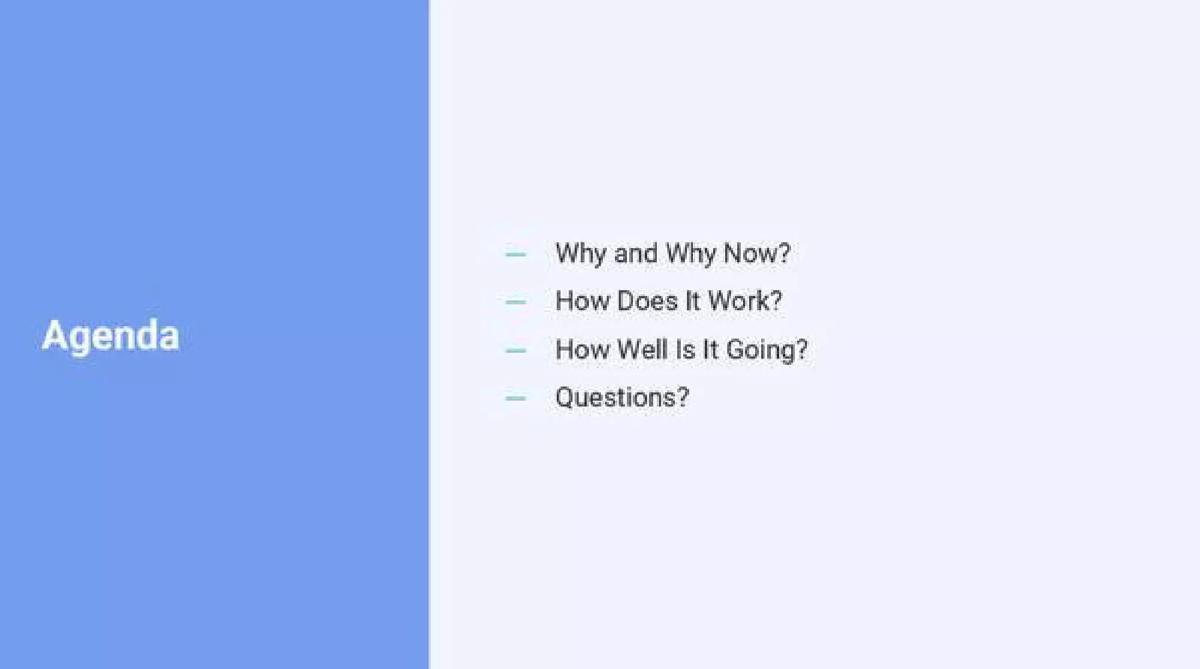
CodeSignal’s pitch deck, used during their growth stages, is a highly structured document that prioritizes market dynamics and hard traction over narrative fluff. Founded in 2015, the company entered a crowded HR tech market but differentiated itself by focusing specifically on the 'technical signal.' The deck consists of 17 slides, organized into four distinct chapters: Why and Why Now, How Does It Work, How Well Is It Going, and Questions.
The Hook and The Agenda (Slides 1-2)
Slide 1 introduces the brand and the core mission statement: #GoBeyondResumes. This hashtag serves as the company’s North Star, immediately identifying the enemy (the resume) and the solution (the 'signal'). Slide 2 provides a clear agenda, signaling to investors that the presentation will be data-driven and focused on efficiency.
Section 1: Why and Why Now?
The Evolution of the Ecosystem (Slides 3-5)
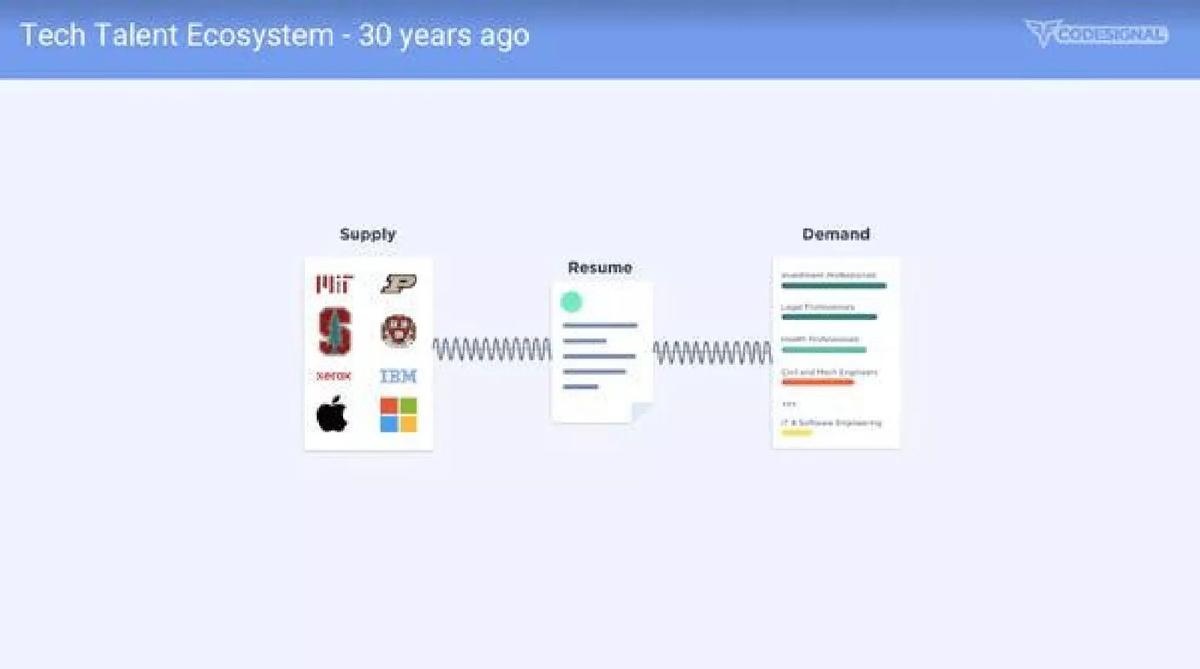
CodeSignal begins by contextualizing the problem through a historical lens. Slide 4 illustrates the 'Tech Talent Ecosystem - 30 years ago,' where supply was limited to a few elite universities (MIT, Stanford, Purdue) and demand came from a handful of tech giants (IBM, Apple, Microsoft). In this era, the resume was a functional bridge because the variables were few.
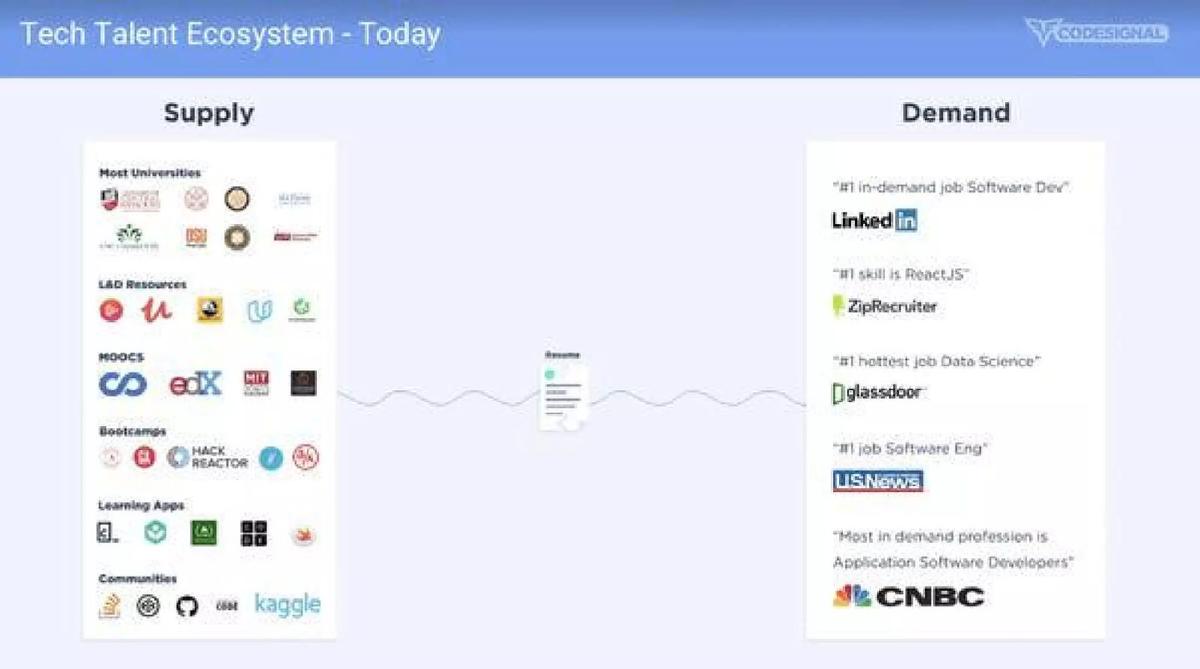
Slide 5 contrasts this with the 'Today' ecosystem. The supply side has exploded to include MOOCs (Coursera, edX), bootcamps (Hack Reactor), and communities (GitHub, Kaggle). Simultaneously, demand has shifted, with every major publication from CNBC to US News declaring software engineering as the #1 job. The core argument is that the resume is now a 'thin' and 'noisy' line that can no longer connect a massive, diverse supply to an insatiable demand.
Quantifying the Inefficiency (Slide 6)
This is the 'Problem' slide, and it is exceptionally strong because it uses specific percentages rather than vague complaints. It states that 79% of resumes are rejected at the top of the funnel and 71% of technical phone interviews end in rejection. By highlighting these failure rates, CodeSignal frames their product not as a 'nice-to-have' tool, but as a necessary filter to prevent massive wasted spend on engineering and recruiting hours.
The Solution (Slide 7)
Slide 7 provides a visual transition. It shows a traditional resume for a candidate named 'Shane Gomez' being transformed into a digital CodeSignal profile. The profile features a radar chart of skills and a 'Certified' badge. This slide effectively communicates that CodeSignal turns subjective text into objective, verified data.
Section 2: How Does It Work?
Research and Integrity (Slides 8-9)
Before showing the 'cool' features, CodeSignal establishes its scientific credibility. Slide 9, titled 'Design - Assessment Research,' shows a blurred research paper with various histograms and distribution curves. The text emphasizes 'Ensuring integrity' and 'building trust.' For an assessment platform, the validity of the test is the product’s most important feature; if the scores don't correlate with job performance, the tool is useless. This slide addresses that concern head-on.
The Developer Experience (Slide 10)
Slide 10 describes the platform as a 'Flight Simulator for Developers.' This is a powerful analogy. It highlights that the tool supports 75+ coding languages and simulates real-world environments for Back-end, Front-end, Data, and SRE roles. By showing the interface on both a laptop and a mobile device, they demonstrate a modern, multi-platform approach to testing.
Standardization: The Coding Score (Slide 11)
One of CodeSignal’s most significant innovations is the 'Coding Score,' detailed on Slide 11. By creating a scale from 300 to 850 (reminiscent of a FICO credit score or an SAT score), they are attempting to create a new industry standard. The slide also shows how they break down this score into sub-metrics like 'Implementation,' 'Debugging,' and 'Speed,' providing recruiters with a nuanced view of a candidate’s strengths.
Section 3: How Well Is It Going?
Volume and Revenue Traction (Slides 12-14)
The 'Traction' section is the heart of this deck. Slide 13 shows a bar chart of 'Accelerating Assessment Volume.' The company notes that they completed over half a million assessments in 2020. The chart shows a clear exponential curve, with a massive spike in the final quarter of 2020.
Slide 14 is the 'money slide.' It claims 4x Year-over-Year (Y/Y) ARR growth. It specifically mentions that growth doubled in the second half of 2020, leading into 2021 with significant momentum. For a Series-stage company, 4x growth is top-tier performance, and the visual representation of the ARR bars makes this growth undeniable.
Sales Efficiency and Social Proof (Slides 15-16)
Slide 15 addresses 'Outstanding Efficiency.' It mentions the 'compounding effect of word of mouth' and shows a 'Magic Number' chart. While the specific numbers on the Y-axis are not visible, the upward trajectory of the line suggests that for every dollar spent on sales and marketing, the company is generating increasing amounts of new revenue.
Slide 16 provides social proof through 'Awards.' It features badges from G2 (Leader Summer 2020, Best Software for 2020) and CNBC (Upstart 100). This slide serves to reassure investors that the market and industry analysts have already vetted the product.
Section 4: Conclusion
The Final Word (Slide 17)
The deck ends on Slide 17 with a quote from Sheryl Sandberg: 'Build Your Skills NOT Your Resume!' This reinforces the company's core philosophy and leaves the audience with a high-level vision of a world where talent is recognized for what they can do, not where they went to school.
What Works
Data-Backed Problem: Using specific rejection rates (79% and 71%) makes the pain point feel urgent and expensive. · Standardization: The 'Coding Score' (Slide 11) is a brilliant product move that creates a 'moat'—if everyone uses the CodeSignal score, it becomes the industry standard. · Growth Momentum: The 4x ARR growth (Slide 14) is the strongest possible signal for a Series-stage investor. · Market Context: The comparison between the talent ecosystem 30 years ago and today (Slides 4-5) clearly explains why this solution is necessary now.
What is Missing
Team Slide: There is no information about the founders or the leadership team. In venture capital, the 'who' is often as important as the 'what.' · Competition: The deck does not mention competitors like HackerRank or Codility. Investors will want to know how CodeSignal wins against these established players. · The Ask: The deck does not state how much money is being raised or how it will be spent (e.g., hiring, international expansion, R&D). · Unit Economics: While Slide 15 mentions efficiency, it lacks specific CAC, LTV, or churn metrics that are standard for SaaS pitches.
What a Founder Should Copy
The 'Flight Simulator' Analogy: Using a high-level analogy to describe a complex technical product helps non-technical investors understand the value proposition immediately. · Visualizing the Shift: The transition from a paper resume to a data-rich profile (Slide 7) is a perfect way to show the 'before and after' of a product. · Quarterly Growth Charts: Showing growth by quarter (Slide 13 and 14) rather than by year provides a much more granular and convincing view of momentum. · Agenda Slide: For longer decks, a simple agenda slide helps manage the flow of the meeting and sets expectations.
Frequently asked questions
- What is the primary problem CodeSignal addresses in this deck?
- CodeSignal addresses the failure of the traditional resume as a signal for technical talent. Slide 6 quantifies this by showing that 79% of resumes are rejected at the top of the funnel and 71% of technical phone interviews fail. The deck argues that the 'Supply' of talent has diversified into bootcamps and MOOCs, while 'Demand' for developers has skyrocketed, making the old resume-based filtering system obsolete and expensive.
- How does CodeSignal quantify developer skills?
- The company uses a proprietary 'Coding Score' and 'Coding Report' shown on Slide 11. The score ranges from 300 (Level 1) to 850 (Level 10). This is supplemented by a radar chart that visualizes a candidate's proficiency across six dimensions: Implementation, Problem Solving, Speed, Debugging, Style, and System Design. This provides a standardized metric that goes beyond the subjective nature of traditional interviews.
- What evidence of market traction does the deck provide?
- Traction is presented through three primary lenses: volume, revenue, and efficiency. Slide 13 shows a bar chart of accelerating assessment volume, surpassing 500,000 in 2020. Slide 14 reports 4x year-over-year ARR growth, with a specific note on 2x growth in the second half of 2020. Slide 15 highlights 'Outstanding Efficiency' in sales, suggesting that word-of-mouth is driving a compounding effect on their growth.
- What technical capabilities does the platform offer?
- According to Slide 10, the platform acts as a 'Flight Simulator for Developers.' It supports over 75 coding languages, frameworks, and libraries. The simulation capabilities extend across various engineering disciplines, including Back-end, Front-end, Data, Site Reliability Engineering (SRE), and Mobile development. This breadth suggests the tool is applicable to almost any technical hiring need within an enterprise.
- What is missing from the CodeSignal pitch deck?
- The deck is notably missing a Team slide, which is standard for Series-stage pitches to show founder-market fit. It also lacks a Competition slide, an 'Ask' slide (detailing how much money they are raising), and a clear breakdown of unit economics like Customer Acquisition Cost (CAC) or Lifetime Value (LTV). While Slide 15 mentions a 'Magic Number' for efficiency, the actual dollar amounts are not disclosed.