The CodeSandbox Series A deck is a masterclass in community-led growth. By 2020, the platform had already reached 7.2 million sandboxes created, with a 250% growth rate in daily creations over the previous year. The narrative centers on the 'fragmentation' of web development and the lag of IDEs moving to the cloud compared to tools like Figma or Google Docs. Rather than focusing on revenue or complex unit economics—which are entirely absent from the deck—the founders lean on social proof from industry leaders like Guillermo Rauch and Dylan Field. The deck successfully positions CodeSandbox as…
Key takeaways
- The deck reports significant traction with 7.2 million sandboxes created by the time of the raise (Slide 8).
- Daily sandbox creation grew by 250% in the 12 months leading up to the 2020 deck (Slide 8).
- The problem is defined as fragmented web development where tooling is built for solo pursuits despite teams being distributed (Slide 4).
- CodeSandbox positions itself as a 'web-first solution' rather than just a local environment moved to the cloud (Slide 16).
- The platform claims deep ecosystem roots with integrations including Vercel, Netlify, GitHub, and VS Code (Slide 9).
- The deck highlights cross-functional utility, allowing designers to tweak styling and PMs to see implementation (Slide 11).
- Social proof is a core pillar, featuring testimonials from prominent developers and founders in the ecosystem (Slide 7).
- The 'Why Now' slide draws a direct parallel between CodeSandbox and successful cloud transitions like Figma and Google Docs (Slide 17).
The Narrative: From Solo Coding to Collaborative Creation
The 2020 CodeSandbox deck arrived at a pivotal moment for remote work and cloud-based tooling. While the deck is visually minimalist, it follows a very specific logic: the world has moved to the cloud, but developers are still stuck in local environments. By positioning the IDE as the last frontier of the cloud transition, CodeSandbox makes a compelling case for a massive market shift.
Slides 1-4: The Problem of Fragmentation
The deck opens with a standard title slide (Slide 1) and moves immediately into the Problem . Slide 2 establishes that while developers are the 'driving force' of modern companies, their environments are becoming more complex and teams more distributed. This sets the stage for a 'collaboration' play rather than just a 'tooling' play.
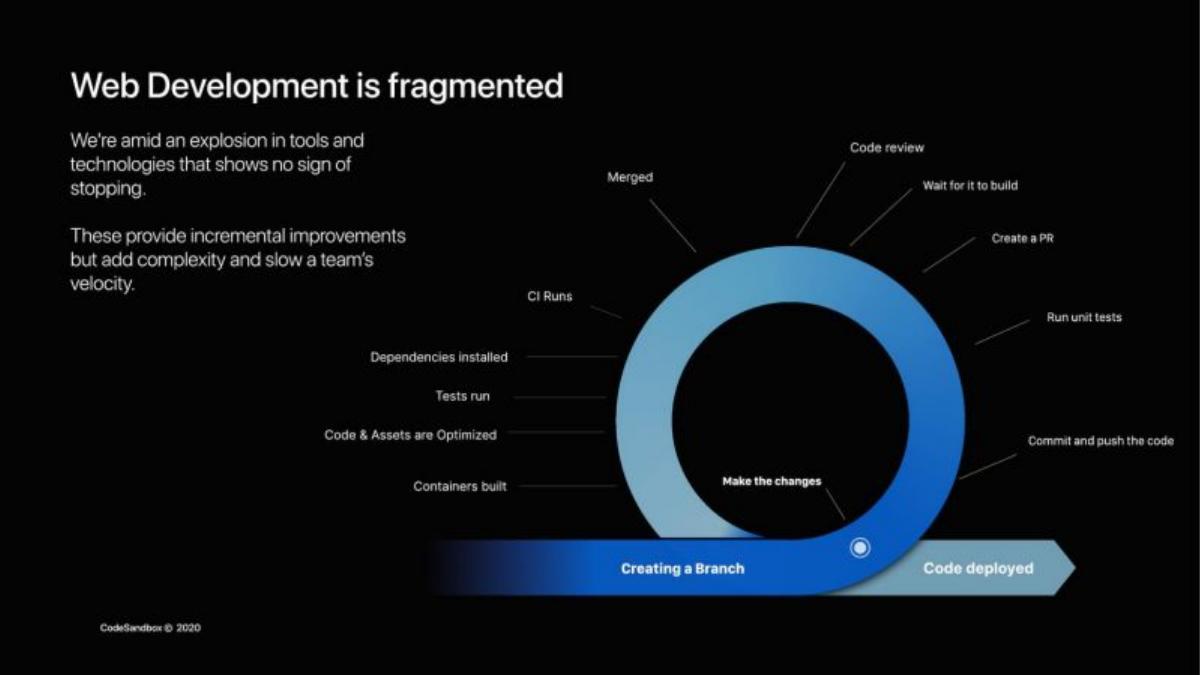
Slide 3, titled 'Web Development is fragmented,' uses a circular diagram to illustrate the exhausting lifecycle of a code change: from creating a branch to dependencies, containers, CI runs, and code reviews. The visual suggests a loop that is too slow for modern velocity. Slide 4 hammers home the 'solo pursuit' fallacy, noting that while tooling is built for individuals writing code locally, reality requires distributed teamwork.
Slides 5-7: The Solution and Social Proof
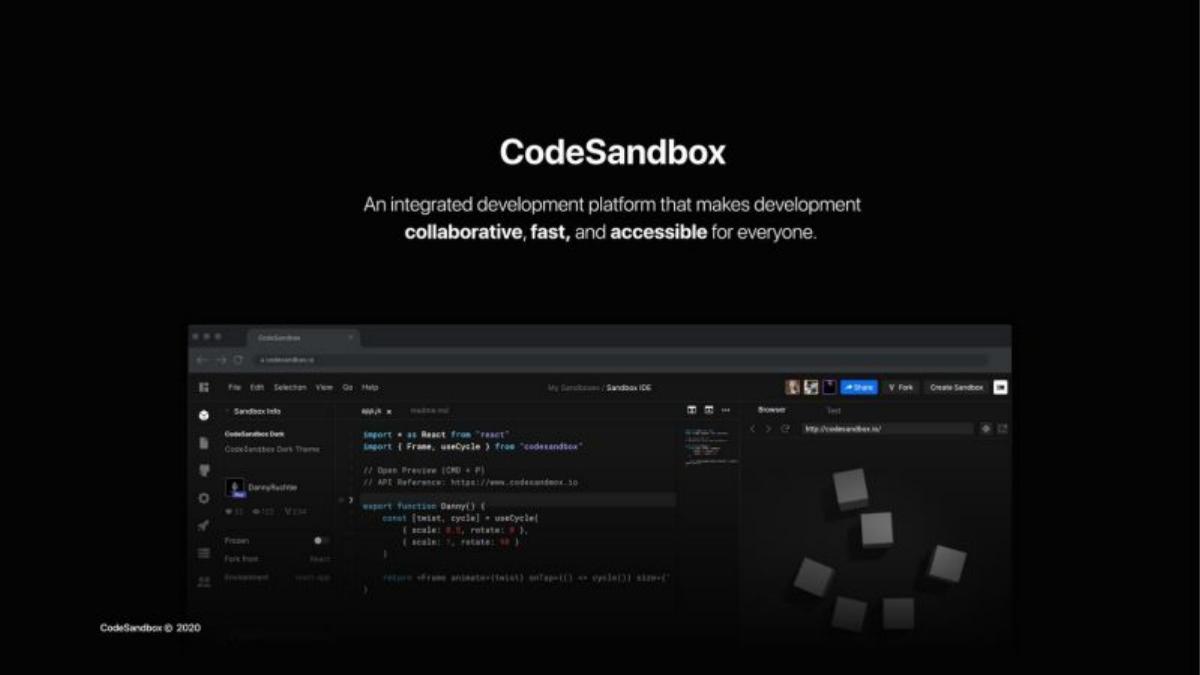
Slide 5 introduces CodeSandbox as an 'integrated development platform' that is collaborative, fast, and accessible. It includes a clean screenshot of the UI, showing a code editor side-by-side with a live browser preview. Slide 6 reiterates these three pillars: fast, accessible, and collaborative.
One of the strongest slides in the deck is Slide 7, 'Built for community.' Instead of listing features, it shows five Twitter testimonials from high-profile developers. This provides immediate credibility. When Guillermo Rauch (Founder of Vercel) says 'I love @codesandbox,' it carries more weight with a technical VC than any internal marketing copy could.
Slides 8-9: Massive Traction and Ecosystem Depth
Slide 8 provides the 'hockey stick' moment. It claims 7.2M sandboxes created and a +250% growth in daily creations over the last 12 months. The chart shows an exponential curve starting from early 2018 through January 2020. This is the core 'proof of work' for the Series A.
Slide 9 demonstrates that CodeSandbox isn't just a toy; it is 'Deeply rooted in the developer ecosystem.' It lists major open-source projects (React, Vue, Redux), publications (Dev.to, CSS Tricks), and education platforms (Lambda School, FreeCodeCamp) that use the tool. This suggests that CodeSandbox has become the default way to share and teach code on the internet.
Slides 10-12: Expanding the User Base
Slide 10 distinguishes between 'Community' use (Learning, Experimentation) and 'Professional' use (Prototyping, Onboarding, Job Interviews, Feedback). This is a subtle nod to their monetization potential—moving from free community users to paying professional teams.
Slide 11 is a strategic pivot: 'Making development accessible for entire teams, not just developers.' It lists how designers, PMs, and marketing teams can interact with the code. This 'democratization' of the dev environment is a classic SaaS play to increase seat count and stickiness. Slide 12 reinforces this with a 'Unit of value: Developers' graph, showing exponential value growth as more developers join the platform.
Slides 13-15: Competitive Advantage and The Team
Slide 13 lists five competitive advantages: 'already ingrained,' 'built for the whole team,' 'built for the web,' 'focused,' and 'simple.' While these are somewhat generic, the 'already ingrained' point is backed by the traction shown earlier.
Slide 14 introduces the team. It describes them as 'product-focused' with 'engineers who are well-known and respected within the community.' This is a critical point for developer tools—the 'builders building for builders' narrative. Slide 15 showcases their 'Investors,' featuring heavyweights like Kleiner Perkins and a list of angel investors that includes the founders of Figma, Vercel, and Netlify. This slide alone likely did half the work of closing the round.
Slides 16-17: The 'Why Now' and Market Context
Slide 16 argues that coding is 'finally moving to the cloud,' noting that while documents and design moved years ago, IDEs lagged behind. Slide 17 is the 'Figma for X' slide. It shows a table of categories: Email (Gmail), Word Processing (Google Docs), Design (Figma), and finally, Development (CodeSandbox). This creates a sense of inevitability. It tells the investor: 'You missed Google Docs and Figma; don't miss the development equivalent.'
What Works in the CodeSandbox Deck
The 'Figma' Comparison: By explicitly linking themselves to Figma on Slide 17, they borrow the valuation multiples and success narrative of one of the most successful SaaS companies of the decade. · Community Traction: 7.2 million units of anything is a massive number for a Series A. The growth rate (250%) proves the product has viral loops. · Social Proof: The inclusion of testimonials and angel investors who are themselves leaders in the dev-tool space creates a 'seal of approval' that is hard to ignore. · Focus on Collaboration: They don't sell a better compiler; they sell a better way for teams to work. This expands the TAM from 'people who write code' to 'everyone involved in the product lifecycle.'
What Is Missing from the CodeSandbox Deck
Revenue and Business Model: There is zero mention of how the company makes money. While common in high-growth developer tools, it leaves a gap regarding the path to profitability. · The Ask: The deck does not state how much money they are looking for or how they plan to spend it. · Competition: There is no competitive matrix. While they mention being 'web-first,' they don't address threats from GitHub (Codespaces) or VS Code's own cloud initiatives. · Unit Economics: There is no data on CAC, LTV, or churn. The deck relies entirely on top-of-funnel usage metrics.
What Founders Should Copy
The 'Why Now' Logic: Use the 'Cloud Transition' table from Slide 17. Showing that your industry is the last one to move to a proven model (like the cloud) is a very effective way to create urgency. · Testimonial Slides: Don't just list logos. Use actual quotes from respected figures in your industry. It humanizes the traction. · Visualizing the Workflow: Slide 3's fragmentation loop is a great way to visualize a 'messy' status quo that your product simplifies. · Minimalist Design: The deck uses a high-contrast black background with white text and limited, high-quality imagery. It looks like a premium developer tool, which reinforces the brand.
Frequently asked questions
- How much did CodeSandbox raise with this deck?
- According to the catalogue data and historical records, CodeSandbox raised $12.7 million in its Series A round in 2020. The round was led by Kleiner Perkins, with participation from Arches Capital and several high-profile angel investors mentioned on Slide 15.
- What is the primary growth metric shown in the deck?
- The primary metric is the volume of 'sandboxes created.' Slide 8 shows a cumulative total of 7.2 million sandboxes and highlights a 250% increase in daily sandbox creation over the preceding 12 months. This emphasizes user activity and platform adoption over traditional financial KPIs.
- Does the deck include a business model or revenue slide?
- No. The 18-slide deck completely omits revenue figures, pricing tiers, and monetization strategies. It focuses entirely on product-market fit, community adoption, and the strategic shift of development to the cloud. This suggests a 'land and expand' strategy where user growth is prioritized over immediate monetization.
- Who are the key investors listed in the deck?
- Slide 15 lists Kleiner Perkins and Arches Capital as institutional investors. It also features a 'who's who' of tech founders as angels, including Dylan Field (Figma), Guillermo Rauch (Vercel), Koen Bok (Framer), and Christian Bach/Mathias Biilmann (Netlify).
- What is the 'Unit of Value' according to CodeSandbox?
- On Slide 12, the company identifies 'Developers' as the unit of value. The slide features a graph showing value increasing exponentially as the number of developers on the platform grows, reinforcing the network effect and community-centric nature of the product.