CodersTrust operates at the intersection of vocational training and micro-finance, specifically targeting aspiring freelancers in South Asia. Their deck highlights a significant bottleneck: while interest in their 'learn and earn' platform is high (336,000 Facebook followers), actual enrollment is limited by students' ability to pay upfront. The company proposes a Series A-backed finance scheme where $500,000 in security collateral unlocks $1.5 million in external lending. This model aims to scale monthly gross profit from $20,000 to $445,000 by December 2018. While the deck is strong on mark…
Key takeaways
- The platform targets a segmented addressable market of 41.5 million students in Bangladesh and India (Slide 04).
- CodersTrust identifies a '15x opportunity' gap between the 36,000 students who applied and the 2,000 who actually enrolled as of 2017 (Slide 06).
- The business model relies on a student finance scheme where $500k in Series A capital acts as collateral for a $1.5M external loan (Slide 10).
- Projected growth targets $445,000 in monthly gross profit by December 2018, up from a current $20,000 (Slide 08).
- The team is geographically distributed across Denmark and Bangladesh, with plans to hire a CFO and Risk Manager in Denmark (Slide 14).
- Strategic B2B partnerships are planned with platforms like Upwork, Fiverr, and Udemy to provide finance solutions to their existing users (Slide 12).
- The deck lists potential exit opportunities across four verticals: IT/BPO, EdTech, Banking/MFIs, and Freelance networks (Slide 16).
- Revenue is projected at $6 million based on 20,000 students paying $300 upfront via the finance scheme (Slide 10).
Executive Summary: The EdTech-Fintech Hybrid
CodersTrust presents a compelling case for a 'Learn and Earn' platform that bridges the gap between education and employment in emerging markets. The deck focuses heavily on the friction of upfront costs, positioning student finance as the primary lever for exponential growth. By targeting the massive freelance labor pools in Bangladesh and India, the company seeks to monetize the transition of unskilled labor into the global digital economy.
Slide 00: Title and Vision
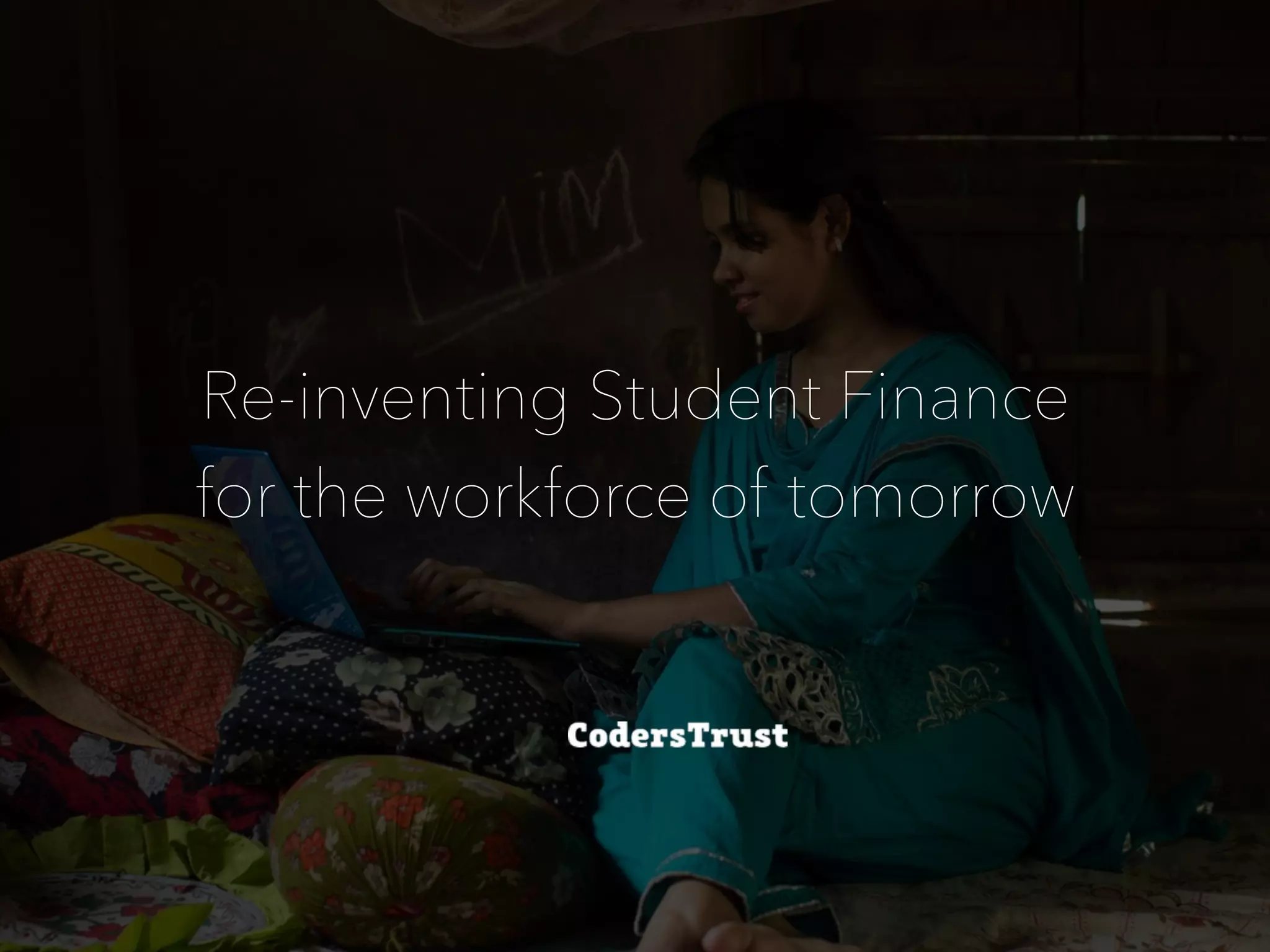
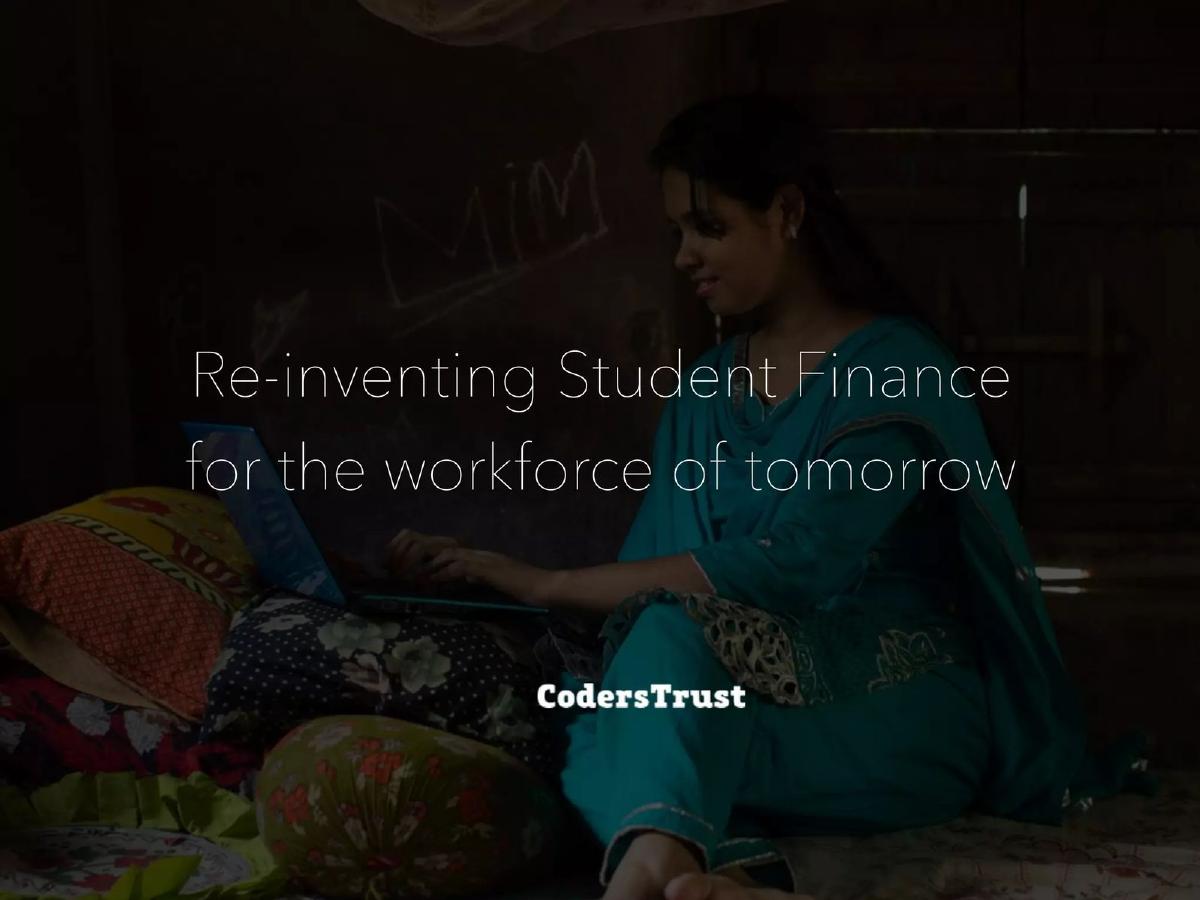
The cover slide establishes a social impact tone with the tagline 'Re-inventing Student Finance for the workforce of tomorrow.' The background imagery of a student using a laptop in a modest setting reinforces the target demographic: individuals in developing nations looking for a path to economic mobility through technology.
Slide 01: The Value Proposition
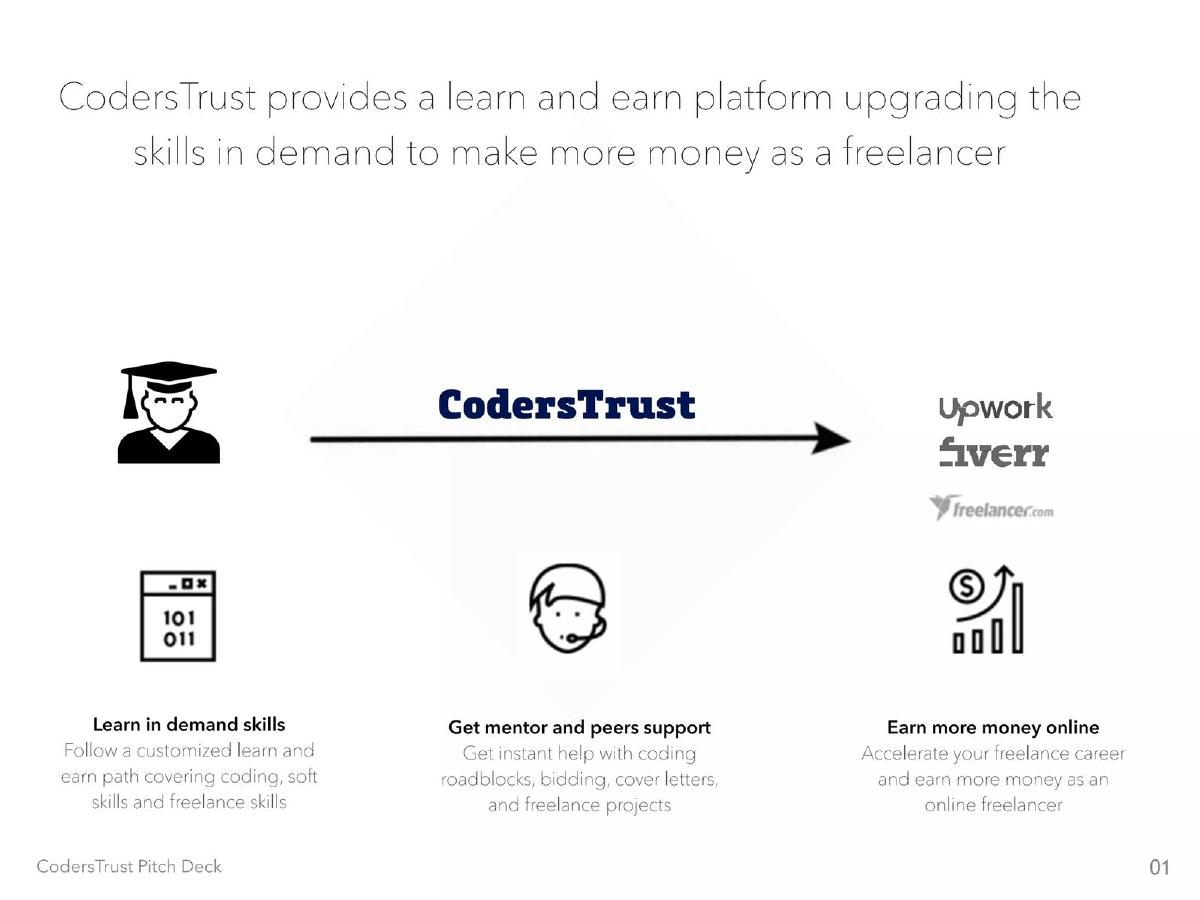
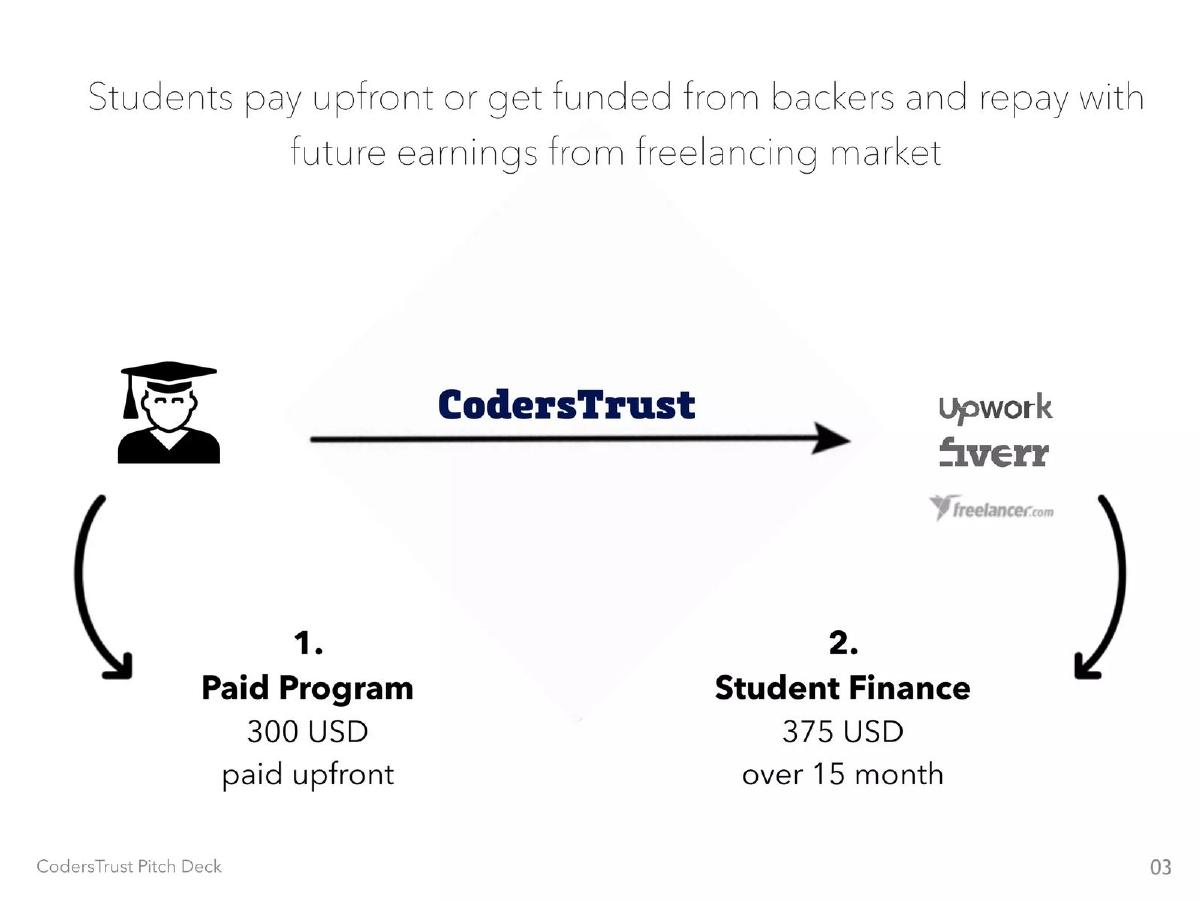
This slide clearly defines the CodersTrust ecosystem. It positions the company as a bridge between a student and freelance platforms like Upwork, Fiverr, and Freelancer.com. The process is broken into three steps: Learn in demand skills (coding and soft skills), Get mentor and peer support (bidding and project help), and Earn more money online . This is a classic 'bridge' slide that explains the utility of the platform in simple terms.
Slide 04: Market Segmentation
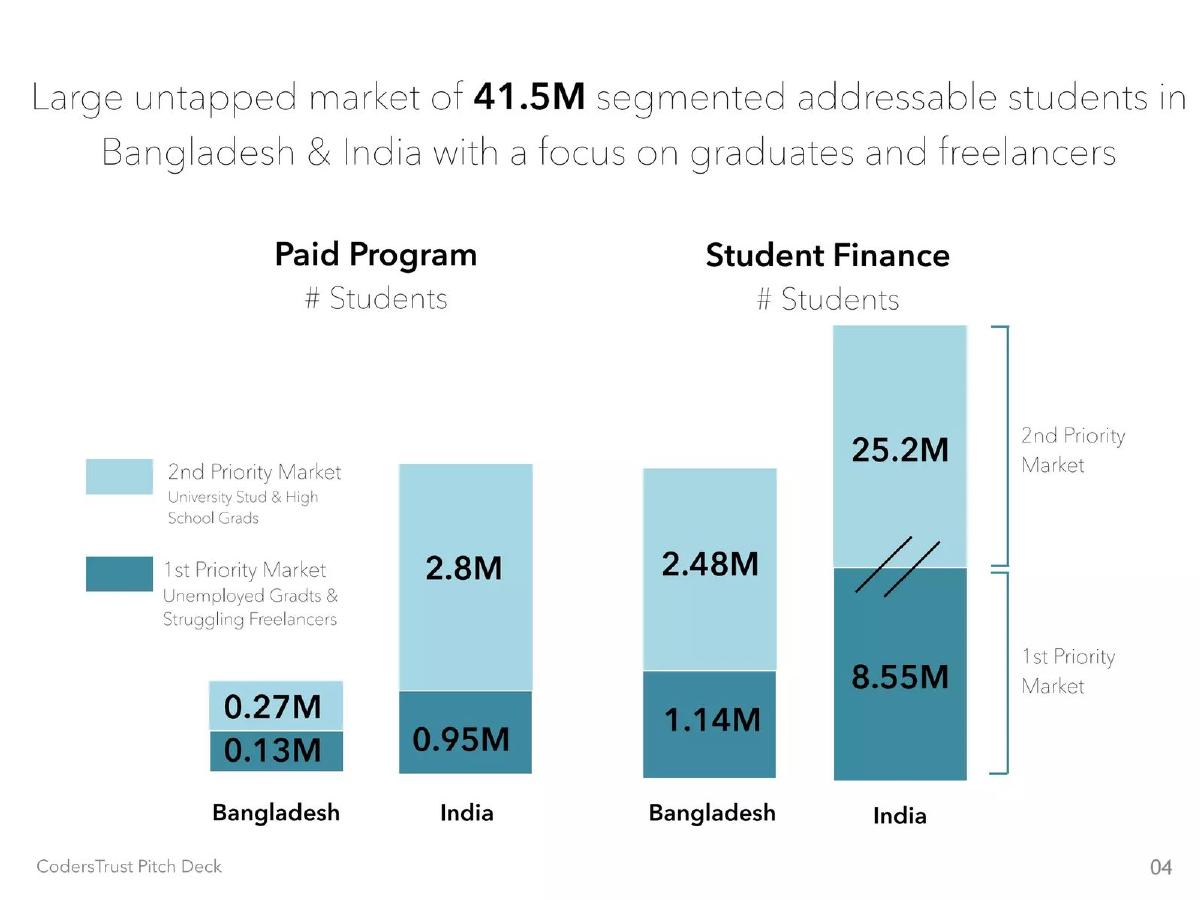
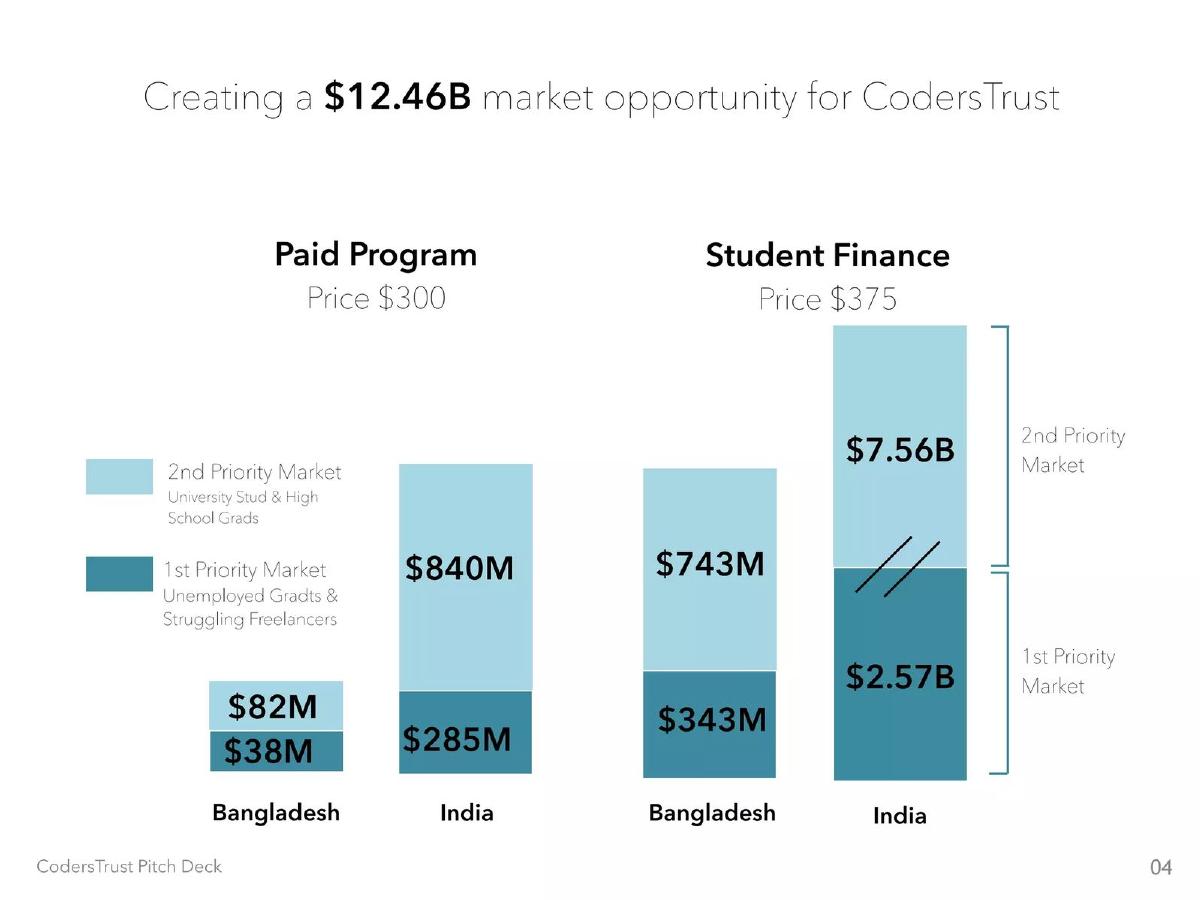
CodersTrust provides a detailed breakdown of their addressable market in Bangladesh and India. They claim a total market of 41.5 million students . The data is segmented by priority:
1st Priority: Unemployed graduates and struggling freelancers (0.13M in Bangladesh, 0.95M in India for the paid program; 1.14M in Bangladesh, 8.55M in India for student finance). · 2nd Priority: University and high school grads (0.27M in Bangladesh, 2.8M in India for the paid program; 2.48M in Bangladesh, 25.2M in India for student finance).
The slide effectively argues that the finance model unlocks a significantly larger market than the standard upfront payment model.
Slide 06: The Traction Gap
This is perhaps the most important slide in the deck. It visualizes a funnel from 2014 to 2017. While they have 336,000 Facebook followers and 36,000 student applications , they only have 2,000 enrolled paid students . The founders label the gap between applications and enrollment as a 'Missed 15X Opportunity.' This framing suggests that the demand is already captured, and the only thing missing is the capital to finance the students' entry.
Slide 08: Growth Projections
The deck sets ambitious targets for December 2018. The 'Current' state is listed as $20,000 USD/month in gross profit with 170 new students per month. The 'Series A target' is $445,000 USD/month in gross profit with 2,660 new students per month. This represents a massive scaling effort, predicated entirely on the implementation of the finance scheme.
Slide 10: The Student Finance Mechanism
This slide explains the flow of funds. It outlines a four-step cycle:
1. $500K Series A Security is deposited as collateral. · 2. $1.5M Student Finance is secured from an external lender (e.g., Lendino). · 3. 20,000 Students are financed over 3 cycles of 15 months each. · 4. $6M Revenue is generated ($300 per student upfront).
This slide is critical for investors to understand how their equity capital is being leveraged to access debt capital for student loans.
Slide 12: B2B Scaling Strategy
CodersTrust intends to scale by partnering with existing giants. They list three 'Business Cases':
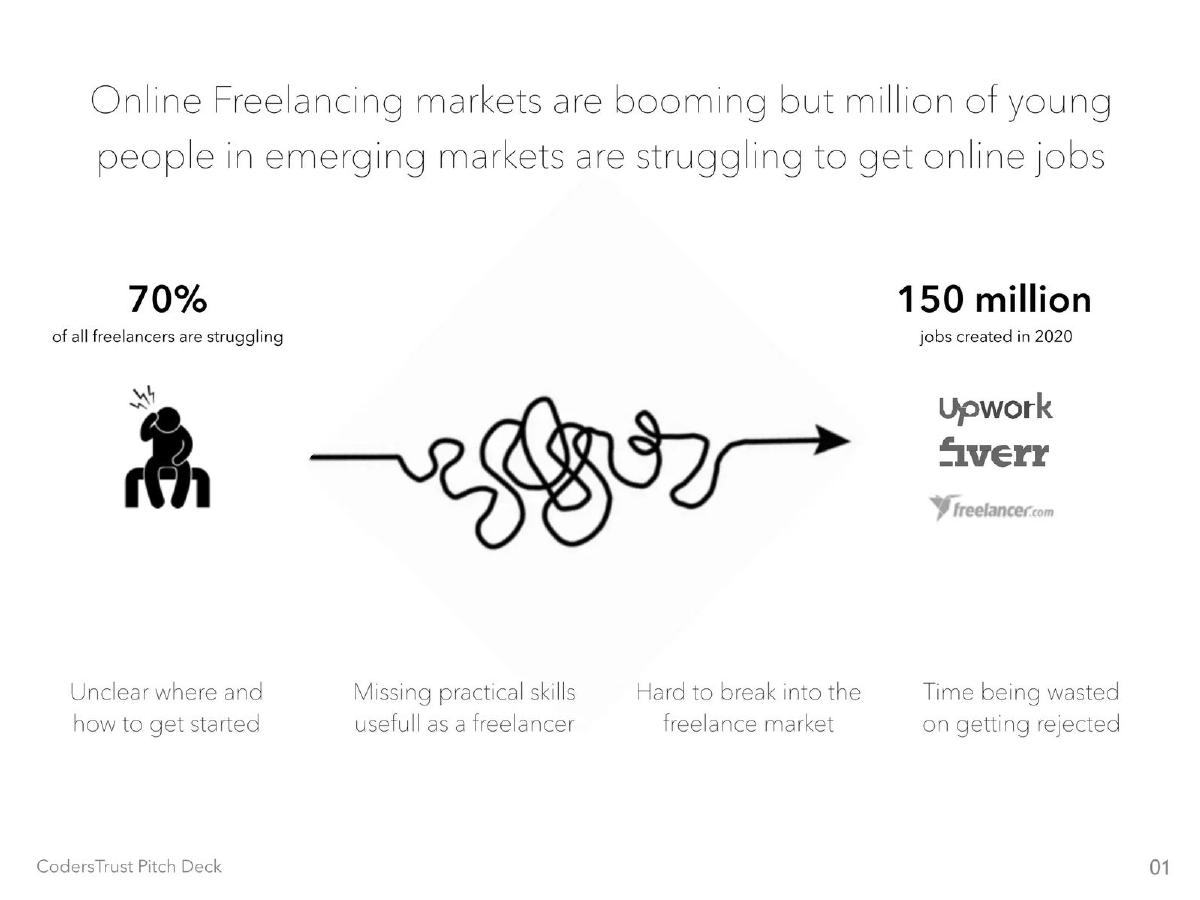
E-learning platforms (Udemy, Pluralsight, Lynda): Converting non-paying users via finance solutions. · Freelance portals (Upwork, Fiverr): Offering finance to the '70% of freelancers who are struggling.' · Mentor networks (CodementorX): Accessing 9,000+ vetted mentors at $90 per student.
This strategy shows an awareness that direct-to-consumer acquisition is expensive and that piggybacking on established platforms is a faster route to scale.
Slide 14: Team and Global Footprint
The team is split between Denmark (Management and Finance) and Bangladesh (Operations and Education). Key figures include Ferdinand Kjærulff (CEO) and Jan Cayo Fiebig (COO). The slide also lists several 'To be Hired' roles in Denmark, including a CFO and a Portfolio Risk Manager, which are essential hires for a company essentially acting as a sub-prime lender for education.
Slide 16: Exit Strategy
Large IT/BPO companies: Tata, Infosys, Wipro (who need a steady stream of trained talent). · EdTech/WorkTech: Recruit, Seek, Pluralsight. · Banks/MFIs: Credit Suisse, SoftBank, UBS. · Freelance Networks: LinkedIn, Freelancer, Upwork.
This slide demonstrates that the founders are thinking about the long-term liquidity for investors across multiple industries.
Slide 18: Closing Vision
The deck ends with a quote: 'A Mind is a terrible thing to waste, but a wonderful thing to invest in.' It returns to the social impact narrative established at the beginning, aiming to leave the investor with a sense of purpose beyond just financial returns.
What Works in This Deck
Clear Problem Identification: The '15x Opportunity' slide (Slide 06) is a masterclass in identifying a bottleneck. It proves there is interest (followers) and intent (applications), but a specific friction point (cash) is stopping the transaction. Investors love seeing a 'dam' that just needs a small opening to release a flood of revenue.
Leverage Model: The explanation of how $500k in equity unlocks $1.5M in debt (Slide 10) is very clear. It shows the founders understand capital efficiency and aren't just looking to spend investor money on marketing, but rather to use it as a tool to unlock larger pools of capital.
Market Specificity: Rather than saying 'the global market is huge,' they provide specific numbers for Bangladesh and India, segmented by student type. This makes the $6M revenue target feel grounded in reality rather than plucked from thin air.
What Is Missing or Weak
The 'Ask' is Vague: While we know they want to use $500k for collateral, the deck never explicitly states the total amount of money they are raising in the Series A. Is it $1M? $5M? Without the total ask, it's hard to evaluate the dilution or the full runway.
Repayment Data: For a business model built on lending to 'struggling freelancers,' the lack of data on historical repayment rates or default rates is a glaring omission. If the students don't make money on Upwork, they can't pay back the loan. The deck assumes a 100% success rate in its revenue calculations, which is unrealistic for any lending product.
Product Depth: We see the 'what' (coding, soft skills) but not the 'how.' There are no screenshots of the platform, no curriculum details, and no explanation of how they ensure the quality of education at scale. As an EdTech company, the 'Ed' part is surprisingly thin compared to the 'Fin' part.
Founder Takeaways
Use your funnel to prove demand: If you have high top-of-funnel interest but low conversion, don't hide it. Use it as CodersTrust did to show that you have a 'distribution' success but a 'transactional' hurdle that investment can fix.
Map your exit: Slide 16 is a great example of how to show an investor that you aren't just building a lifestyle business. By mapping specific companies in specific verticals, you show you understand the M&A landscape of your industry.
Geographic Arbitrage: The team slide (Slide 14) shows a smart use of resources—keeping high-level management and finance in a stable regulatory environment (Denmark) while running operations in a high-growth, lower-cost market (Bangladesh). This is a strong model for startups targeting emerging markets.
Frequently asked questions
- What is the core problem CodersTrust is solving?
- CodersTrust addresses the financial barrier preventing skilled but underfunded individuals in developing markets from accessing high-quality vocational training. While many students want to learn coding to join freelance platforms like Upwork, they lack the upfront capital for tuition. By providing student finance, CodersTrust aims to convert 'missed opportunities' into paying students who then repay the loan through their increased freelance earnings.
- How does the student finance mechanism work?
- According to slide 10, CodersTrust plans to use $500,000 from their Series A round as a security deposit. This collateral allows them to secure $1.5 million in student finance from an external lender (citing Lendino as an example). This capital is then used to finance 20,000 students over 15-month cycles, generating an estimated $6 million in upfront revenue for the company.
- What is the current traction of the company?
- As of the 2017 data shown on slide 06, the company had 336,000 Facebook followers, 36,000 student applications, and 2,000 enrolled paid students. Slide 08 notes their 'current' gross profit at the time of the deck was $20,000 per month, with an intake of 170 new students per month.
- Who is the target audience for their services?
- The market is segmented into two priorities across Bangladesh and India. The '1st Priority Market' includes unemployed graduates and struggling freelancers (approx. 9.69 million people). The '2nd Priority Market' includes university students and high school graduates (approx. 31.8 million people). The total addressable market cited is 41.5 million students (Slide 04).
- What is missing from this pitch deck?
- The deck omits the specific total amount of the Series A 'Ask.' While it mentions using $500k for collateral, it doesn't state the full round size. Additionally, there is no data on historical repayment rates for students or 'default' risks, which is critical for a finance-heavy model. Detailed unit economics—such as Customer Acquisition Cost (CAC) versus Lifetime Value (LTV)—are also absent.