The CodersTrust pitch deck from June 2017 outlines a platform designed to bridge the gap between education and employment for freelancers in markets like India and Bangladesh. By providing a 'learn and earn' path that includes coding and soft skills training, the company targets a $12.96B market opportunity. The deck is notable for its detailed financial modeling of student loans, projecting a 10% annual return for external backers. While it boasts high-profile advisors and a clear roadmap involving the World Bank and BRAC, the deck relies heavily on aggressive growth projections—aiming to sc…
Key takeaways
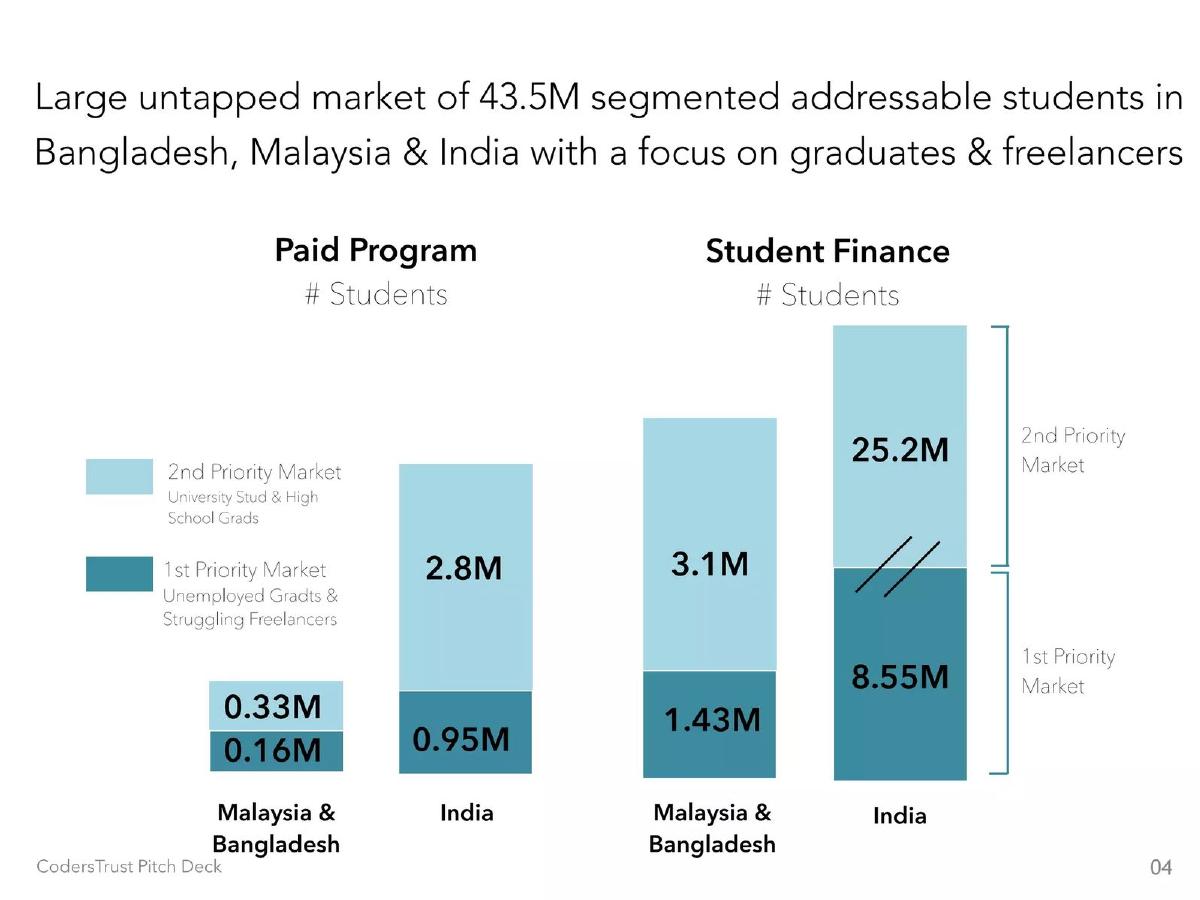
- The company identifies a $12.96B market opportunity across India, Malaysia, and Bangladesh, split between paid programs and student finance (Slide 04).
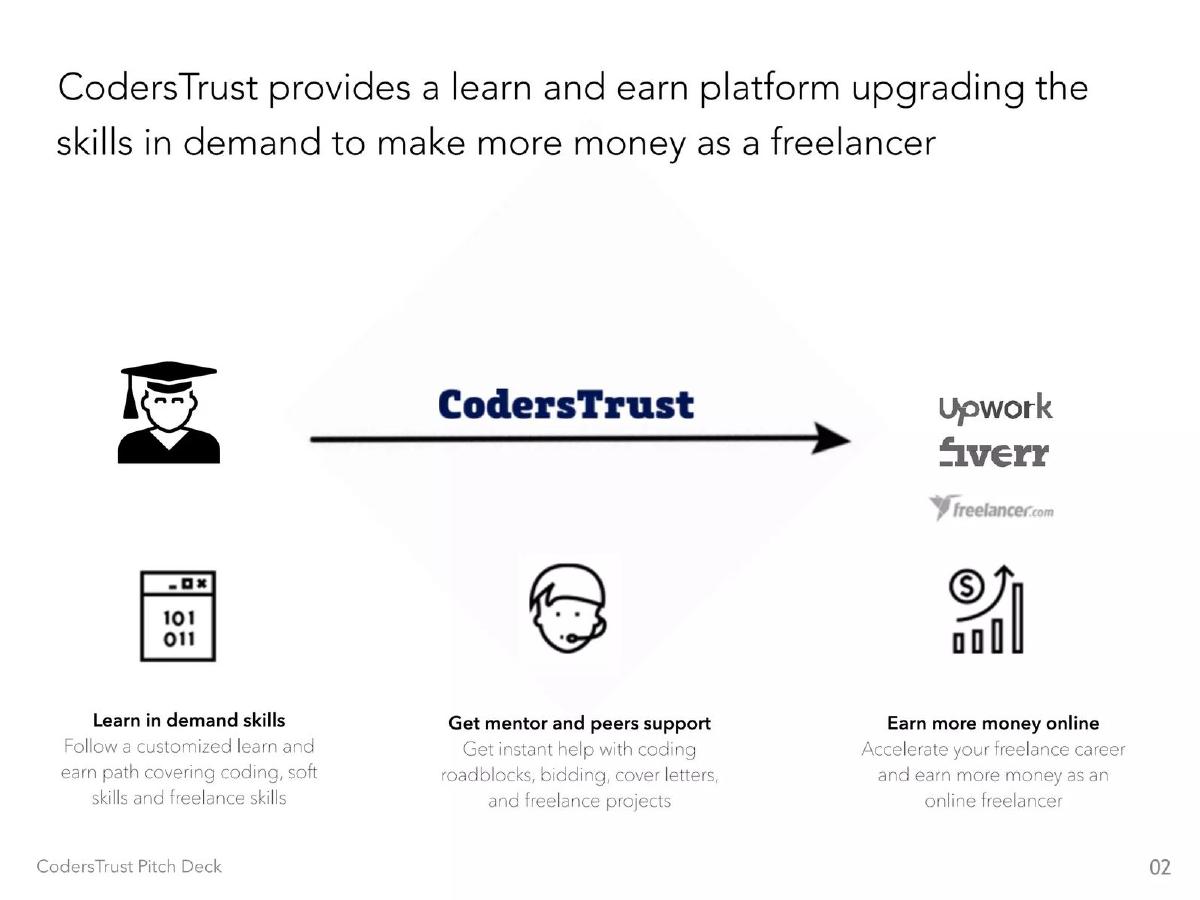
- CodersTrust utilizes a 'learn and earn' model that connects students to major freelance platforms like Upwork, Fiverr, and Freelancer.com (Slide 02).
- The financial model for student backing assumes a $300 upfront course fee, where investors provide 75% ($225) and students pay 25% ($75) (Slide 15).
- Investors are promised a 10% annual IRR based on an 82.5% student repayment rate over 15 months (Slide 15).
- The deck projects a 15x growth opportunity, targeting $445,000 in monthly gross profit by December 2018 (Slide 05).
- The team is distributed across Denmark and Bangladesh, with plans to hire a CFO and Portfolio Risk Manager in Denmark post-Series A (Slide 16).
- High-profile backers include Morten Lund (Skype investor) and the Godrej Family (Slide 17).
- The roadmap highlights significant institutional partnerships with the World Bank, BRAC, and MDEC (Slide 25).
Executive Summary: The Convergence of EdTech and Microfinance
The CodersTrust pitch deck, dated June 2017, presents a sophisticated approach to the global skills gap. Rather than just offering another MOOC (Massive Open Online Course), CodersTrust positions itself as a financial and educational bridge for freelancers in developing economies. The deck focuses heavily on the mechanics of their student finance model, attempting to de-risk the investment by showing a clear path from education to income generation on established global platforms.
Slide 01: Title Slide
The deck opens with a minimalist teal background and the tagline: "Re-inventing Student Finance for the workforce of tomorrow." This immediately signals that the company views itself as a fintech play as much as an edtech one. The date, June 2017, places this in a period where freelance marketplaces like Upwork were seeing massive growth in South Asian labor participation.
Slide 02: The Learn and Earn Platform
Slide 02 defines the value proposition: "CodersTrust provides a learn and earn platform upgrading the skills in demand to make more money as a freelancer." The slide uses a simple flow diagram showing a student moving through CodersTrust to reach platforms like Upwork, Fiverr, and Freelancer.com . The three pillars of the service are listed as: 1) Learn in-demand skills (coding, soft skills), 2) Get mentor and peer support (bidding, cover letters), and 3) Earn more money online. This slide is effective because it connects the "learning" directly to the "earning" outcome, which is the primary motivator for their target demographic.
Slide 04: Market Opportunity
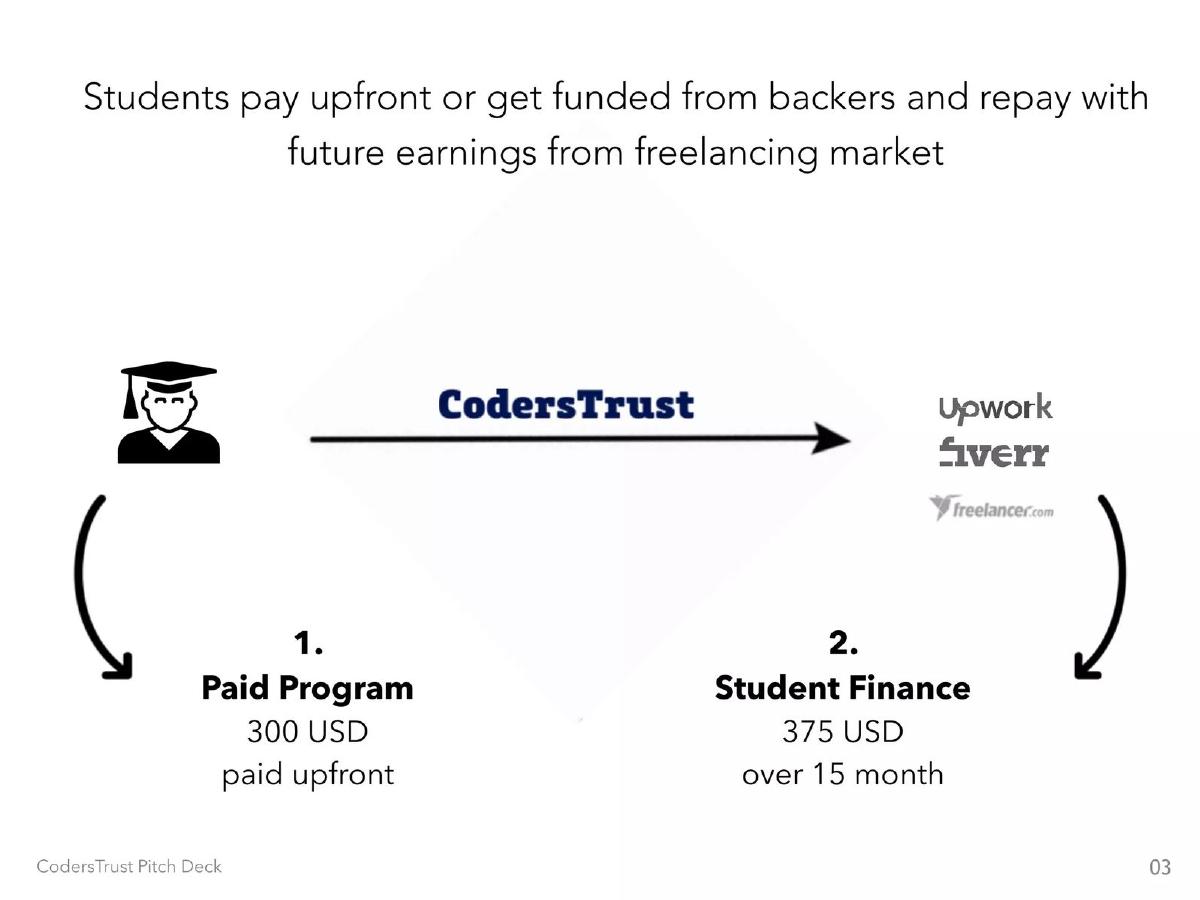
CodersTrust quantifies a "$12.96B market opportunity" on Slide 04. The data is segmented by product type (Paid Program vs. Student Finance) and geography (India vs. Malaysia & Bangladesh). India represents the lion's share of the opportunity, with a total projected value of over $10 billion. The slide distinguishes between two target segments: "1st Priority Market" (Unemployed grads & struggling freelancers) and "2nd Priority Market" (University & High School grads). The pricing is transparently listed: $300 for the Paid Program and $375 for the Student Finance option. This $75 premium for financing is a key detail for potential investors.
Slide 05: Growth Trajectory and Series A Targets
This slide presents the "Ask" context by showing what a Series A round is intended to achieve. The company claims to be at 170 new students per month with $20,000 USD in monthly gross profit at the time of the pitch ("NOW"). They project a massive ramp-up by December 2018, targeting 2,660 new students per month and $445,000 USD in monthly gross profit . They label this a "15x Opportunity to be realised." While the chart is visually clear, the jump from 170 to 2,660 students in roughly 18 months is an aggressive projection that would require significant operational scaling.
Slide 15: The Student Finance Model
This is arguably the most important slide in the deck. It breaks down the unit economics of their lending product. For a $300 upfront course fee , the breakdown is:
75% ($225): Average Backing / Investor · 25% ($75): Average Downpayment / Student
The slide projects an Investor IRR of 10% p.a. and assumes an 82.5% student repayment rate . The repayment is structured over 15 months, with the student's earnings (light blue bars) increasing over time to cover the student payments (dark blue bars). By Month 15, the $300 is repaid to the backer in 8 installments. This level of detail is excellent for a pitch deck as it shows the founders have modeled the risk and the cash flow cycles of their primary revenue driver.
Slide 16: The Team
The team slide shows a distributed structure. The leadership, including Ferdinand Kjærulff (CEO) and Jan Cayo Fiebig (COO) , is based in Denmark. The technical and data leads are spread across Europe, while the operational "boots on the ground" are in Bangladesh, led by Ataul Osmani (Country Manager) . The slide also lists four key roles "To be Hired in DK" : CFO, Portfolio Risk Manager, Back End Lead, and UX Lead. The inclusion of a Portfolio Risk Manager reinforces the company's focus on the lending aspect of their business.
Slide 17: Investors and Advisors
CodersTrust displays a very strong roster of backers. Morten Lund (Skype investor) and Hide, Segnel Ventures are listed as Board Members. Other notable investors include the Godrej Family and Lone Fønss Schrøder . The advisory board includes Douglas Rushkoff and Jan Mattson . Having this level of institutional and high-net-worth backing provides significant social proof for a Series A round, suggesting that the model has already been vetted by sophisticated parties.
Slide 19: Risks and Mitigations
Transparency regarding risk is often missing in pitch decks, but CodersTrust includes a dedicated slide for it. They identify "Student drop-out" as a High risk, "Partial Repayment" as a Partial risk, and "Student employment" as a Low risk. Their mitigations include:
Selective intake based on scoring. · Students having "skin in the game" via the 25% downpayment. · A mentor model using the top 5% of freelancers to guide new students. · Clustering students based on captured data to predict success.
This slide demonstrates a mature understanding of the challenges inherent in lending to uncollateralized individuals in emerging markets.
Slide 25: Roadmap and Partnerships
The final slide in this selection shows a timeline of achievements and future goals. It highlights a World Bank Project , partnerships with BRAC (one of the world's largest NGOs), MDEC in Malaysia, and integrations with Payoneer . It notes 9,144 registered users and launches in Bhutan, Malaysia, and India. The presence of logos like Udemy and Code School suggests they are aggregating existing content rather than just building their own, which is a scalable approach.
What Works in This Deck
1. The Hybrid Model: The deck successfully bridges the gap between a social impact story and a hard-nosed financial product. By framing education as a loan-backed asset, they appeal to investors looking for both yield and growth.
2. Detailed Unit Economics: Slide 15 is a masterclass in explaining a complex financial product simply. It answers the investor's first question: "How do I get my money back?"
3. Social Proof: The combination of high-profile Danish investors and massive NGOs like the World Bank and BRAC creates a sense of inevitability and stability that is rare for a startup at this stage.
4. Risk Awareness: By explicitly labeling student drop-out as a "High" risk, the founders build trust. It shows they aren't naive about the difficulties of their chosen market.
What Is Missing or Could Be Improved
1. Competitive Landscape: The deck (at least the slides provided) does not mention other coding bootcamps or microfinance institutions. While they mention Upwork as a partner/destination, they don't address how they compete with free resources or local vocational schools.
2. Technology Deep Dive: There is very little information on the actual "platform." Is it a proprietary LMS (Learning Management System)? How does the "scoring" for selective intake work? Investors would want to know if there is a "moat" beyond just the financial structure.
3. Historical Cohort Data: While they project an 82.5% repayment rate, the deck doesn't provide historical data from their first 9,000 users to prove this rate is achievable. Real-world data on default rates would be more convincing than projections.
4. The "Ask": While the deck mentions a "Series A target," it doesn't explicitly state the amount of capital being raised or the specific valuation sought in these slides.
Founder Takeaways
Structure your financials for your audience: If you are raising for a fintech-adjacent company, you must show the flow of funds. CodersTrust does this perfectly on Slide 15. Don't just say you are profitable; show the installment plan.
Leverage your advisors: If you have high-profile backers, don't just list their names. List their specific achievements (e.g., "Invested in Skype") to transfer that credibility to your own venture.
Address the 'Human' risk: In EdTech, the biggest risk is always the user giving up. CodersTrust addresses this head-on with their "Risks & Mitigations" slide. Every founder should have a slide that admits what is hard about their business and how they are solving it.
Partner for Scale: The roadmap shows that CodersTrust didn't try to do everything alone. By partnering with the World Bank and BRAC, they gained access to infrastructure and credibility that a startup could never build from scratch in two years.
Frequently asked questions
- What is the core business model of CodersTrust?
- CodersTrust operates a 'learn and earn' platform. It provides coding and soft skills training to freelancers in emerging markets, helping them earn more on platforms like Upwork and Fiverr. The business generates revenue through a $300 paid program or a student finance model where external investors fund the tuition in exchange for a projected 10% annual return.
- How does the student finance mechanism work?
- According to slide 15, the upfront course fee is $300. The student pays a 25% downpayment ($75), and an external investor/backer provides the remaining 75% ($225). The student then repays the backer in 8 installments over 15 months, fueled by their increased earnings as a freelancer. The model assumes an 82.5% repayment rate to achieve a 10% IRR.
- Which markets are prioritized in the deck?
- The deck focuses on South and Southeast Asia. Slide 04 identifies India as the primary market opportunity ($10.13B total), followed by Malaysia and Bangladesh ($1.5B combined). They categorize their audience into '1st Priority' (unemployed grads and struggling freelancers) and '2nd Priority' (university and high school students).
- Who are the key investors and advisors mentioned?
- The company boasts a high-profile cap table and advisory board. Key names include Morten Lund (early Skype investor), the Godrej Family (Indian conglomerate), and Lone Fønss Schrøder (Volvo Chairman). Advisors include American media theorist Douglas Rushkoff and former UNOPS Executive Director Jan Mattson.
- What are the primary risks identified by the founders?
- Slide 19 categorizes risks into three levels: High (Student drop-out), Partial (Repayment), and Low (Student employment). To mitigate drop-outs, they use selective intake based on scoring and a 'skin in the game' requirement where students must self-finance at least 25% of the cost.