Cogint’s October 2016 presentation outlines a dual-pronged business model centered on 'Information Services' and 'Performance Marketing.' The company positions itself as a data fusion powerhouse, utilizing a proprietary database to provide holistic views of consumers for risk management, retail, and healthcare. A key highlight is the 'idiCORE' platform, which offers investigative insights into individuals and assets. The deck emphasizes technical infrastructure, claiming sub-250 millisecond query times and the processing of 5 million daily consumer responses. While the presentation lacks spec…
Key takeaways
- The company operates two primary segments: Information Services (idiCORE) and Performance Marketing (Audience Solutions), as shown on slide 10.
- Cogint claims a high-performance technical stack with sub-250 millisecond query response times and four 9s of service uptime (slide 16).
- The data pipeline ingests five distinct categories: Public Record, Behavioral, Demographic, Ethnographic, and Meta data (slide 7).
- Management pedigree is a central selling point, featuring leaders with experience at Equifax, TransUnion, LexisNexis, and Seisint (slide 19).
- The platform processes over 5 million consumer responses daily to maintain comprehensive profiles (slide 16).
- Case studies for Western Union and Verde Energy USA demonstrate significant engagement lifts, including an 8x improvement in open rates for the former (slide 13).
- The business model is built on a 'massive proprietary database' designed to enable deterministic, omni-channel marketing (slide 4).
Executive Summary: The Data Fusion Narrative
The Cogint presentation from October 2016 is a study in enterprise-grade positioning. Rather than focusing on a single app or niche tool, the deck presents a comprehensive data ecosystem. The company positions itself at the intersection of big data, machine learning, and consumer marketing. By leveraging a 'massive proprietary database,' Cogint aims to solve the fragmentation of consumer identity across different channels. The deck is structured to move from high-level value propositions to technical specifications, concluding with a heavy emphasis on the 'Proven, Successful Leadership' that underpins the entire operation.
Slide 1: Title and Branding
The cover slide is minimalist, featuring the Cogint logo and the text 'COMPANY PRESENTATION' dated October 2016. The background image of a modern train station with converging tracks serves as a visual metaphor for 'data fusion' and the 'path forward,' though it provides no specific information about the company's industry or product.
Slide 4: Company Highlights
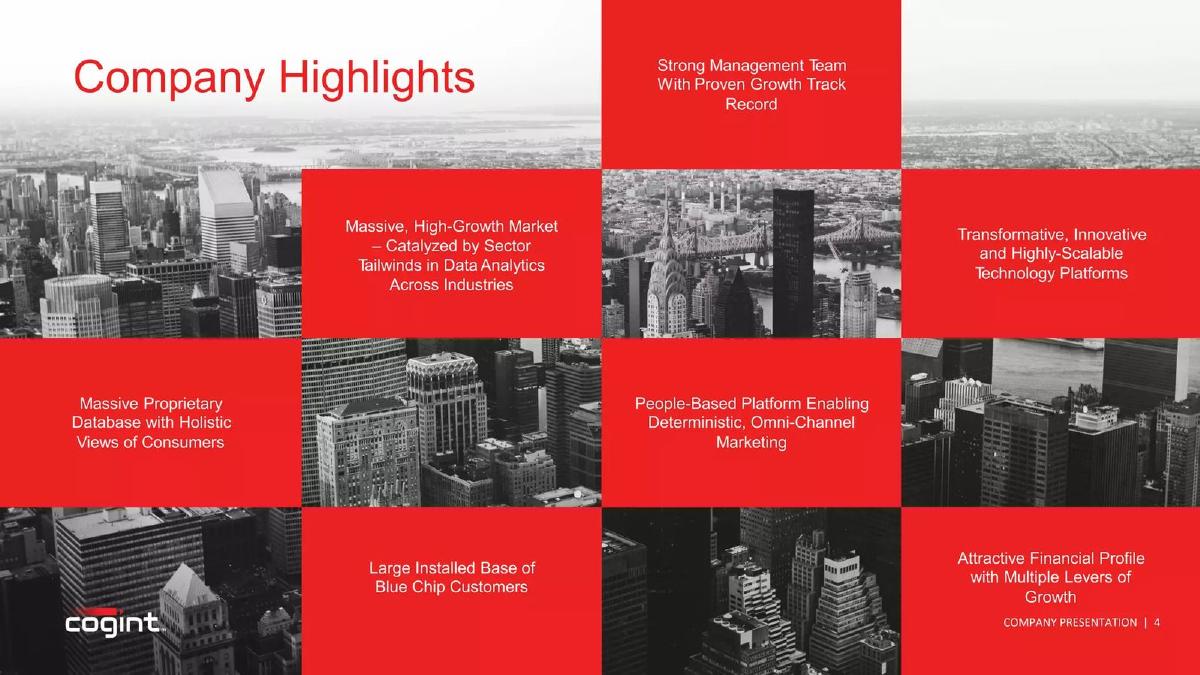
This slide uses a grid layout to establish six pillars of the business. It claims a 'Massive, High-Growth Market' fueled by data analytics tailwinds and a 'Massive Proprietary Database.' Notably, it mentions a 'Large Installed Base of Blue Chip Customers' and an 'Attractive Financial Profile with Multiple Levers of Growth.' While these are strong claims, this slide functions as an executive summary of themes rather than a data-heavy evidence sheet. The mention of 'Deterministic, Omni-Channel Marketing' suggests a focus on precision over probabilistic modeling.
Slide 7: The Data Processing Funnel
Slide 7 provides a conceptual look at how Cogint’s technology works. It shows a funnel ingesting five types of data: Public Record, Behavioral, Demographic, Ethnographic, and Meta . This data passes through four internal stages: Ingest, Assimilate for Modeling, Data Fusion Layer, and GRC Controls. The output is shown as 'Real-Time' solutions for three personas: a risk management profile (bankruptcy/loan defaults), a retail profile (shopping frequency and shoe size), and a healthcare profile (specific medical conditions). This slide is critical because it explains the 'how' behind their 'holistic view' of consumers.
Slide 10: Product Overview
Cogint divides its offerings into two distinct buckets: Information Services and Performance Marketing . Under Information Services, the flagship product is idiCORE , described as an analytical platform for investigative solutions regarding individuals, businesses, and assets. Under Performance Marketing, they list Audience Solutions and a Mobile Acquisition Engine . This dual-track approach suggests the company is monetizing its data both as a tool for researchers (investigative) and as a tool for advertisers (acquisition).
Slide 13: Client Case Studies
This slide provides social proof through two specific examples. For Western Union , Cogint claims an '8x improvement in open rates and engagement' and 'ongoing growth of 15x in key metrics in the first 4 months.' For Verde Energy USA , they report generating 'hundreds of thousands of leads per month' and an 'increased investment into our platform by 20x.' These figures are the most concrete evidence of product-market fit provided in the deck, showing that the platform can scale within existing accounts.
Slide 16: Technology Infrastructure
To appeal to technical due diligence, slide 16 lists specific performance metrics. The platform is 'Cloud-based' and 'PCI compliant' with 'greater than four 9s of service uptime.' It utilizes 'six datacenters spread geographically' and claims a 'Sub 250 millisecond query response time.' The scale is further emphasized by the mention of 'billions of data records' and 'over 5 million consumer responses compiled everyday.' This slide aims to prove that Cogint is not just a data reseller, but a high-performance technology provider.
Slide 19: Leadership Team
The presentation concludes its narrative with a 'Proven, Successful Leadership' slide. It features seven executives, highlighting their past roles at major industry players. Michael Brauser (Executive Chairman) and Derek Dubner (CEO) are linked to Seisint, Inc. and Naviant. Other team members, like Dan MacLachlan and Ole Poulsen , bring experience from TransUnion, TLOxp, and LexisNexis. This slide is intended to reduce perceived risk by showing that the team has 'been there, done that' in the highly regulated and competitive data sector.
What Cogint Does Well
The deck excels at segmentation and clarity of purpose . By clearly splitting the business into Information Services and Performance Marketing, the founders avoid the 'jack of all trades' trap. They explain exactly what data goes in (Slide 7) and exactly what products come out (Slide 10). The inclusion of specific infrastructure metrics (Slide 16) like 'four 9s' of uptime and sub-250ms latency provides a level of technical rigor that is often missing from marketing-heavy decks. Furthermore, the use of recognizable logos like Western Union (Slide 13) provides immediate credibility to their claims of being a 'Blue Chip' provider.
What Is Missing from the Deck
The most glaring omission in the provided slides is a detailed financial breakdown . While Slide 4 mentions an 'Attractive Financial Profile,' there are no charts showing revenue growth, EBITDA margins, or customer acquisition costs (CAC). Additionally, the deck lacks a Competition slide . In a crowded market featuring giants like Experian, Acxiom, and the very companies their leadership came from (LexisNexis, Equifax), failing to define a unique competitive advantage or 'moat' is a significant gap. Finally, there is no specific 'Ask' or use of proceeds slide in this selection, leaving the investor's next steps undefined.
Founder's Playbook: Lessons to Copy
Pedigree as a Moat: If your team has exits or senior leadership experience at the industry incumbents, make that a cornerstone of your deck. Cogint uses Slide 19 to essentially say, 'We built the giants, now we are building the next generation.' · Visualizing the 'Black Box': Data companies often struggle to explain what happens between 'data in' and 'insight out.' The funnel graphic on Slide 7 is an excellent way to visualize a complex backend process for a non-technical audience. · Quantifiable Case Studies: Don't just say your customers like you. Use specific multipliers. Cogint’s use of '8x improvement' and '20x increased investment' (Slide 13) is far more persuasive than a generic testimonial. · Infrastructure as a Feature: In the world of enterprise SaaS and data, speed and reliability are features. Listing your datacenter count and query response times (Slide 16) signals that your product is ready for enterprise-scale deployment.
Frequently asked questions
- What is the core technology behind Cogint?
- Cogint’s technology is built around a data fusion layer that ingests multiple data types—including public records, behavioral, and demographic data—to create a 'holistic view' of consumers. According to slide 16, this is supported by six geographically spread datacenters and proprietary machine learning algorithms that manage billions of records with sub-250 millisecond query speeds.
- Who are Cogint's primary customers?
- The deck identifies 'Blue Chip Customers' as a key highlight on slide 4. Specific examples provided on slide 13 include Western Union, where Cogint claims to have delivered an 8x improvement in engagement, and Verde Energy USA, where they generated hundreds of thousands of leads per month.
- What specific products does Cogint offer?
- As detailed on slide 10, the product suite is divided into two categories. Information Services includes 'idiCORE' (an investigative analytical platform) and Data Acquisition Solutions. Performance Marketing includes 'Audience Solutions' for ad targeting and a 'Mobile Acquisition Engine' that matches users to apps based on self-declared interests.
- How does the company differentiate its data processing?
- Slide 7 illustrates a funnel process: Ingesting data inputs, assimilating data for modeling, a data fusion layer, GRC (Governance, Risk, and Compliance) controls, and finally, delivery output. This process is applied across diverse sectors like Risk Management, Retail, and Healthcare to provide real-time solutions.
- What is the background of the leadership team?
- The leadership team, shown on slide 19, consists of industry veterans. Executive Chairman Michael Brauser and CEO Derek Dubner both have backgrounds at Seisint and Naviant. Other members bring experience from major data bureaus like Equifax, TransUnion, and LexisNexis, emphasizing a deep expertise in large-scale data analytics.