Coco Robotics (formerly Cyan Robotics) utilizes a timeline-based deck to showcase its rapid ascent in the autonomous delivery sector. Starting with a 5-robot pilot in 2020, the company details its growth to a 1,300+ robot fleet by 2025, supported by over $110M in total funding. The narrative emphasizes operational efficiency, citing a 97% on-time rate and a 30% reduction in delivery times. Key to their strategy is the integration with major platforms like Uber Eats and DoorDash, alongside a strategic AI collaboration with OpenAI. While the deck lacks specific unit economics or a detailed comp…
Key takeaways
- The company was founded in 2020 by UCLA graduates Zach Rash and Brad Squicciarini, originally under the name Cyan Robotics Inc. (Slide 2).
- Coco raised a $36M Series A in 2021, which was later reported as approximately $56M in total for that period (Slide 3).
- Operational metrics from 2021 include a 97% on-time rate and delivery speeds 30% faster than traditional methods (Slide 3).
- The company achieved a milestone of 500,000 lifetime deliveries by 2024, facilitated by partnerships with DoorDash and Uber Eats (Slide 5).
- A $80M Series B led by SNR, with participation from Sam Altman, brought total funding to over $110M by 2025 (Slide 6).
- The fleet expanded from 100+ robots in 2021 to over 1,300 robots across cities including Los Angeles, Miami, Chicago, and Helsinki by 2025 (Slides 3, 6).
- Future monetization strategies include exploring ad revenue, B2B logistics, and package delivery beyond food (Slide 7).
- The leadership team includes specialized roles such as VP of Government Relations, reflecting the regulatory hurdles of sidewalk robotics (Slide 8).
Executive Summary: The Chronological Case for Robotics
The Coco Robotics deck is a masterclass in using a timeline to build momentum. Unlike traditional decks that start with a problem/solution framework, this presentation relies on a 'proven track record' narrative. By walking the reader through year-by-year milestones, the company demonstrates a consistent ability to raise capital, deploy hardware, and secure tier-one partnerships. The primary focus is on scale—moving from a 5-robot pilot to a projected 10,000-robot global fleet.
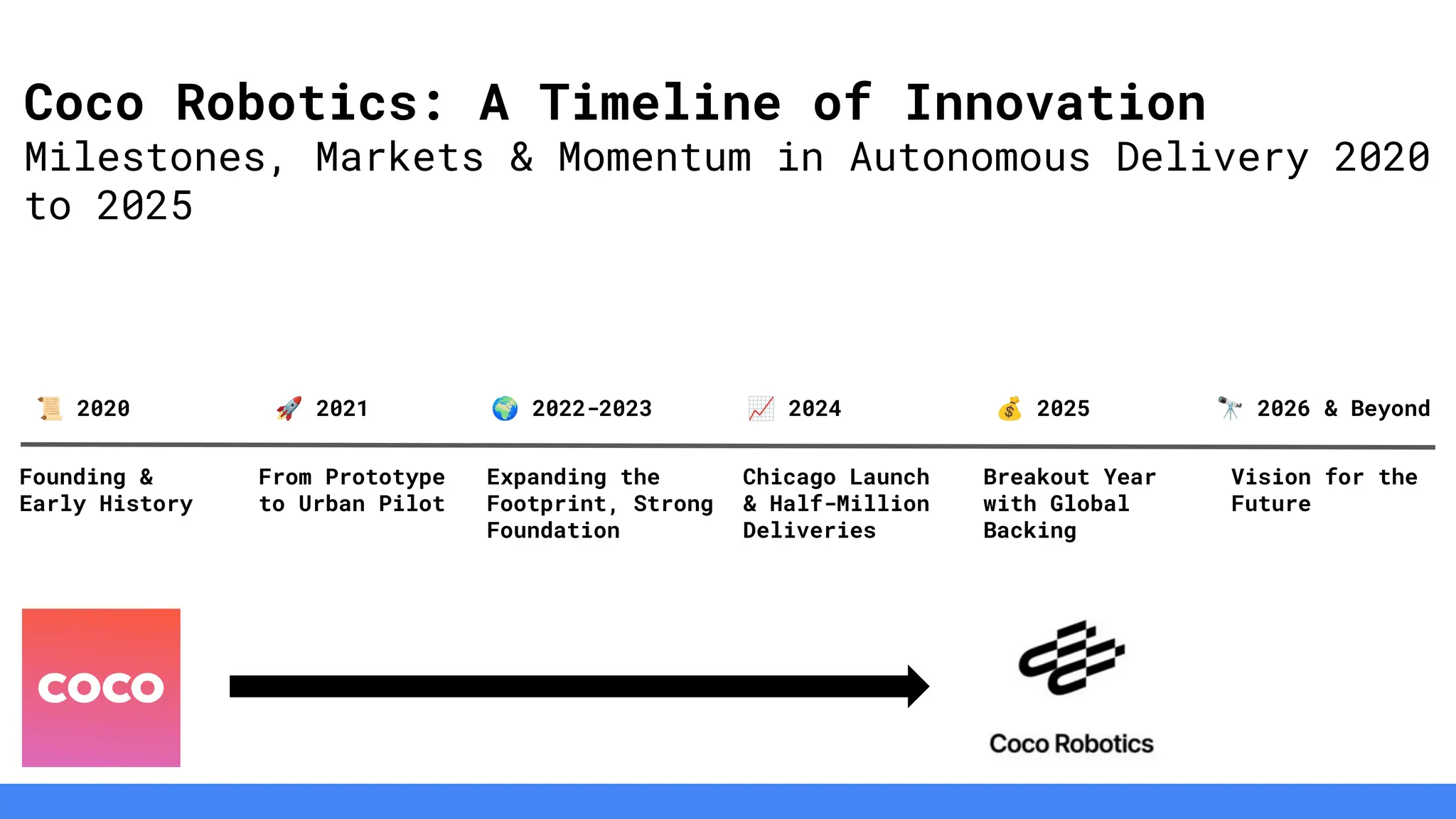
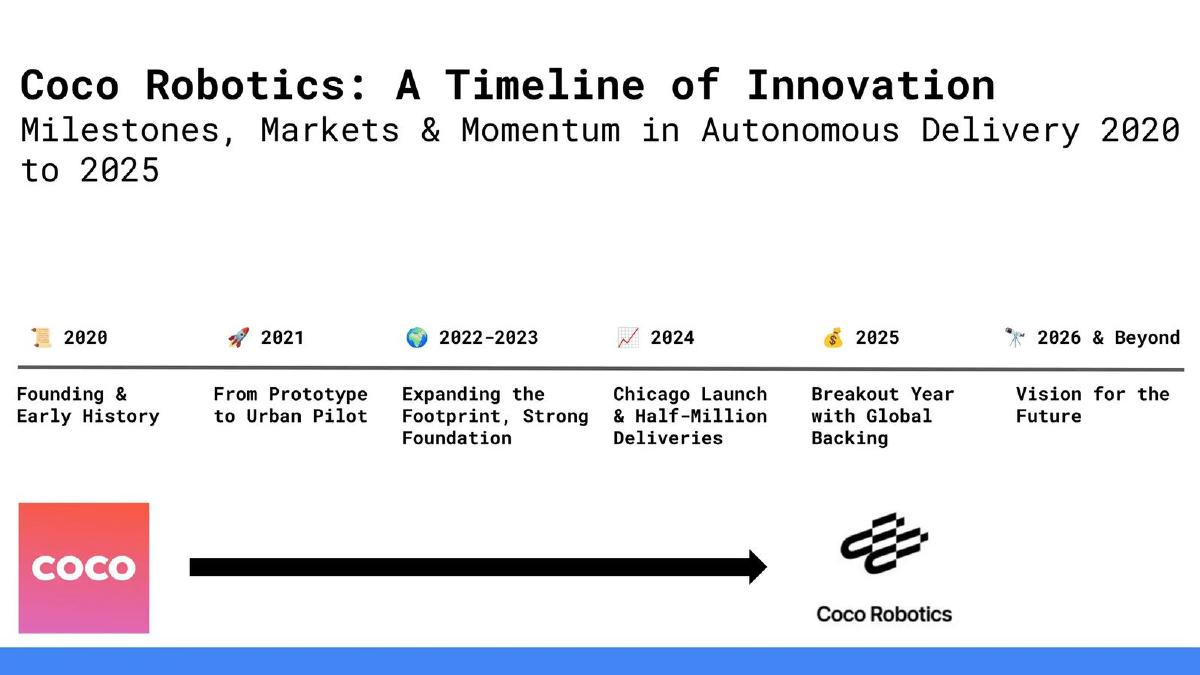
Slide 1: Title and Timeline Overview
The cover slide sets the stage with the subtitle 'Milestones, Markets & Momentum in Autonomous Delivery 2020 to 2025.' It introduces a visual timeline that anchors the entire deck. The transition from the original 'Coco' logo to a more corporate 'Coco Robotics' logo at the end of the timeline suggests a maturation of the brand from a startup to an industrial player.
Slide 2: 2020 - Founding & Early History
This slide establishes the company's origins. Founded as Cyan Robotics Inc. by UCLA graduates Zach Rash and Brad Squicciarini, the company started with a modest $1.5M seed round. The key takeaway here is the starting point: a 5-robot pilot in Santa Monica. Notably, the slide admits to using 'remote human teleoperations,' which manages expectations regarding their early autonomous capabilities.
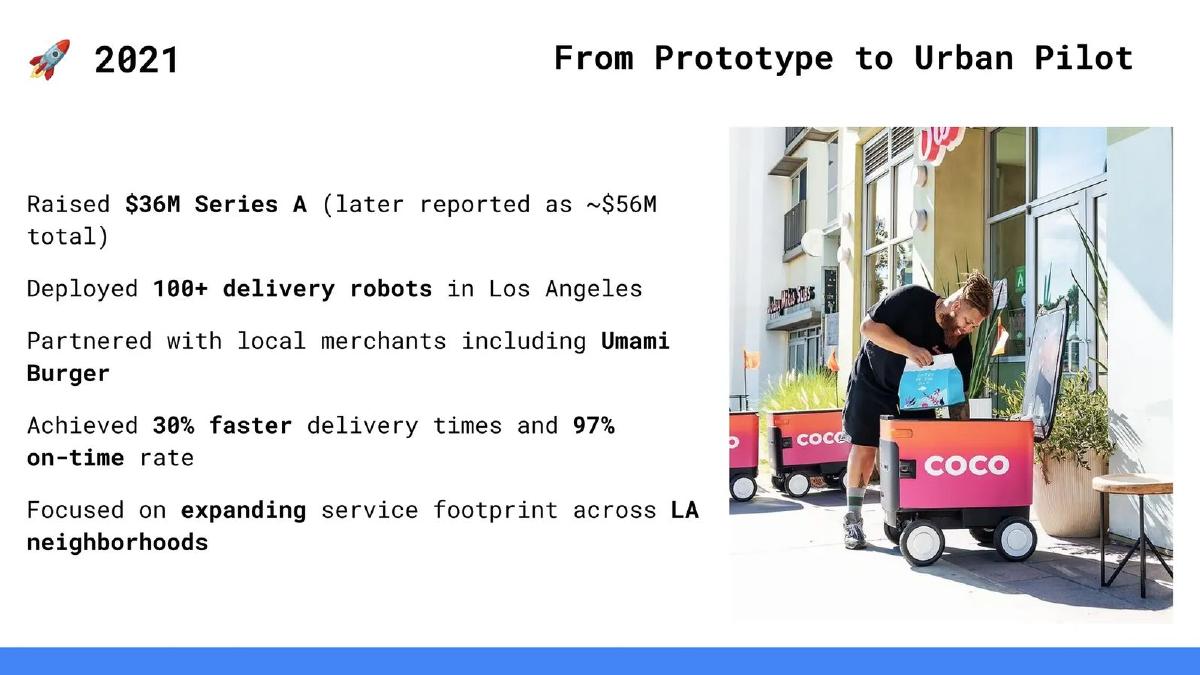
Slide 3: 2021 - From Prototype to Urban Pilot
The narrative shifts to rapid scaling. The company raised a significant Series A (totaling ~$56M) and deployed over 100 robots in Los Angeles. This slide introduces the first set of hard performance metrics: 30% faster delivery times and a 97% on-time rate. These figures are crucial for proving that robots aren't just a novelty but a functional improvement over human couriers. The mention of Umami Burger as a partner provides merchant-side validation.
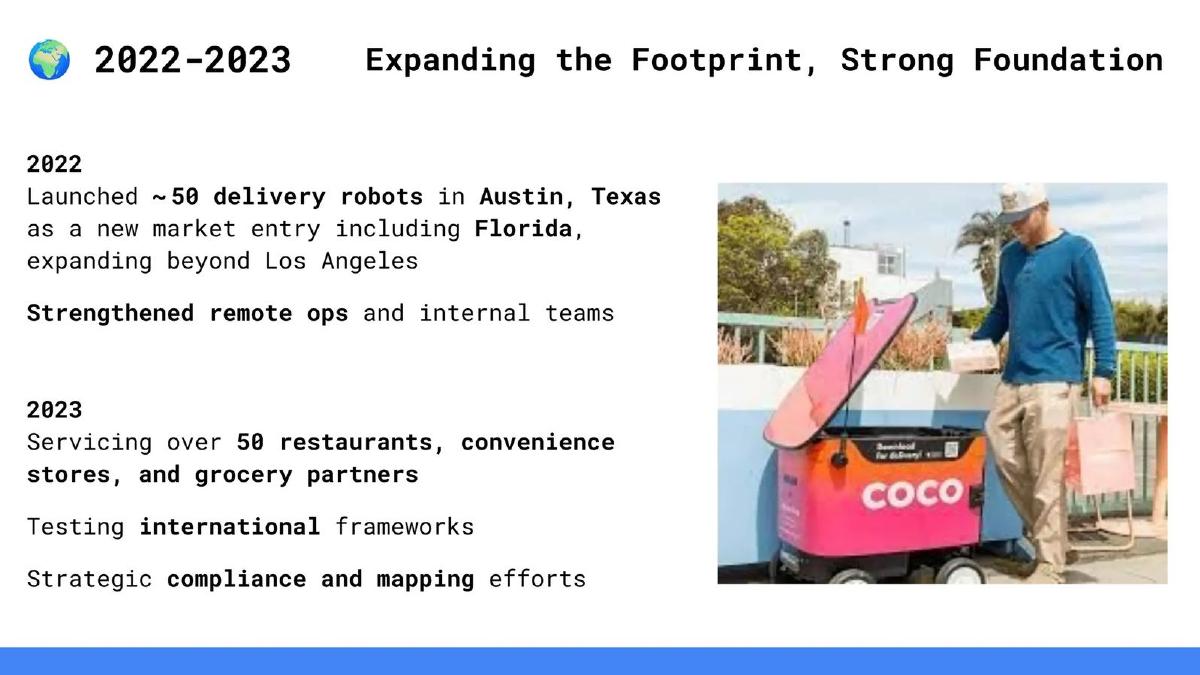
Slide 4: 2022-2023 - Expanding the Footprint
Expansion moves beyond California into Austin, Texas, and Florida. The deck notes that by 2023, the company was servicing over 50 restaurants and convenience stores. This period is described as a time for 'strengthening internal teams' and 'strategic compliance,' which hints at the regulatory work required to operate on public sidewalks. The mention of 'testing international frameworks' prepares the reader for the global expansion mentioned later.
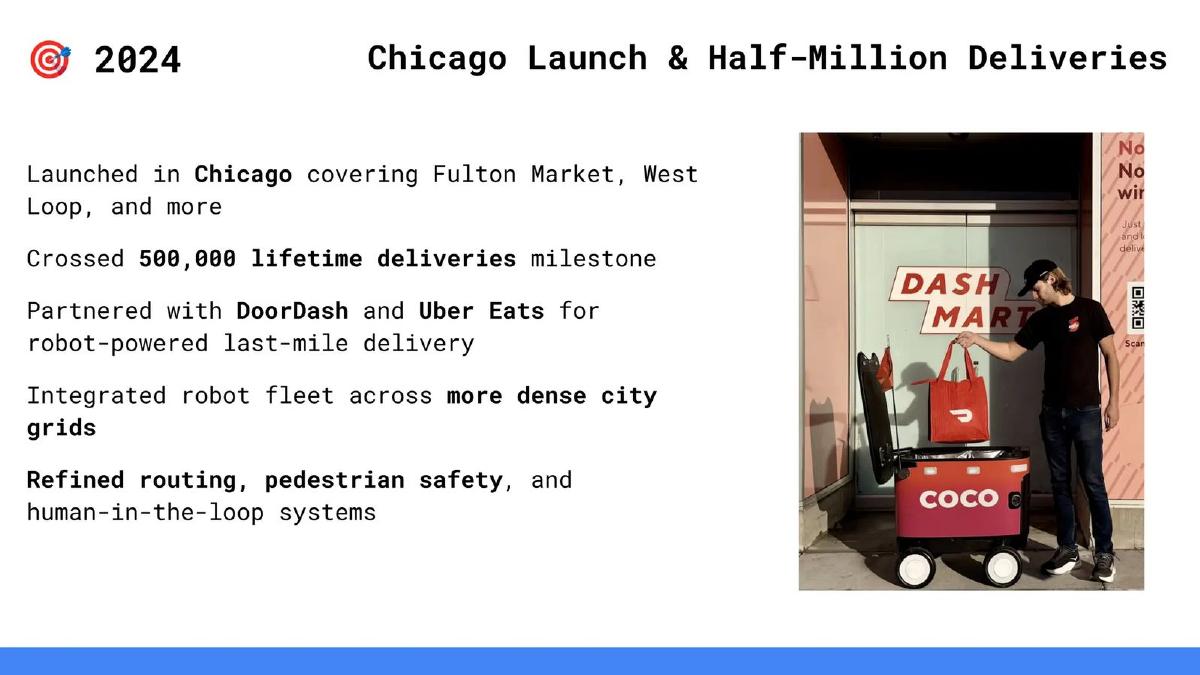
Slide 5: 2024 - Chicago Launch & Half-Million Deliveries
This slide marks a major milestone: 500,000 lifetime deliveries. The launch in Chicago (specifically Fulton Market and West Loop) demonstrates the robot's ability to handle dense, high-traffic urban grids. Most importantly, this slide highlights the integration with DoorDash and Uber Eats. This is a pivotal strategic shift; Coco is positioning itself as an infrastructure layer for the existing delivery giants rather than a standalone consumer app.
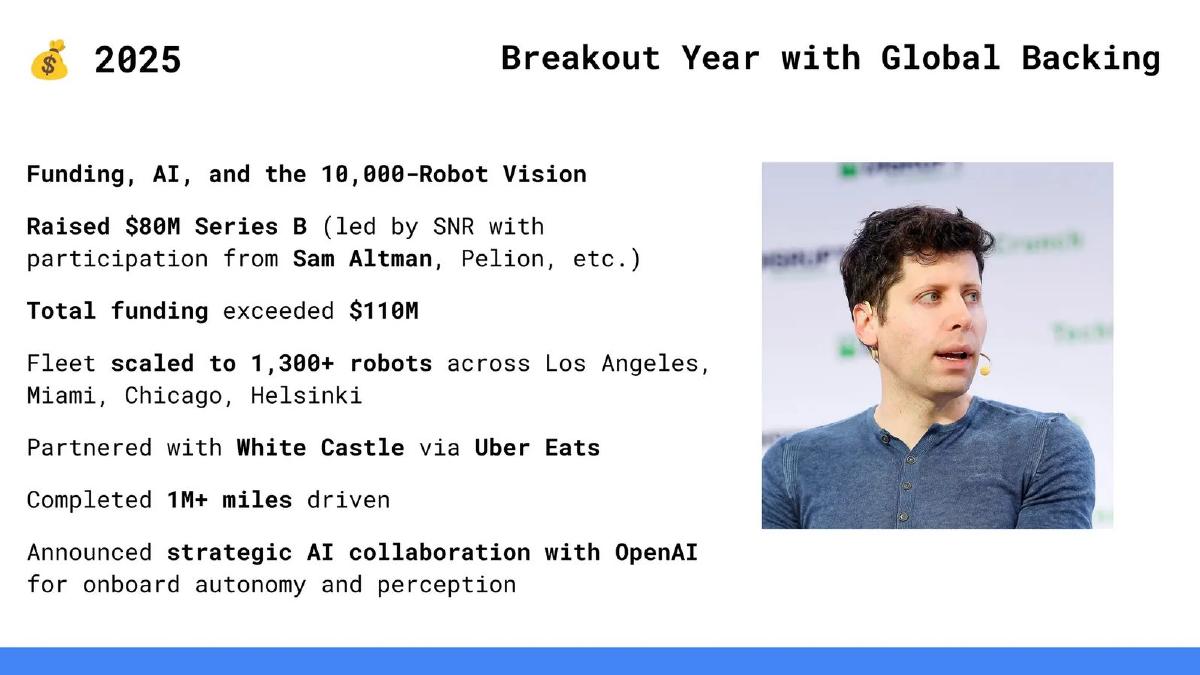
Slide 6: 2025 - Breakout Year with Global Backing
The 'Big Reveal' slide. It features a photo of Sam Altman, signaling high-level Silicon Valley endorsement. The $80M Series B led by SNR brings total funding to over $110M. The fleet size jumps to 1,300+ robots, and the company enters the European market via Helsinki. A 'strategic AI collaboration with OpenAI' is mentioned, which is a significant value-add for their autonomy claims.
Slide 7: 2026 & Beyond - Vision for the Future
The deck concludes its forward-looking statements with a target of 10,000 robots. The expansion targets are ambitious: NYC, London, and Berlin. The slide also introduces new revenue streams, including ad monetization on the robots themselves and B2B logistics. This suggests the company is looking for ways to improve unit economics beyond the thin margins of food delivery.
Slide 8: Current Leadership
The final slide lists the executive team. Beyond the founders, the inclusion of a 'VP of Gov. Relations' (Carl Hansen) is a smart inclusion for this sector. Sidewalk robotics is a regulatory minefield, and showing that the company has dedicated leadership for government relations addresses a major unspoken risk for investors.
What Coco Robotics Does Well
Momentum Building: By structuring the deck as a timeline, Coco makes their growth feel inevitable. Each year shows a clear step up in funding, fleet size, and geographic reach. This 'staircase' effect is very persuasive for late-stage investors.
Social Proof: The deck heavily leverages its association with Sam Altman and OpenAI. In the current investment climate, an AI partnership with OpenAI is a massive differentiator for a hardware-heavy robotics company.
Platform Integration: Highlighting partnerships with Uber Eats and DoorDash shows a realistic path to market. It proves that Coco doesn't need to spend millions on customer acquisition because they are tapping into existing demand aggregators.
What Is Missing from the Deck
Unit Economics: While the deck mentions '30% faster delivery,' it never mentions the cost per delivery. Investors in this space are typically obsessed with the 'cost per mile' compared to a human driver. The omission of margins or a path to profitability is a notable gap.
Competitive Landscape: There is no mention of competitors like Starship Technologies or Serve Robotics. Acknowledging the competitive field and explaining Coco's hardware or software advantages would have strengthened the case.
Technical Specifications: For a robotics company, there is very little detail on the hardware itself. Battery life, payload capacity, and sensor suites are not discussed, leaving the 'how' of their 97% on-time rate a mystery.
Founder's Guide: What to Copy
The Milestone Slide: If your company has a clear, linear growth story, the year-by-year breakdown used here is much more effective than a standard 'Traction' slide. It shows consistency over time.
Strategic Role Highlighting: Including a VP of Government Relations on the team slide is a great way to signal that you understand the non-technical hurdles of your industry. Founders in regulated spaces (fintech, healthtech, robotics) should follow this lead.
Visualizing the Future: Slide 7 uses an aerial shot of robots in a crosswalk to visualize their 10,000-robot goal. This helps investors 'see' the scale of the opportunity in a way that a simple bullet point cannot.
Frequently asked questions
- What is Coco Robotics' core technology approach?
- Coco initially launched using remote human teleoperations for delivery tasks in 2020. By 2024, they refined human-in-the-loop systems, and in 2025, they announced a strategic collaboration with OpenAI to enhance onboard autonomy and perception, aiming to reduce dependency on human oversight as they scale.
- Who are the primary investors in Coco Robotics?
- The deck highlights a $80M Series B led by SNR. Notable participants in their funding rounds include Sam Altman and Pelion. Total funding is stated to exceed $110M as of 2025, providing the capital necessary for their international expansion into markets like Helsinki.
- How does Coco Robotics handle last-mile delivery logistics?
- Rather than competing directly with delivery giants, Coco has integrated its fleet into existing platforms. Slide 5 notes partnerships with DoorDash and Uber Eats for 'robot-powered last-mile delivery.' This allows them to plug into existing order flows from merchants like Umami Burger and White Castle.
- What are the company's expansion plans for 2026 and beyond?
- Coco targets a fleet of 10,000 robots. Geographically, they are looking to move into dense urban environments including New York City, London, and Berlin. They also plan to diversify their service offerings to include B2B logistics and package delivery, moving away from a pure food-delivery focus.
- What operational milestones has the company reached?
- By 2024, Coco crossed the 500,000 lifetime deliveries mark. By 2025, they had completed over 1 million miles driven. These milestones are used to demonstrate the reliability and maturity of their hardware and routing software in complex urban grids like Chicago's Fulton Market.