Collectiwise positions itself at the intersection of predictive analytics and collective intelligence, using the 2008 financial crisis as a cautionary tale for poor decision-making. The deck outlines a product capable of mapping thoughts and monitoring 'tail events' through a microservices architecture. While it identifies a massive total addressable market—citing 70 million business app users and billion-dollar opportunities in the UK and USA—it fails to provide the granular detail required for a professional investment round. The presentation lacks a team slide, a clear go-to-market strateg…
Key takeaways
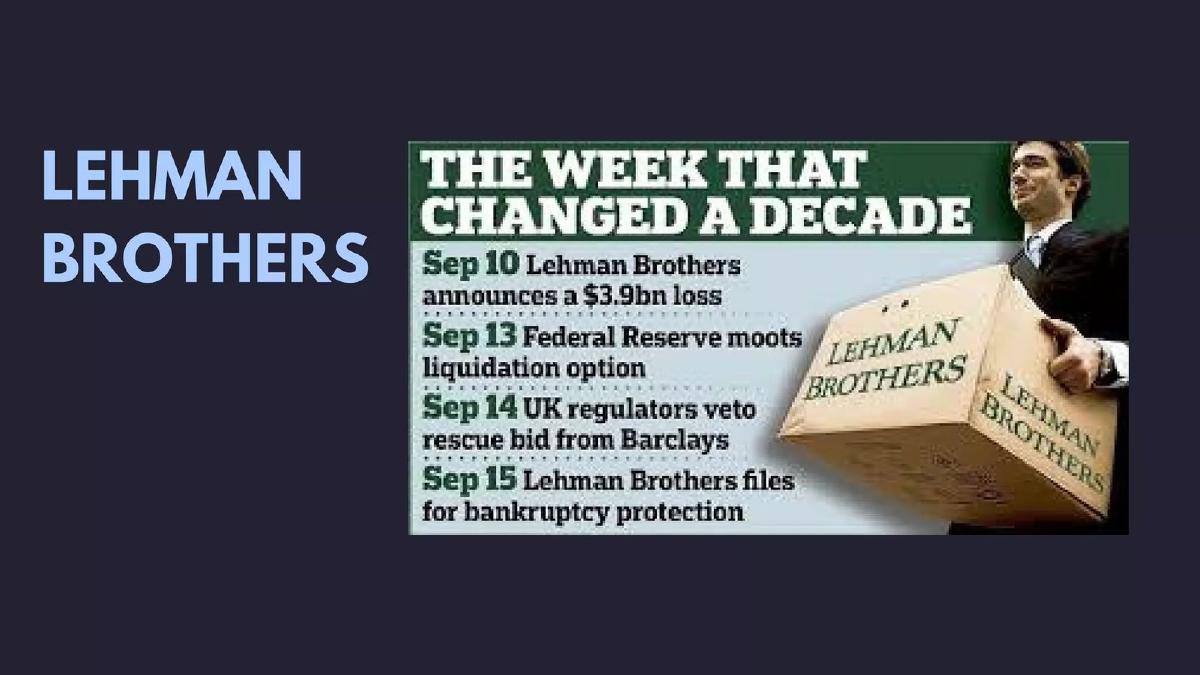
- The deck uses the Lehman Brothers bankruptcy as a primary emotional hook for why better decision-making tools are needed (Slide 2).
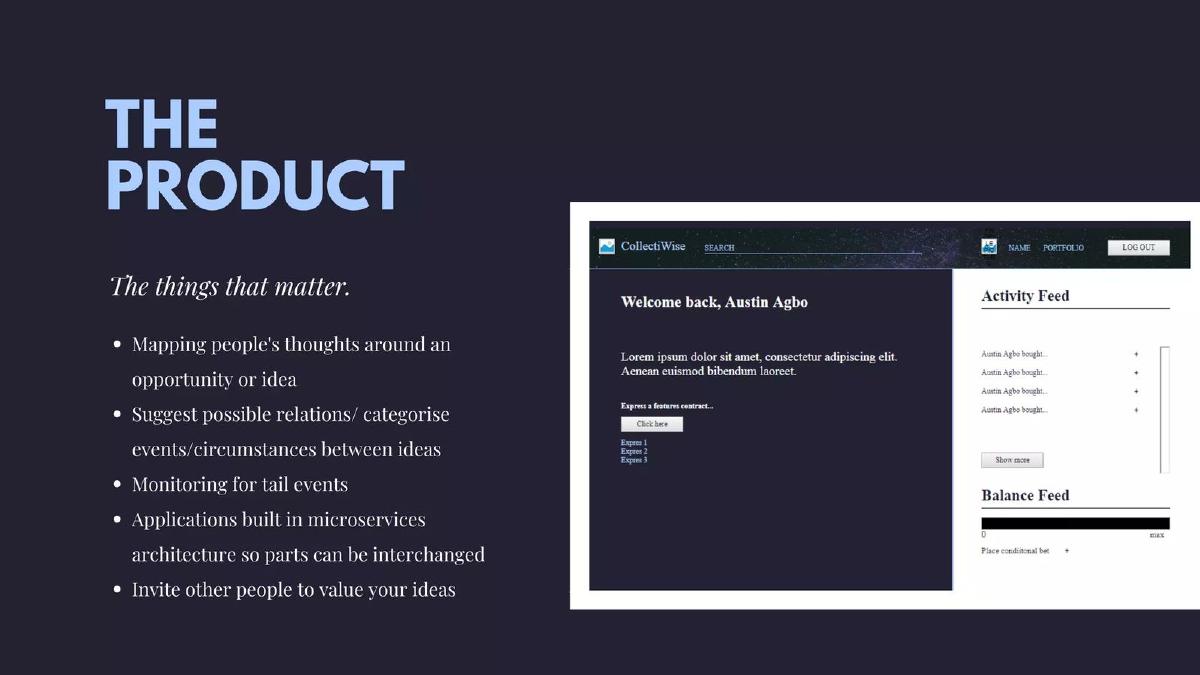
- Product features include mapping thoughts around ideas, monitoring for tail events, and interchanging parts via microservices (Slide 3).
- The technology stack claims to utilize Artificial General Intelligence via OpenCog and smart contracts (Slide 4).
- Market positioning places the company at the center of Predictive Analytics ($6.2bn), AI ($4.8bn), and Enterprise Collaboration ($58.9bn) (Slide 5).
- The deck cites a broad user base of 70 million people currently using business apps as the target demographic (Slide 6).
- Revenue potential is estimated at $28 million monthly in the UK and $1.1 billion monthly in the USA based on fixed company counts (Slide 7).
- There is no mention of the founding team, their backgrounds, or their technical expertise in AI or finance (Omitted).
- The deck lacks a specific 'Ask' slide detailing how much capital is being raised and how it will be deployed (Omitted).
Slide-by-Slide Analysis
Slide 1: Title Slide
The cover slide introduces Collectiwise as a 'Solution for Collective Decision Making.' The background image of the Golden Gate Bridge in fog is a common trope in tech decks, likely intended to signify a bridge to better outcomes or a San Francisco-centric tech ambition. The subtitle 'Investor Pitch Deck' clearly defines the document's purpose, though the slide lacks a specific date or version number.
Slide 2: The Hook - Lehman Brothers
This slide serves as the 'Problem' statement by using a historical case study. It features a graphic titled 'The Week That Changed A Decade,' detailing the timeline of the Lehman Brothers collapse in September 2008. By highlighting the $3.9bn loss and subsequent bankruptcy, Collectiwise implies that their tool could have prevented such a failure by improving the way the organization processed information and made decisions. It is a high-stakes emotional hook, but it lacks a direct transition into how the software specifically addresses these historical pain points.
Slide 3: The Product
Slide 3 provides a high-level overview of product functionality alongside a screenshot of a web-based dashboard. The dashboard shows a 'Welcome back' message for a user named Austin Agbo, an activity feed, and a 'Balance Feed' for placing conditional bets. The bullet points list five key features: mapping thoughts around an opportunity, suggesting relations between ideas, monitoring for tail events, a microservices architecture, and an invitation system for others to value ideas. The mention of 'conditional bets' suggests the platform uses a prediction market mechanism to aggregate collective wisdom.
Slide 4: Technology
The technology slide lists five technical pillars: Special AI Algorithms, Modular APIs, Artificial General Intelligence (OpenCog), Smart Contracts, and GDPR alignment. The inclusion of 'Artificial General Intelligence' is a bold claim, as AGI remains a largely theoretical or nascent field. Referencing OpenCog provides some technical context, but for an investor, this slide raises more questions than it answers regarding the feasibility and proprietary nature of the tech stack. The background image is an abstract geometric pattern, which adds little to the technical explanation.
Slide 5: Market Positioning
This slide uses a four-circle Venn diagram to position Collectiwise at the center of several massive industries. It cites Statista as the source for the following figures: Enterprise Collaboration Solutions at $58.9 billion, Predictive Analytics at $6.2 billion, and Artificial Intelligence at $4.8 billion. 'Collective Intelligence' is the fourth circle but lacks a valuation. This slide is intended to show the 'Total Addressable Market' (TAM), but it conflates three distinct industries rather than defining a specific niche the company can dominate.
Slide 6: Target Audience
Slide 6 is a 'Big Number' slide, stating there are '70 Million people using business apps.' This is a very broad metric that includes everything from Slack to Microsoft Excel. While it demonstrates a large potential user base, it does not help an investor understand the company's specific 'Serviceable Obtainable Market' (SOM). It functions more as a filler slide to emphasize the scale of the digital workplace.
Slide 7: Revenue Projections
The financial slide provides a simplified revenue model for two regions: the UK and the USA. For the UK, it projects $28 million USD monthly based on 7,000 companies paying $4,000. For the USA, it projects $1.1 billion USD monthly based on 19,464 companies paying $6,000. These figures are extremely optimistic and lack a timeframe or a 'bottom-up' build. There is no explanation for why the US price point is 50% higher than the UK, nor how the company arrived at these specific numbers of target companies.
Slide 8: Closing Slide
The final slide is a standard 'Thank You' with the call to action 'Join us on our journey.' It provides the website URL (collectiwise.com). Notably, there is no contact information for a specific founder, no email address, and no phone number, which is a significant oversight for a document intended to initiate investor dialogue.
What Works in This Deck
The Emotional Hook: Using the Lehman Brothers collapse is an effective way to illustrate the cost of bad decision-making. It immediately establishes the 'why' behind the product in a way that most business professionals can understand.
Visual Consistency: The deck uses a consistent color palette of dark navy and light blue. The typography is clean and legible, which makes the deck feel professional at a glance, even if the content is lacking in depth.
Market Context: The Venn diagram on Slide 5 successfully communicates that the company is trying to bridge the gap between collaboration tools and analytical tools. It helps an investor categorize the startup within the broader tech ecosystem.
What Is Missing
The Team: This is the most critical omission. Investors back people, especially at the early stage. Without knowing who the founders are, their technical background in AI, or their experience in enterprise software, it is impossible to evaluate the execution risk.
Traction: There is no evidence that this product has been tested. A slide showing a pilot program, a waitlist, or even user feedback from a beta version is necessary to prove that there is actual demand for 'collective decision-making' software.
The Ask: The deck does not state how much money the company is looking to raise. Without a clear 'Ask' and a 'Use of Funds' breakdown, the deck feels more like a general presentation than a fundraising tool.
Competition: The deck ignores the competitive landscape. Tools like prediction markets (e.g., Augur or Gnosis) and enterprise collaboration giants (e.g., Slack or Microsoft Teams) are direct or indirect competitors that should be addressed.
Founder Takeaways
Avoid 'Top-Down' Market Slides: Citing a $58 billion market is less impressive than showing how you will capture your first $1 million. Founders should focus on their Serviceable Obtainable Market (SOM) rather than broad industry totals. · Be Specific with Tech Claims: Claiming to use 'Artificial General Intelligence' (AGI) is a red flag for many technical investors unless you have the academic credentials and white papers to back it up. Be specific about what your AI actually does (e.g., natural language processing, sentiment analysis). · Include a Clear Business Model: The revenue slide in this deck is too abstract. A better approach is to show a tiered pricing model (e.g., $10/user/month) and a realistic growth trajectory based on a specific sales strategy. · Never Omit the Team: Even if the team is small, their presence is mandatory. Highlight the unique 'founder-market fit' that makes you the right person to solve this specific problem.
Frequently asked questions
- What is the core problem Collectiwise is trying to solve?
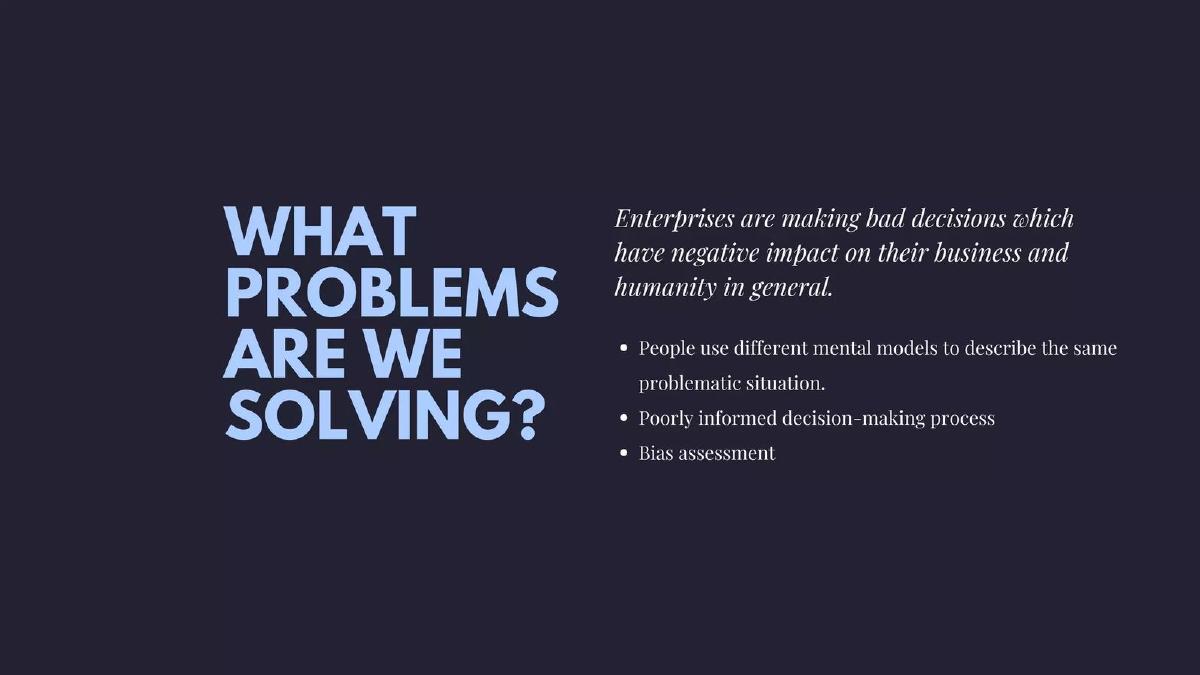
- Collectiwise aims to solve the problem of poor collective decision-making in large organizations. By referencing the Lehman Brothers collapse on Slide 2, the company suggests that systemic failures occur when organizations cannot effectively map thoughts, categorize events, or monitor for 'tail events' (rare, high-impact risks). The platform is designed to aggregate and value ideas from multiple stakeholders to prevent such catastrophic oversights.
- What specific technologies does Collectiwise claim to use?
- According to Slide 4, the platform is built on 'Special AI Algorithms,' modular APIs, and Smart Contracts. Most notably, it claims to utilize Artificial General Intelligence (AGI) through OpenCog, an open-source software project. The deck also emphasizes that the technology is 'Aligned with GDPR,' which is a critical compliance factor for enterprise collaboration tools handling internal company data.
- How does the company define its market size?
- The company uses a Venn diagram on Slide 5 to show it sits at the intersection of three multi-billion dollar markets: Enterprise Collaboration Solutions ($58.9 billion), Predictive Analytics ($6.2 billion), and Artificial Intelligence ($4.8 billion). It also references 'Collective Intelligence' as a fourth pillar, though no specific dollar value is assigned to that segment on the slide.
- What are the projected revenues mentioned in the deck?
- Slide 7 presents two primary revenue targets: $28 million USD monthly in the UK and $1.1 billion USD monthly in the USA. These figures are calculated by multiplying a set number of companies (7,000 in the UK and 19,464 in the USA) by a flat monthly fee ($4,000 and $6,000 respectively). However, the deck does not explain the rationale behind these specific company counts or price points.
- What critical information is missing from the Collectiwise deck?
- The deck is missing several fundamental components required for a successful fundraise. There is no team slide, leaving investors unaware of who is building the technology. There is no traction slide showing current users or revenue. Additionally, there is no roadmap, no competitive analysis beyond broad market categories, and no 'Ask' slide specifying the amount of funding sought or the valuation.