CommerceIQ’s 2021 Series C deck is a masterclass in identifying a specific, high-value market segment—Indirect Retail—and demonstrating product-market fit through granular case studies. Raising $60M, the company positioned itself as the essential operating system for enterprise brands selling on Amazon, Walmart, and Target. The deck relies heavily on the 'COVID pull-forward' narrative, citing a 400bps jump in e-commerce penetration in a single year. By focusing on 'Management by Exception' and real-time automation, CommerceIQ moved the conversation away from simple analytics toward active exe…
Key takeaways
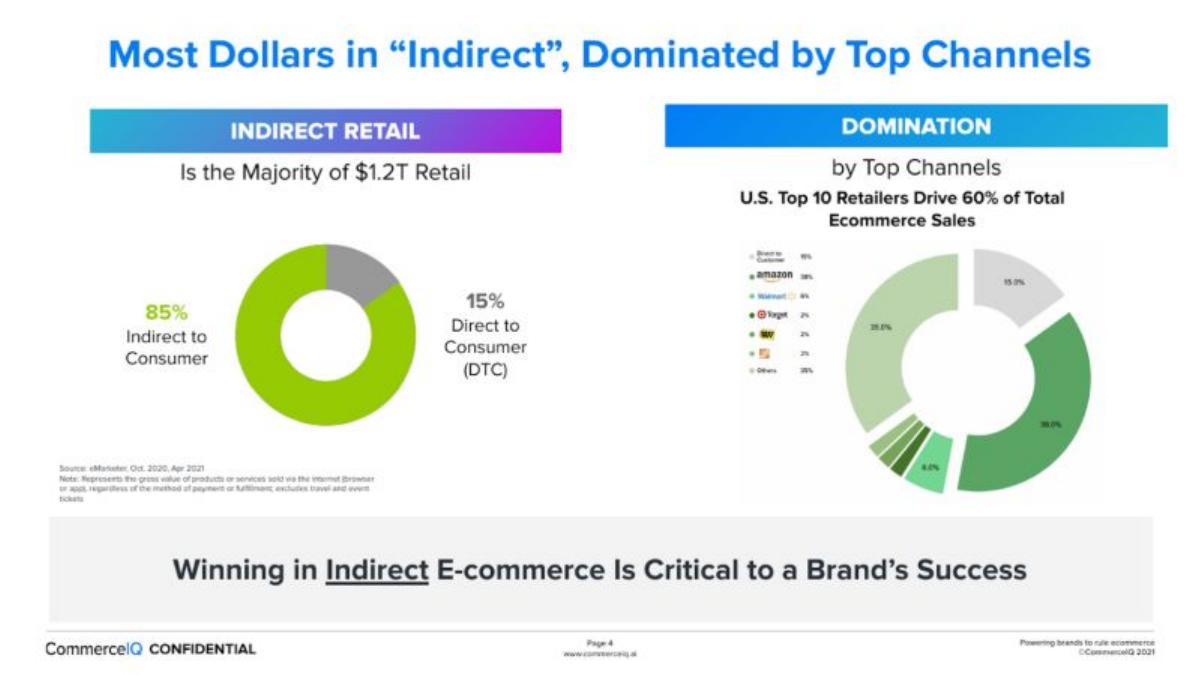
- The deck identifies that 85% of the $1.2T retail market is 'Indirect to Consumer,' making third-party marketplaces the primary battleground (Slide 4).
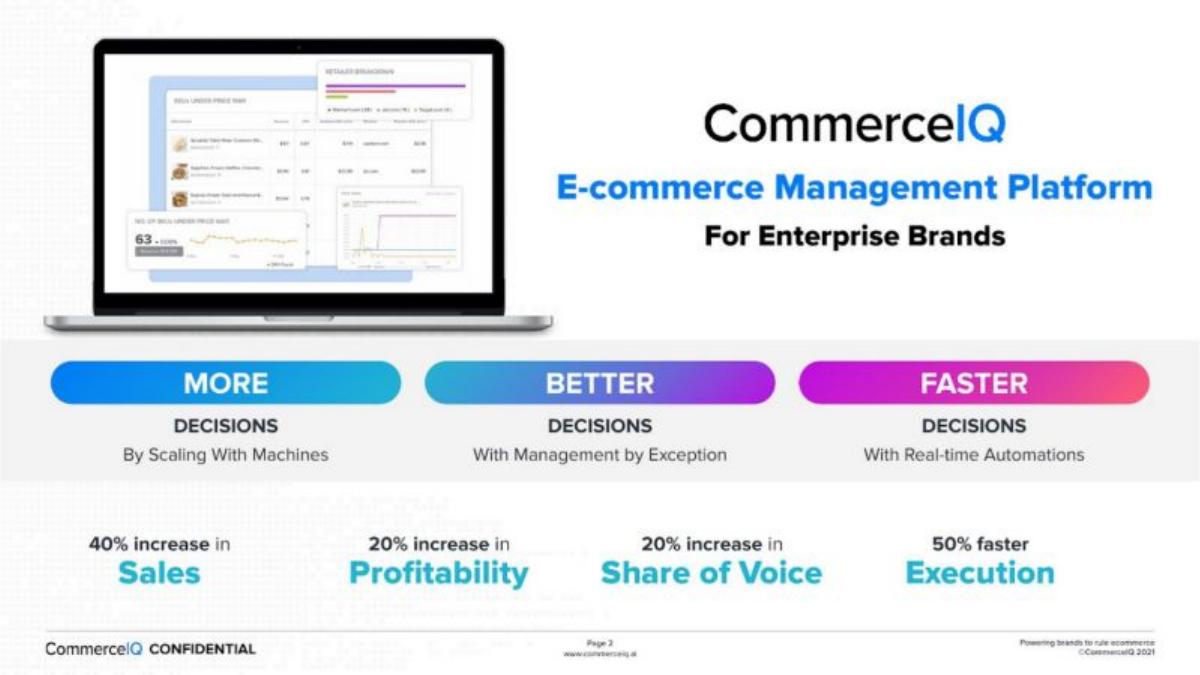
- CommerceIQ claims to drive a 40% increase in sales and a 20% increase in profitability for its users (Slide 2).
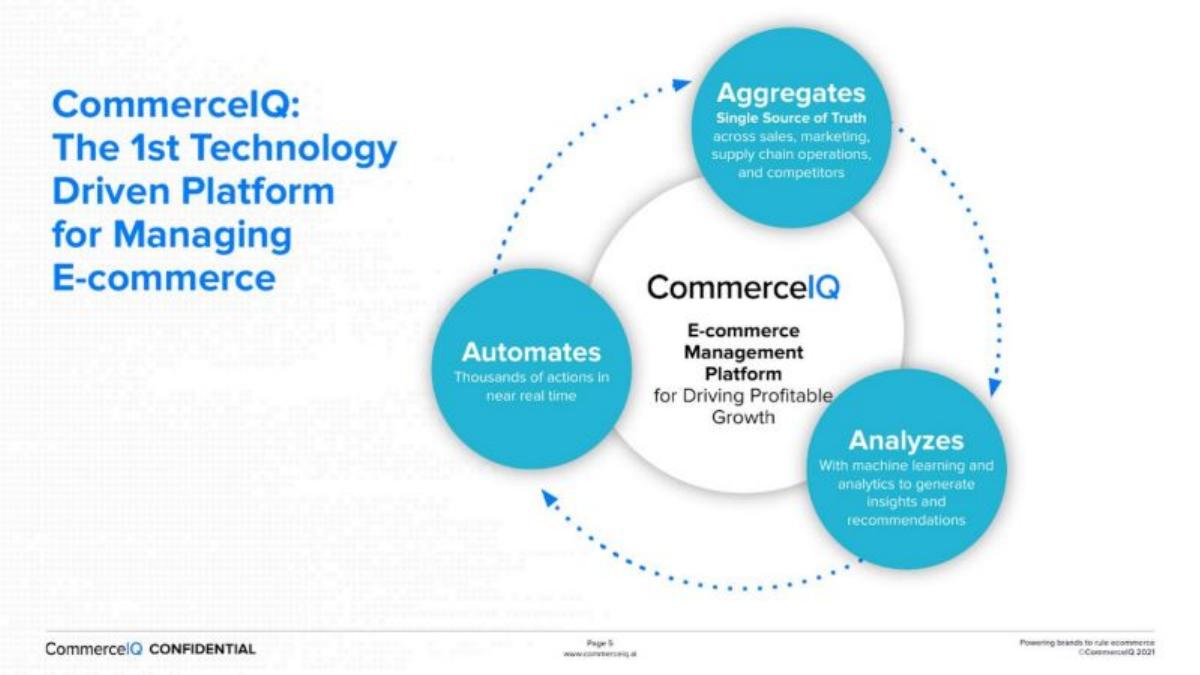
- The platform is positioned as a 'Single Source of Truth' that aggregates, analyzes, and automates across sales, marketing, and supply chain (Slide 5).
- A specific case study shows the platform recovering $315K in revenue in four days by detecting an incorrect 'Out of Stock' status on Amazon (Slide 9).
- The company demonstrates technical depth by showing how it removes '3P Variants'—unauthorized duplicate listings—to recapture $1.3M in revenue (Slide 10).
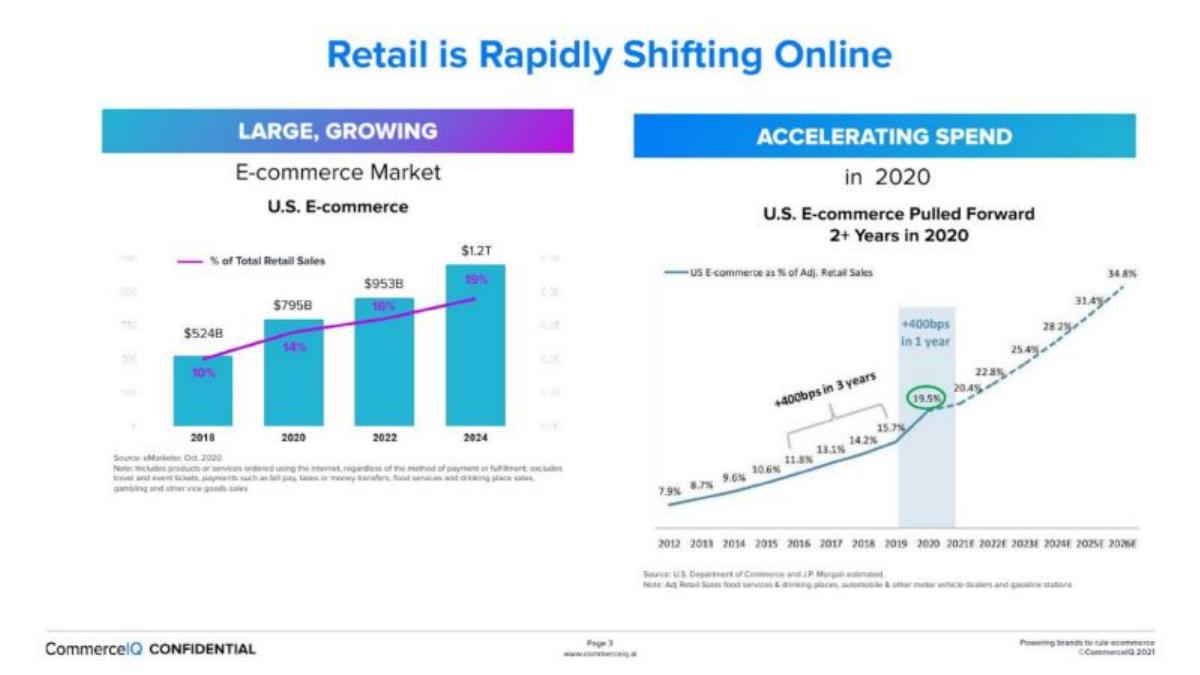
- Market data shows that U.S. e-commerce penetration was pulled forward by 2+ years in 2020 alone (Slide 3).
- The deck highlights a shift from manual, siloed organizational structures to an integrated, automation-led 'managed function' (Slide 12).
- CommerceIQ targets the 'Top 10 Retailers' who drive 60% of total e-commerce sales, specifically naming Amazon, Walmart, and Target (Slide 4).
The Strategic Pivot to Indirect Retail Automation
CommerceIQ’s Series C deck arrived at a pivotal moment in 2021. The e-commerce landscape had just undergone a massive acceleration due to global lockdowns, and enterprise brands were struggling to manage the sheer volume of data and actions required to stay competitive on marketplaces like Amazon. This deck is not a standard 'problem-solution' pitch; it is an 'operational efficiency' pitch designed for investors who already understand the market size but need to see a path to enterprise-grade automation.
Slides 1-2: The Value Proposition
The deck opens with a clean title slide (Slide 1) establishing the brand as the power behind 'Enterprise Brands.' Slide 2 immediately hits the viewer with hard outcomes. It categorizes the platform's benefits into three pillars: More Decisions (scaling with machines), Better Decisions (management by exception), and Faster Decisions (real-time automations). Below these pillars, the company claims significant ROI metrics: a 40% increase in sales, 20% increase in profitability, 20% increase in Share of Voice, and 50% faster execution. By leading with these numbers, CommerceIQ sets a high bar for the technical evidence that follows.
Slides 3-4: The Market Context
Slide 3 utilizes data from eMarketer and J.P. Morgan to illustrate the 'COVID pull-forward' effect. It shows U.S. e-commerce jumping from 15.7% of retail sales in 2019 to 19.5% in 2020—a 400bps increase in a single year. Slide 4 is perhaps the most important strategic slide in the deck. It distinguishes between 'Direct to Consumer' (DTC) and 'Indirect Retail.' It argues that 85% of the $1.2T retail market is indirect, and that the top 10 retailers (led by Amazon at 38% and Walmart at 6%) drive 60% of total sales. This focuses the investor's attention on where the 'real' money is: the complex, third-party marketplaces where CommerceIQ operates.
Slides 5-6: The Flywheel and Platform Mechanics
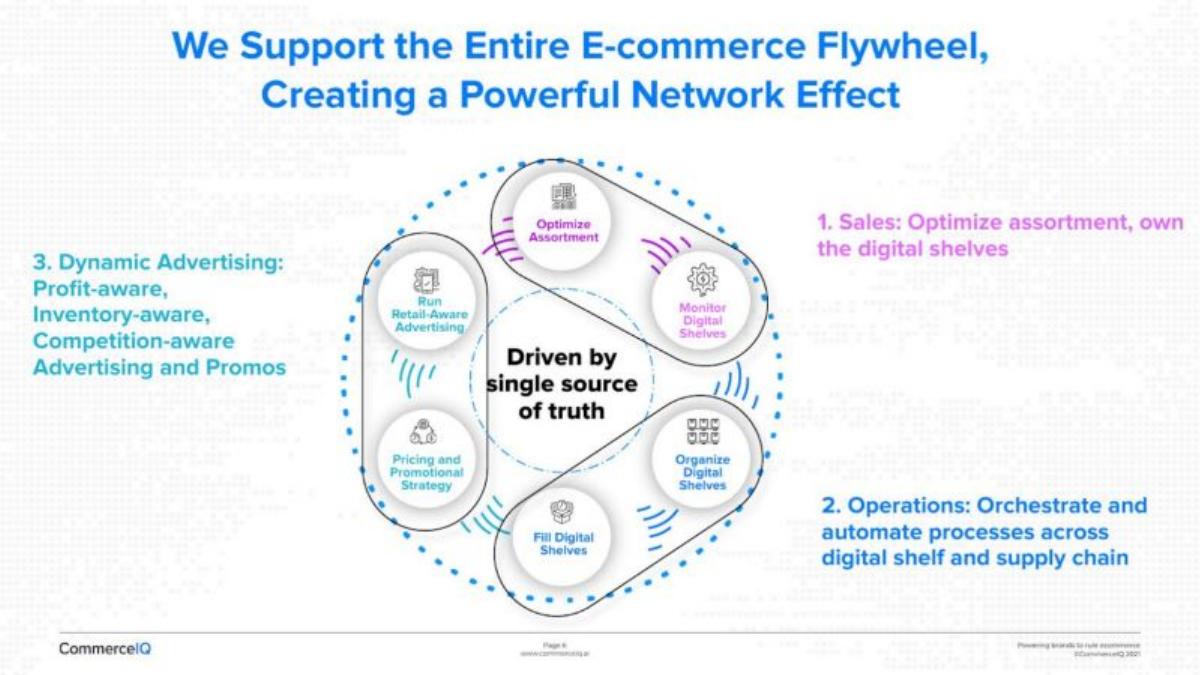
Slide 5 introduces the platform's functional loop: Aggregates (single source of truth), Analyzes (machine learning insights), and Automates (thousands of actions). This moves the product from a passive dashboard to an active agent. Slide 6 expands this into an 'E-commerce Flywheel.' It details three specific areas: Sales (optimizing assortment), Operations (supply chain automation), and Dynamic Advertising (profit-aware and inventory-aware promos). The 'inventory-aware' note is critical—it suggests the platform won't waste ad spend on products that are out of stock, a common pain point for large brands.
Slides 7-8: The Enterprise Case Study
CommerceIQ uses a 'Fortune 1000 Company' as its anchor client (Slide 7). The brand is described as a leading CPG brand with $3.8B in revenue and 10,000+ ASINs on Amazon. A quote from a VP of E-commerce emphasizes the need for a 'technology-first approach' to optimize retail media spend. Slide 8 breaks down the structural and operational challenges this client faced: teams operating in silos, no visibility into day-to-day operations, and manual processes disconnected from the market. This slide effectively mirrors the 'Before' state that CommerceIQ intends to fix.
Slides 9-11: What Winning Looks Like
These three slides provide the 'proof of work.' Slide 9 shows a specific instance where Amazon incorrectly flagged a SKU as 'Out of Stock' despite the brand having 4,221 units on hand. CommerceIQ detected this and filed an automated workflow, recovering $315K in revenue in just four days. Slide 10 tackles '3P Variants'—unauthorized third-party sellers creating duplicate listings that steal traffic. The platform identified these and removed tens of thousands of variants, recapturing $1.3M in revenue. Slide 11 demonstrates a 3X increase in Share of Voice (SOV) by optimizing spend across 850 category keywords. These slides are highly effective because they move beyond vague promises of 'AI' and show specific, dollar-denominated wins.
Slides 12-14: Organizational Transformation and Summary
Slide 12 contrasts the 'Manual' vs. 'Automation' organizational structure. The manual side shows fragmented teams (Sales, Marketing, Ops) using disconnected tools. The automation side shows CommerceIQ (the 'IQ' logo) at the center of an integrated function. This positions the software not just as a tool, but as the central nervous system of the e-commerce department. Slide 13 provides a summary of the investment thesis: Massive Market, Differentiated Solution, Expanding Adoption, Attractive Model, and Positioned for Success. Slide 14 is a standard closing slide from the source library.
What CommerceIQ Does Well
The deck excels at segmentation . By focusing on 'Indirect Retail,' CommerceIQ avoids the crowded DTC marketing tech space and stakes a claim in the much larger, more complex world of marketplace management. The use of specific revenue recovery examples is also a major strength. Investors at the Series C stage are looking for 'predictable revenue growth' and 'defensible technology.' Showing exactly how the platform recovers $315K or $1.3M through automated tickets provides tangible evidence of the platform's value and 'stickiness.'
What is Missing
Despite raising $60M, this specific 'Overview' version of the deck is missing several standard components:
Team Slide: There is no mention of the founders or the leadership team's background (e.g., former Amazon or Walmart executives). · Financials: No ARR, growth rates, or NRR (Net Revenue Retention) figures are included, which are typically mandatory for a Series C. · Competition: The deck does not address other players in the space (like Pacvue or Helium 10), relying instead on the 'Manual vs. Automation' comparison. · The Ask: There is no slide detailing how much capital is being raised or how it will be spent (e.g., international expansion, R&D).
What Other Founders Should Copy
Founders should emulate the 'What Winning Looks Like' format. Instead of just showing a screenshot of a dashboard, CommerceIQ shows a timeline of an event (the out-of-stock error), the platform's intervention, and the resulting dollar value. This 'Event-Action-Outcome' framework is the most persuasive way to demo enterprise SaaS. Additionally, the market education on Slide 4 (DTC vs. Indirect) is a brilliant way to reframe a market so that your company appears to be the only logical leader in the largest sub-sector.
Frequently asked questions
- How much did CommerceIQ raise with this deck?
- According to the catalogue facts, CommerceIQ raised $60M in a Series C round in 2021. The deck itself serves as an 'Overview' of the platform's value proposition and market positioning rather than a granular financial disclosure.
- What is the core problem CommerceIQ solves?
- The deck identifies the 'Indirect Retail' challenge. Brands selling through third-party retailers like Amazon and Walmart often face siloed data, manual processes, and a lack of visibility. CommerceIQ automates these operations to prevent revenue leakage from out-of-stock errors and unauthorized third-party sellers.
- What metrics does the deck use to prove value?
- CommerceIQ cites high-level performance gains on Slide 2, including a 40% increase in sales and a 50% faster execution speed. It validates these with specific case studies, such as a 3X increase in Share of Voice (SOV) and $1.3M in recaptured revenue from variant cleanup.
- Who is the target customer for CommerceIQ?
- The deck explicitly targets 'Enterprise Brands.' It uses a Fortune 1000 CPG brand with $3.8B in revenue and over 10,000 ASINs on Amazon as its primary case study example on Slides 7 and 8.
- What is missing from the CommerceIQ pitch deck?
- This version of the deck omits a team slide, a competition slide, detailed unit economics (like CAC/LTV), and a specific 'Ask' or use-of-funds slide. It functions more as a strategic narrative for the Series C round.