ComBio’s 9-slide growth deck is a masterclass in clarity for infrastructure-heavy startups. By focusing on the 'no upfront CapEx' value proposition, the company addresses the primary barrier to industrial decarbonization: the high cost of switching from fossil fuel boilers to biomass systems. The deck highlights a decade of execution, citing 2.26 million tons of CO2 emissions prevented since 2012. While the deck is light on specific financial projections and competitive analysis, it leans heavily on its operational track record and 'Sistema B' certification to build trust. The $90M raise, rep…
Key takeaways
- ComBio identifies that 50-90% of CO2 emissions in sectors like textiles and mining come from thermal energy generation (Slide 2).
- The core business model relies on removing upfront CapEx for the client, with ComBio handling all O&M and biomass origination (Slide 3).
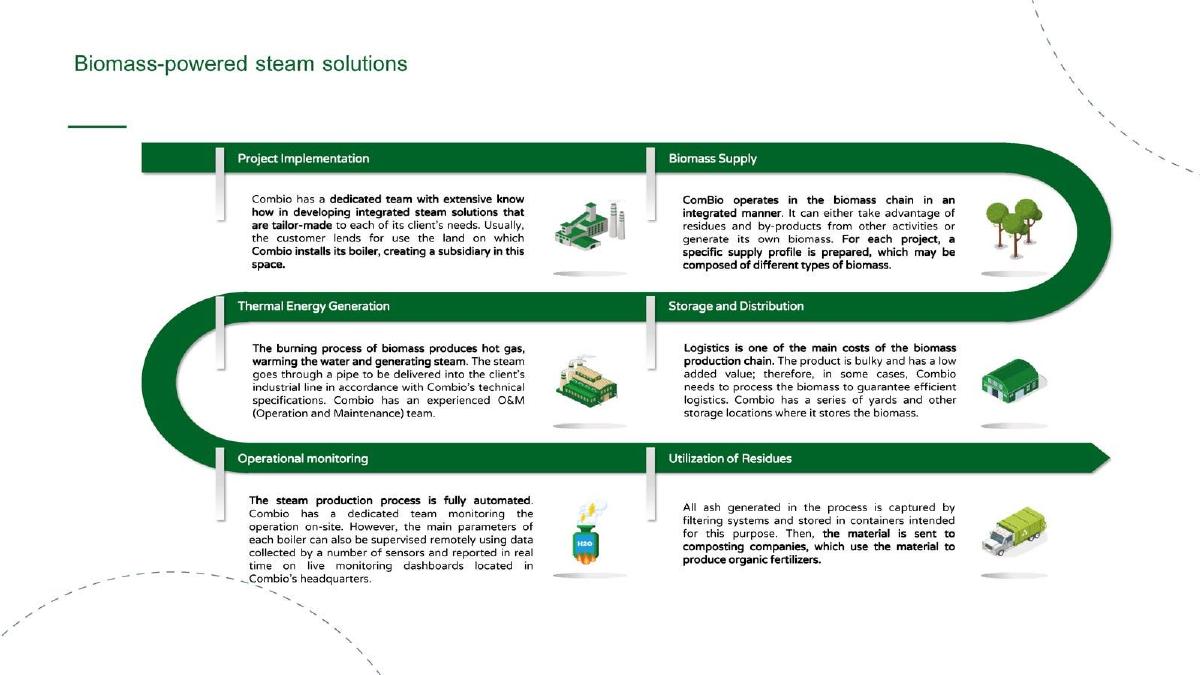
- The company operates an integrated supply chain, including the capture of ash for use as organic fertilizer by composting companies (Slide 4).
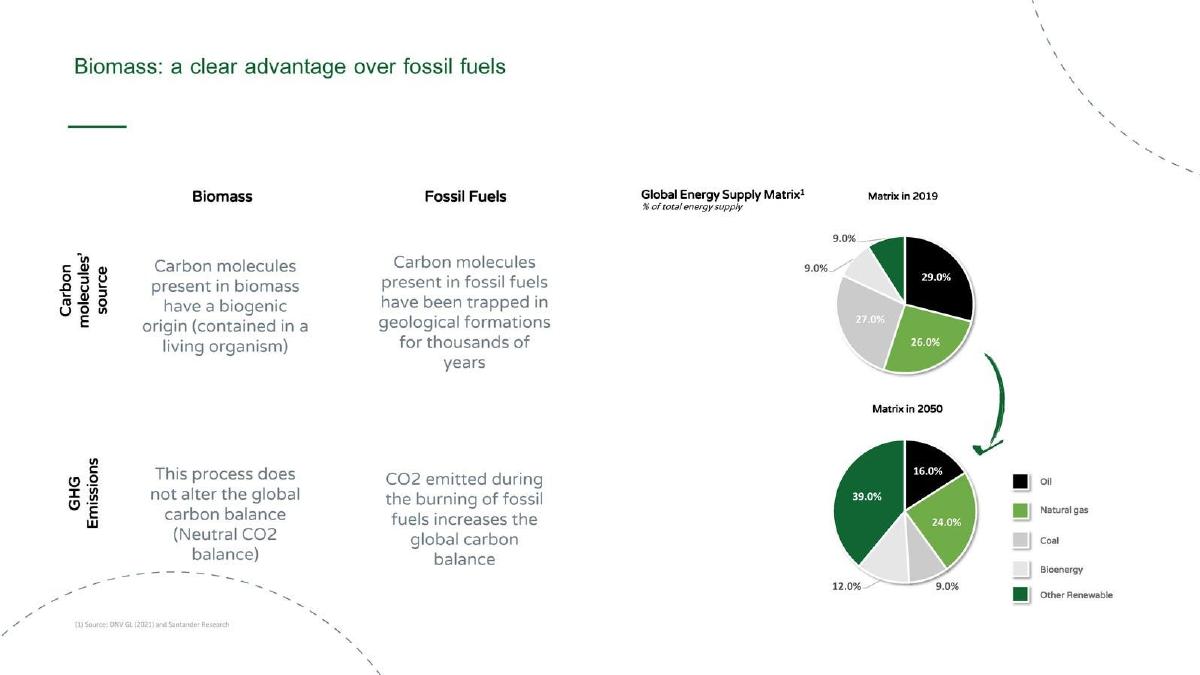
- Biomass is positioned as carbon neutral because the carbon molecules have a biogenic origin from living organisms (Slide 5).
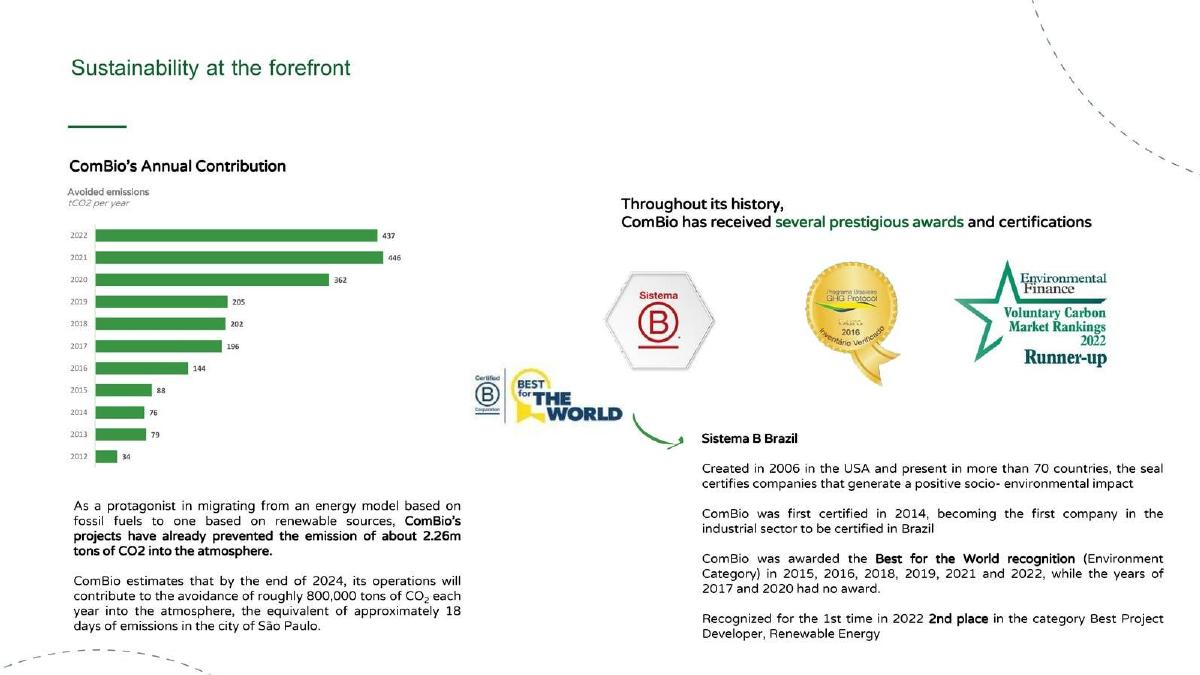
- ComBio reports a cumulative avoidance of 2.26 million tons of CO2 since its inception (Slide 6).
- The company has been 'Sistema B' certified since 2014, claiming to be the first in Brazil's industrial sector to achieve this (Slide 6).
- The management team includes specific roles for Sustainability, Operations, and Strategy, emphasizing a balanced leadership structure (Slide 8).
- The deck omits a specific 'Ask' slide, though Business Insider reports the round totaled $90M in 2024.
ComBio: Decarbonizing the Industrial Heat Engine
ComBio’s growth funding deck is a focused, 9-slide presentation that targets a very specific pain point in the industrial sector: the transition from fossil fuel-based steam generation to sustainable biomass. Headquartered in Brazil, a region with a massive agribusiness footprint, ComBio leverages local resources to solve a global problem. The deck, used for a 2024 growth round that reportedly raised $90M according to Business Insider, prioritizes operational reliability and environmental impact over the typical 'hockey stick' growth charts found in software decks.
Slide 1: Title and Branding
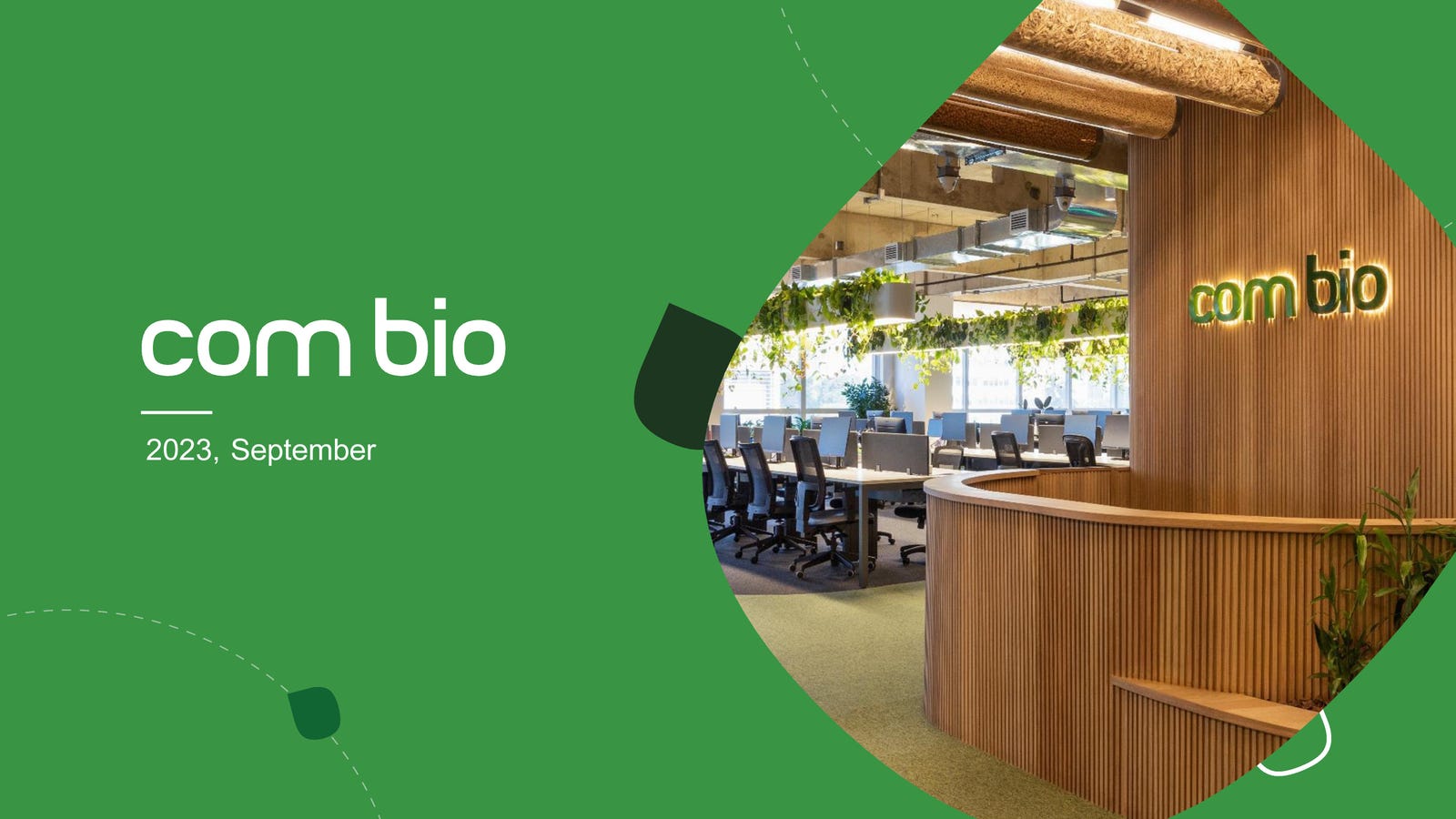
The cover slide is minimalist, featuring the ComBio logo and the date '2023, September.' The imagery shows a modern, wood-paneled office space with visible biomass samples (wood chips/pellets) in glass tubes integrated into the decor. This immediately establishes the company’s identity as a professional, corporate entity rooted in the physical biomass industry. There is no tagline on this slide, relying entirely on the brand name and the visual cues of the office environment.
Slide 2: The Industrial Thermal Problem
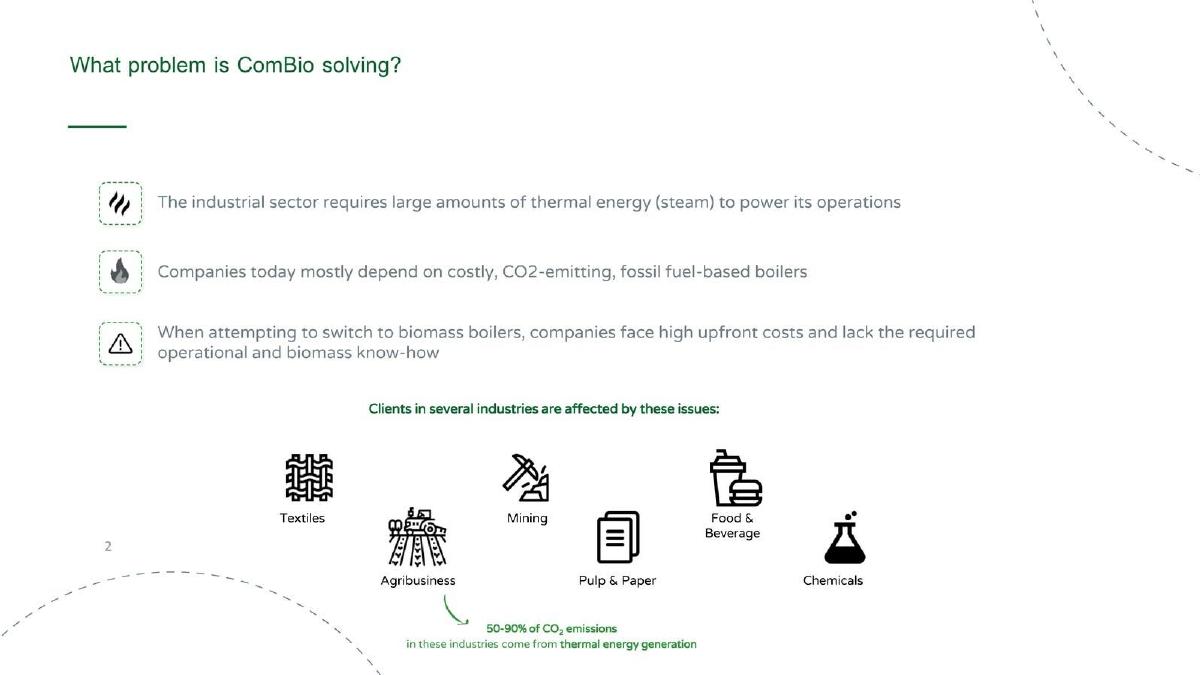
Slide 2 defines the problem space. It identifies that the industrial sector requires massive amounts of thermal energy (steam) but currently depends on 'costly, CO2-emitting, fossil fuel-based boilers.' Crucially, it highlights the barrier to entry: high upfront costs and a lack of operational know-how. The slide lists six target industries—Textiles, Agribusiness, Mining, Pulp & Paper, Food & Beverage, and Chemicals—and includes a vital statistic: 50-90% of CO2 emissions in these industries come from thermal energy generation. This framing turns a niche utility problem into a massive ESG opportunity.
Slide 3: The Solution and Value Prop
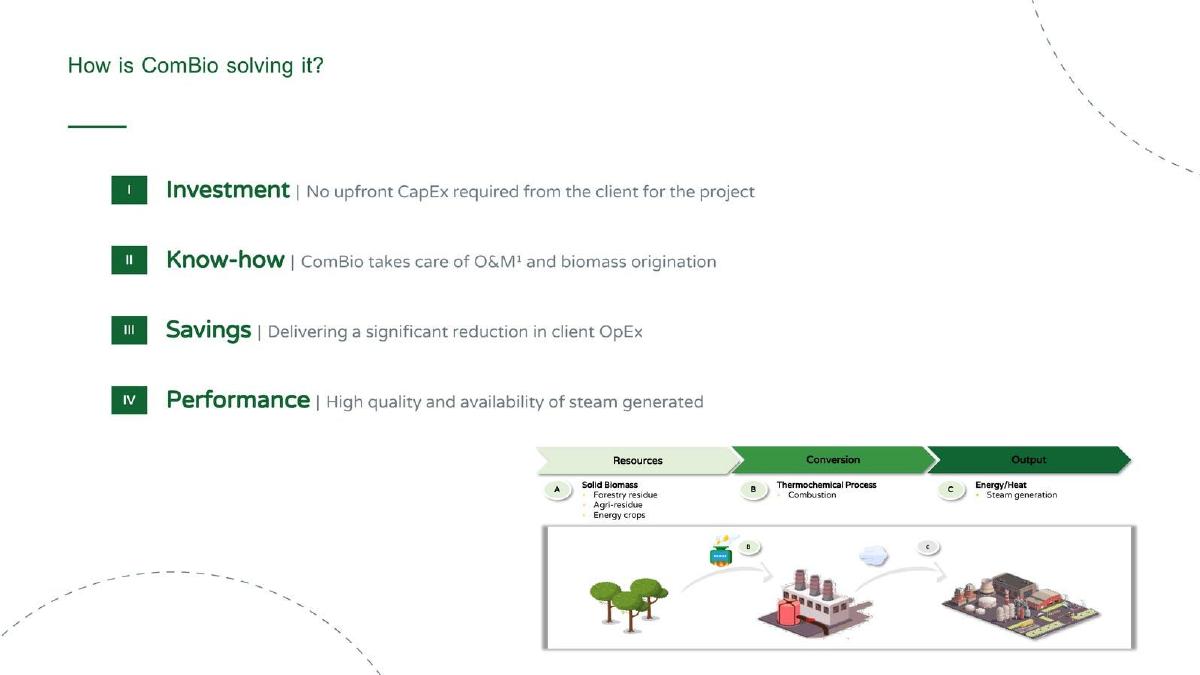
ComBio outlines its solution through four pillars: Investment, Know-how, Savings, and Performance. The standout feature here is 'No upfront CapEx required from the client.' By taking the financial burden onto their own balance sheet, ComBio removes the primary objection for industrial CFOs. The slide also includes a simplified process diagram showing the flow from 'Solid Biomass' (forestry residue, agri-residue, energy crops) through a 'Thermochemical Process' to the final 'Energy/Heat' output. This clarifies that ComBio is a full-stack service provider, not just an equipment vendor.
Slide 4: Integrated Operations and Logistics
This slide uses a serpentine process map to explain the lifecycle of a ComBio project. It covers Project Implementation (where ComBio creates a subsidiary on the client's land), Biomass Supply, Thermal Energy Generation, and Storage. Two points are particularly important for investors: 'Operational monitoring' (real-time sensor data reported to HQ) and 'Utilization of Residues.' By turning ash into organic fertilizer, ComBio demonstrates a circular economy model that appeals to modern impact investors. It also acknowledges that logistics is a 'main cost,' showing a realistic understanding of the business's unit economics.
Slide 5: The Case for Biomass
Slide 5 serves as a technical justification for biomass over fossil fuels. It explains the difference between biogenic carbon (living organisms) and trapped carbon (geological formations). The slide includes two 'Global Energy Supply Matrix' pie charts comparing 2019 to 2050 projections. The data, cited from DNV GL and Santander Research, shows 'Bioenergy' growing from 9.0% to 12.0% of the global matrix, while 'Other Renewables' jump to 39.0%. This positions ComBio within a growing, non-fossil fuel segment of the energy market.
Slide 6: Impact and Certifications
This is the 'Traction' slide, but it measures success in tons of CO2 rather than dollars. A bar chart shows 'Avoided emissions' growing steadily from 34 tCO2 in 2012 to 437 tCO2 in 2022 (though the unit 'tCO2 per year' likely refers to thousands or millions given the text below). The text clarifies that ComBio projects have prevented 2.26 million tons of CO2 emissions to date. The slide also leans heavily on its B Corp status (Sistema B), noting they were the first industrial company in Brazil to be certified in 2014. This longevity in the ESG space is a significant differentiator for a growth-stage company.
Slide 7: The Vision
Slide 7 is a transition slide titled 'Looking to the future.' It contains high-level mission statements about preserving the environment for future generations. While it lacks hard data, it reinforces the company's role as a 'protagonist in the energy transition.' In a growth deck, this slide serves to align the investor's values with the company's long-term goals before introducing the team.
Slide 8: The Management Team
The team slide features a group photo of five men: Roberto Veras (Sustainability Director), Paulo Skaf (CEO), Marcos Brant (CSO), Roberto Lombardi (Board Member), and Fabio Brant (COO). The text claims a 'solid track record in the biomass and energy space.' While the slide lacks the logos of previous successful exits or blue-chip companies often seen in Silicon Valley decks, the inclusion of a dedicated Sustainability Director at the leadership level reinforces the company’s impact-first positioning.
Slide 9: Contact and Closing
The final slide provides contact information and a high-resolution photo of a ComBio industrial facility. The facility is complex and large-scale, serving as visual proof that ComBio is an established infrastructure player, not a pre-revenue startup. The address listed is in São Paulo, Brazil, grounding the company in its primary geographic market.
What ComBio Does Well
Clarity of the Business Model: The deck makes it very clear that ComBio is an 'Energy-as-a-Service' provider. By explicitly stating 'No upfront CapEx,' they address the biggest hurdle in industrial sales. Investors can immediately see how the company scales: by deploying capital into assets that generate long-term, recurring revenue from steam sales.
Focus on Hard-to-Abate Sectors: By listing mining, chemicals, and pulp & paper, ComBio targets industries that cannot easily electrify their heat requirements. This gives them a 'moat' against purely electric renewable competitors, as biomass is one of the few viable ways to generate high-pressure industrial steam sustainably.
Longevity and Credibility: The fact that ComBio has been B Corp certified since 2014 (Slide 6) is a powerful trust signal. In an era of 'greenwashing,' a decade-long track record of verified impact is a massive asset for a growth-stage raise.
What is Missing from the ComBio Deck
Financial Performance: For a growth round of $90M, the absence of revenue figures, EBITDA margins, or contract lengths (Weighted Average Lease Term) is notable. While this may have been in a separate data room, a growth deck usually includes at least a high-level summary of financial health.
Competitive Landscape: The deck does not mention other biomass providers or alternative technologies like industrial heat pumps or concentrated solar thermal. Investors need to know why ComBio’s specific approach to biomass is superior to other emerging decarbonization technologies.
The 'Ask': There is no slide detailing how much money is being raised or how the funds will be allocated. While publisher-reported facts state the round was $90M, the deck itself is silent on the terms of the investment or the specific growth milestones the capital will unlock.
Founder Takeaways
Solve the CFO's Problem: If your product requires a massive change in infrastructure, follow ComBio’s lead and find a way to remove the upfront cost. The 'as-a-service' model is just as powerful for industrial boilers as it is for software.
Use Impact as Traction: If your financial metrics are sensitive, use environmental impact metrics (like tons of CO2 avoided) to demonstrate scale and momentum. It proves the 'engine' of the business is working even if you aren't ready to disclose top-line revenue in a teaser deck.
Visual Proof of Infrastructure: For 'HardTech' or infrastructure startups, photos of actual working plants (Slide 9) and professional office environments (Slide 1) are essential. They move the conversation from 'science project' to 'operating business.'
Frequently asked questions
- What is ComBio's primary value proposition to industrial clients?
- ComBio's primary value proposition is the elimination of upfront capital expenditure (CapEx) for industrial clients. According to Slide 3, they provide the investment for the project, handle operations and maintenance (O&M), and manage biomass origination. This allows clients to reduce their operating expenses (OpEx) while transitioning to a high-quality, sustainable steam supply without the financial risk of building their own infrastructure.
- How does ComBio handle the environmental impact of its biomass process?
- ComBio emphasizes a circular economy approach. Slide 4 explains that all ash generated during the biomass combustion process is captured by filtering systems. This material is then sent to composting companies to be used in the production of organic fertilizers. Additionally, Slide 5 argues that biomass is carbon neutral because the carbon molecules are biogenic, meaning they do not alter the global carbon balance like fossil fuels do.
- Which industries does ComBio target for its thermal energy solutions?
- Slide 2 explicitly lists six key industries affected by high thermal energy emissions: Textiles, Agribusiness, Mining, Pulp & Paper, Food & Beverage, and Chemicals. The company notes that in these specific sectors, between 50% and 90% of total CO2 emissions are derived from thermal energy generation, making them prime candidates for biomass conversion.
- What is ComBio's track record regarding sustainability certifications?
- ComBio has a long-standing commitment to ESG standards. Slide 6 notes that the company was first certified as a B Corp (Sistema B) in 2014. It has received 'Best for the World' recognition in the Environment category six times (2015, 2016, 2018, 2019, 2021, and 2022) and was a runner-up in the 2022 Environmental Finance Voluntary Carbon Market Rankings.
- Who leads ComBio, and what is their background?
- The leadership team, shown on Slide 8, consists of Paulo Skaf (CEO), Marcos Brant (CSO), Fabio Brant (COO), Roberto Veras (Sustainability Director), and Roberto Lombardi (Board Member). The deck describes them as an experienced management team with a 'solid track record in the biomass and energy space,' though it does not list specific former companies or academic credentials.