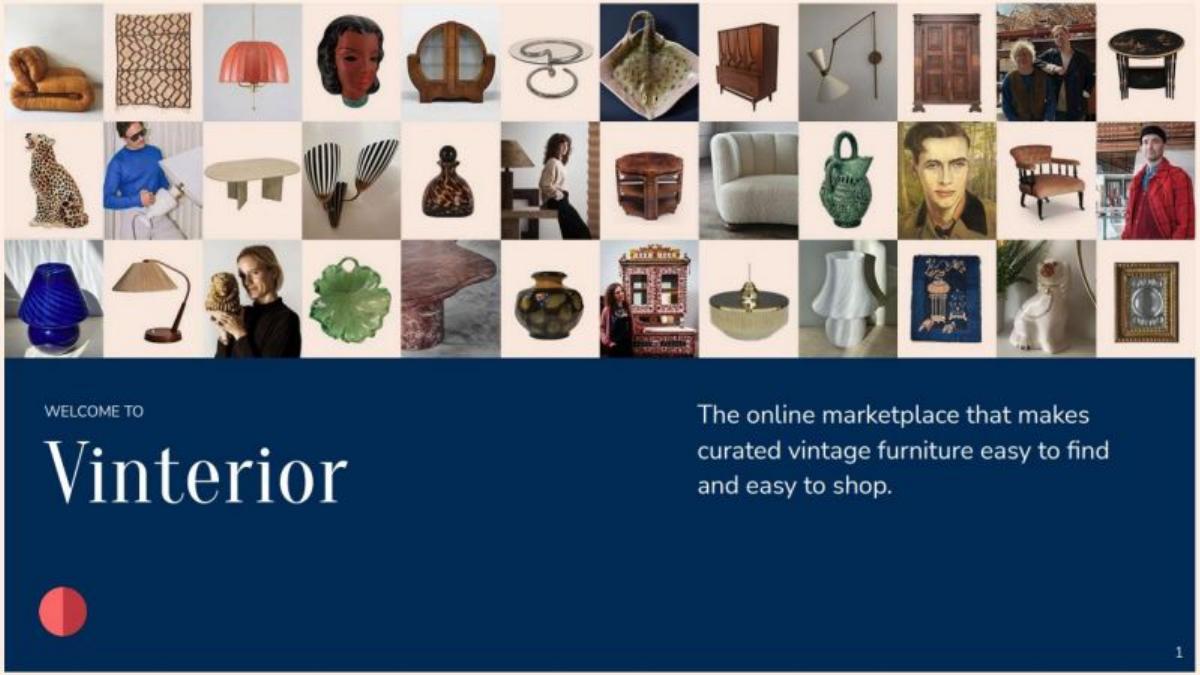
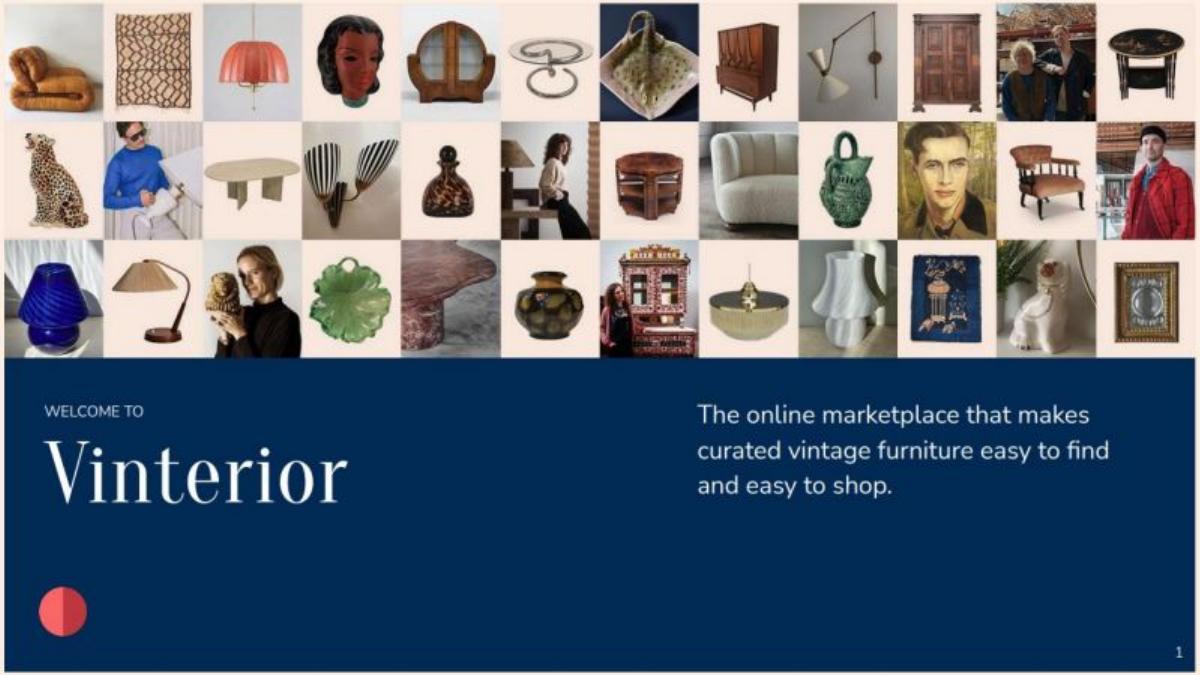
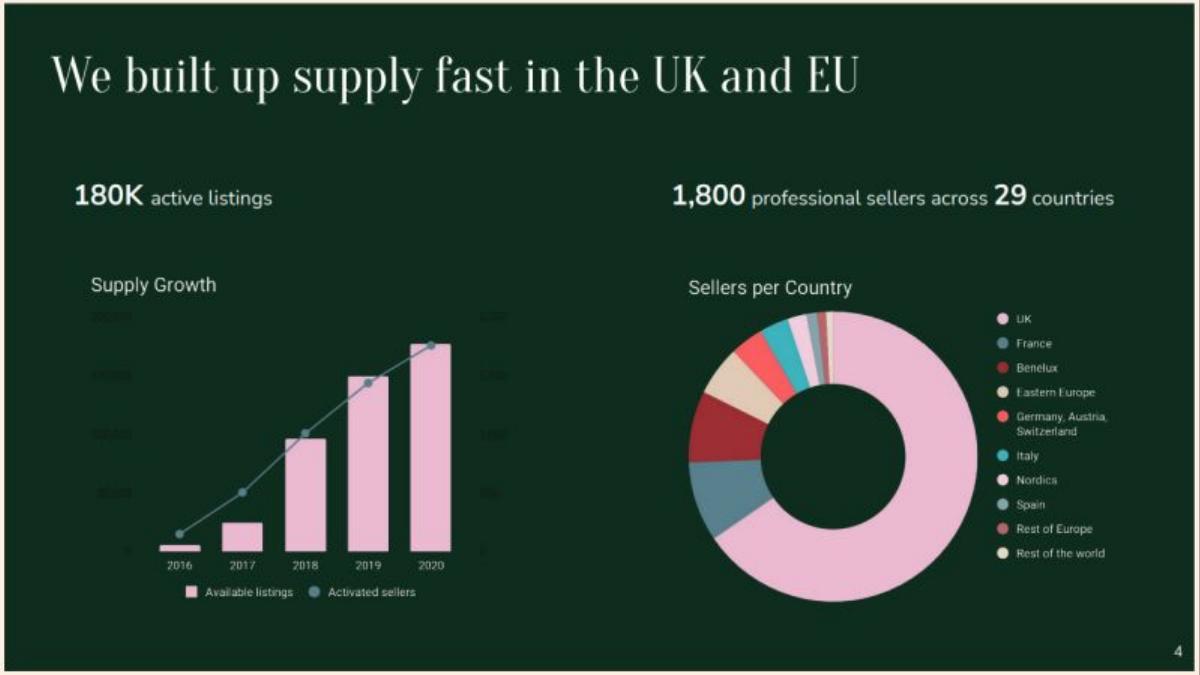
Vinterior’s Series A deck is a masterclass in marketplace metrics, focusing heavily on the supply-side health and organic demand that VCs crave in the e-commerce sector. By 2021, the company had successfully transitioned from high-cost paid acquisition to a model where 74% of customers were acquired through organic channels, as stated on slide 3. The deck emphasizes scale, showcasing 180,000 active listings from 1,800 professional sellers across 29 countries (slide 4). While the deck is visually lean, it provides critical unit economics, including LTV/CAC ratios for both B2C and B2B segments…
Key takeaways
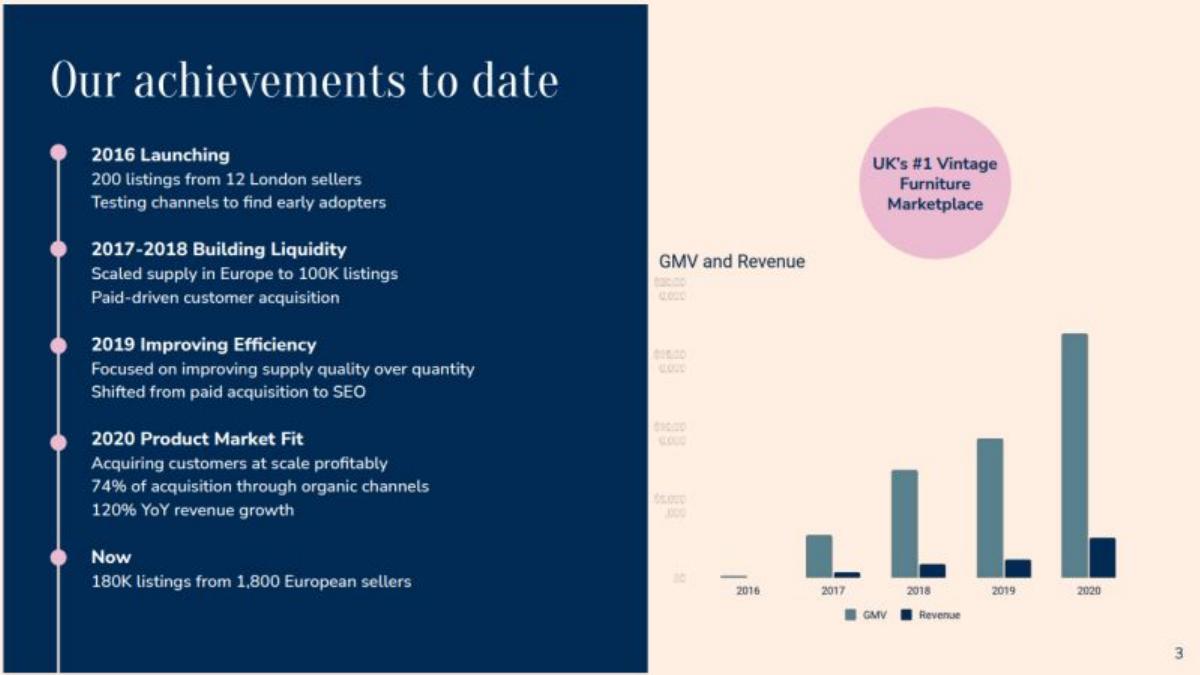
- The company achieved 120% YoY revenue growth by 2020, as noted on slide 3.
- Organic channels accounted for 74% of customer acquisition by the time of the raise (slide 3).
- Supply is highly diversified, with sellers spanning 29 countries, though the UK remains the largest segment (slide 4).
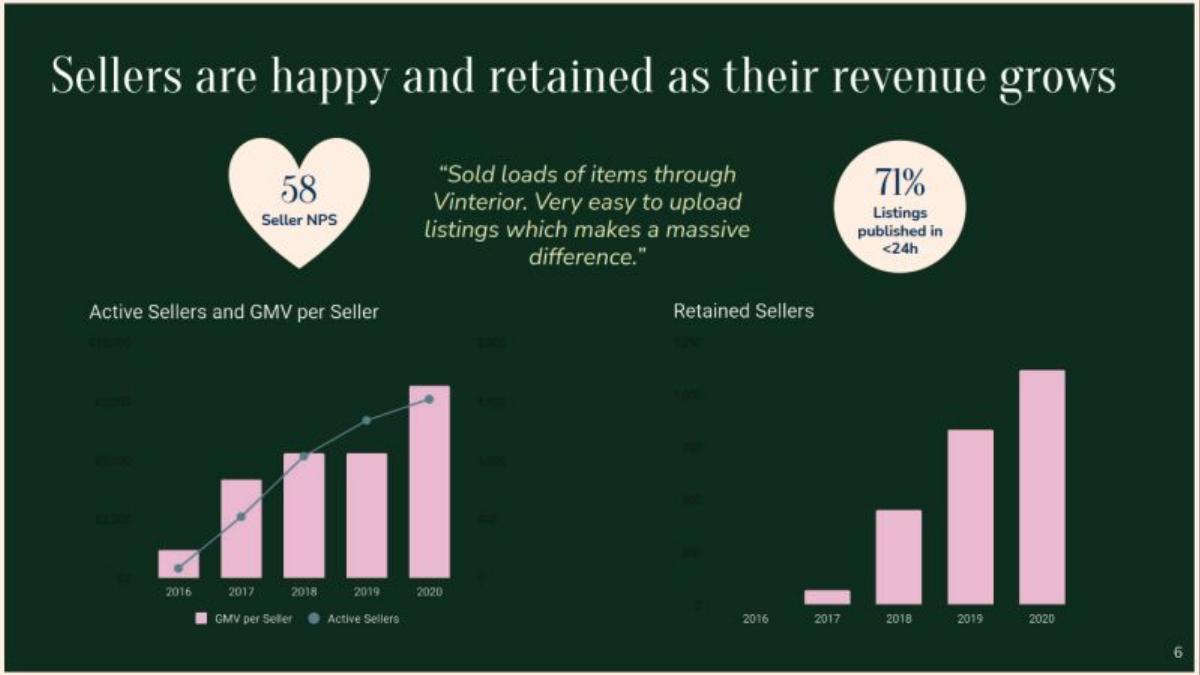
- Seller satisfaction is a core metric, evidenced by a Seller NPS of 58 and 71% of listings being published in under 24 hours (slide 6).
- The marketplace serves two distinct buyer segments, with the B2B LTV/CAC significantly outperforming the B2C segment by 2020 (slide 7).
- Marketing efficiency improved over time, with marketing spend as a percentage of GMV decreasing from 2018 to 2020 (slide 8).
- The total addressable market for professional furniture recommerce in Europe and North America is valued at $28 billion (slide 10).
- The deck lacks a specific funding ask, valuation, or use of funds breakdown within the 13 slides provided.
Marketplace Liquidity as a Competitive Moat
Vinterior’s Series A deck, used to raise $11M in 2021, is a data-driven narrative that prioritizes marketplace health over flashy product features. In the world of e-commerce, especially in the 'recommerce' or vintage space, the hardest problem to solve is not building the website, but building a reliable, high-quality supply chain. Vinterior uses the first half of its deck to prove they have mastered the supply side, which in turn fuels a highly efficient demand side.
Slides 1-2: The Hook and the Friction
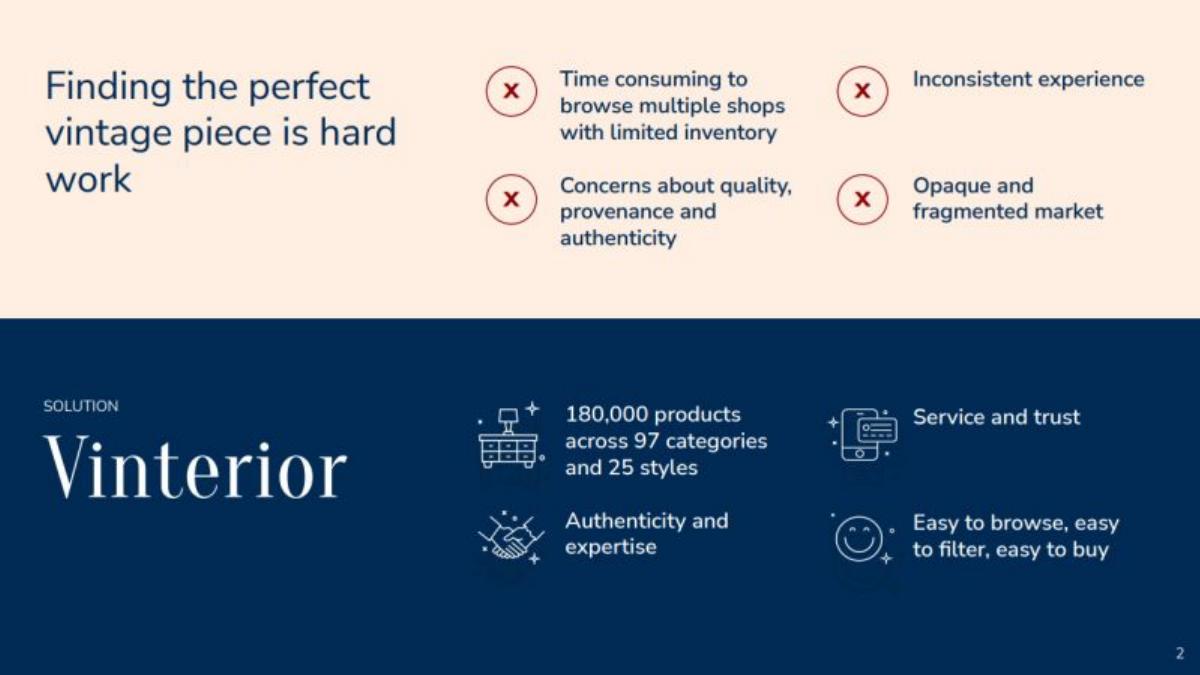
Slide 1 introduces Vinterior as the "online marketplace that makes curated vintage furniture easy to find and easy to shop." The visual collage of high-end vintage items immediately establishes the brand's aesthetic and 'curated' positioning. Slide 2 moves directly into the problem/solution framework. It identifies four specific pain points: the time-consuming nature of browsing multiple shops, concerns about quality and authenticity, inconsistent experiences, and an opaque, fragmented market. The solution is presented as a scale play: 180,000 products across 97 categories, backed by 'authenticity and expertise.'
Slide 3: The Traction Timeline
This is arguably the most important slide in the deck. It tracks the company's evolution from 2016 to 2020. It shows a clear strategic shift: 2017-2018 was about "Building Liquidity" through paid acquisition, while 2019 was about "Improving Efficiency" by shifting to SEO. By 2020, they claim "Product Market Fit," citing 120% YoY revenue growth and 74% of acquisition through organic channels. The bar chart shows GMV and Revenue growing in tandem, though specific currency units are obscured, the trajectory is clearly aggressive.
Slides 4-6: The Supply-Side Deep Dive
Marketplaces live or die by their sellers. Slide 4 highlights the scale of their supply: 180,000 active listings from 1,800 professional sellers. A donut chart reveals that while the UK is their primary market, they have established a foothold in France, Benelux, and Eastern Europe. Slide 5 describes their supply acquisition as "efficient and predictable," utilizing both inbound organic applications and a sales outreach funnel. Slide 6 focuses on seller retention and satisfaction, boasting a Seller NPS of 58. A key operational metric is highlighted here: 71% of listings are published in under 24 hours, indicating a highly streamlined onboarding process that keeps sellers engaged.
Slides 7-9: Demand and Unit Economics
Having proved the supply, the deck turns to the buyers. Slide 7 shows that while the number of new buyers is increasing, the CAC (Customer Acquisition Cost) is trending downward. This is the 'holy grail' for VCs. The slide also breaks down LTV/CAC by segment, showing that the B2B segment (likely interior designers and trade professionals) has a significantly higher return than the B2C segment. Slide 8 reinforces the efficiency narrative, showing that marketing as a percentage of GMV is dropping as SEO and organic channels become the dominant drivers of demand. Slide 9 rounds this out with social proof: a 4.6/5 Trustpilot score and a 67 consumer NPS.
Slides 10-13: Market, Team, and Conclusion
Slide 10 addresses the TAM (Total Addressable Market), valuing professional furniture recommerce at $28 billion across Europe and North America. They attribute this growth to remote work, sustainability, and e-commerce adoption. Slide 11 introduces the team, led by founders Sandrine Zhang Ferron and Leslie Fournier. Interestingly, the deck does not include bios or logos of previous employers, which is unusual for a Series A deck but perhaps reflects the strength of the metrics provided in earlier slides. Slide 12 serves as a closing brand statement, and Slide 13 is a promotional slide for the deck source.
What Vinterior Got Right
1. Focus on Organic Growth: The most compelling part of this deck is the transition from paid to organic acquisition. Investors are often wary of e-commerce companies that are 'addicted' to Facebook or Google ads. By showing that 74% of acquisition is organic (Slide 3) and that marketing spend as a percentage of GMV is falling (Slide 8), Vinterior proves they have a sustainable brand, not just a media-buying operation.
2. Segmented Unit Economics: Breaking down LTV/CAC by B2B and B2C (Slide 7) is a sophisticated move. It shows the founders understand their different customer personas and where the highest-margin growth lies. The B2B growth curve is particularly impressive and suggests a high-value 'pro' user base that likely has higher repeat purchase rates.
3. Supply-Side Transparency: Most marketplaces gloss over how they get their supply. Vinterior dedicates three slides (4, 5, and 6) to explaining their seller network, their acquisition funnel, and their seller satisfaction scores. This builds immense confidence that the marketplace has 'liquidity'—the hardest thing to build and the easiest thing to lose.
What Is Missing from the Deck
1. The Ask: There is no slide detailing how much money is being raised, the valuation, or how the funds will be allocated. While this information is often shared in a separate document or during the pitch, its absence in the deck makes the narrative feel slightly unfinished.
2. Competitive Landscape: The deck completely ignores competitors. In 2021, the vintage furniture space was becoming crowded with players like 1stDibs, Pamono (later acquired by Chairish), and Selency. A slide explaining Vinterior's unique positioning against these rivals would have been beneficial.
3. Financial Projections: While the deck shows historical growth up to 2020, it does not offer a forward-looking view. Investors at the Series A stage typically want to see a 3-5 year roadmap of where the $11M will take the company in terms of GMV and profitability.
Founder's Playbook: What to Copy
Use the 'Achievements to Date' Timeline: Slide 3 is a perfect example of how to tell a story through milestones. Instead of just showing a growth chart, Vinterior explains what they were doing in each phase (e.g., "Building Liquidity," "Improving Efficiency"). This shows strategic intent behind the numbers.
Prioritize NPS and Retention: Including both Seller NPS (58) and Consumer NPS (67) shows that the company cares about the long-term health of both sides of the marketplace. For a Series A, these 'quality' metrics are often more important than raw top-line growth.
Visual Consistency: The deck uses a consistent color palette (navy, cream, and pink) and high-quality product photography. For a company in the furniture and design space, the deck must look good. Vinterior succeeds by making the deck feel as curated as their marketplace.
Frequently asked questions
- What is Vinterior's primary value proposition?
- According to slide 1, Vinterior is an online marketplace designed to make curated vintage furniture easy to find and shop. It addresses the 'hard work' of vintage shopping, which slide 2 defines as time-consuming browsing, concerns over authenticity, and a fragmented market. They solve this by offering 180,000 products across 97 categories and 25 styles with a focus on expertise and trust.
- How does Vinterior acquire its supply?
- Slide 5 illustrates a dual-path supply acquisition strategy. The first is 'Inbound applications,' where sellers find the platform via organic search, social media, and industry referrals. The second is 'Sales outreach,' a structured funnel that moves from qualified leads to onboarded sellers. This has resulted in 1,800 professional sellers across 29 countries as of slide 4.
- What are the key growth drivers for the vintage furniture market?
- Slide 10 identifies three specific trends propelling the $28 billion furniture recommerce market: more time spent at home due to remote work becoming the 'new normal,' an increased consumer commitment to sustainability, and the general acceleration of e-commerce adoption.
- How efficient is Vinterior's marketing spend?
- The deck shows a significant improvement in efficiency. Slide 8 contains a chart showing 'Marketing as a % of GMV' trending downward from 2018 to 2020. This is supported by the fact that SEO and 'Direct, Email, Organic Social' make up the majority of their marketing channels, reducing reliance on performance marketing.
- Who are the key members of the Vinterior leadership team?
- Slide 11 lists four key leaders: Sandrine Zhang Ferron (CEO/Founder), Leslie Fournier (COO/Founder), Karlyn Armstrong (VP of Growth), and Jack Bryant (Head of Engineering). The deck does not provide their professional backgrounds or previous company experience, focusing only on their current titles.