Virect’s 10-slide deck is an exercise in extreme minimalism, relying on large-scale typography and iconography rather than traditional narrative prose. The company successfully highlights significant traction, reporting $1M in Gross Merchandise Volume (GMV) and a 70% repeat customer rate on slide 3. Despite its age, the deck utilizes a modern aesthetic to showcase a marketplace for video creators, validated by a logo wall of global brands including Google, Facebook, and Starbucks on slide 5. While the deck lacks a specific 'Ask' or detailed financial projections, it compensates with a strong…
Key takeaways
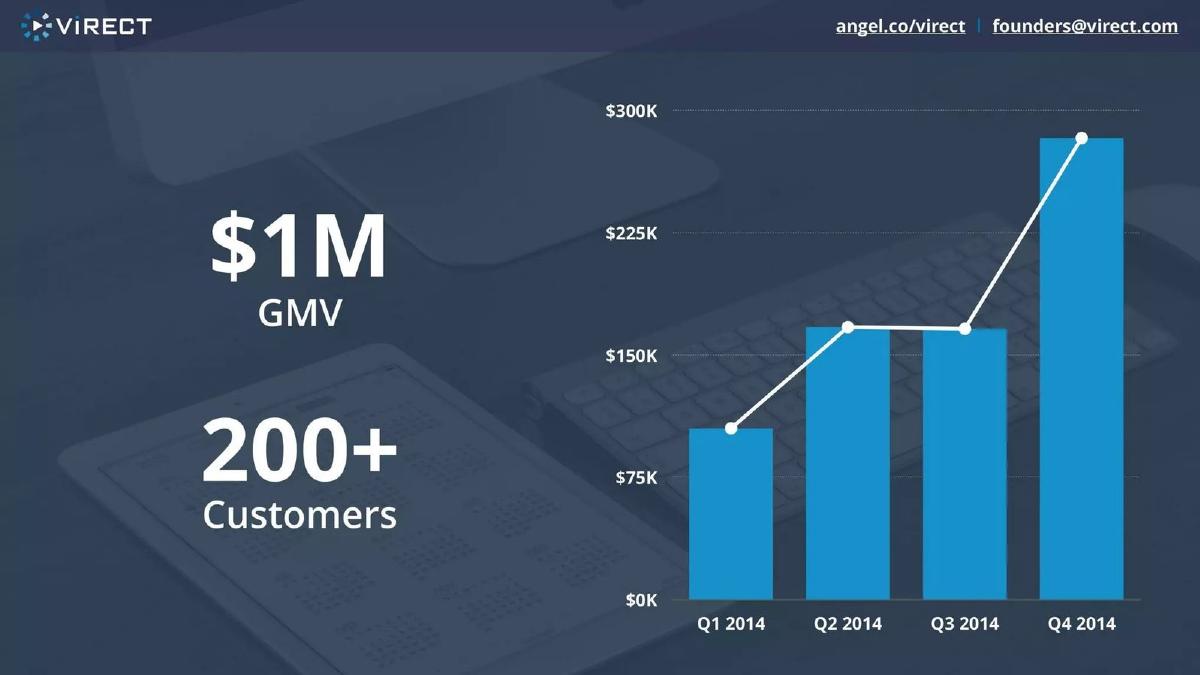
- The company achieved $1M in GMV with over 200 customers by Q4 2014, as shown on slide 3.
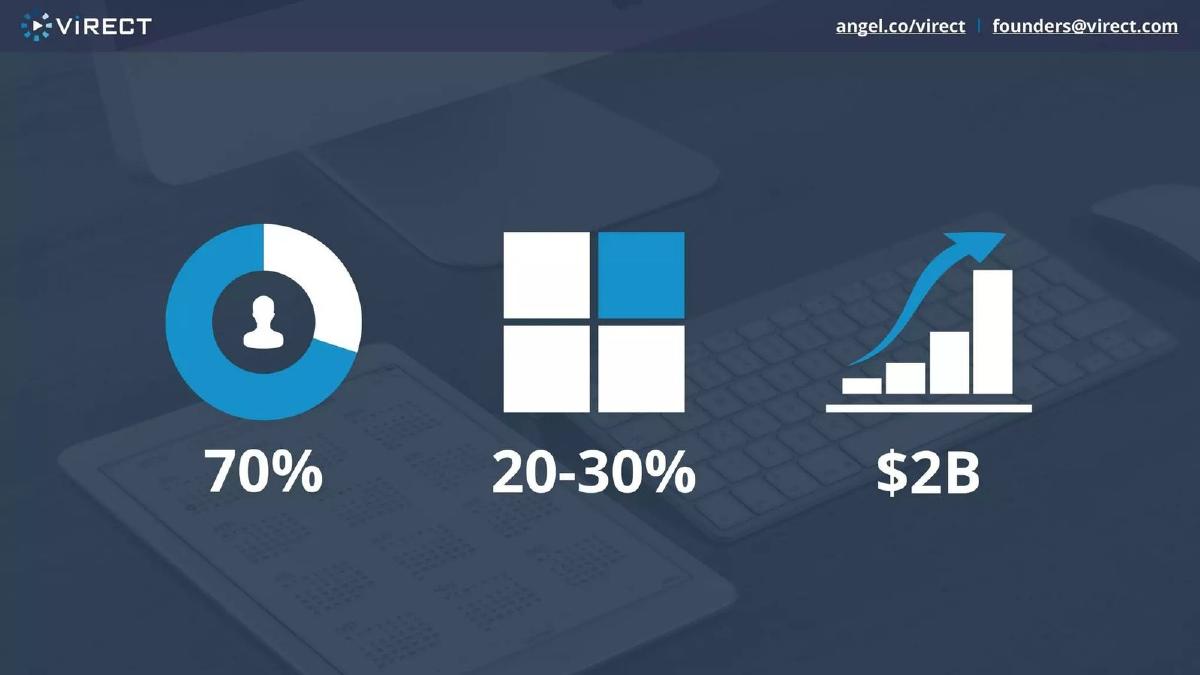
- A high retention rate is a core value proposition, with 70% of customers being repeat users (slide 4).
- The marketplace operates on a 20-30% take rate, indicated by the percentage graphic on slide 4.
- Virect identifies a $2B total addressable market for video production services on slide 4.
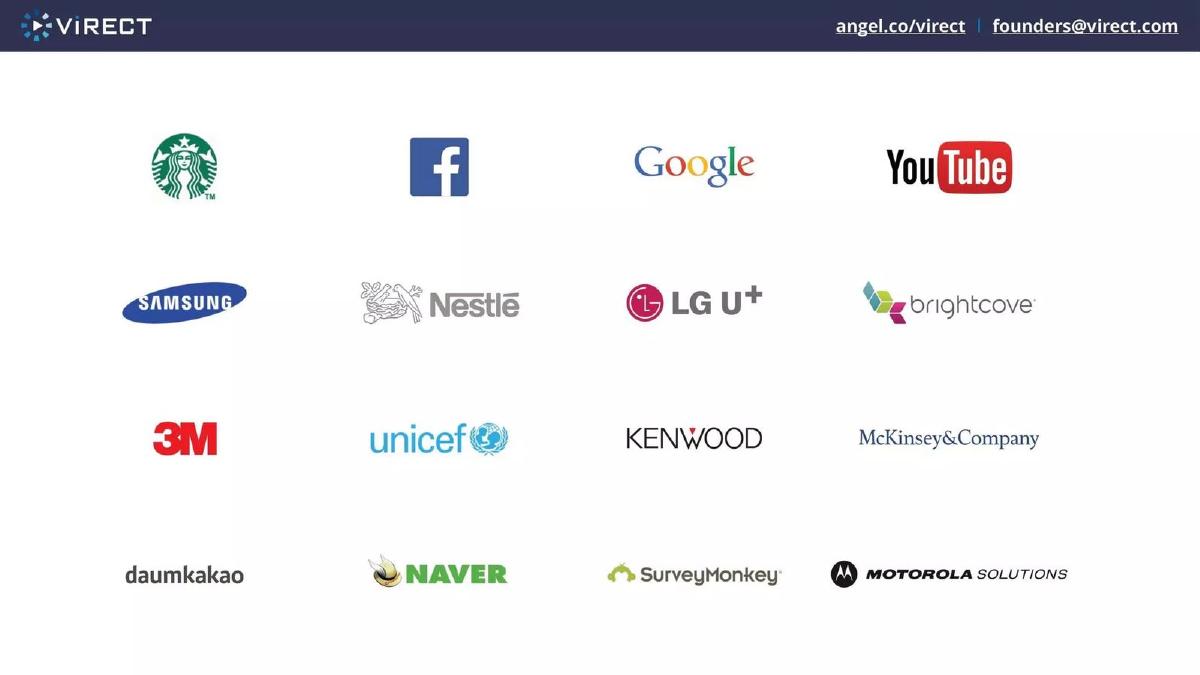
- The platform has been used by major global entities including YouTube, Samsung, McKinsey & Company, and UNICEF (slide 5).
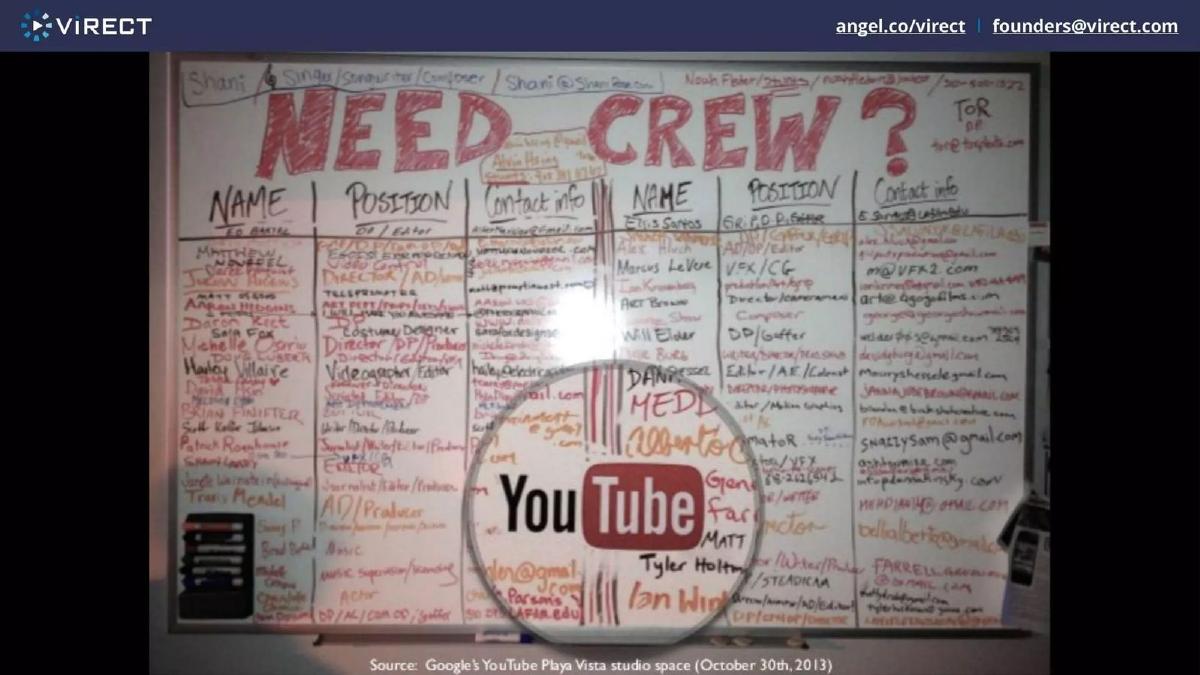
- The problem of fragmented creator discovery is illustrated by a photo of a chaotic 'Need Crew?' whiteboard at a YouTube studio (slide 6).
- The product interface allows users to view 'Recent Videos' and 'Proposals' from creators in specific cities like Mountain View and Atlanta (slide 7).
- The team possesses significant institutional pedigree from Stanford University and the Stanford Graduate School of Business (slide 9).
The Minimalist Marketplace: Virect's $150k Seed Deck
Virect’s pitch deck is a notable example of the 'less is more' philosophy in early-stage fundraising. Produced in 2011, the deck avoids the text-heavy pitfalls of its era, opting instead for a visual narrative that emphasizes scale and social proof. With only 10 slides, the company manages to communicate a massive market opportunity and significant early traction without a single bulleted list of features. This teardown examines how they used high-level metrics to validate a marketplace model in the burgeoning video production sector.
Slide 1: The Cover Slide
The deck opens with a clean, professional cover slide. It features the Virect logo—a stylized play button surrounded by a circular loading-style graphic—and the clear value proposition: "Find and Hire the Best Video Creators." The background image is a MacBook Air showing the Virect platform, which immediately establishes that the product is live and functional. Contact information and an AngelList link are prominently displayed at the bottom, a standard practice for the 2011-2014 era.
Slide 2: The Visual Hook
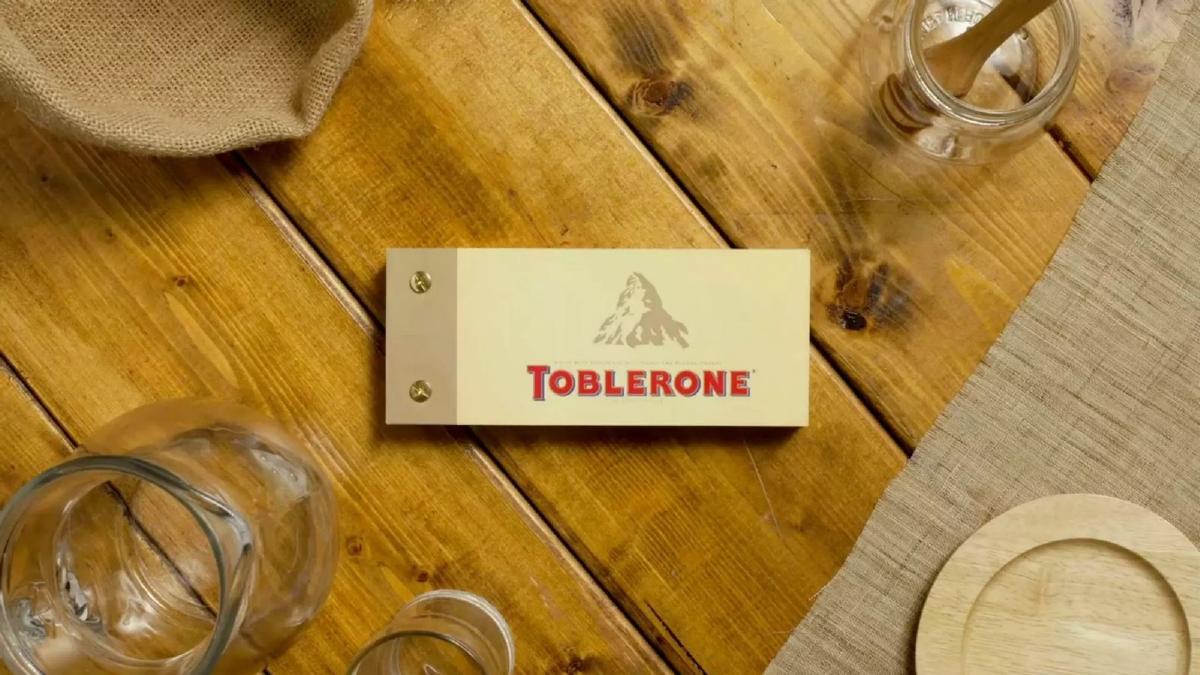
Slide 2 is an unconventional choice. It is a full-bleed, high-quality photograph of a Toblerone package on a wooden table. There is no text on this slide. In a live presentation, this likely served as a backdrop for a case study or a 'story moment' regarding a specific project completed through the platform. In a standalone deck, it functions as a testament to the high-quality production value the marketplace facilitates, though without context, its utility is limited to aesthetic appeal.
Slide 3: Traction and Growth
This is the 'meat' of the deck. Slide 3 presents three critical data points: $1M GMV , 200+ Customers , and a quarterly growth bar chart for 2014. The chart shows steady performance in Q2 and Q3 (around $175K per quarter) followed by a massive jump in Q4 2014 to approximately $275K. By leading with Gross Merchandise Volume rather than revenue, Virect emphasizes the total economic activity on their platform, which is a key metric for marketplace investors.
Slide 4: Market Dynamics and Opportunity
Slide 4 uses three large icons and figures to explain the business's health and the market's potential. The 70% figure (accompanied by a user icon) represents the repeat customer rate, which is exceptionally high for a service-based marketplace. The 20-30% figure indicates the take rate, or the percentage of each transaction Virect keeps as revenue. Finally, the $2B figure points to the total addressable market. This slide effectively answers three investor questions: Do customers come back? How do you make money? How big can this get?
Slide 5: The Logo Wall
Social proof is delivered in bulk on slide 5. The company displays 16 logos of high-profile clients and partners. Notable names include Google, Facebook, YouTube, Samsung, Starbucks, Nestle, 3M, and McKinsey & Company . For a startup at the 'Other' stage (likely Seed or Bridge), having a client list that includes the world’s largest tech and consumer brands is a powerful validator of the platform's ability to handle enterprise-grade requirements.
Slide 6: The Problem Statement
Instead of a slide titled 'The Problem,' Virect uses a photograph of a whiteboard at a Google/YouTube studio space dated October 30th, 2013. The board is covered in handwritten names, positions (Director, Editor, Gaffer), and contact info under the heading "NEED CREW?" . This is a brilliant 'show, don't tell' moment. It illustrates the chaotic, analog, and localized nature of hiring video talent that Virect aims to digitize and globalize.
Slide 7: Product Interface
Slide 7 provides a screenshot of the platform's 'Proposals' page. It shows a user interface where a business can review bids for a project (in this case, a 'Holographic Dev Kit'). The UI displays creator names like MarketME Video Production and BayCreative , their locations (Mountain View, Atlanta, San Francisco), and their 'Recent Videos' portfolios. It also shows a rating system (e.g., 'Recommended by 30 of 33 clients'). This confirms the marketplace's core features: discovery, portfolio review, and reputation management.
Slide 8: Value Pillars
Slide 8 is purely iconographic, featuring a film strip, a piggy bank with a dollar sign, and a stopwatch. Without text, these icons represent the three pillars of the Virect value proposition: Quality Video, Cost Savings, and Speed/Efficiency . While the meaning is clear, this slide is perhaps too minimalist for a deck intended to be read without a presenter, as it offers no specific data to back up these claims.
Slide 9: The Team
The team slide (Slide 9) features six members with their roles and a column of prestigious logos. The pedigree is strong: Stanford University, Stanford Graduate School of Business, Sorbonne, Oracle, and LG . The team is balanced between leadership (Chee-Hyung Yoon), creative (Naejin Hyeon), and execution (Engineering, Operations, Marketing). This mix suggests the company has the technical capability to build the platform and the creative understanding to vet the talent on it.
Slide 10: The Summary / Closing
The final slide repeats the core metrics from earlier in the deck: $1M GMV, 70% Repeat, and $2B Market . It serves as a final anchor for the investor, ensuring the most impressive numbers are the last thing they see. It includes the same contact information as the cover, providing a clear path for follow-up.
What Works in the Virect Deck
The primary strength of this deck is its unwavering focus on traction . By placing the $1M GMV and 70% repeat rate early and repeating them at the end, Virect makes it impossible for an investor to miss their momentum. The use of the 'Need Crew?' whiteboard is a masterstroke in problem definition; it provides a visceral, real-world example of the inefficiency they are solving. Furthermore, the logo wall is exceptionally strong for an early-stage company, suggesting that they have already solved the 'cold start' problem that plagues most marketplaces.
What is Missing from the Virect Deck
The most glaring omission is a specific 'Ask' slide . There is no mention of how much capital they are seeking, the valuation they are targeting, or what the milestones for the next 18 months look like. Additionally, the deck lacks unit economics . While we see a 20-30% take rate, there is no information on Customer Acquisition Cost (CAC) or Lifetime Value (LTV), which are critical for evaluating the scalability of a marketplace. Finally, there is no competitor analysis . In 2011-2014, the video production space was becoming crowded with platforms like Tongal or even general freelance sites like Upwork (then oDesk/Elance), and Virect offers no explanation of their unique competitive advantage.
What a Founder Should Copy
Founders should emulate Virect’s visual hierarchy . The deck uses large, bold numbers for its most important metrics, ensuring they are legible even on a mobile screen or a projector. The 'Show, Don't Tell' problem slide (the whiteboard) is another high-value tactic; if you can find a photo of your target customers struggling with the status quo, it is always more effective than a list of pain points. Lastly, the repetition of key metrics on the final slide is a smart way to 'close' the pitch, leaving the audience with the specific data points you want them to remember during their internal partner meetings.
Frequently asked questions
- What was the primary business model for Virect?
- Based on slide 4, Virect utilized a marketplace commission model. The slide displays a '20-30%' figure alongside a grid icon, which typically represents the platform's take rate or commission on transactions between businesses and video creators. This is supported by the $1M GMV figure, suggesting the platform facilitates high-value service contracts.
- How did Virect demonstrate product-market fit?
- Virect demonstrated fit through two primary metrics on slide 3 and slide 4: a $1M GMV and a 70% repeat customer rate. The growth chart on slide 3 shows a significant spike in volume in Q4 2014, nearly doubling the performance of the previous two quarters. High repeat usage in a service marketplace is a strong indicator that the quality of creators meets business standards.
- Who were the key members of the Virect team?
- The team, shown on slide 9, was led by Co-founder/CEO Chee-Hyung Yoon and Co-founder/Creative Naejin Hyeon. The technical and operational side included Taenyon Kim and Alexandre Bonny in Engineering, Hyeryeon Lee in Operations, and Richard Hyun in Marketing. Their collective background includes experience at Oracle, LG, and education at Stanford and Sorbonne.
- What problem was Virect trying to solve?
- Virect addressed the friction in finding and hiring video production talent. Slide 6 uses a 'Need Crew?' whiteboard from a YouTube studio to show the manual, analog way creators and businesses used to connect. By providing a digital marketplace with 'verified portfolios and reviews' (per the catalogue description), they aimed to professionalize and streamline this discovery process.
- Is there a clear exit strategy or financial forecast in the deck?
- No. The deck is strictly focused on historical traction and current market size. It lacks a slide for financial projections, use of funds, or potential acquirers. This suggests the deck was likely used as a high-level teaser or for a demo day presentation where the 'Ask' and detailed financials were handled in person or in a follow-up data room.