Virti’s Series A deck is a masterclass in demonstrating operational efficiency and market fit within the high-growth EdTech and MedTech sectors. By positioning themselves as 'The Human Performance Company,' Virti moves beyond simple VR novelty to offer an end-to-end enterprise solution for creating, distributing, and analyzing experiential training. The deck highlights a massive $170bn global workplace training market and contrasts their 4-month healthcare sales cycle against a 12-month industry average. Despite redacting specific revenue figures in this public version, the inclusion of sophi…
Key takeaways
- Virti targets four distinct market segments, the largest being Global Workplace Training at $170bn with a 4.3% CAGR (Slide 2).
- The product is positioned as an end-to-end suite covering creation (2D, VR, AR), distribution (Mobile, Desktop), and AI-driven analysis (Slide 3).
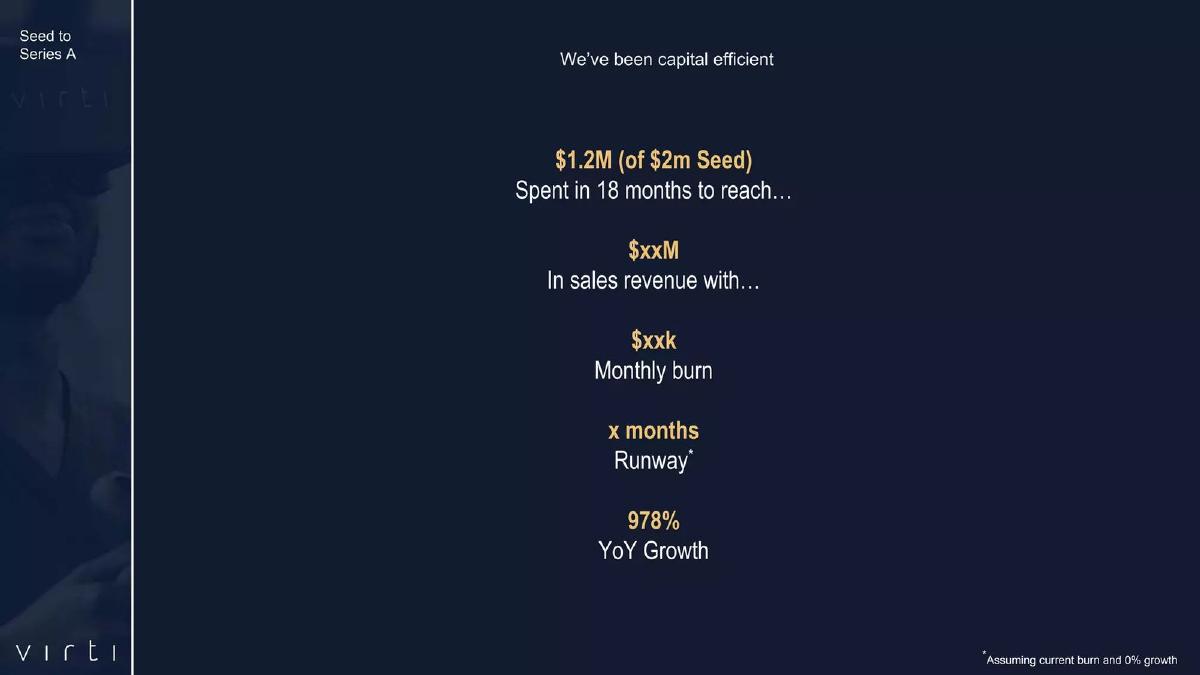
- The company claims high capital efficiency, having spent only $1.2M of a $2M seed round over 18 months (Slide 4).
- Virti reports a staggering 978% Year-over-Year growth, though the baseline revenue figure is redacted as $xxM (Slide 4).
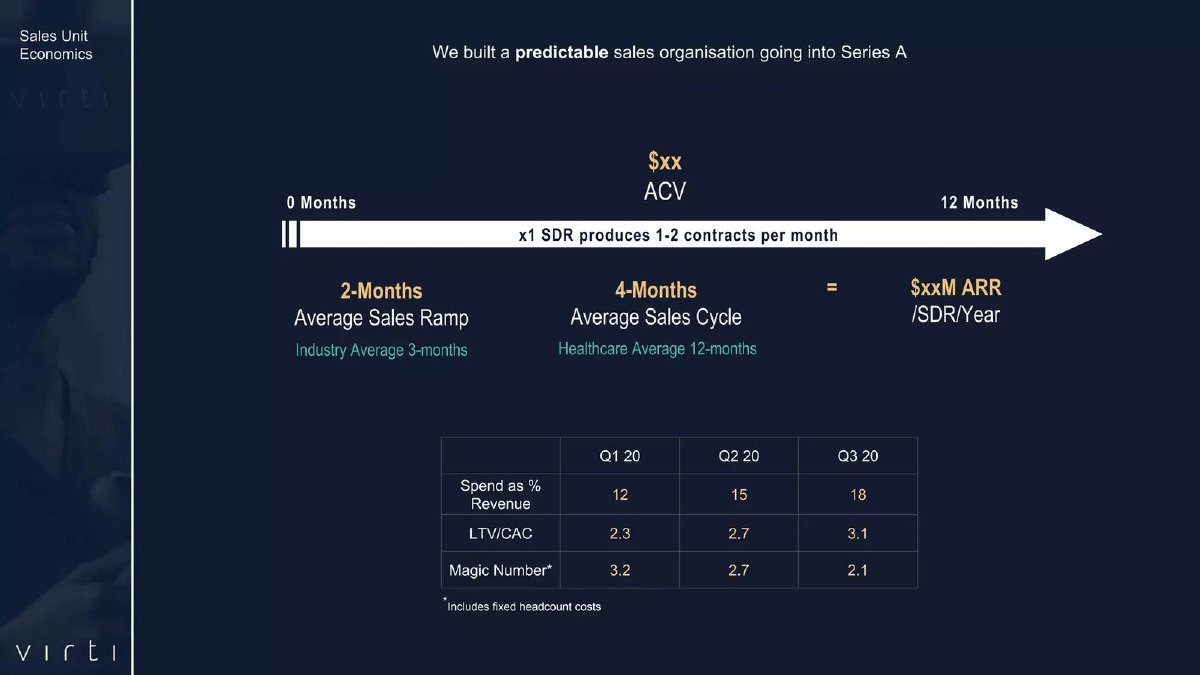
- Sales efficiency is a core pillar, with an average sales cycle of 4 months compared to a healthcare industry average of 12 months (Slide 5).
- Unit economics show improving health, with LTV/CAC rising from 2.3 in Q1 20 to 3.1 in Q3 20 (Slide 5).
- The team is led by a founder with deep domain expertise: Dr. Alex Young, an Orthopaedic Surgeon with degrees in surgery and education (Slide 6).
- The $10M Series A ask is primarily allocated to Product Development (56%) and Sales & Marketing (25%) (Slide 7).
Introduction
Virti’s Series A pitch deck is a clinical, data-driven presentation that focuses heavily on operational excellence and market opportunity. By branding themselves as "The Human Performance Company," they successfully pivot away from the "VR for the sake of VR" trap that many early-stage immersive tech companies fall into. Instead, they frame their technology as a solution to a massive, fragmented corporate training problem. The deck is structured to prove that they have not only built a product but also a scalable, efficient machine for selling that product into the notoriously difficult healthcare sector.
Slide 1: Title and Positioning
The cover slide is minimalist, featuring the Virti logo and the tagline "The Human Performance Company: For Healthcare and Beyond." The background image shows a person using a VR headset, but it is darkened to keep the focus on the text. The inclusion of "Virti.com" and the specific focus on healthcare immediately establishes the company's primary vertical while hinting at broader enterprise applications.
Slide 2: The Market Opportunity
Virti uses this slide to establish the scale of their ambition. They break the market down into four distinct, high-value segments:
Global Workplace Training: $170bn (4.3% CAGR) · Healthcare Training: $87.6bn (17% CAGR) · Patient Education: $41.7bn (17.3% CAGR) · Medical Device Education: $8bn (10.3% CAGR)
By highlighting the 17% and 17.3% CAGR in healthcare-related segments, they demonstrate that their core market is growing significantly faster than general workplace training. The visual uses concentric circles to show how these markets overlap and contribute to a massive Total Addressable Market (TAM).
Slide 3: The Product Ecosystem
This slide addresses the "how" by showcasing an end-to-end enterprise solution. Virti breaks their offering into three pillars: Create, Distribute, and Analyse . Create involves a suite for 2D, VR, and AR content. Distribute utilizes a cloud platform accessible via mobile, desktop, and headsets. Analyse uses an AI engine for performance analysis. The inclusion of "AI Virtual Humans" as a specific feature highlights their technical sophistication, moving beyond simple 360-degree video into interactive, simulated environments.
Slide 4: Capital Efficiency and Growth
Slide 4 is a "traction" slide that emphasizes how much the team has achieved with limited resources. They state they spent $1.2M of a $2M Seed round over 18 months to reach their current state. The key metric here is the 978% YoY Growth . While the specific revenue ($xxM), monthly burn ($xxk), and runway (x months) are redacted in this version, the placeholder format suggests these were the central figures in the live pitch. The footnote "Assuming current burn and 0% growth" for the runway calculation is a standard, conservative accounting practice that builds trust with investors.
Slide 5: Sales Unit Economics
This is arguably the strongest slide in the deck for a Series A investor. It moves away from the product and into the mechanics of the business. Virti claims a 4-month average sales cycle , which they contrast against a 12-month healthcare average . They also highlight a 2-month sales ramp versus a 3-month industry average. A table at the bottom tracks three quarters of data (Q1 20 to Q3 20), showing:
LTV/CAC: Improved from 2.3 to 3.1. · Magic Number: Remained strong, ending at 2.1. · Spend as % Revenue: Increased from 12% to 18%.
These metrics prove that the business becomes more efficient as it scales, a key requirement for a $10M Series A.
Slide 6: The Executive Team
The team slide focuses on the two founders and the broader company culture. Dr. Alex Young (CEO) is highlighted as an Orthopaedic Surgeon with postgraduate degrees in surgery and education, providing essential domain authority. Nils Hellberg (CTO) is positioned as a veteran of the gaming and streaming industries. The slide also includes impressive internal metrics: a >90 eNPS (employee Net Promoter Score) and the fact that 60% of payroll is Engineering . The bottom of the slide features a "trust bar" of logos including Cedars Sinai Accelerator, PWC, and the NHS, validating their market presence.
Slide 7: The $10M Series A Ask
The penultimate slide clearly defines the fundraising goal: $10M Series A to Accelerate Growth . A pie chart breaks down the use of funds:
Product Dev: 56% · Sales & Marketing: 25% · Customer Experience (Cx): 12% · Other: 7%
The focus on Product Development (over half the raise) suggests that Virti intends to maintain a significant technological moat, while the Sales & Marketing allocation is designed to fuel the "predictable sales organisation" proven in Slide 5. The slide also lists three redacted strategic goals (1. XX, 2. XX, 3. XX) that likely detailed specific geographic or vertical expansions.
Slide 8: Confidentiality
The final slide is a standard legal disclaimer. It asserts that all information is the sole property of Virtihealth LTD and must be kept confidential. While not a "pitch" slide, its presence indicates the professional, enterprise-ready posture of the company.
What Virti Does Well
Virti excels at comparative benchmarking . Throughout the deck, they don't just state their metrics; they compare them to industry averages. Telling an investor you have a 4-month sales cycle is good; telling them the industry average is 12 months is powerful. This framing transforms a simple data point into a competitive advantage.
The deck also does a fantastic job of balancing the 'Why' and the 'How.' The market slide (Slide 2) explains why the opportunity is huge, while the product slide (Slide 3) explains how they capture it. The sales economics slide (Slide 5) then explains how they do so profitably. This logical flow answers the most pressing investor questions before they are even asked.
What is Missing from the Deck
Despite its strengths, there are a few notable omissions in these 8 slides:
Competitive Landscape: There is no slide dedicated to competitors. While Virti mentions being the "first end-to-end" solution, they don't explicitly name or differentiate themselves from other VR training platforms like Osso VR or PrecisionOS. · Case Studies/Social Proof: While they show logos of accelerators and the NHS, the deck lacks a specific "Success Story" slide detailing how a specific client saved money or improved outcomes using Virti. · Detailed Financial Projections: The deck focuses on historical unit economics but does not show a 3-5 year forward-looking revenue projection, which is standard for a Series A.
Founder Takeaways: What to Copy
1. Use a 'Magic Number': If you are a SaaS founder, include your Magic Number (Net New ARR / Sales & Marketing Spend). It is one of the most respected metrics for measuring sales efficiency and shows you understand how to scale revenue.
2. Highlight Domain Authority: If your CEO has a professional designation (like Dr. Alex Young), lead with it. In sectors like healthcare or legal, the "practitioner-turned-founder" narrative is a massive de-risking factor for investors.
3. The 'End-to-End' Narrative: Investors often fear 'feature companies' that can be easily Sherlocked by incumbents. By positioning themselves as an end-to-end suite (Create, Distribute, Analyse), Virti makes themselves look like a platform, which commands a higher valuation than a content library.
4. Internal Metrics Matter: Including eNPS and the engineering-to-payroll ratio (Slide 6) is a subtle way to show that the company is well-managed and talent-dense. It suggests that the $10M will be managed by a competent organization, not just a group of developers.
Frequently asked questions
- What is Virti's primary value proposition?
- Virti positions itself as an end-to-end enterprise training solution. Unlike point solutions that only provide content, Virti offers a 'Creation Suite' for VR/AR, a 'Cloud Platform' for distribution across devices, and an 'Analytics Engine' to measure user performance. This full-stack approach aims to help organizations scale experiential training that was previously difficult to track or deploy.
- How does Virti justify its sales efficiency in the difficult healthcare market?
- Healthcare is notoriously slow, with a 12-month average sales cycle. Virti claims to have reduced this to 4 months. They attribute this efficiency to a 'predictable sales organisation' where one SDR produces 1-2 contracts per month. They also note a sales ramp time of 2 months, which is faster than the 3-month industry average, suggesting a highly refined go-to-market motion.
- What do the unit economics tell us about the business?
- The deck shows a healthy trajectory for a Series A company. The LTV/CAC ratio improved from 2.3 to 3.1 over three quarters in 2020. Additionally, their 'Magic Number'—a measure of sales efficiency—remained above 2.0 even as spending as a percentage of revenue increased from 12% to 18%. This indicates that new marketing spend is effectively generating incremental recurring revenue.
- Who is behind the company and what is their background?
- The leadership team combines clinical expertise with technical experience. CEO Dr. Alex Young is an Orthopaedic Surgeon, providing the 'subject matter expert' credibility essential for healthcare sales. CTO Nils Hellberg brings the technical pedigree, having directed the Bristol Games Hub and worked in video streaming. This pairing suggests the company can balance medical accuracy with high-end software engineering.
- How does Virti plan to use the $10M Series A funds?
- The majority of the funds (56%) are earmarked for Product Development, indicating a focus on maintaining their technological lead in AI and VR. Sales & Marketing receives 25%, likely to scale the 'predictable sales organisation' mentioned in Slide 5. The remaining funds are split between Customer Experience (12%) and Other (7%), focusing on cross-sell and upsell opportunities.