Virtual Communications Corporation (VCC) utilizes this 15-slide deck to pitch ALICE Receptionist, a digital visitor management system designed to replace or augment physical front-desk staff. The presentation highlights significant early traction with 207 corporate and government customers globally and a series of industry awards, including recognition from Inc. Magazine and SXSW. The company seeks $5,000,000 in funding, structured in $1,000,000 tranches, to scale sales, marketing, and development. While the deck excels at showcasing product versatility—offering desktop, wall-mounted, and kio…
Key takeaways
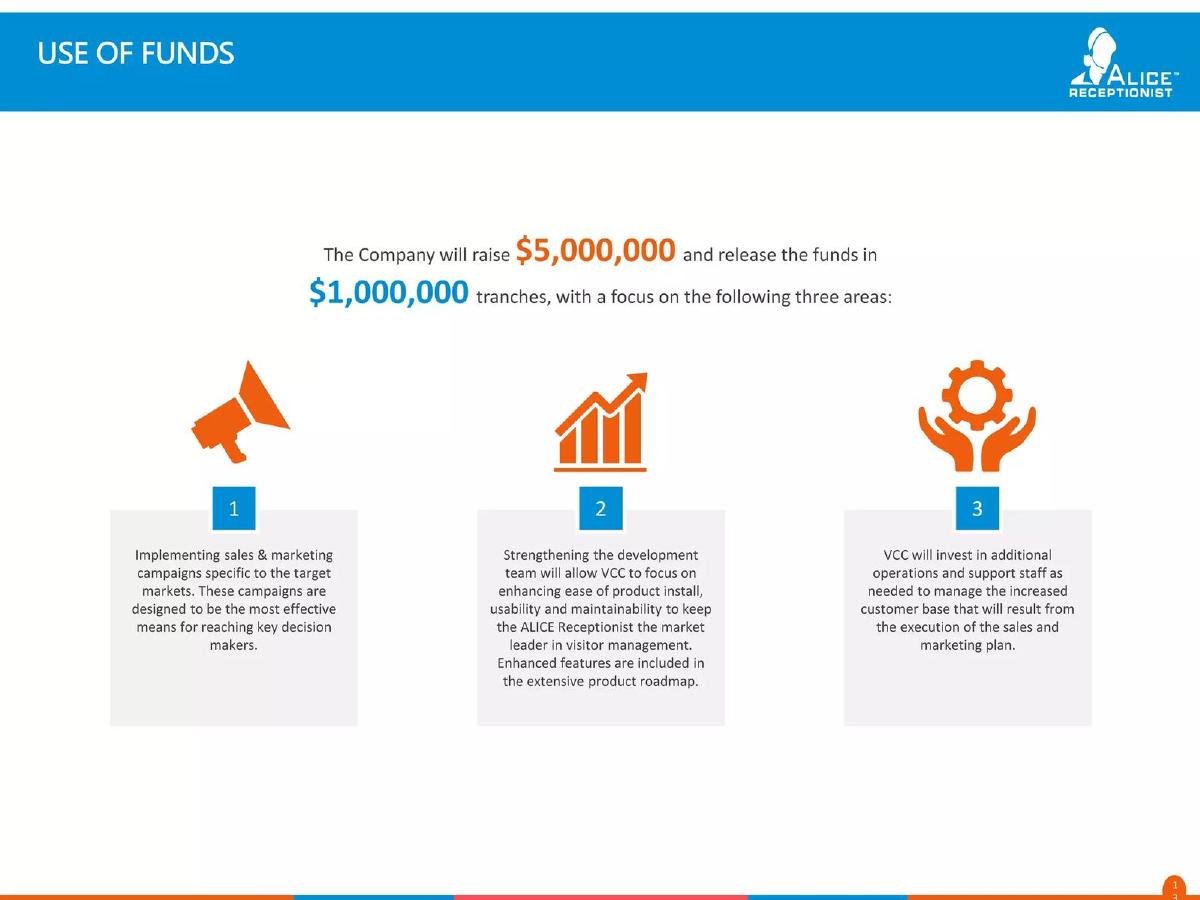
- The company is seeking a total of $5,000,000 to be released in $1,000,000 tranches (Slide 13).
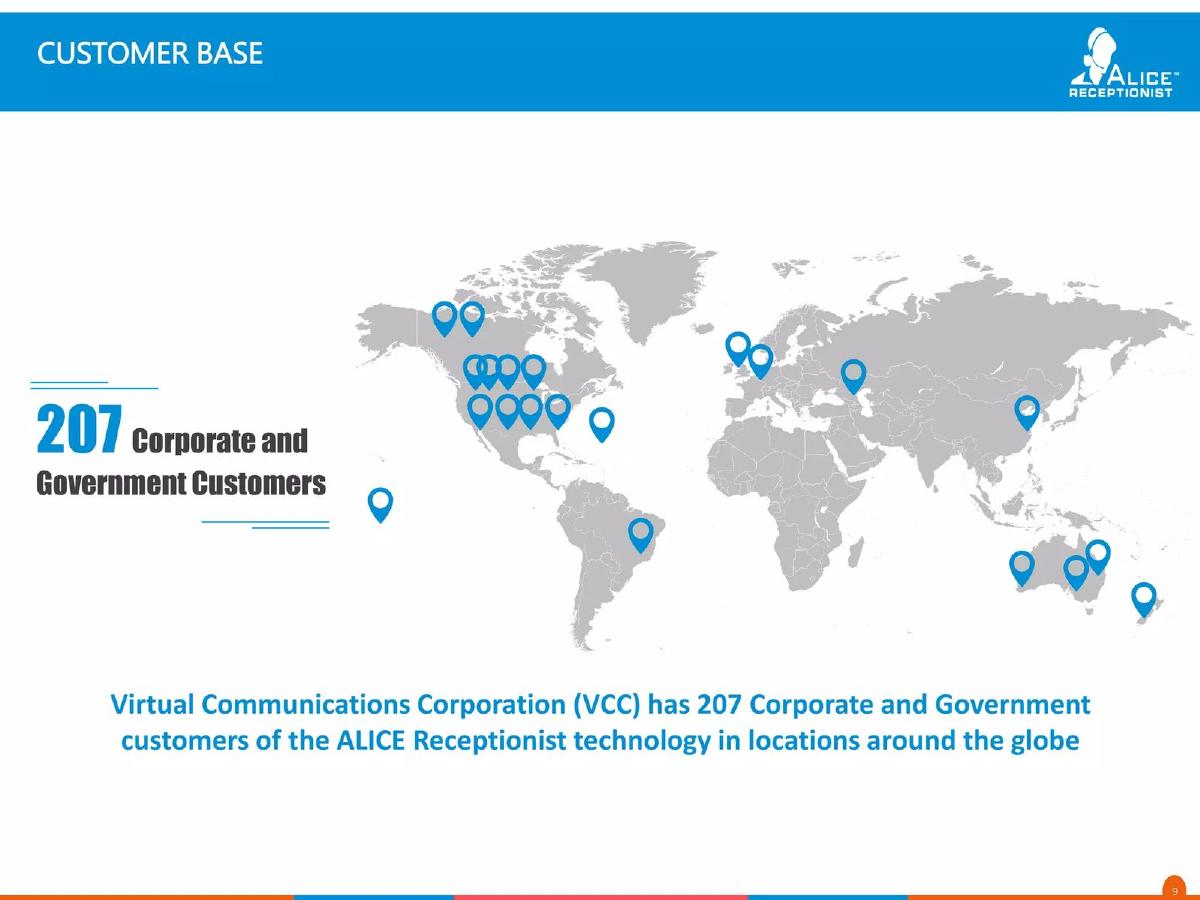
- ALICE Receptionist has secured 207 corporate and government customers across global locations (Slide 9).
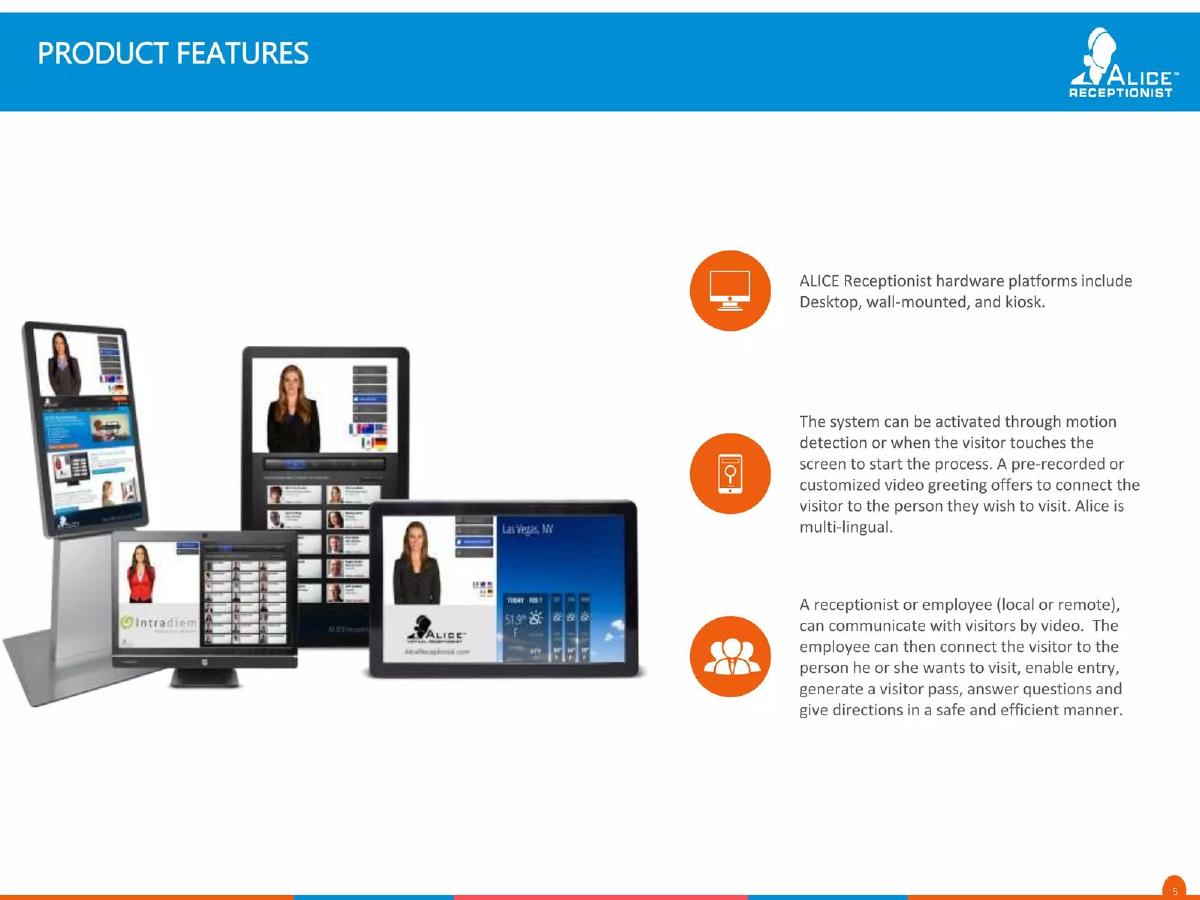
- The product suite includes three hardware form factors: desktop, wall-mounted, and kiosk (Slide 5).
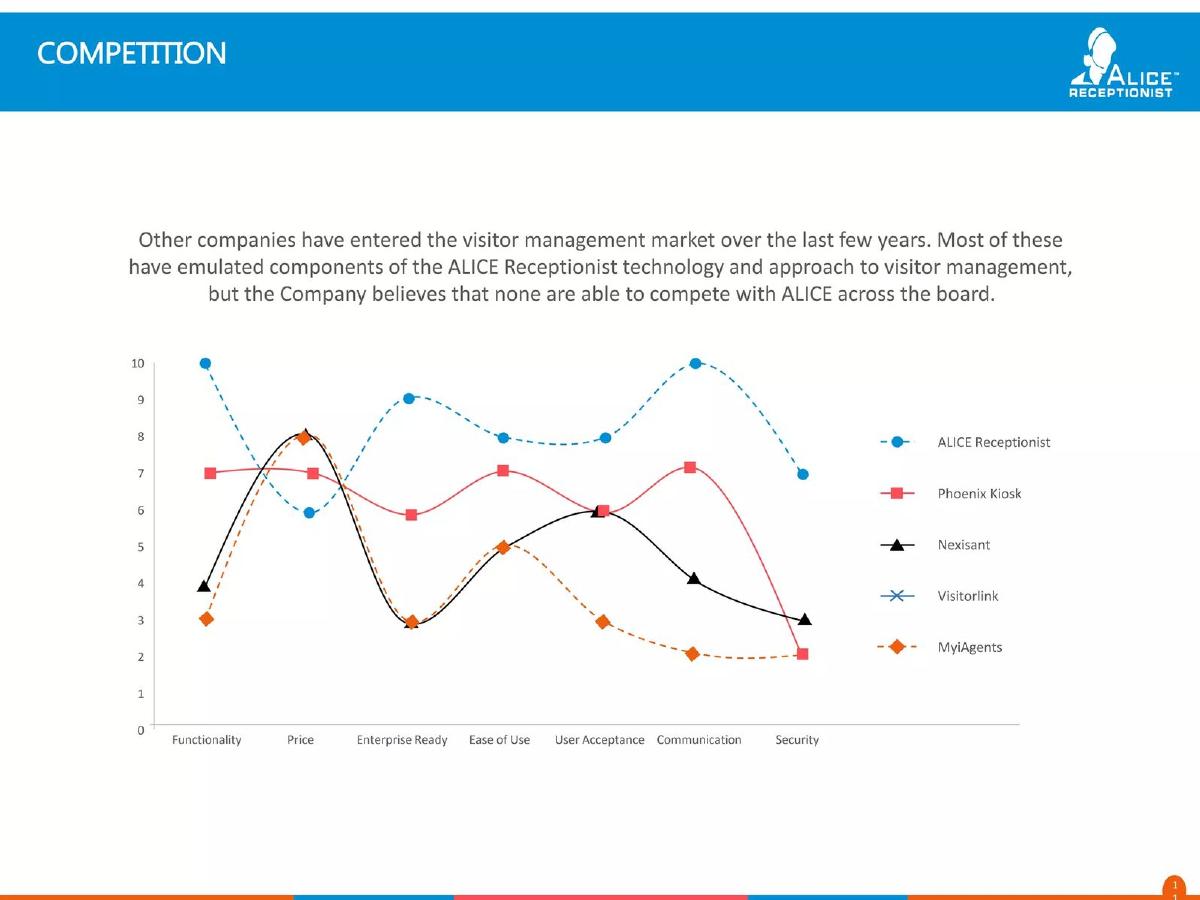
- VCC claims a competitive advantage in communication and functionality over rivals like Phoenix Kiosk and Nexisant (Slide 11).
- The system features motion detection, multi-lingual support, and remote video communication capabilities (Slide 5).
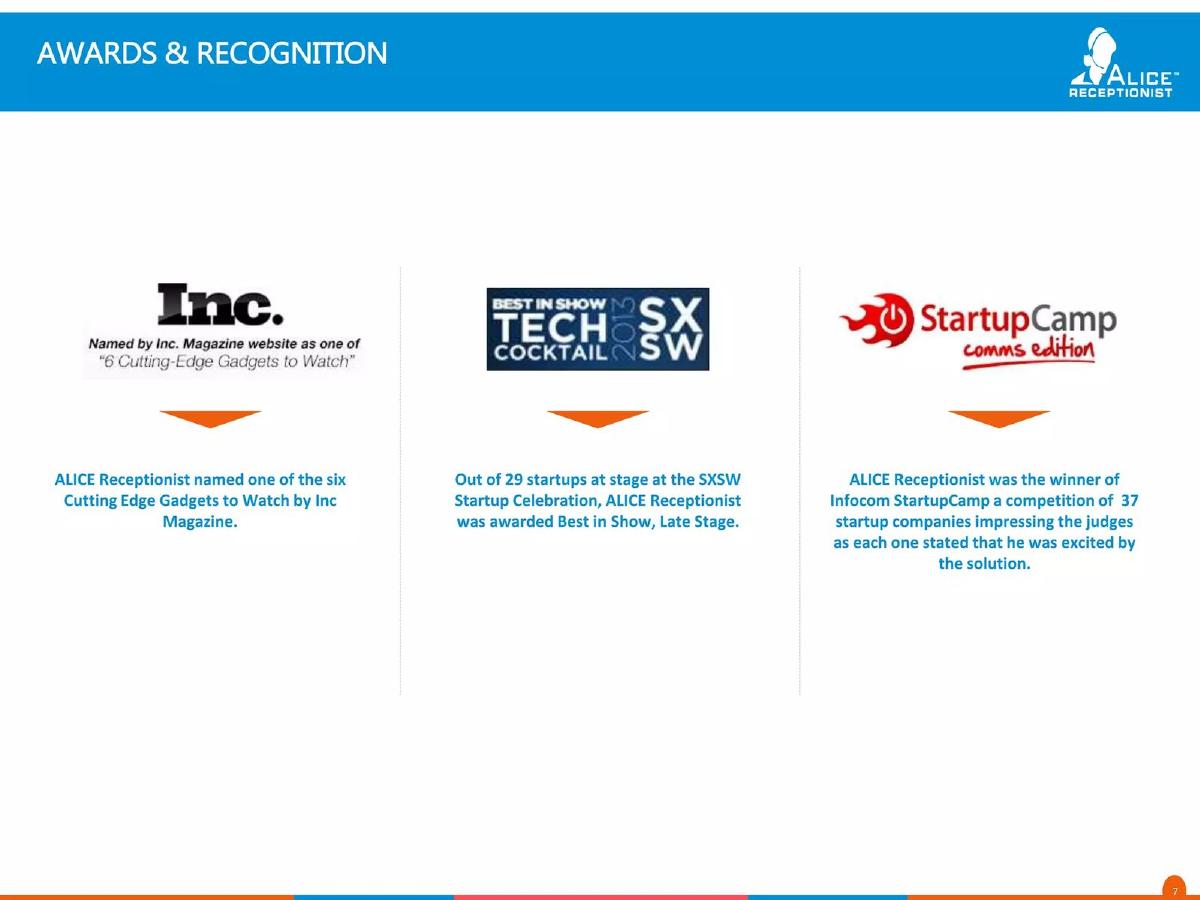
- The company received 'Best in Show, Late Stage' at the 2013 SXSW Startup Celebration (Slide 7).
- Funds are earmarked for three specific areas: sales/marketing, development team expansion, and operations/support staff (Slide 13).
- The deck concludes with contact details for Managing Directors at Merit Harbor Group and OfferBoard Securities rather than the company founders (Slide 15).
Executive Summary: The Digital Front Desk
Virtual Communications Corporation (VCC) presents a solution for the modern office lobby through its ALICE Receptionist product. The deck is a straightforward, professionally designed presentation that focuses heavily on product utility and existing market traction. By the time of this pitch, the company had already moved past the pure 'idea' stage, boasting over 200 customers and several high-profile industry awards. The ask is substantial at $5 million, suggesting a move toward aggressive scaling in the visitor management sector.
Slide 1: Title and Branding
The opening slide features the ALICE Receptionist logo—a stylized silhouette of a woman in a traditional receptionist cap—set against a high-contrast dark sidebar. The background image shows a modern, glass-walled office lobby with people in motion, immediately establishing the physical context of the product. The URL alicereceptionist.com is clearly displayed in the bottom right corner.
Slide 3: Confidentiality and Forward-Looking Statements
This slide contains standard legal boilerplate. It notes that the presentation includes "forward-looking" statements pursuant to the Private Securities Litigation Reform Act of 1995. Crucially, it mentions the presentation is for use in connection with a "Capital transaction for a cash secured Letter of Credit," providing a hint at the specific financial structure being sought beyond a simple equity raise.
Slide 5: Product Features
VCC uses this slide to define the hardware and software capabilities of ALICE. It lists three hardware platforms: Desktop, wall-mounted, and kiosk . The software features highlighted include:
Motion detection activation. · Pre-recorded or customized video greetings. · Multi-lingual support. · Two-way video communication between visitors and employees (local or remote). · Functionality for enabling entry, generating visitor passes, and giving directions.
The imagery shows the interface on various screen sizes, emphasizing a consistent UI across different form factors.
Slide 7: Awards & Recognition
This is a high-impact social proof slide. It highlights three major accolades:
Inc. Magazine: Named one of the "6 Cutting-Edge Gadgets to Watch." · SXSW 2013: Awarded "Best in Show, Late Stage" out of 29 startups. · Infocomm StartupCamp: Winner of the competition among 37 startup companies.
The inclusion of "Late Stage" in the SXSW award suggests that at the time of this deck, VCC was already an established entity with a mature product.
Slide 9: Customer Base
The deck quantifies its traction with a clear headline: 207 Corporate and Government Customers . A world map populated with blue location pins shows a heavy concentration in North America, with additional presence in Europe, the Middle East, Asia, and Australia. This slide serves to prove that the product has global appeal and has successfully navigated the procurement processes of both private corporations and government agencies.
Slide 11: Competition
VCC utilizes a multi-variable line graph to compare ALICE Receptionist against four competitors: Phoenix Kiosk, Nexisant, Visitorlink, and MyiAgents . The comparison metrics include Functionality, Price, Enterprise Ready, Ease of Use, User Acceptance, Communication, and Security. According to the chart, ALICE leads significantly in Communication and Functionality but is positioned as a more expensive option (indicated by a lower score on the 'Price' axis, where higher usually denotes affordability or value). This positioning suggests a premium product strategy.
Slide 13: Use of Funds
The financial ask is clearly stated: $5,000,000 , to be released in $1,000,000 tranches . The allocation is divided into three equal-weighted pillars:
1. Sales & Marketing: Implementing campaigns to reach key decision-makers in target markets. · 2. Development: Strengthening the team to focus on ease of installation, usability, and the product roadmap. · 3. Operations & Support: Investing in staff to manage the increased customer base resulting from the sales push.
Slide 15: Contact Information
The final slide does not list the company's founders. Instead, it provides contact details for John Illes and Nate Nead , Managing Directors at Merit Harbor Group / OfferBoard Securities . This indicates that VCC is using an investment bank or a specialized placement agent to manage the fundraise, which is common for companies at a more mature stage or those seeking specific debt/equity structures like the previously mentioned Letter of Credit.
What Works in This Deck
The deck is highly effective at establishing credibility through traction . Many early-stage decks rely on "projected" users or "letters of intent," but VCC leads with 207 active customers and a map showing global distribution. This immediately de-risks the investment by proving product-market fit.
The Product Features slide (Slide 5) is also a highlight. It avoids overly technical jargon and instead focuses on the user experience—how the visitor interacts with the screen and how the employee receives the call. By showing the hardware in three different formats, they demonstrate that the solution can fit into any office environment, from a small reception desk to a large corporate lobby.
Finally, the Awards slide (Slide 7) provides third-party validation that is difficult to ignore. Winning "Best in Show" at a venue as competitive as SXSW gives the company a pedigree that helps it stand out in a crowded enterprise software market.
What Is Missing
The most glaring omission is the Internal Team Slide . While the contact slide lists financial advisors, investors generally invest in people first. There is no mention of the CEO, the CTO, or the engineering talent that built the system. Without knowing the background of the leadership, it is difficult to assess the company's ability to execute the $5 million plan.
There is also a complete lack of Financial Data . While 207 customers is a great number, the deck does not disclose the Average Contract Value (ACV), the churn rate, or the total annual recurring revenue (ARR). For a $5 million ask, investors would expect to see a breakdown of the unit economics—specifically, how much it costs to acquire one of these corporate customers versus their lifetime value.
The Problem Slide is also missing. The deck assumes the audience already understands why a digital receptionist is necessary. While the benefits are implied, a strong deck usually starts by quantifying the pain point—such as the high cost of human receptionists, the inefficiency of missed visitors, or the security risks of unmonitored lobbies.
What a Founder Should Copy
Founders should emulate the visual clarity of the Use of Funds slide (Slide 13) . It doesn't just give a number; it explains the logic of the tranches and groups the spending into three logical buckets that cover the entire business lifecycle: getting customers (Sales), building the product (Dev), and keeping customers (Ops).
The Competitive Analysis (Slide 11) is also a good model for companies with a premium product. Rather than just saying "we are better," the graph acknowledges that the product might be more expensive than the competition but justifies that cost by showing superior performance in "Communication" and "Functionality." This is a honest way to frame a high-price, high-value market position.
Lastly, the Customer Map (Slide 9) is a powerful tool for any company with physical deployments. It visually communicates the scale of the operation far more effectively than a simple list of names would. It tells a story of a company that knows how to handle international logistics and global support.
Frequently asked questions
- What is the primary product offered by Virtual Communications Corporation?
- The primary product is ALICE Receptionist, a digital visitor management system. It combines hardware (kiosks, wall mounts, or desktops) with software that allows for motion-activated greetings, multi-lingual interaction, and two-way video communication between visitors and employees, whether those employees are local or remote.
- How much capital is the company raising and how will it be used?
- The company is raising $5,000,000, intended to be released in $1,000,000 tranches. According to Slide 13, the funds are allocated to three pillars: implementing targeted sales and marketing campaigns, strengthening the development team to enhance product installation and features, and hiring additional operations and support staff to manage the growing customer base.
- What evidence of market validation does the deck provide?
- Market validation is presented through two main lenses: customer count and industry awards. Slide 9 notes that the company has 207 corporate and government customers globally. Slide 7 highlights accolades such as being named one of Inc. Magazine’s '6 Cutting-Edge Gadgets to Watch' and winning 'Best in Show' at SXSW 2013.
- Who are the competitors mentioned in the pitch?
- Slide 11 identifies four specific competitors in the visitor management market: Phoenix Kiosk, Nexisant, Visitorlink, and MyiAgents. The deck uses a line graph to suggest that ALICE Receptionist outperforms these competitors in categories such as functionality, communication, and security, though it trails slightly in price.
- What is missing from this pitch deck?
- The deck lacks several critical components for a late-stage or growth-round pitch. There is no slide detailing the internal management team or their background. Additionally, there are no financial projections, revenue figures, or unit economics (such as CAC or LTV). The deck also omits a clear 'Problem' slide, jumping straight into product features and recognition.