Virtual Communication Corporation (VCC) utilizes its ALICE Receptionist brand to provide automated, video-enabled visitor management systems. The deck highlights a mature product with three hardware form factors—desktop, wall-mounted, and kiosk—and a global footprint of 207 corporate and government customers. Seeking $5,000,000 in $1,000,000 tranches, the company aims to scale sales, marketing, and development. While the deck demonstrates strong external validation through awards from Inc. Magazine and SXSW, it lacks specific financial performance data, unit economics, and internal team biogr…
Key takeaways
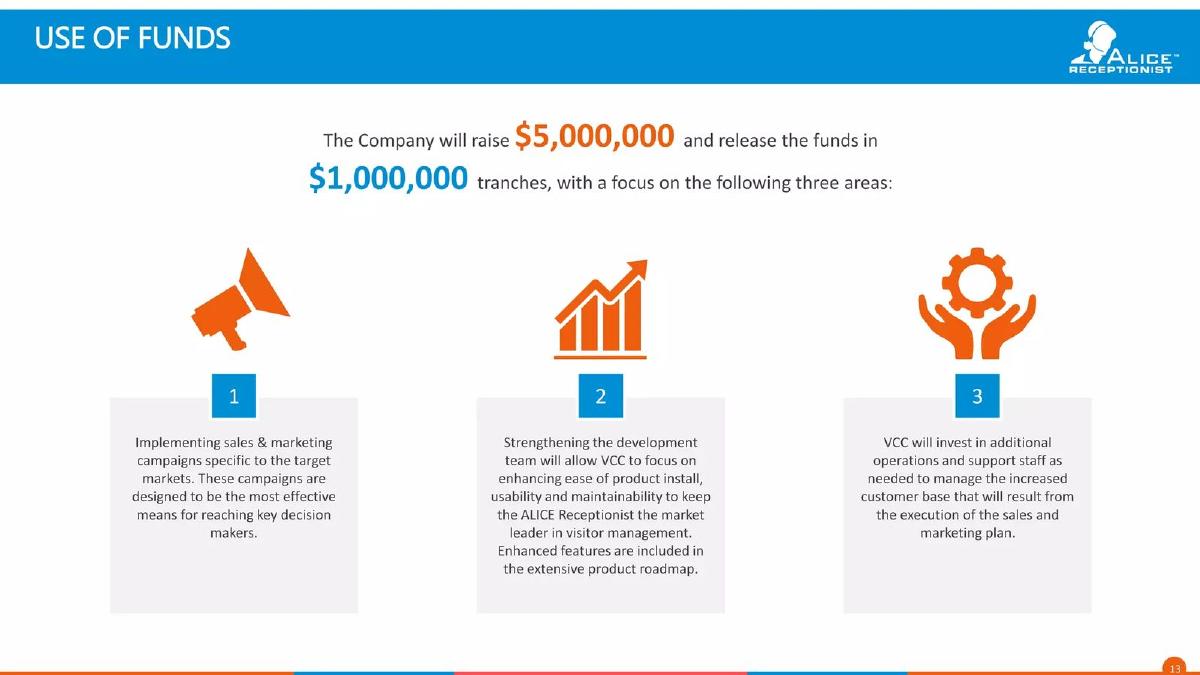
- The company is seeking a total of $5,000,000, to be released in $1,000,000 tranches (Slide 13).
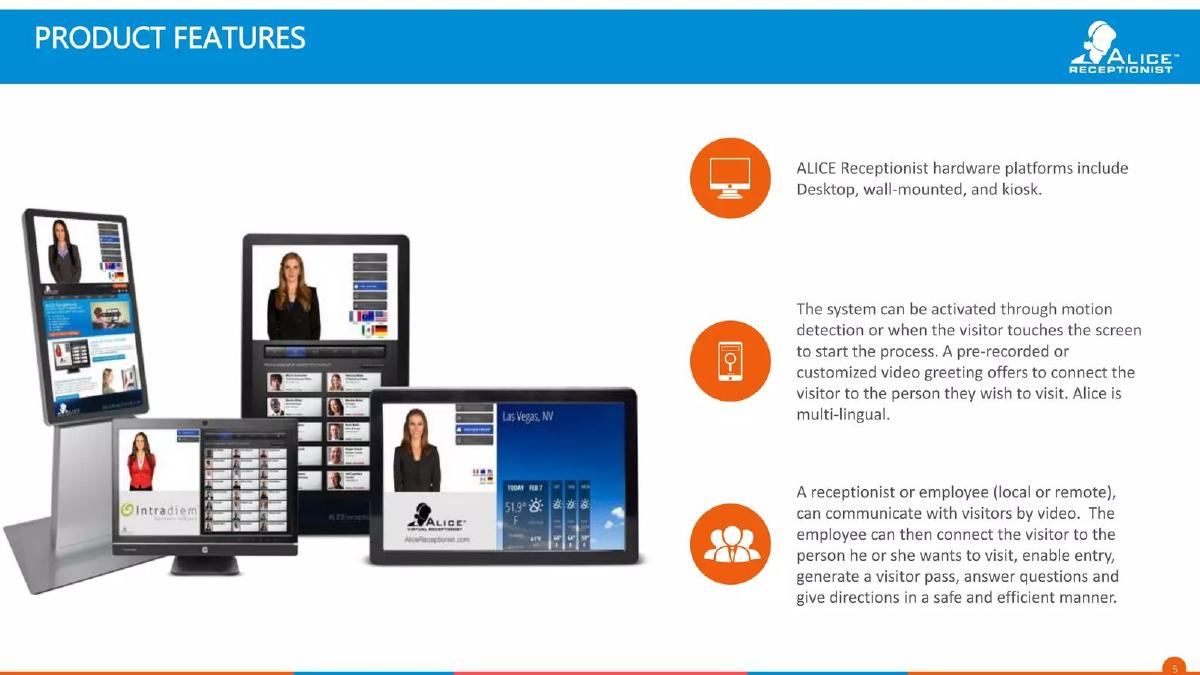
- ALICE Receptionist offers three distinct hardware platforms: Desktop, wall-mounted, and kiosk (Slide 5).
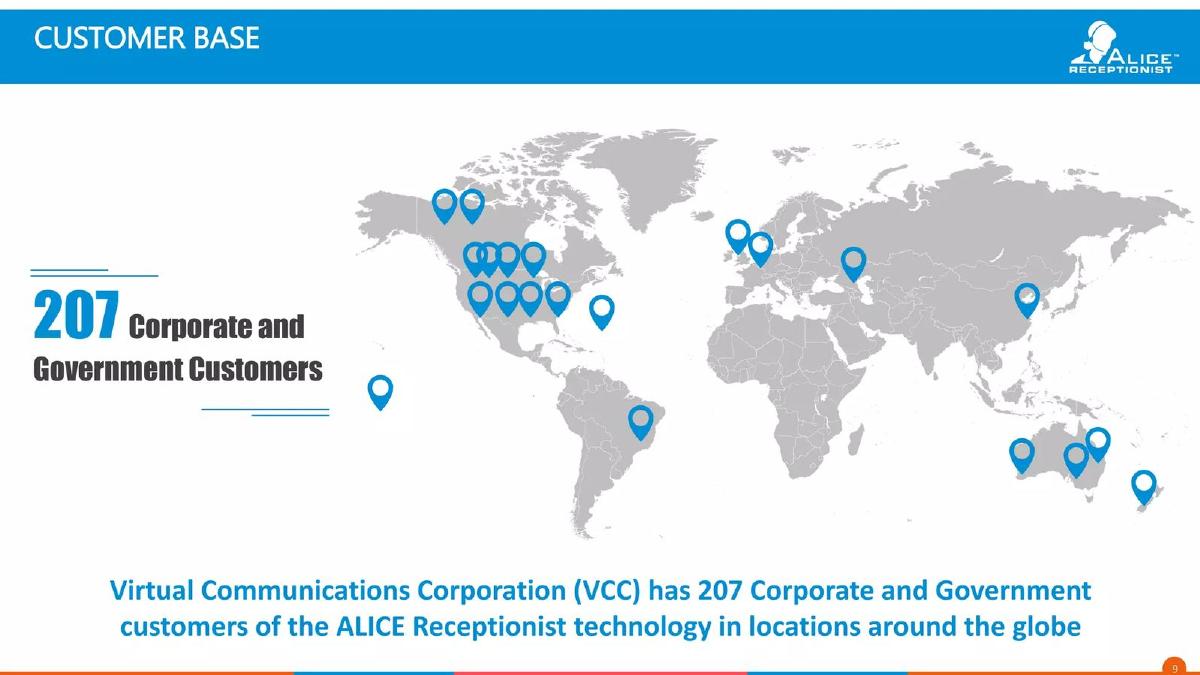
- The product has achieved global reach with 207 corporate and government customers across multiple continents (Slide 9).
- The system features multi-lingual support and can be activated via motion detection or touch (Slide 5).
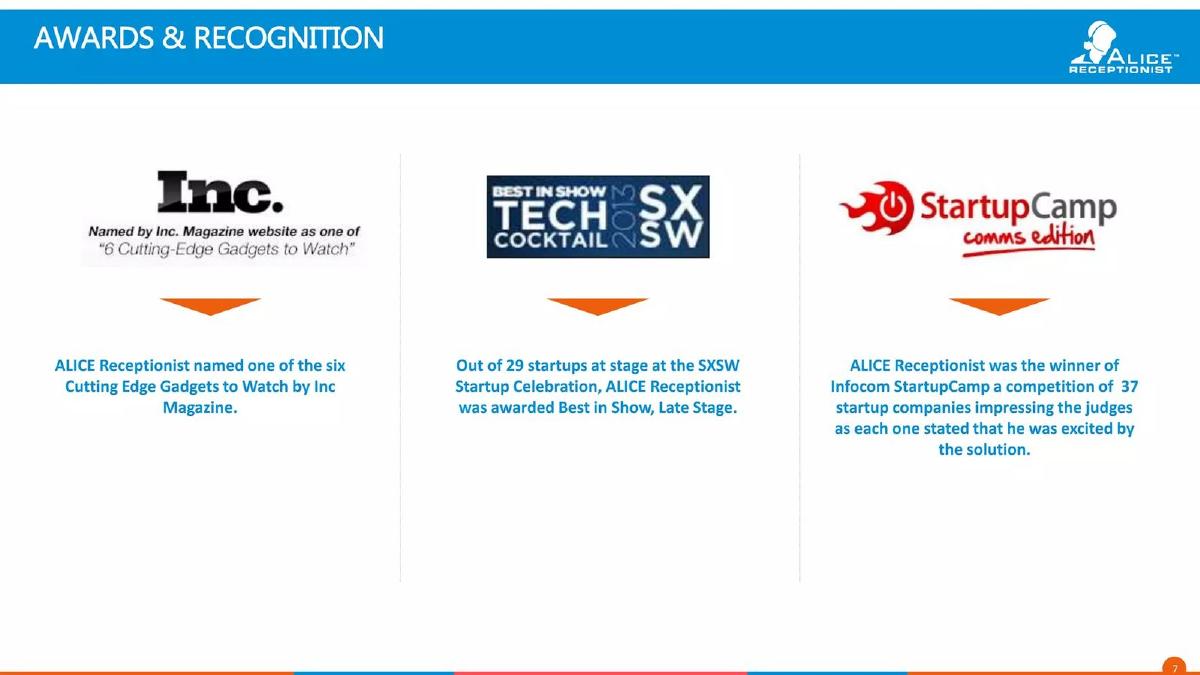
- External validation includes being named one of '6 Cutting-Edge Gadgets to Watch' by Inc. Magazine (Slide 7).
- VCC won 'Best in Show, Late Stage' at the SXSW Startup Celebration out of 29 startups (Slide 7).
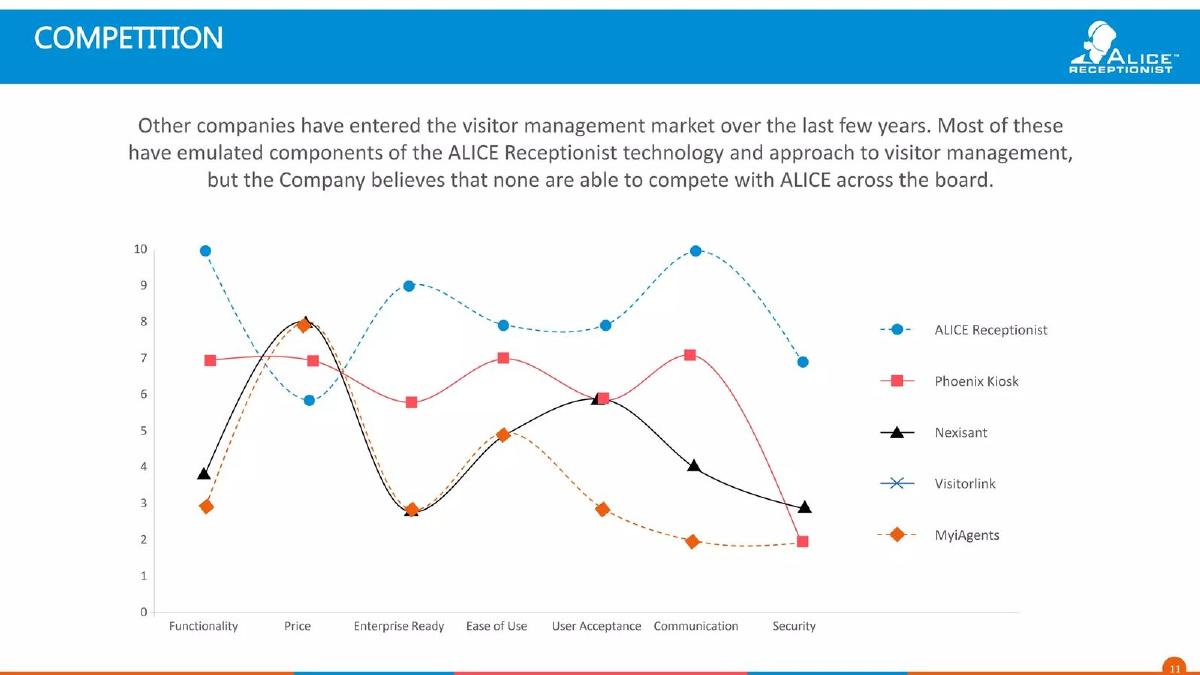
- The competitive analysis claims ALICE outperforms Phoenix Kiosk, Nexisant, Visitorlink, and MyiAgents in functionality and communication (Slide 11).
- Funding is allocated to three specific areas: sales/marketing, development team strengthening, and operational support staff (Slide 13).
Virtual Communication Corporation: The ALICE Receptionist Teardown
Virtual Communication Corporation (VCC) presents a deck focused on its flagship brand, ALICE Receptionist. The company positions itself at the intersection of telepresence and facility security, offering an automated solution for front-desk management. This teardown analyzes the 15-slide deck (8 slides provided) used to solicit a $5 million investment.
Slide 1: Title and Branding
The cover slide features the ALICE Receptionist logo, which includes a silhouette of a woman in a stylized cap, and a high-resolution background image of a modern glass-walled lobby with people in motion. The URL alicereceptionist.com is clearly displayed. The branding is professional and immediately communicates the physical environment where the product operates.
Slide 3: Confidentiality and Legal Disclaimers
Slide 3 is a standard legal disclaimer. It mentions that the presentation includes "forward-looking" statements pursuant to the Private Securities Litigation Reform Act of 1995. Crucially, it notes the presentation was prepared for use in connection with a "Capital transaction for a cash secured Letter of Credit." This suggests a specific financial structure for the raise that differs from a standard equity round.
Slide 5: Product Features and Hardware
This slide defines the physical and functional nature of the product. It lists three hardware platforms: Desktop, wall-mounted, and kiosk . The visuals show various screen sizes and form factors, including a large vertical kiosk and a standard desktop monitor. Key features highlighted include:
Activation via motion detection or touch screen. · Pre-recorded or customized video greetings. · Multi-lingual capabilities. · Two-way video communication between visitors and employees (local or remote). · Functional tasks: enabling entry, generating visitor passes, and giving directions.
Slide 7: Awards & Recognition
VCC uses Slide 7 to establish third-party credibility. It highlights three major accolades:
Inc. Magazine: Named one of the "6 Cutting-Edge Gadgets to Watch." · SXSW 2013: Awarded "Best in Show, Late Stage" out of 29 startups at the Tech Cocktail Startup Celebration. · Infocomm StartupCamp: Winner among 37 startup companies.
This slide serves to de-risk the investment by showing that the technology has been vetted by industry experts and media.
Slide 9: Customer Base and Global Reach
Slide 9 provides a quantitative look at market adoption. It states that VCC has 207 Corporate and Government Customers . A world map shows pins across North America, South America, Europe, Asia, and Australia. The inclusion of "Government" customers is a significant detail, as it implies the product meets the security and procurement standards required for public sector contracts.
Slide 11: Competitive Landscape
The competition slide uses a line graph to compare ALICE Receptionist against four competitors: Phoenix Kiosk, Nexisant, Visitorlink, and MyiAgents . The categories for comparison are Functionality, Price, Enterprise Ready, Ease of Use, User Acceptance, Communication, and Security. ALICE is depicted as the leader in almost every category except Price, where it sits lower on the 0-10 scale, suggesting it is a premium-priced product. This is a standard "we are the best" slide, though it lacks objective data points to support the 0-10 rankings.
Slide 13: Use of Funds
This slide outlines the financial ask. The company is seeking $5,000,000 , to be released in $1,000,000 tranches . The allocation is divided into three pillars:
Sales & Marketing: Implementing campaigns targeting key decision-makers. · Development: Strengthening the team to focus on product install ease, usability, and maintainability. · Operations: Investing in support staff to manage the increased customer base resulting from the sales push.
Slide 15: Contact Information
The final slide does not list the company's founders. Instead, it lists two directors from Merit Harbor Group / OfferBoard Securities : John Illes and Nate Nead. This indicates that the fundraise is being managed by an investment banking or advisory firm rather than the founders directly. Contact details include offices in Henderson, NV, and Tacoma, WA.
What Works in This Deck
The product visualization on Slide 5 is excellent. By showing the different hardware form factors, the company makes a complex software-hardware integration feel tangible. The use of a global map on Slide 9 is also effective; it proves that the product isn't just a local pilot but has successfully navigated international logistics and diverse corporate environments. Furthermore, the awards slide (Slide 7) provides strong social proof, which is vital for a "Late Stage" (as noted in the SXSW award) company looking for a mid-market investment.
What Is Missing
The most glaring omission is a Team Slide . Investors fund people as much as products, and the absence of founder bios or a leadership overview is a significant gap. Additionally, there are no Financials . While the deck mentions 207 customers, it does not state the revenue generated from those customers, the average contract value (ACV), or the margins on the hardware versus the software. The "tranche" structure of the $5M ask also requires more explanation—specifically, what milestones must be hit to trigger the release of each $1M segment. Finally, a Problem Slide is missing from this selection; the deck jumps straight into features without explicitly defining the pain point (e.g., high cost of physical receptionists, security gaps) they are solving.
Founder Takeaways
Quantify your traction: VCC does a good job of stating a specific number of customers (207). Founders should always use hard numbers rather than vague terms like "many" or "growing." Leverage third-party validation: If your startup has won awards or been featured in major press, dedicate a slide to it. It acts as an external audit of your claims. Be transparent about pricing: In the competitive matrix, VCC admits they are not the cheapest option. This is a smart move; it signals that they are a premium enterprise solution rather than a budget tool, which justifies their focus on "Functionality" and "Security."
Frequently asked questions
- What is the core product offered by Virtual Communication Corporation?
- The core product is ALICE Receptionist, a virtual visitor management system. It combines hardware (kiosks, wall mounts, or desktops) with software that allows employees to communicate with visitors via video. The system handles visitor greetings, connection to employees, entry enablement, and visitor pass generation, supporting multi-lingual interactions and motion-activated triggers.
- How much capital is the company raising and what are the terms?
- The company is seeking $5,000,000. Interestingly, the deck specifies that these funds will be released in $1,000,000 tranches. The use of funds is split between sales and marketing, product development (usability and install ease), and hiring additional operations and support staff to manage the projected increase in the customer base.
- What level of market traction does the company demonstrate?
- VCC demonstrates significant traction with 207 corporate and government customers. A map on Slide 9 shows a global distribution, with heavy concentrations in North America and additional installations in Europe, South America, Australia, and Asia. This suggests the product has moved past the pilot phase into international scaling.
- Who are the primary competitors identified in the deck?
- The deck identifies four primary competitors: Phoenix Kiosk, Nexisant, Visitorlink, and MyiAgents. VCC uses a line chart to rank itself against these rivals across seven categories, including functionality, price, and security. Notably, VCC ranks itself lower on price (implying a higher cost) but higher on functionality and communication.
- What critical information is missing from this pitch deck?
- The deck lacks a dedicated 'Team' slide featuring the founders or executive leadership; instead, it only provides contact info for a third-party group, Merit Harbor Group. It also omits specific financial metrics such as annual recurring revenue (ARR), churn rates, customer acquisition costs (CAC), and a detailed breakdown of the product roadmap.