VIOS is a healthtech SaaS startup positioning itself as a solution for rapid, safe doctor-patient engagements. The deck highlights a transition from a '1.0' platform to a '2.0' integration, reporting a base of 170+ registered doctors and 2,400+ patient profiles as of March 2020. The startup emphasizes cost reduction and operational scalability as its primary value drivers. Seeking a $120,000 investment in exchange for 15% equity, the proposal is aimed at pre-seed or angel investors, with funds earmarked for technical upgrades, cybersecurity, and B2B expansion. While the deck provides a clear…
Key takeaways
- The company is seeking a $120,000 investment in exchange for 15% equity, implying an $800,000 post-money valuation (Slide 9).
- Traction data from October 2019 to March 2020 shows 170+ registered doctors and 2,400+ patient profiles (Slide 6).
- A significant portion of the current user base is described as 'dormant,' awaiting the launch of the ViOS 2.0 platform (Slide 6).
- The platform includes specific technical features such as encrypted secure remote login, automated session recording, and mobile financial services (Slide 5).
- Market context points to a 19.4% average annual growth in internet subscriptions since 2012, with a surge in 2020 online healthcare activity (Slide 3).
- The value proposition centers on reducing operational expenses, travel costs, and exposure risks for healthcare providers (Slide 4).
- The investment ask includes non-monetary 'support requirements' such as mentorship, leadership training, and B2B access points (Slide 9).
- The company has established a B2B partnership for telehealth development with an entity named Orbis (Slide 7).
VIOS Pitch Deck Analysis
The VIOS pitch deck is a straightforward, early-stage presentation focused on the burgeoning telehealth sector. It positions the company as a necessary bridge for the healthcare industry to adopt 'startup-like' efficiencies. The deck relies heavily on the timing of the 2020 pandemic to justify the immediate need for its 2.0 platform integration.
Slide 1: Title Slide
The cover slide is minimalist, featuring the company name 'VIOS' and the tagline 'See your Doctor Quickly | Safely | Today.' The imagery of a doctor holding a tablet reinforces the mobile-first, digital nature of the service. It immediately establishes the sector (Healthtech) and the core value proposition (speed and safety).
Slide 2: Key Issues to Impactful Operations
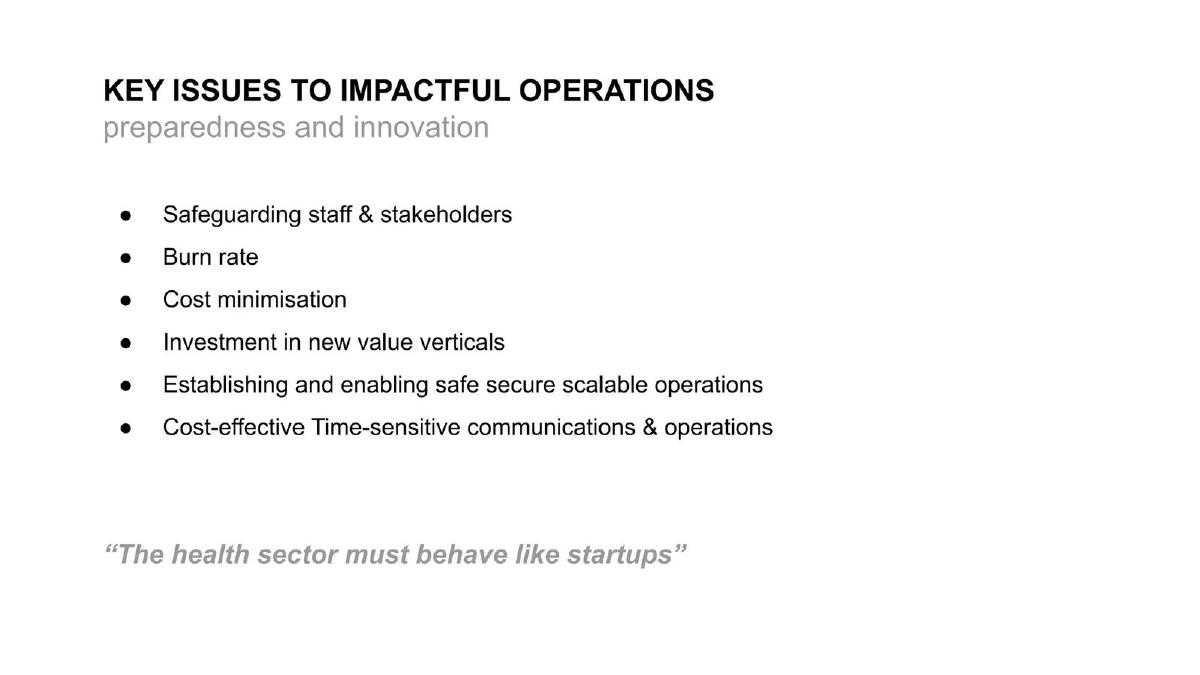
This slide serves as the 'Problem' slide, though it frames issues as operational hurdles. It lists safeguarding staff, burn rate, and cost minimization as primary concerns. The quote at the bottom, 'The health sector must behave like startups,' suggests that VIOS views its role not just as a software provider, but as an operational consultant enabling agility in a traditionally slow-moving industry.
Slide 3: Market Context and Growth
VIOS uses a bar chart to show internet subscription growth, citing a 19.4% average annual growth rate since 2012. The value reaches 87.7 by June 2018. The slide adds a qualitative note that 2020 saw 'triple the growth in online activity,' specifically for healthcare products. This slide attempts to validate the 'Why Now?' by showing that the infrastructure (internet access) and consumer behavior (online searches) have reached a tipping point.
Slide 4: Key Outputs - Telemedicine System
This slide functions as the 'Solution' or 'Value Proposition' slide. It uses a simple 'down arrow' for costs and a 'checkmark' for gains. It claims to decrease operational expenses, travel time, accommodation, exposure risks, and insurance premiums. Conversely, it claims to increase operations expansion, value activities, integrations, R&D, and innovation. It is a high-level summary of the ROI for a healthcare provider using the system.
Slide 5: Technical Capacity
The 'Product' slide lists nine specific features. Notable inclusions are 'Encrypted Secure remote login' and 'Mobile financial services.' The latter is particularly interesting as it suggests VIOS handles the billing or payment aspect of the consultation, which is a significant friction point in telehealth. The mention of 'Attendance tracking' and 'Automated session recording' indicates a focus on compliance and record-keeping.
Slide 6: Current User Traction
This is the most data-dense slide in the deck. It covers the period from October 2019 to March 2020. It reports 170+ registered doctors, with 84 verified and 46 active. It also claims 2,400+ patient profiles and 5-8 daily engagements. However, the footnote is a critical piece of honesty: 'Due to current situation, these users are dormant in vios 1.0 platform waiting for vios 2.0 integration.' This tells an investor that while there is a lead list, the current product is in a state of flux.
Slide 7: B2B Partnership
Slide 7 highlights a partnership between 'ViOS - Orbis' for telehealth development. While it doesn't detail the terms of the partnership, the inclusion of a B2B partner name is intended to provide third-party validation and a potential channel for customer acquisition.
Slide 8: Healthtech Beyond the Pandemic
This slide addresses the long-term viability of the business. It argues that the platform will remain relevant by providing real-time impact data for fundraising, enhanced oversight, and brand retention. It attempts to move the narrative away from a 'pandemic-only' tool to a permanent piece of healthcare infrastructure.
Slide 9: Investment Proposal & Support Requirements
The 'Ask' slide is very specific. VIOS is seeking $120,000 for 15% equity. The list of requirements includes both capital uses (SaaS upgrades, server support, cybersecurity) and 'soft' needs (mentorship, leadership training). This suggests a first-time founder or a very early-stage team looking for an incubator-style relationship rather than just a silent check.
Slide 10: Contact Information
The deck concludes with a contact email and website URL. The branding is consistent with the rest of the deck—clean, white, and professional.
What Works in This Deck
Clear Traction Metrics: Slide 6 provides a transparent breakdown of registered vs. active doctors. The honesty regarding the 'dormant' status of users due to the 2.0 integration builds trust with potential investors. · Specific Technical List: Slide 5 avoids vague buzzwords and lists actual features like 'Mobile financial services' and 'Attendance tracking,' which helps an investor understand the product's scope. · Reasonable Ask: The $120,000 ask is modest and aligned with the reported traction and the 'support requirements' listed. It doesn't overreach for a pre-seed round.
What is Missing
Team Slide: In the provided 10-slide sample, there is no information about the founders' backgrounds. In a pre-seed round, the team is often the most important factor. · Competitor Analysis: The telehealth space is crowded. The deck does not explain how VIOS differentiates itself from major players or local competitors. · Business Model: While 'Mobile financial services' are mentioned, the deck does not explicitly state how VIOS makes money (e.g., per-consultation fee, monthly SaaS subscription, or a percentage of billings). · Unit Economics: There is no mention of Customer Acquisition Cost (CAC) or Lifetime Value (LTV), which are standard for a SaaS teardown.
What a Founder Should Copy
The 'Key Outputs' Format: Slide 4 is an excellent way to visually represent the dual benefit of cost reduction and value creation. It is easy to read and digest in seconds. · The Traction Footnote: If your product is undergoing a major pivot or upgrade that has caused a temporary dip in activity, be upfront about it like VIOS is on Slide 6. Investors will find it anyway during due diligence. · Combining Capital and Mentorship: If you are a first-time founder, explicitly asking for 'Leadership training' and 'Mentorship' as VIOS does on Slide 9 can attract the right kind of 'smart money' investors who enjoy a hands-on approach.
Frequently asked questions
- What is the current valuation of VIOS based on this deck?
- Based on Slide 9, VIOS is asking for $120,000 in exchange for 15% equity. This calculation suggests a pre-money valuation of approximately $680,000 and a post-money valuation of $800,000. This is a typical range for a pre-seed startup with early traction but a product still in the integration phase.
- How many active users does the platform currently have?
- According to Slide 6, the platform has 170+ registered doctors, but only 46 are listed as 'Active Doctor profiles.' Additionally, there are 2,400+ patient profiles. However, a footnote indicates these users are currently dormant while waiting for the ViOS 2.0 integration, suggesting the platform is in a transition period.
- What specific problems does VIOS aim to solve for doctors?
- Slide 4 and Slide 8 outline the core benefits: reducing operational expenses, travel time, and exposure risks. It also aims to help healthcare providers manage 'burn rate' and establish 'safe secure scalable operations.' The goal is to make the health sector behave more like a startup in terms of efficiency.
- What technical capabilities are built into the VIOS platform?
- Slide 5 lists several 'Technical Capacity' features including end-to-end user profile generation, encrypted login, on-demand video call initiation, attendance tracking, automated session recording, a data cloud link, text functions for prescriptions, and mobile financial services.
- What are the primary uses of the requested $120,000 investment?
- Slide 9 specifies that the funds and support will be directed toward SaaS upgrades, high-fidelity server support, cybersecurity infrastructure, and co-branding campaigns. The founders also explicitly request mentorship and leadership training as part of the investment package.