Village Defense raised $475,000 in 2011 with a deck that leans heavily on visual storytelling and emotional resonance. Positioned as a crowdsourced safety network, the deck uses a 'show, don't tell' approach to illustrate the inefficiency of existing communication tools like email and Facebook for urgent neighborhood safety. While the deck excels at demonstrating product-market fit through rapid neighborhood adoption—growing to 3,500 neighborhoods by October—it is notably silent on business model specifics, unit economics, and competitive landscape analysis. The presentation focuses on the 'V…
Key takeaways
- The deck highlights a significant growth trajectory, reaching 3,500 neighborhoods and 300+ cities by October (Slide 13).
- A specific case study in Atlanta claims a 70% reduction in home burglaries, providing strong impact validation (Slide 16).
- The founders use Slide 5 to critique existing tools, implying that Gmail and Facebook are inadequate for real-time safety coordination.
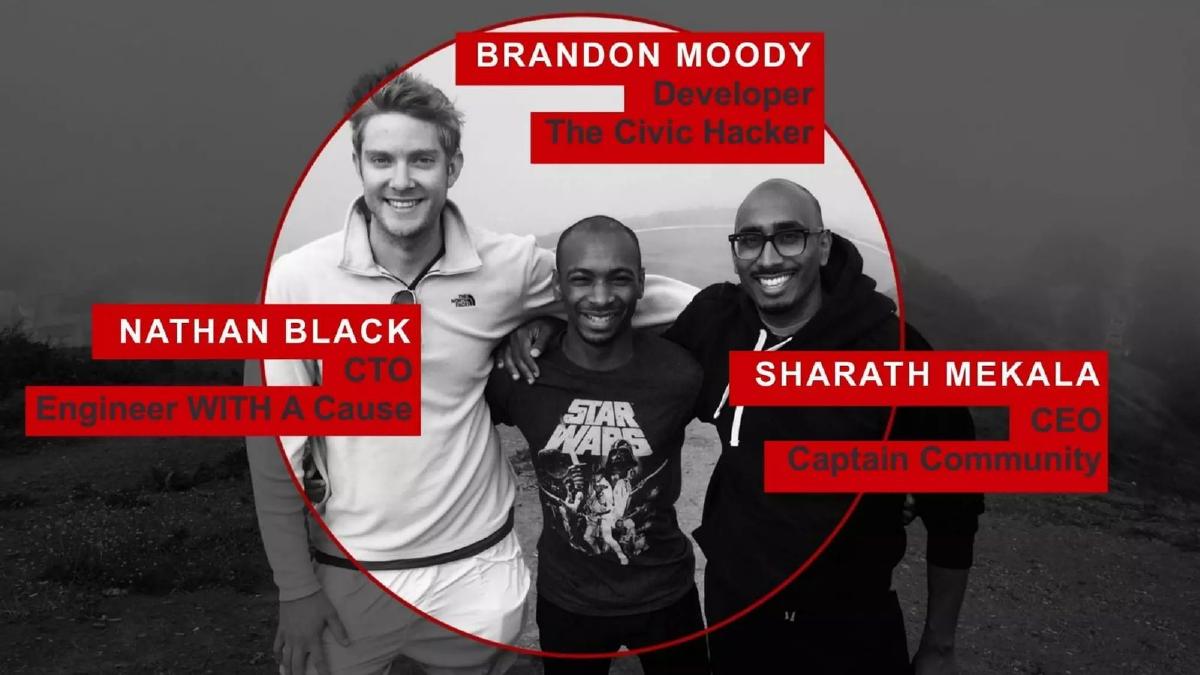
- The team slide emphasizes 'civic' and 'community' DNA, positioning the founders as mission-driven rather than purely profit-motivated (Slide 3).
- Rapid adoption is demonstrated by the Oakland metric, where the service reached 85% of a neighborhood in 4 hours (Slide 15).
- The deck lacks a formal 'Ask' slide, omitting the specific funding amount or intended use of proceeds.
- There is no mention of revenue streams, pricing models, or long-term monetization strategies within the 16 slides.
- The 'Waze for crime' analogy is explicitly visualized to simplify the value proposition for investors (Slide 17).
The Visual Narrative of Community Safety
The Village Defense pitch deck from 2011 is a study in minimalist, high-impact visual storytelling. At a time when the 'sharing economy' and 'crowdsourcing' were becoming dominant investment themes, this deck attempted to apply those principles to the public safety sector. The deck consists of 16 slides that focus almost entirely on the emotional weight of the problem and the viral nature of the solution, largely ignoring the traditional 'business' slides one might expect in a Seed round.
Introduction and Team
Slide 1: Title Slide The deck opens with the company logo over a dark map background. The tagline 'OUTSMARTING CRIME, TOGETHER' immediately establishes the collaborative nature of the platform.
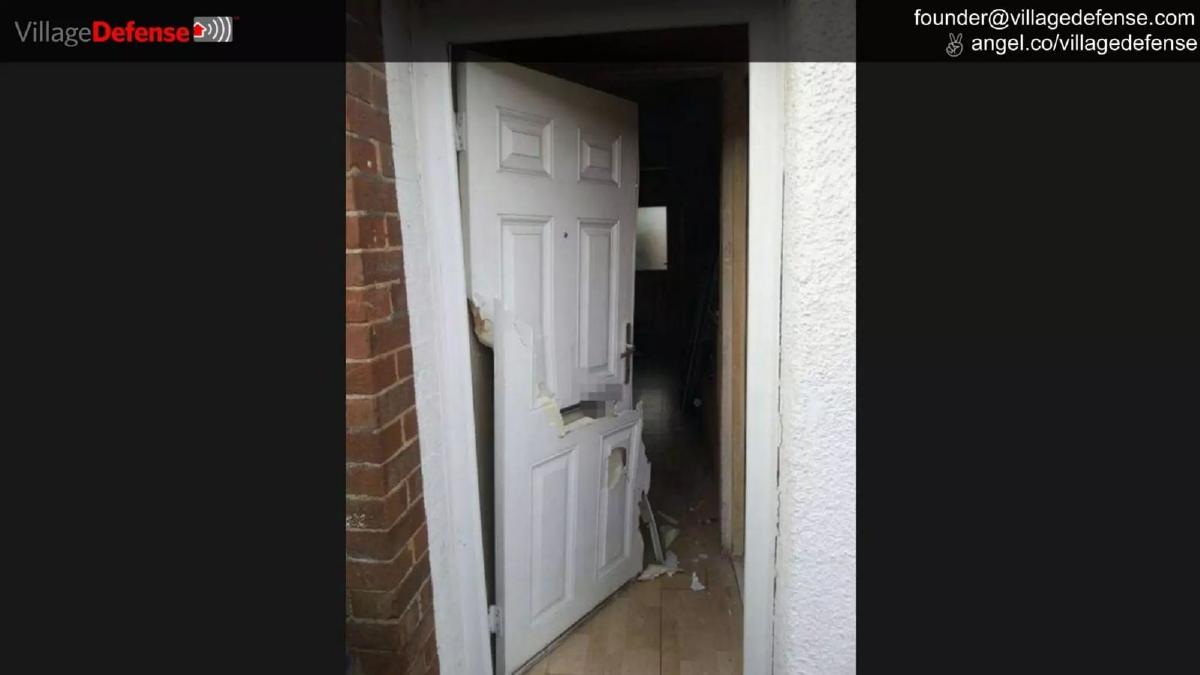
Slide 2: The Hook A full-bleed image of a kicked-in white door. There is no text on this slide other than the company email and AngelList URL in the header. This is a classic 'visceral' opening designed to trigger an emotional response regarding home security.
Slide 3: The Team The founders are presented in a casual, outdoor photo. Sharath Mekala (CEO), Nathan Black (CTO), and Brandon Moody (Developer) are given titles that emphasize their mission: 'Captain Community,' 'Engineer WITH A Cause,' and 'The Civic Hacker.' This suggests a team that views themselves as social entrepreneurs rather than just software developers.
The Problem with Current Tools
Slide 4: The Status Quo A simple slide showing the icons for Gmail, Facebook, and a generic house icon. This sets up the argument that follows.
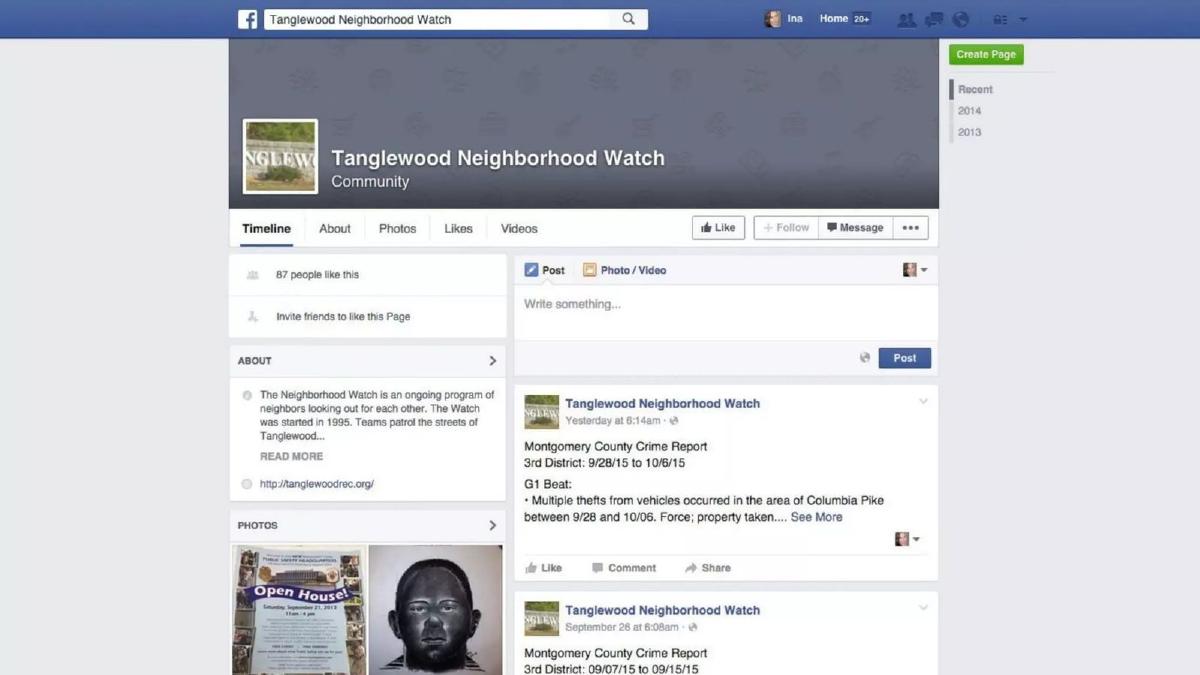
Slide 5: The Inefficiency of Social Media A screenshot of a 'Tanglewood Neighborhood Watch' Facebook page. The content shows a crime report that is several days old. The implication is that by the time a neighbor posts on Facebook and others see it, the criminal is long gone. The deck argues that social media is a record of the past, not a tool for the present.
The Village Defense Solution
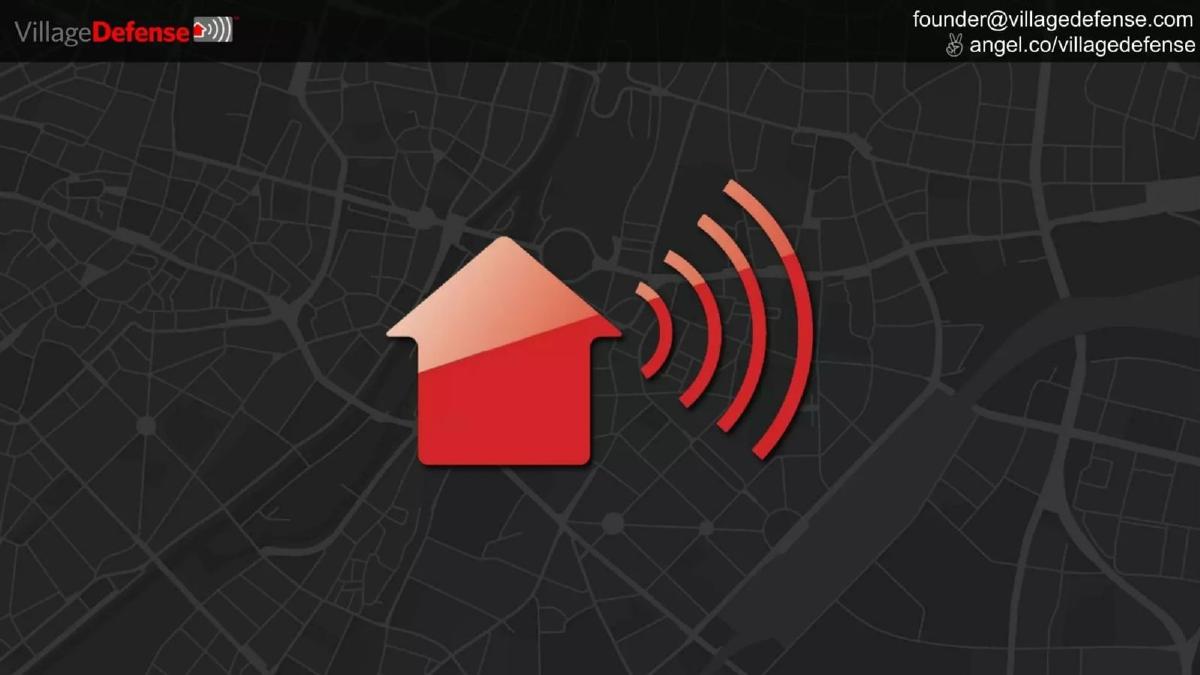
Slide 6: The Signal A red house icon emitting signal waves over a map. This represents the core technology: a localized broadcast system.
Slide 7: The Threat Another high-tension image, this time of a burglar in a balaclava using a crowbar on a window. Like Slide 2, this reinforces the 'why' behind the app.
Slide 8: The Interface The first look at the mobile app. The UI is dark with red accents, featuring four main buttons: Send Alerts, Group Chat, Map, and Profile. It is a simple, utility-focused design.
Slide 9: The Broadcast Mechanism A visualization of a red dot (the user) sending a signal that covers a specific radius on a map. This illustrates the 'hyper-local' nature of the alerts.
Slide 10: The Network Effect The same map, but now populated with dozens of red dots within the signal radius. This represents the 'Village Defenders'—the neighbors who receive the alert and can take action.
Slide 11: Real-Time Communication Three smartphone mockups showing the 'Group Chat' feature. The text in the chats includes neighbors reporting 'a loud bang' and 'dogs barking like crazy.' One user, Bruce Wauer, notes, 'This is where this app comes in super handy.' This slide serves as both a product demo and a source of anecdotal social proof.
Traction and Impact
Slide 12: Growth Metrics A line graph showing a sharp upward trend from July to October. The slide lists '3500 Neighborhoods,' '300+ Cities,' and '30 New Neighborhoods Per Day.' This is the strongest slide in the deck for a Seed investor, as it demonstrates significant organic or low-cost acquisition.
Slide 13: The Persona Silhouettes of 'superhero' neighbors. The text reads, 'AND WE COULDN’T DO IT WITHOUT OUR VILLAGE DEFENDERS.' This emphasizes that the value of the platform is the network, not just the code.
Slide 14: Oakland Case Study A metric-heavy slide stating '85% of neighborhood in 4 hours.' This demonstrates the viral potential of the product when a community feels an immediate need for safety.
Slide 15: Atlanta Case Study A claim of '70% home burglary reduction' in Atlanta. While the methodology for this statistic isn't provided, it serves as a powerful 'North Star' metric for the company’s social impact.
Slide 16: The Analogy The final content slide compares Waze ('Crowdsourcing to help beat Traffic') with Village Defense ('Crowdsourcing to help beat Crime'). This 'X for Y' analogy is a standard pitch deck technique to help investors quickly categorize the business model.
Slide 17: Closing A repeat of the title slide with contact information.
What Works in This Deck
Emotional Urgency: The use of high-quality, dramatic imagery (the broken door, the burglar) creates a sense of necessity. It moves the product from a 'nice-to-have' social app to a 'must-have' safety tool.
Clear Analogy: Comparing themselves to Waze is highly effective. In 2011, Waze was a rising star in the mobile space, and the comparison immediately explains the utility, the crowdsourced data model, and the potential for a large-scale exit.
Localized Traction: The Oakland and Atlanta slides provide concrete examples of how the app performs in the real world. Showing 85% penetration in 4 hours is a powerful indicator of a high K-factor (virality).
What Is Missing
The Business Model: There is zero mention of how Village Defense makes money. Are they selling to HOAs? Is it a freemium model? Do they sell data to insurance companies? For a Seed round, investors usually expect at least a slide on the intended revenue streams.
The Ask: The deck ends without asking for a specific amount of money. While this might have been handled in a verbal presentation, a standalone deck should typically include the funding target and a brief breakdown of how those funds will be allocated (e.g., 50% engineering, 30% marketing).
Competitive Landscape: The deck ignores competitors like Nextdoor (founded in 2008) or traditional alarm companies like ADT. Investors need to know how Village Defense defends its 'village' from larger, better-funded incumbents.
What a Founder Should Copy
The 'Anti-Solution' Slide: Slide 5, which shows the failure of Facebook for real-time safety, is excellent. Founders should always show why the current 'good enough' solution is actually failing the user. It justifies the existence of a new, dedicated platform.
Simplicity of Product Demo: Instead of a 10-slide walkthrough of every feature, Village Defense uses three screens to show the one thing that matters: neighbors talking to each other during a crisis. Keep your product slides focused on the 'magic moment.'
Impact Metrics: If your startup has a social component, find a way to quantify it. The '70% burglary reduction' is the most memorable stat in the deck. Even if it is a small sample size, it gives investors a reason to believe in the mission.
Final Analysis
Village Defense successfully raised $475,000 with this deck because it captured the zeitgeist of 2011: mobile, social, and crowdsourced. The deck is light on business fundamentals but heavy on 'proof of concept' and growth. It relies on the assumption that if you build a massive, engaged network of people protecting their homes, the monetization will follow. For a Seed stage company, this 'traction-first' approach is often enough to secure initial capital, provided the growth numbers are as compelling as the ones shown on Slide 13.
Frequently asked questions
- What is the core problem Village Defense aims to solve?
- The deck identifies that while the world is increasingly connected, safety remains a 'solo effort.' It suggests that current communication methods like email and Facebook groups (Slide 5 and 6) are too slow or disorganized to handle real-time crime alerts. By showing a broken door (Slide 2) and a burglar (Slide 8), the deck frames the problem as an urgent, physical threat that requires immediate, localized community response.
- How does the product actually work based on the slides?
- The product is a mobile application that allows users to 'Send Alerts,' engage in 'Group Chat,' and view a 'Map' of incidents (Slide 9). When a user sends an alert, it broadcasts to a radius of neighbors (Slide 10 and 11). The group chat feature (Slide 12) enables neighbors to share specific details, such as descriptions of suspicious activity or confirming police involvement, creating a real-time feedback loop.
- What evidence of traction does the company provide?
- Village Defense provides three main traction data points. First, a growth chart (Slide 13) shows an increase from roughly 1,000 neighborhoods in July to 3,500 by October, with a rate of 30 new neighborhoods per day. Second, they cite a viral adoption rate in Oakland, hitting 85% neighborhood penetration in 4 hours (Slide 15). Third, they claim a 70% burglary reduction in Atlanta (Slide 16).
- Who are the founders and what is their background?
- The team consists of three core members: Sharath Mekala (CEO), described as 'Captain Community'; Nathan Black (CTO), described as an 'Engineer WITH A Cause'; and Brandon Moody (Developer), labeled 'The Civic Hacker' (Slide 3). The descriptions focus on their identity as community builders and civic-minded technologists rather than listing previous corporate roles or exits.
- What is missing from this pitch deck?
- The deck is missing several standard venture components. There is no financial slide detailing revenue or burn rate. There is no competitive analysis comparing them to services like Nextdoor or traditional security systems. Most importantly, there is no 'Ask' slide; the $475,000 raise is known from catalogue data, but the deck itself does not state how much capital is being sought or how it will be spent.