Vidrovr’s demo day deck presents a compelling case for the automation of video metadata, targeting large-scale media organizations. The presentation relies heavily on the technical pedigree of its founders and the patented nature of its technology, which originated at Columbia University. By identifying a specific pain point—a single media company paying $360,000 per month for manual metadata services—Vidrovr establishes a clear value proposition. However, the deck is structurally incomplete in this version, lacking a detailed team slide, a specific financial ask, or a competitive landscape a…
Key takeaways
- The company targets a massive U.S. digital video audience of 217 million viewers, representing 78.4% of internet users (Slide 2).
- Vidrovr identifies a significant market inefficiency where companies struggle to search and leverage their extensive video archives (Slide 3).
- A specific customer case study reveals a media company paying $360,000 monthly for manual metadata generation (Slide 7).
- The technology is backed by patents from Columbia University, providing a defensive intellectual property moat (Slide 6).
- The 'News Rover' pipeline is capable of processing 100 hours of video per day across 12 simultaneous channels (Slide 6).
- Technical capabilities include event detection, visual speaker detection, and cross-media story linking (Slide 6).
- The company has earned industry recognition, including 1st Place Grand Prize at ACM MM and 2nd place at the NYC Media Lab Annual Summit (Slide 6).
- The deck includes placeholder slides for 'Competitors & Partners' and 'Team,' but provides no data on these topics in the current sequence (Slides 8 and 9).
Introduction and Brand Identity
Slide 1: Title Slide
The deck opens with a clean, minimalist title slide featuring the Vidrovr logo—a stylized diamond shape composed of four nodes connected by lines. Below the company name, the Columbia University logo and the text 'IN THE CITY OF NEW YORK' are prominently displayed. This immediately establishes the company’s academic pedigree and geographic location, signaling that the venture is likely a product of university research or a formal spin-off.
The Macro Market Context
Slide 2: Videos Today
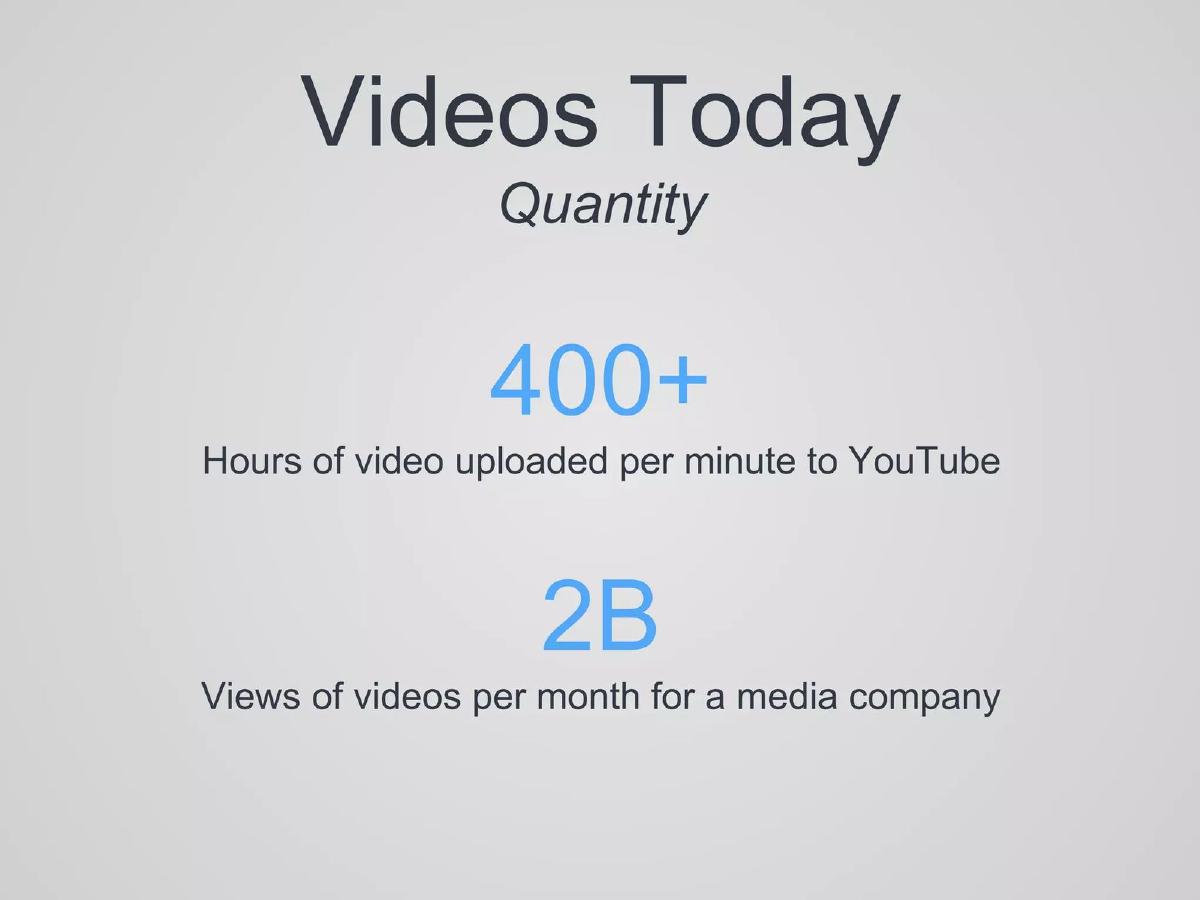
Slide 2 provides the macro-economic justification for the business. It cites two key metrics: 217 million U.S. viewers of digital video and the fact that 78.4% of internet users watch video. By starting with these broad figures, the founders are attempting to demonstrate the sheer scale of the medium they are targeting. However, these are consumer-facing metrics, while the subsequent slides suggest a B2B enterprise focus, creating a slight disconnect between the audience size and the actual customer base.
Problem Identification
Slide 3: The Content Paradox
This slide introduces the core tension of the pitch. It states that 'Companies are sitting on a gold mine of video content...' but follows with the caveat that 'video content is REALLY hard to search and leverage.' The use of underlining and color emphasis on 'search' and 'leverage' points to the specific functional gaps Vidrovr intends to fill. It frames video not just as media, but as an underutilized asset class.
Slide 4: Target Customer Logos
Slide 4 is a 'logo cloud' featuring major media and telecommunications entities. Included are AP (Associated Press), The New York Times, Vice, Hearst, A+E Networks, MTV, VH1, Viacom, Verizon, AT&T, and Vonage. The inclusion of these logos serves to define the target market—high-volume content producers and distributors—rather than necessarily claiming them all as current customers, though the context of a demo day often implies these are the types of organizations the founders have interviewed or piloted with.
Slide 5: Customer Validation
To reinforce the problem, Slide 5 provides a direct quote from a 'Video Management, News Company.' The quote reads: 'We’ve tried a lot of services, but we haven’t been able to find a CMS that allows us to quickly find and use our video clips.' This slide is critical because it moves the problem from a theoretical 'hard to search' claim to a specific operational pain point: the failure of existing Content Management Systems to handle video metadata effectively.
The Technical Solution
Slide 6: News Rover and Technical Validation
This is the most information-dense slide in the deck. It describes 'News Rover,' which appears to be the internal name for the product or the underlying technology stack. The slide is divided into three functional blocks: Server Pipeline (handling 100 hours of video per day and 12 simultaneous channels), ML + CV (Machine Learning and Computer Vision capabilities like speaker detection and story linking), and APIs/Front end . Crucially, a footer note states the technology is 'Patented by Columbia.' The right side of the slide lists impressive technical accolades, including a 1st Place Grand Prize at ACM MM and recognition from the NYC Media Lab. This slide serves as the 'Proof of Product' and 'Defensibility' section of the deck.
Market Opportunity and Economics
Slide 7: Metadata Generation Economics
Slide 7 provides a rare glimpse into the unit economics of the problem. It notes that a manual metadata generation service is 'currently being paid by a media company' at a rate of $360,000 per month. The founders then project this across 50 potential contracts to arrive at a $216 million annual market. This is a classic 'bottom-up' market sizing exercise. It successfully quantifies the cost of the status quo, making the ROI of an automated solution like Vidrovr immediately apparent to an investor.
Missing Content and Placeholders
Slide 8: Competitors & Partners
This slide contains only the header 'Competitors & Partners.' In a full pitch, this would typically include a 2x2 matrix or a feature comparison table. Its absence in this sequence leaves the reader wondering how Vidrovr differentiates itself from existing video AI players or legacy DAM (Digital Asset Management) providers.
Slide 9: Team
Similar to the previous slide, this is a placeholder with only the word 'Team.' For a university spin-out, the team slide is arguably the most important, as it validates the technical expertise required to build the ML and CV models described on Slide 6. The omission of founder bios, academic credentials, and previous industry experience is a significant gap in this version of the deck.
Analysis of What Works
Specific Pain Point Quantification: The strongest element of this deck is Slide 7. By identifying a specific, high-dollar manual cost ($360k/month), the founders move beyond vague promises of 'efficiency' and provide a concrete financial target. This makes the business case much more tangible for venture capitalists who look for high-margin automation opportunities.
Technical Pedigree: The association with Columbia University and the mention of specific patents (Slide 6) provide immediate credibility. In the crowded field of 'AI for video,' having a patented pipeline and winning grand prizes at academic conferences like ACM MM serves as a powerful filter for quality.
Clear Use Case: The deck does not try to be everything to everyone. By focusing on 'News Rover' and quoting news companies, Vidrovr identifies a specific vertical—broadcast and digital news—where the volume of video is high and the need for speed is critical. This 'wedge' strategy is often more successful than a generic horizontal play.
What Is Missing
The Business Model: While the deck shows what customers are currently paying for manual labor, it does not explain how Vidrovr intends to charge. Is it a SaaS subscription, a per-hour processing fee, or an enterprise license? Without this, the path to the $216M market remains unclear.
Competitive Landscape: The placeholder on Slide 8 is a missed opportunity. The video intelligence space is highly competitive, with offerings from major cloud providers (AWS Rekognition, Google Video AI) and specialized startups. A teardown of this deck reveals a lack of positioning against these giants.
The Ask: There is no slide in this sequence detailing the funding requirements. A standard pitch deck should conclude with the amount of capital being raised, the milestones that capital will enable, and the current runway. This deck feels more like a technical demo presentation than a complete investment vehicle.
Founder Takeaways
Lead with the 'Manual Cost': If you are building an automation tool, find the most expensive manual process your target customer currently performs and put that number in large font. Vidrovr’s use of the $360,000/month figure is a masterclass in establishing value early.
Leverage Institutional Credibility: If your tech comes from a lab or has won awards, don't hide it. The 'Patented by Columbia' note is a small detail that carries massive weight in due diligence, as it suggests a barrier to entry for competitors.
Bridge the Gap Between Tech and Product: Slide 6 does a good job of explaining the 'how' (ML + CV) and the 'what' (News Rover). Founders should ensure their technical slides always link back to a specific business outcome—in this case, 'Story linking' and 'Event detection' directly solve the search problem mentioned on Slide 5.
Frequently asked questions
- What is the primary problem Vidrovr is solving?
- Vidrovr addresses the difficulty of searching and leveraging large volumes of video content. According to Slide 3, companies possess a 'gold mine' of video that is currently hard to navigate. Slide 5 quotes a news company stating they cannot find a Content Management System (CMS) that allows them to quickly find and use their video clips, highlighting a gap in existing enterprise tools.
- How does Vidrovr validate its market opportunity?
- The deck uses a bottom-up market validation approach on Slide 7. It cites a real-world example of a media company paying $360,000 per month for manual metadata generation. By extrapolating this across approximately 50 similar contracts, Vidrovr estimates a $216 million annual market opportunity for automating this specific manual service.
- What technical capabilities does the Vidrovr platform offer?
- As detailed on Slide 6, the 'News Rover' system includes a server pipeline for analog or digital ingestion, Machine Learning (ML), and Computer Vision (CV). Specific features include event detection, visual speaker detection, cross-media analysis, and story linking. The system is designed to handle high-volume throughput, specifically 100 hours of video daily.
- What is the relationship between Vidrovr and Columbia University?
- Vidrovr appears to be a spin-out or heavily influenced by research from Columbia University. The title slide (Slide 1) features the Columbia University logo prominently, and Slide 6 explicitly states that the technology is 'Patented by Columbia.' This suggests a formal technology transfer or licensing agreement is in place.
- What crucial information is missing from this pitch deck?
- This version of the deck is missing several standard components. While there are header slides for 'Competitors & Partners' (Slide 8) and 'Team' (Slide 9), the content for these sections is absent. Additionally, there is no slide detailing the business model, the specific amount of capital being raised, or the projected financial growth of the company.