Vic.ai’s deck is a masterclass in establishing a 'data moat' as a primary competitive advantage. By highlighting an unusual partnership that granted them access to cloud accounting data for 40,000 companies and over 200 million financial documents, the company shifts the conversation from simple software-as-a-service to a proprietary intelligence play. The deck identifies Accounts Payable as a specific beachhead within a massive $200 billion US accounting market. While the deck lacks a formal team slide and specific financial projections, it relies on high-level traction signals—such as servi…
Key takeaways
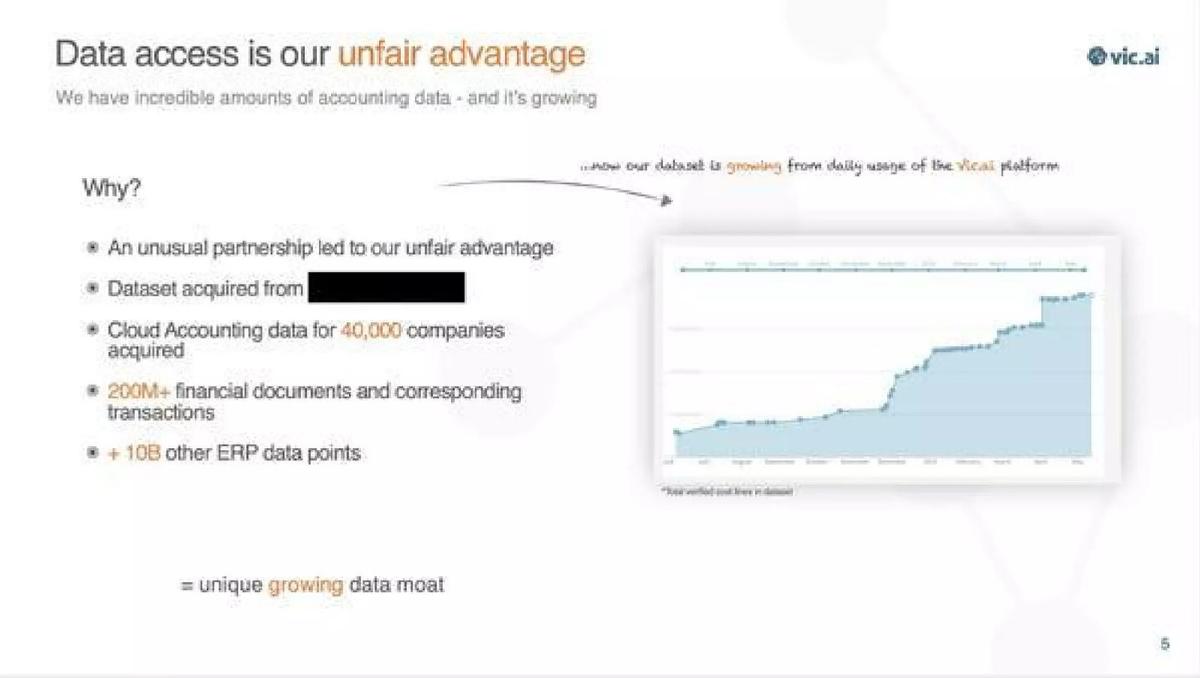
- The company claims a massive data moat consisting of 200M+ financial documents and 10B+ ERP data points on slide 5.
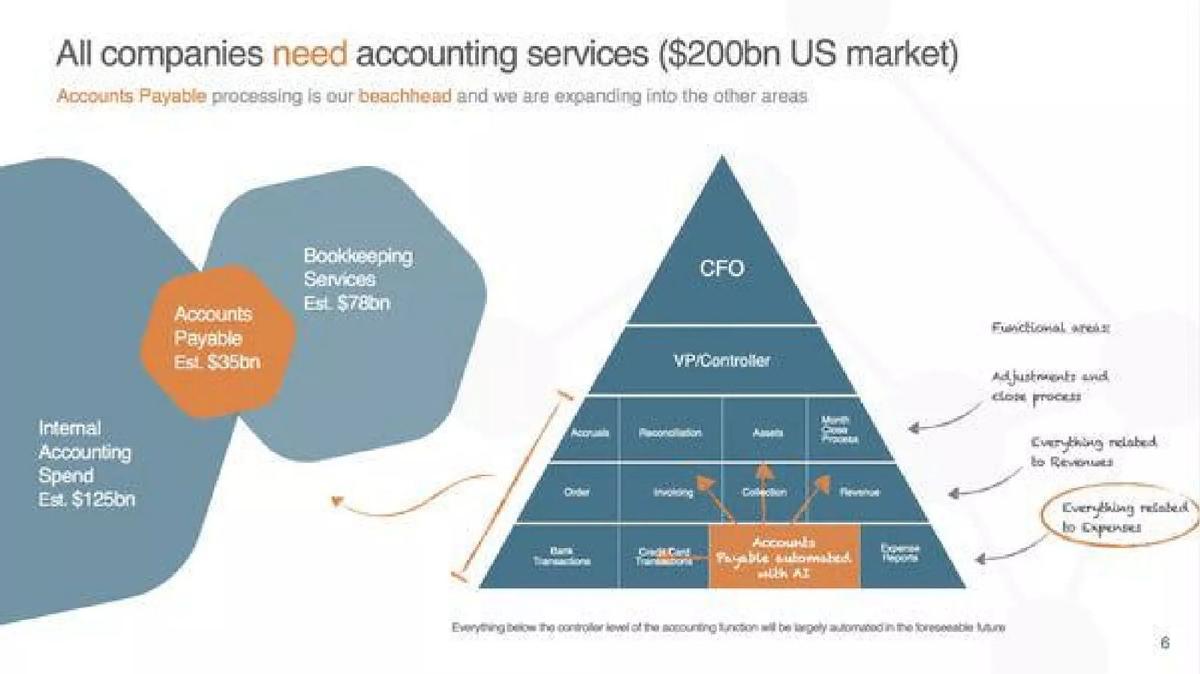
- Vic.ai identifies its primary beachhead as Accounts Payable automation, valued at an estimated $35bn on slide 4.
- The deck asserts that 4 of the top 10 accounting firms are already using the platform, indicating early product-market fit on slide 2.
- The platform integrates with major accounting systems including Intacct, NetSuite, and QuickBooks Online as shown on slide 8.
- A 'perpetual learning loop' is presented as the core mechanism for deepening their competitive moat over time on slide 9.
- The total addressable market is framed broadly, including a $1 trillion B2B payments opportunity on slide 10.
- The deck omits a dedicated team slide, though slide 2 mentions 'Experienced founders with multiple previous exits.'
- There is no specific 'Ask' or use of funds slide included in this 10-slide sequence.
The Strategic Positioning of Autonomous Accounting
Vic.ai entered the market at a time when 'AI' was often used as a buzzword without substance. This deck, used for their Series A, attempts to ground that buzz in a massive, proprietary dataset. The narrative is simple: accounting is moving from manual to autonomous, and the winner will be the one with the most data. By securing $62.7M in total funding since its inception, the company has clearly convinced investors of this 'data moat' thesis.
Slide 1: Title and Positioning
The cover slide is minimalist, featuring the logo and a clear sub-headline: 'The AI platform for Accounting Firms & Enterprise Finance Departments.' It identifies the round as Series A. The branding is consistent with the orange and blue color palette used throughout the deck. The use of a network-style icon inside a hexagon hints at the 'intelligence' and 'connectivity' themes that follow.
Slide 2: High-level Summary
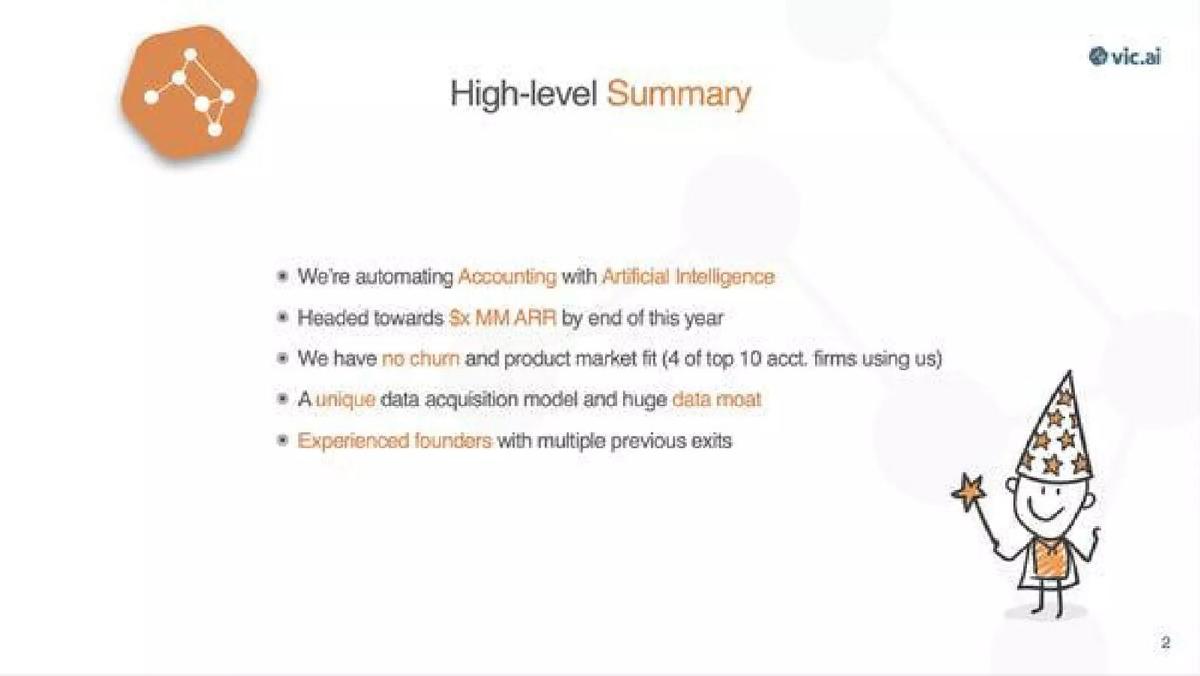
Slide 2 serves as an executive summary. It lists five key pillars: automating accounting with AI, a target for '$x MM ARR by end of this year' (the specific figure is redacted), a claim of 'no churn,' and the fact that '4 of top 10 acct. firms' are users. It also mentions the 'unique data acquisition model' and 'experienced founders.' Interestingly, it introduces a hand-drawn 'wizard' character, which adds a touch of personality to an otherwise dry subject matter, though it contrasts slightly with the professional enterprise tone.
Slide 3: The Era of Intelligent Accounting
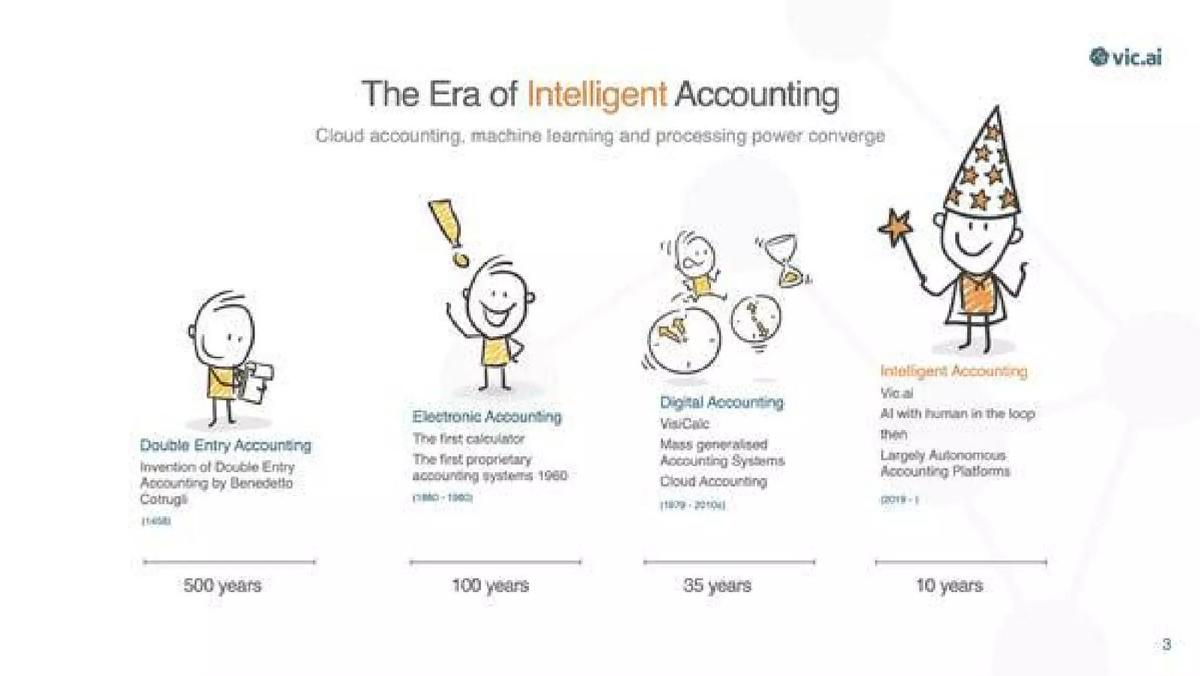
This slide provides historical context, mapping the evolution of accounting over 500 years. It starts with Double Entry Accounting (1458), moves to Electronic Accounting (1960s), then Digital/Cloud Accounting (1979-2010s), and finally 'Intelligent Accounting' (2019+). Vic.ai positions itself in this final category, moving from 'AI with human in the loop' to 'Largely Autonomous Accounting Platforms.' This timeline creates a sense of inevitability—investors are being invited to fund the next logical step in a 500-year evolution.
Slide 4: Market Opportunity and Beachhead
Slide 4 quantifies the opportunity. It cites a '$200bn US market' for accounting services. The slide uses a pyramid graphic to show the hierarchy of a finance department, from the CFO down to transaction levels. Vic.ai identifies 'Accounts Payable automated with AI' as its beachhead, estimated at '$35bn.' The slide notes that internal accounting spend is '$125bn' and bookkeeping services are '$78bn.' The arrows indicate an expansion strategy from AP into accruals, reconciliation, assets, and revenue.
Slide 5: The Data Moat
This is arguably the most important slide in the deck. It explicitly labels data access as an 'unfair advantage.' The company claims to have acquired a dataset from an 'unusual partnership' (the partner name is redacted). The stats are impressive: 'Cloud Accounting data for 40,000 companies,' '200M+ financial documents,' and '+ 10B other ERP data points.' A growth chart on the right shows the dataset expanding over time. In the world of machine learning, the quality and quantity of training data are the primary barriers to entry, and Vic.ai uses this slide to prove they have already cleared that hurdle.
Slide 6: Target Customers
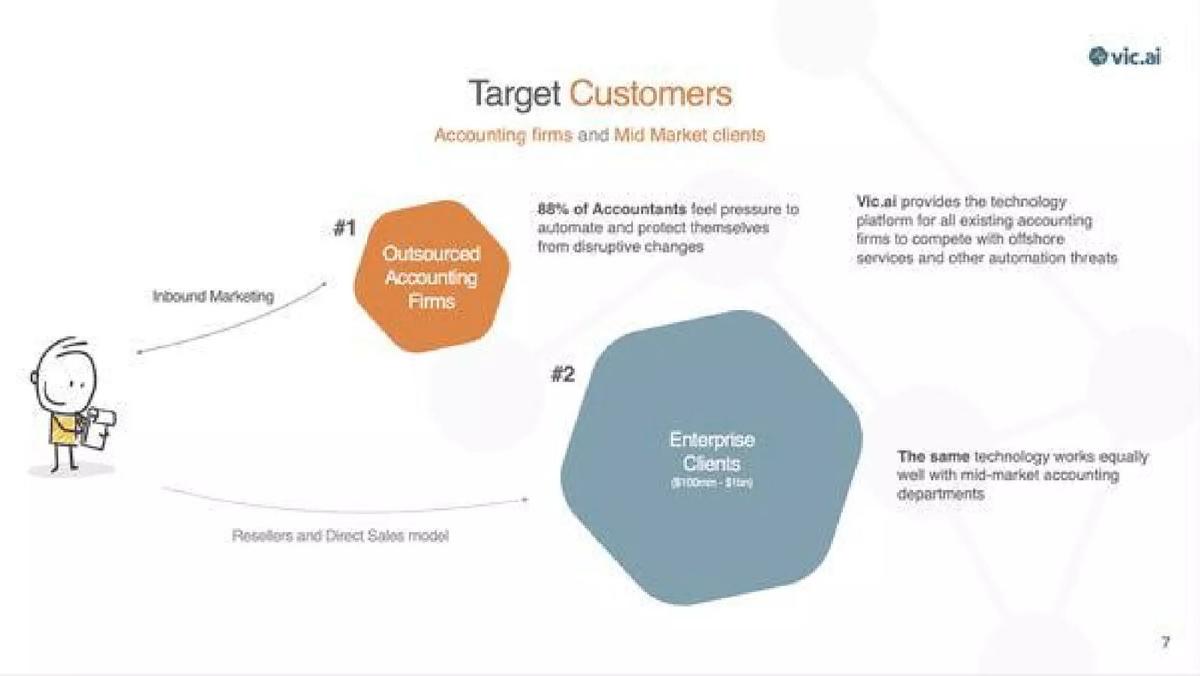
Slide 6 breaks down the Go-To-Market (GTM) strategy. The primary targets are 'Outsourced Accounting Firms' (reached via inbound marketing) and 'Enterprise Clients' with revenues between '$100mm - $1bn' (reached via resellers and direct sales). A key insight provided is that '88% of Accountants feel pressure to automate,' framing Vic.ai not as a threat to accountants, but as a survival tool against offshore competition.
Slide 7: Product Workflow (Invoice Processing)
This slide explains the 'how.' It shows a flow chart starting with an 'Invoice/Document,' moving through the 'Vic.ai AI Engine,' and resulting in either an 'OK' (automated) or a 'Review' (human intervention). The slide lists integrations with major systems: 'Intacct, Dyn GP, 247office, Netsuite, QBO, and bill.com.' The value proposition is clearly stated at the bottom: shifting the workflow from 'transaction entry to exception handling.'
Slide 8: The Learning Loop
Slide 8 illustrates the 'perpetual learning loop.' It’s a five-step circular process: 1. New data from clients, 2. Predicting the answer, 3. Collecting user behavior (recording interactions), 4. Improved prediction, and 5. Educated accountants adding a 'human touch' to further enrich the dataset. This slide reinforces the idea that the product gets better—and the moat gets deeper—with every single transaction processed.
Slide 9: Long-term Vision
Slide 9 uses a Venn diagram to show how Vic.ai plans to expand. While they started in AP, they have their 'eyes on large inefficient markets' including 'Auditing ($100bn),' 'Internal Accounting ($125bn),' 'Bookkeeping Services ($78bn),' and a massive 'B2B Payments ($1 Trn)' opportunity. This slide is designed to show the 'billion-dollar upside' required for a Series A venture investment.
Slide 10: Conclusion
The final slide is a simple 'Thank You' with the company logo. It includes a slide number (17), suggesting that the version of the deck provided may be an excerpt or that several appendix slides were omitted from the primary sequence.
What Works in the Vic.ai Deck
The deck’s greatest strength is its focus on the 'Unfair Advantage.' Many AI startups claim to have superior algorithms, but Vic.ai focuses on the proprietary data required to train those algorithms. By citing 200 million documents and 10 billion data points, they make a compelling case that their AI is 'smarter' than a competitor starting from scratch.
The beachhead strategy is also very clear. Instead of claiming they will automate all of accounting on day one, they focus specifically on Accounts Payable and invoice processing. This gives investors a clear understanding of the initial product-market fit while the later slides provide the necessary 'vision' for expansion into B2B payments and auditing.
Finally, the social proof on slide 2—stating that 4 of the top 10 accounting firms use the platform—is a powerful validator. In the conservative world of finance and accounting, having top-tier firms as early adopters mitigates the perceived risk of the technology failing.
What is Missing from the Vic.ai Deck
The most glaring omission is a Team Slide . While slide 2 mentions 'experienced founders,' there are no names, photos, or specific track records provided in this 10-slide set. For a Series A, the pedigree of the engineering and leadership team is usually a top-three evaluation criteria for VCs.
There is also a lack of Unit Economics . While the deck mentions 'no churn,' it does not provide details on Customer Acquisition Cost (CAC), Lifetime Value (LTV), or the specific pricing model. Investors would want to know if this is a per-seat SaaS model or a per-transaction 'tax' on the accounting process.
Lastly, there is no Ask Slide . The deck does not state how much capital is being raised or how that capital will be allocated (e.g., 50% to engineering, 30% to sales). While this information is often handled in the verbal pitch or a separate document, its absence here makes the deck feel more like a product overview than a complete fundraising instrument.
What a Founder Should Copy
Founders should emulate the 'Evolutionary Timeline' on slide 3. It is a highly effective way to frame your startup as the 'inevitable next step' in a long-standing industry. It moves the conversation from 'Why should this exist?' to 'When will this happen?'
The 'Learning Loop' on slide 8 is another excellent inclusion. If your product involves machine learning, you must demonstrate how you will maintain a lead over time. Showing that your users' daily actions actually improve your core IP creates a 'flywheel' effect that is very attractive to venture capitalists.
Finally, the Market Sizing on slide 4 and 9 is well-executed. Instead of just one big 'TAM' number, Vic.ai breaks the market down into functional areas (AP, Bookkeeping, Auditing). This shows a sophisticated understanding of the industry structure and gives the 'beachhead' strategy more credibility.
Final Thoughts
Vic.ai’s deck is a lean, data-centric presentation that prioritizes defensibility. By focusing on a massive historical dataset and a clear entry point into the enterprise, they successfully navigated the transition from a Seed-stage 'idea' to a Series A 'machine.' While the deck could benefit from more transparency regarding the team and financials, the core thesis—that data is the ultimate moat in accounting—is delivered with high impact.
Frequently asked questions
- What is Vic.ai's primary product focus according to the deck?
- According to slide 4 and slide 8, Vic.ai focuses on the 'Invoice Processing Module' within the Accounts Payable (AP) function. They describe AP as their 'beachhead' into the broader accounting market. The goal is to shift the workflow from manual transaction entry to 'exception handling,' where the AI processes the bulk of the work and humans only review anomalies.
- How does Vic.ai justify its competitive advantage in AI?
- The deck leans heavily on data access. Slide 5 explicitly states that 'Data access is our unfair advantage.' They claim to have acquired a dataset covering 40,000 companies, featuring over 200 million financial documents and 10 billion ERP data points. This massive historical dataset allows their models to start with a level of accuracy that new entrants cannot easily replicate.
- Who are the target customers for this platform?
- Slide 7 identifies two primary segments: Outsourced Accounting Firms and Enterprise Clients (specifically those with $100mm to $1bn in revenue). They note that 88% of accountants feel pressure to automate, positioning Vic.ai as a tool to help these firms compete against offshore services and other automation threats.
- What integrations does the Vic.ai platform support?
- Slide 8 lists several major accounting systems that Vic.ai integrates with to facilitate its autonomous workflow. These include Sage Intacct, Microsoft Dynamics GP, 247office, Oracle NetSuite, QuickBooks Online (QBO), and Bill.com. This suggests the platform is designed to sit on top of existing ERP infrastructure rather than replacing it.
- What is missing from this pitch deck?
- The deck is notably missing several standard components: a dedicated team slide with names and bios, a detailed financial breakdown or 'Ask' slide, a specific competitor comparison matrix, and a roadmap of future product features beyond the general expansion into other accounting areas mentioned on slide 10.