Vibe’s Series A deck is a masterclass in leveraging founder credibility to de-risk a difficult market. By highlighting the successful exit of their previous company, KMTX, and their subsequent $7.1M self-funding via a SAFE, the founders established immediate trust. The narrative focuses on the 'unserved' SME market, which they value at $70B, contrasting it against legacy solutions built for the Fortune 500. While the deck is light on specific financial metrics—redacting revenue and cap table details—it compensates with strong social proof, including a 4.9/5 G2 rating and case studies showing…
Key takeaways
- The founders used proceeds from their previous exit, KMTX, to raise a $7.1M SAFE for Vibe, demonstrating significant skin in the game (Slide 3).
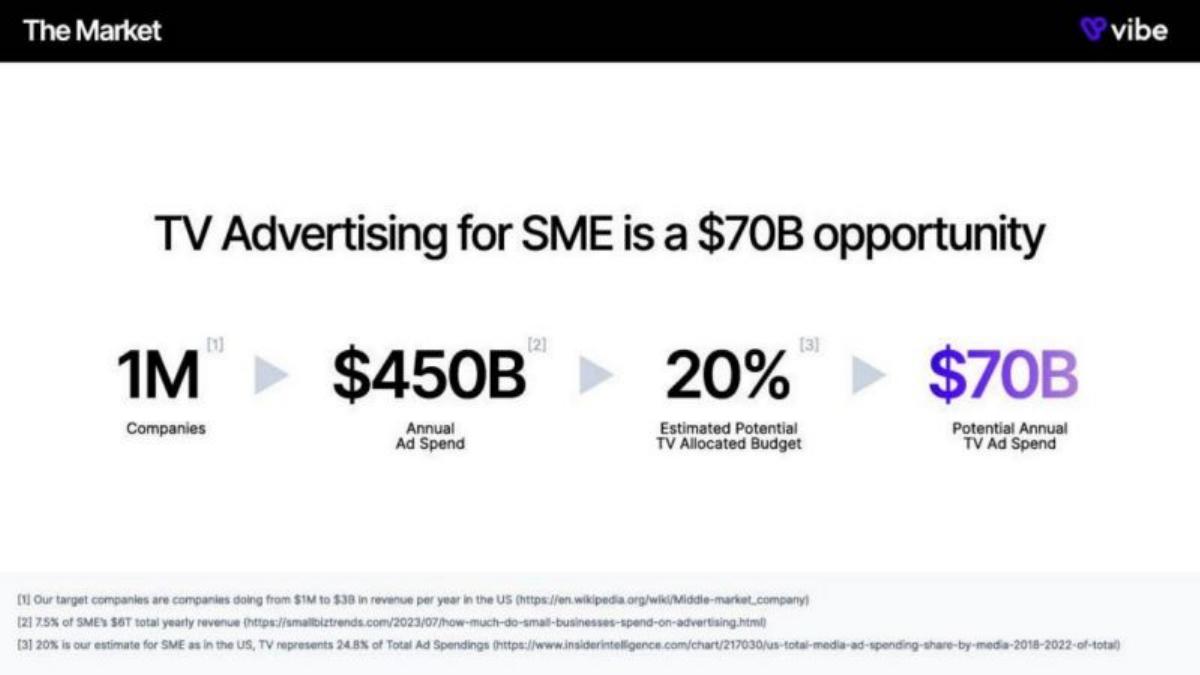
- Vibe identifies a $70B annual TV ad spend opportunity specifically within the SME segment, which represents 1 million companies (Slide 5).
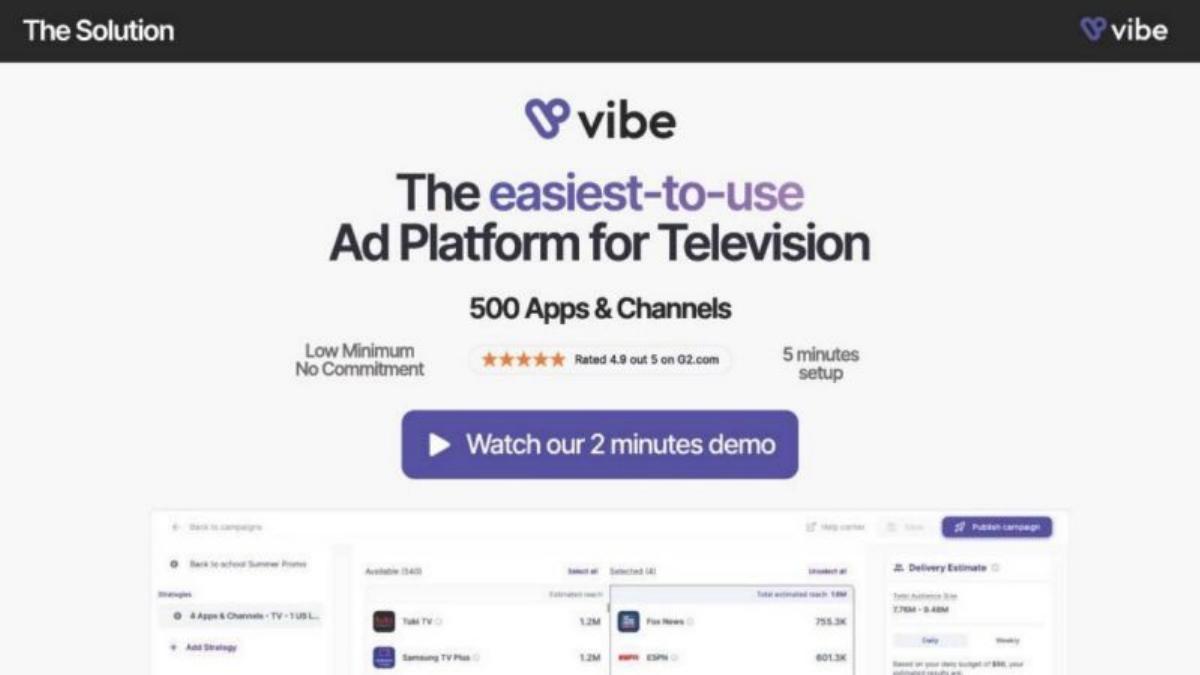
- The platform boasts a 4.9 out of 5 rating on G2 and claims a setup time of just 5 minutes (Slide 6).
- The team consists of 36 total FTEs, with a notable 0% resignation rate and an average of 8 years of experience (Slide 2).
- Vibe positions itself against 'Walled Gardens' and 'Enterprise focused' solutions, scoring 4.5/5 on their own competitive matrix (Slide 10).
- Case studies highlight specific performance wins, such as an 860% ROAS for CleanEatz and a 28% increase in foot traffic for Abuelo's (Slide 11).
- The deck omits a specific 'Ask' slide, though external data confirms a $22.5M raise led by Singular (Listing facts).
- The 'Drowning in Demand' slide uses a visual of a packed calendar to prove product-market fit without disclosing raw lead numbers (Slide 7).
Vibe Series A Teardown: The SME Play for Connected TV
Vibe’s Series A pitch deck is a concise, 13-slide presentation that successfully secured $22.5M in 2024. The deck is characterized by a strong emphasis on founder pedigree and a clear identification of a massive, underserved market. In an era where Connected TV (CTV) is often seen as the playground of global brands, Vibe makes a compelling case for the democratization of the medium. By focusing on the 'Small & Mid Market,' they distance themselves from the high-friction, high-cost world of traditional TV buying.
Slide 1: The Hook
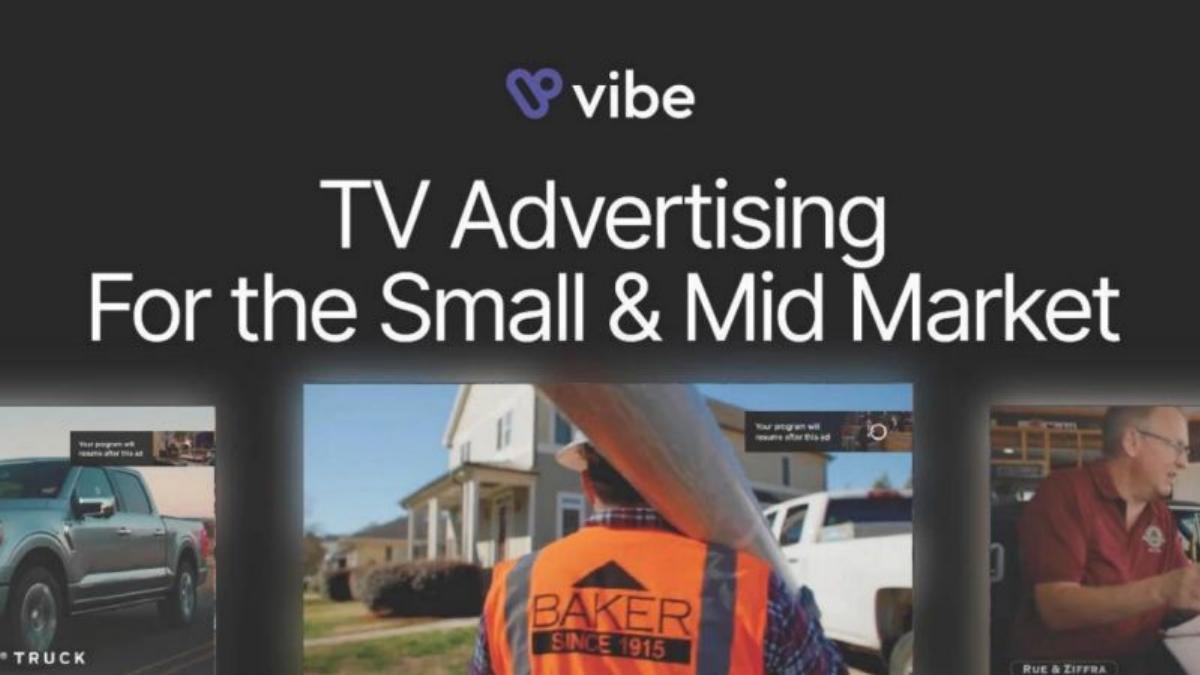
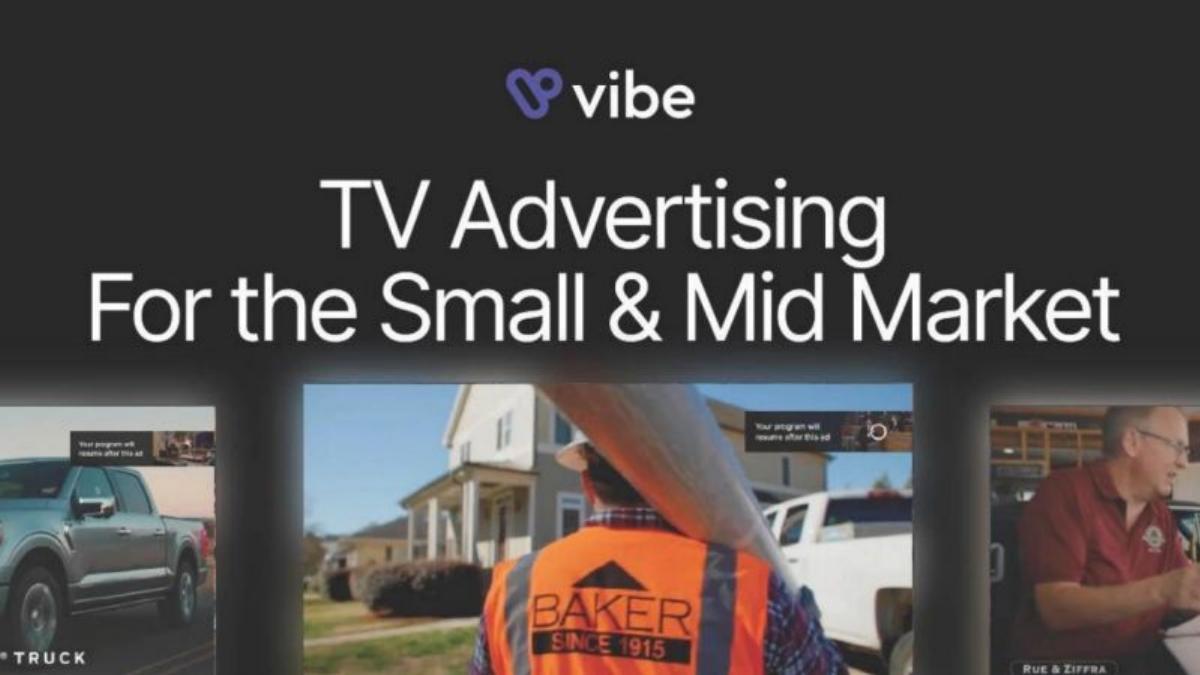
The cover slide is minimalist, featuring the Vibe logo and the tagline: "TV Advertising For the Small & Mid Market." The background shows blurred stills of commercials for local-style businesses, such as a construction company ('Baker Since 1915') and a law firm ('Rue & Ziffra'). This immediately signals that the platform is built for 'real-world' businesses, not just digital-native startups or global conglomerates.
Slide 2: The Team of Veterans
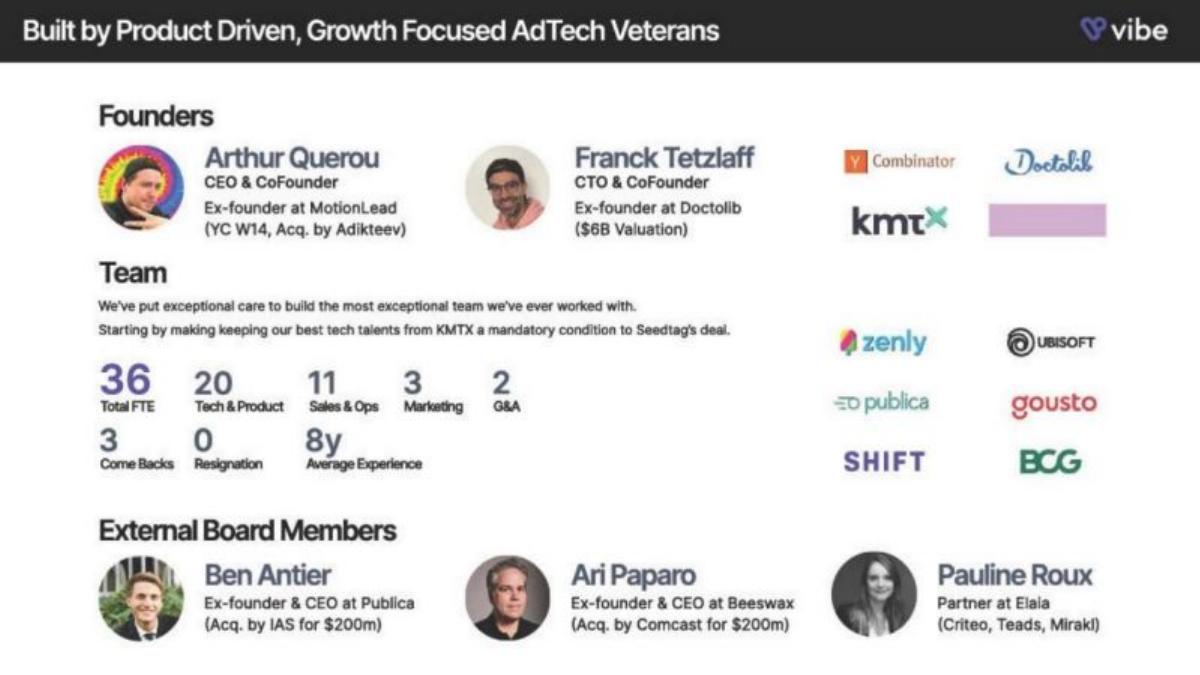
Vibe places its team slide second, which is a common tactic for serial founders. The slide is titled "Built by Product Driven, Growth Focused AdTech Veterans." It highlights CEO Arthur Querou (ex-MotionLead, YC W14) and CTO Franck Tetzlaff (ex-Doctolib, $6B valuation). The slide also includes impressive team stats: 36 total FTEs, 0 resignations, and an average of 8 years of experience. The inclusion of external board members like Ben Antier (Publica) and Ari Paparo (Beeswax)—both of whom led $200M exits—adds a layer of institutional credibility that is vital for a Series A round.
Slide 3: The Origin Story and Skin in the Game
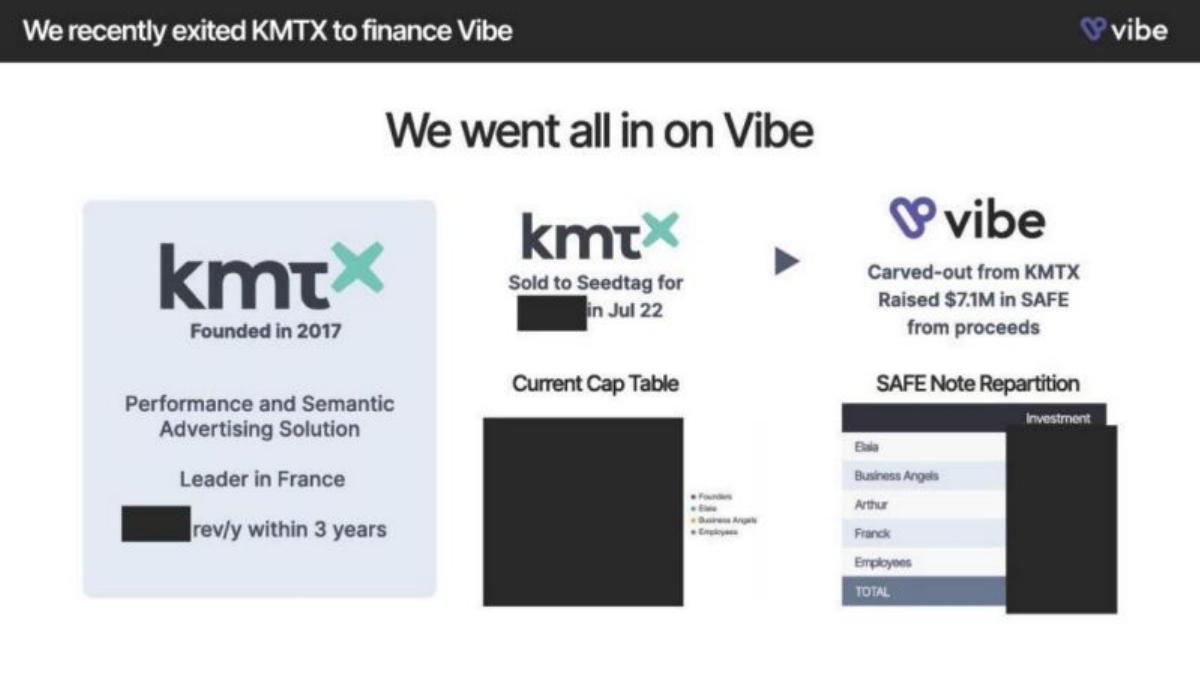
Slide 3, titled "We recently exited KMTX to finance Vibe," is perhaps the most important slide for de-risking the investment. It explains that Vibe was carved out from KMTX (sold to Seedtag in July 2022). The founders state they "went all in on Vibe," raising a $7.1M SAFE from the proceeds of that sale. While the specific revenue figures for KMTX and the current cap table are redacted in this version of the deck, the message is clear: the founders are betting their own wealth on this vision.
Slide 4: The SME Problem
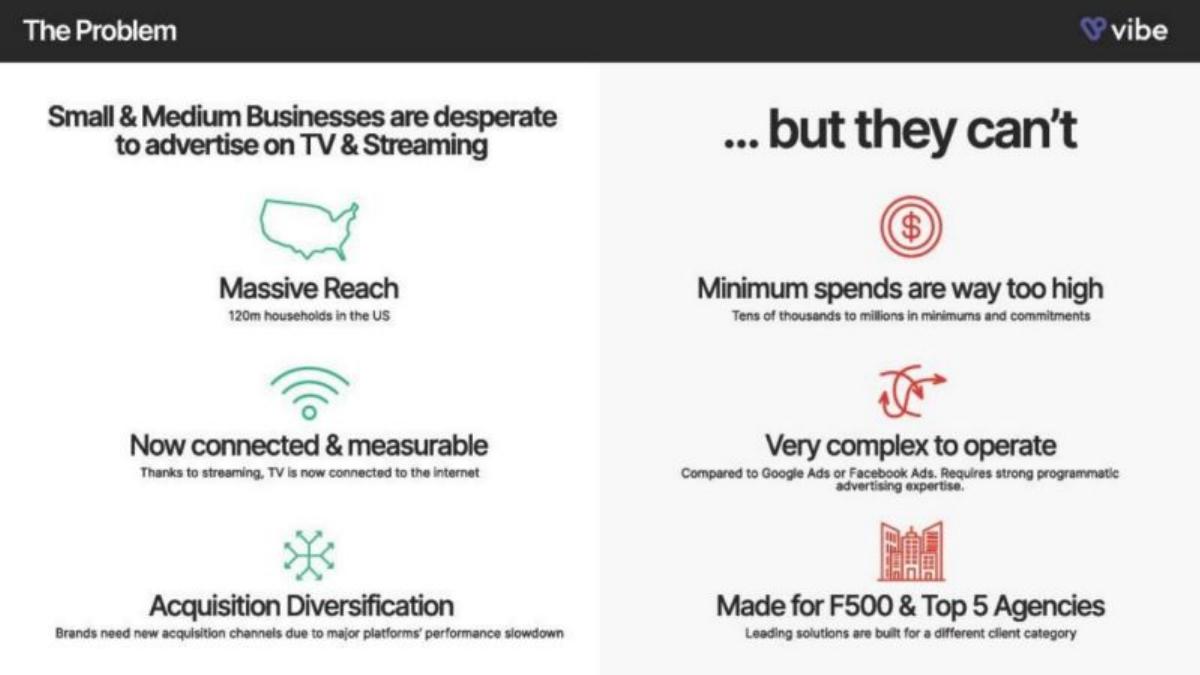
The problem slide is split into two halves: why SMEs want TV and why they can't have it. Vibe notes that while TV offers "Massive Reach" (120m US households) and is now "connected & measurable," SMEs are blocked by high minimum spends and operational complexity. They explicitly state that current solutions are "Made for F500 & Top 5 Agencies." This framing sets up Vibe as the only logical alternative for the 'other' 99% of businesses.
Slide 5: The $70B Market Opportunity
Vibe quantifies the opportunity with a top-down calculation. They target 1 million companies with $1M to $3B in revenue. With an estimated $450B in total annual ad spend, they project that a 20% allocation to TV results in a "$70B opportunity." The slide includes footnotes citing sources like Wikipedia, SmallBizTrends, and Insider Intelligence, which helps ground their estimates in third-party data.
Slide 6: The Solution
The solution slide introduces Vibe as "The easiest-to-use Ad Platform for Television." Key features mentioned include access to 500 apps and channels, "Low Minimum No Commitment," and a "5 minutes setup." A screenshot of the interface shows recognizable logos like Tubi TV, Samsung TV Plus, Fox News, and ESPN, proving that 'small' advertisers can still access 'big' inventory. They also highlight a 4.9/5 rating on G2, providing immediate social proof.
Slide 7: Product-Market Fit
Instead of a standard traction chart, Slide 7 uses a quote from Michael Seibel (Y Combinator): "My definition of product-market fit is: You are drowning in demand." The background is a collage of what appears to be a heavily booked Google Calendar. This is a clever way to signal high demand and sales velocity without revealing sensitive revenue growth numbers in a shared deck.
Slide 8: Vibe Connect
This slide focuses on the supply side of the marketplace. "Vibe Connect makes us the SME Sales Powerhouse for Publishers." It lists benefits for publishers, such as reporting, yield optimization, and direct access to Vibe's unique SME inventory. The partner logos are redacted, but the slide establishes that Vibe isn't just a dashboard; it's a strategic partner for the media companies selling the ad space.
Slide 9: Social Proof
Slide 9 is dedicated to client testimonials. Quotes from agency owners and CEOs of companies like SpringServe and Hyundai Dealerships emphasize speed and ease of use. One quote from Kathy Sale of New Harmony Inn stands out: "We get 3 times more exposure than we do with Google Ads at very affordable rates." This direct comparison to Google Ads is crucial for convincing SMEs to shift their budget.
Slide 10: The Competitive Landscape
Vibe uses a standard feature-comparison matrix to position itself against 'Walled Gardens,' 'Enterprise focused' solutions, and 'SME Generalists.' Vibe gives itself a 4.5/5 score , losing half a point only on 'Instant Access to all the supply.' They position themselves as the only solution that is simultaneously self-service, easy-to-use, performance-driven, and TV-focused.
Slide 11: Performance Metrics
The 'Delivering strong ROI' slide provides concrete case studies. It highlights an "860% ROAS for CleanEatz" and a "409% ROAS for Hoodsly." By showing that TV can drive measurable foot traffic (+28% for Abuelo's), Vibe counters the traditional view that TV is only for top-of-funnel brand awareness. The bottom half of the slide shows blurred charts, likely representing the specific performance data for these clients.
Slide 12: The Strategic 'Why Now'
The final content slide, "When life gives you lemons, make lemonade," addresses the difficulty of the SME market. It acknowledges that the playbook for SMEs is 'unknown' and 'risky' for big companies. Vibe argues that because they started with a 'bottom-up' product focus and have a 'unique expertise in growth,' they are uniquely positioned to crack a market that legacy players cannot reach.
What Works in the Vibe Deck
Founder Credibility: By leading with their previous exit and the fact that they self-funded the early stages of Vibe, the founders eliminate the 'can they execute?' question immediately. · Clear Market Segmentation: They don't just say 'advertising.' They specify 'TV advertising for SMEs,' which is a much more defensible and specific niche. · Performance Focus: In a medium (TV) traditionally associated with 'vibes' and 'branding,' the deck focuses heavily on ROAS and foot traffic metrics. · Supply-Side Strategy: Including a slide on why publishers need Vibe (Slide 8) shows a sophisticated understanding of the two-sided marketplace dynamics.
What is Missing from the Vibe Deck
The Ask: There is no slide detailing how much they are raising or how the funds will be used. While we know from the listing it was $22.5M, its absence in the deck suggests this may have been a 'teaser' or a version used after the terms were already being discussed. · Unit Economics: There is no mention of Customer Acquisition Cost (CAC), Lifetime Value (LTV), or churn rates. For a Series A, investors usually expect to see the 'machine' of the business quantified. · Financial Projections: The deck is entirely backward-looking or focused on the current state. There are no forward-looking revenue projections or milestones. · Specific Cap Table: The cap table is completely redacted (Slide 3). While understandable for a public version, the lack of even a high-level breakdown of institutional vs. founder ownership is a gap.
Founder Lessons from Vibe
Leverage Your History: If you have a successful exit, make it a central pillar of your next deck. It proves you know how to build value and provides a 'reason to believe' for new investors. · Use Social Proof Early: Vibe doesn't wait until the end to show they are liked. The G2 rating on Slide 6 and the calendar visual on Slide 7 build momentum before the reader even sees the case studies. · Address the 'Hard' Parts: Slide 12 is excellent because it acknowledges why the market is difficult. Don't pretend your business is easy; explain why your specific team and product are the only ones who can handle the difficulty. · Visual Consistency: The deck uses a clean, dark-mode aesthetic with a consistent color palette (purple and green). It looks professional and modern, which is essential for a company claiming to modernize a legacy industry like TV advertising.
Frequently asked questions
- How much did Vibe raise and who were the investors?
- According to the catalogue listing, Vibe raised $22.5 million in a Series A round in 2024. The round was led by Singular, with participation from Sequoia's Scout Fund and Motier Ventures. The deck itself mentions an earlier $7.1M SAFE raised from the proceeds of the founders' previous company exit, KMTX.
- What is Vibe's core value proposition for small businesses?
- Vibe aims to solve the three main barriers SMEs face in TV advertising: high minimum spends (often tens of thousands to millions), operational complexity compared to Google or Facebook Ads, and the fact that legacy solutions are built for Fortune 500 companies and top agencies. Vibe offers a self-service platform with no commitments and a 5-minute setup.
- What does the team's background look like?
- The team is led by 'AdTech Veterans.' CEO Arthur Querou previously founded MotionLead (YC W14, acquired by Adikteev), and CTO Franck Tetzlaff was a co-founder at Doctolib, which reached a $6B valuation. They also list external board members from Publica and Beeswax, both of which had $200M exits.
- How does Vibe define its market opportunity?
- Vibe targets 1 million companies in the US with revenues between $1M and $3B. They estimate these companies have a total annual ad spend of $450B. By assuming a 20% allocation to TV, they calculate a potential annual TV ad spend market of $70B for the SME segment.
- What specific results has Vibe delivered for its clients?
- Slide 11 showcases four case studies: a political media agency win, an 860% Return on Ad Spend (ROAS) for CleanEatz, a 409% ROAS for Hoodsly, and a 28% increase in foot traffic for the restaurant chain Abuelo's. These metrics serve as proof of the platform's performance-driven approach.