Existing Investors Slide: Funding History Examples
How startups show current investors and money raised to date in a pitch deck: amounts, lead investors, dates and cap table. Seven real slides compared.
Existing Investors Slide: Funding History Examples
Seven real slides, shown in full, compare how startups present who has already invested and how much they have raised.
TL;DR
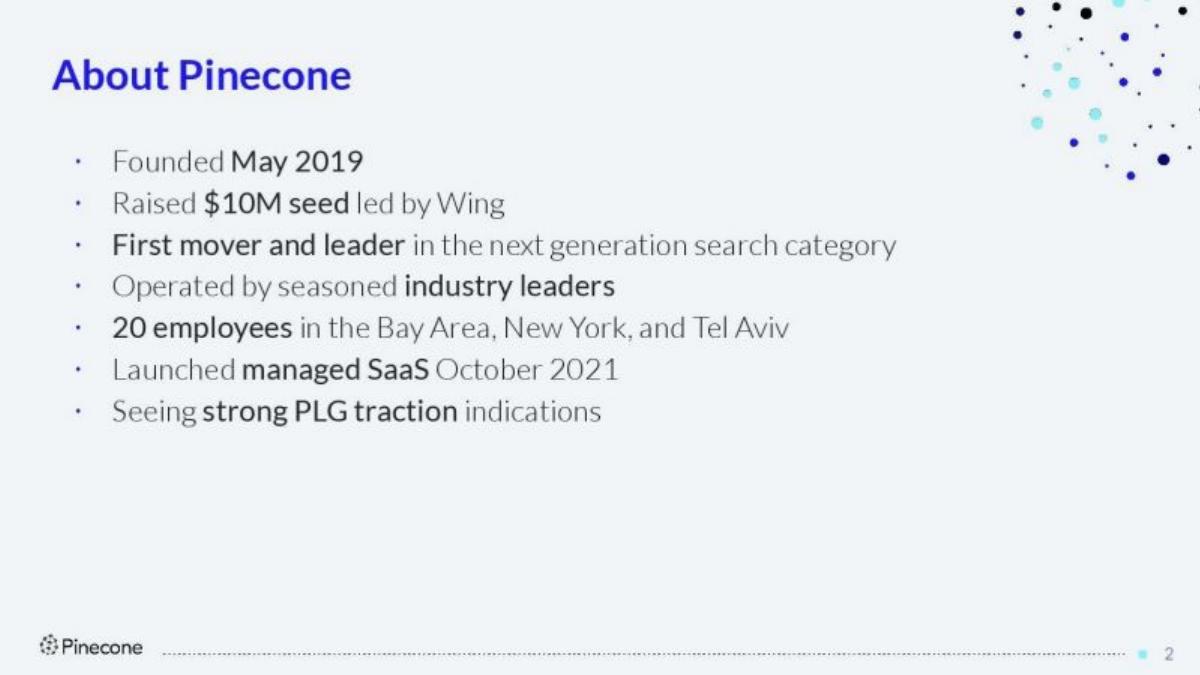
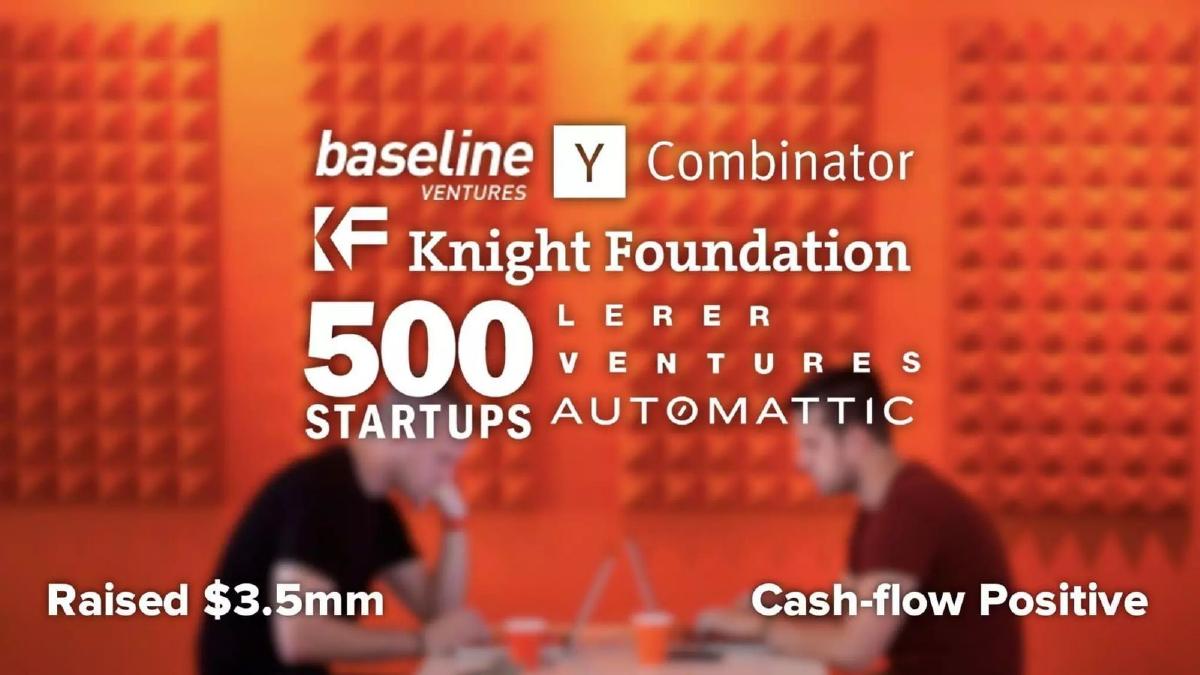
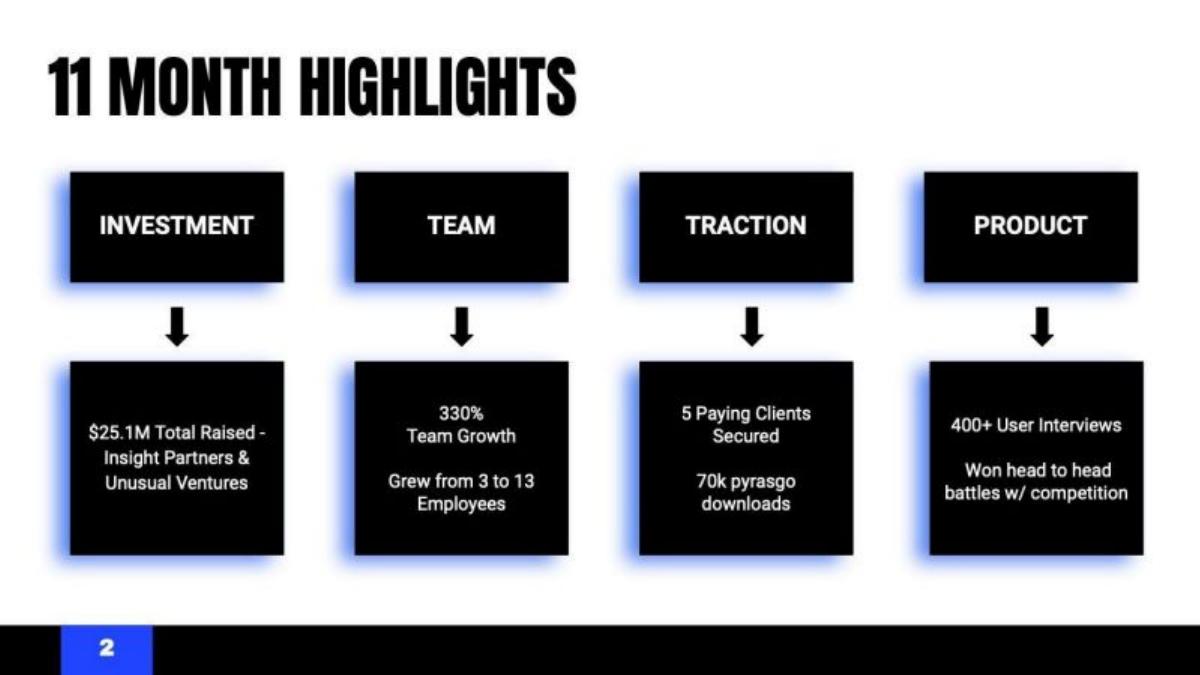
A new investor wants to know how much you've raised, from whom, when, and what you did with it. The clearest slides below give an amount, a round, a lead and a date in one line (Pinecone: "Raised $10M seed led by Wing"), or tie money raised to progress (OwnLocal: "Raised $3.5mm" next to "Cash-flow positive"; Rasgo: total raised next to team, traction and product). Weaker slides show investor logos with no amounts, or mix investors with customers. Name the round, the lead, the amount and the date, and show what the money achieved.
Investor and funding history slides from real pitch decks
Each example shows the exact stored slide above its analysis and links to the full teardown. Figures are as shown on the slides; we have not verified them. Stage and year are given only where the slide or deck states them.
Pinecone investors slide — slide 2
Vector database. The slide refers to October 2021.
Pinecone deck, slide 2. Exact stored slide matched to this analysis.
Our analysis: Amount, round and lead fit in one line, next to founding date and team size.
Evidence and limitation: "Strong PLG traction indications" has no number. Add one.
What a founder can adapt: Write your funding history as amount, round, lead, date.
Supporting analysis
What the deck claims: "About Pinecone": founded May 2019; "Raised $10M seed led by Wing"; first mover and leader in the next-generation search category; operated by seasoned industry leaders; 20 employees in the Bay Area, New York and Tel Aviv; launched managed SaaS October 2021; seeing strong PLG traction indications.
Presentation choice: Amount, round and lead fit in one line, next to founding date and team size.
When it does not fit: "Strong PLG traction indications" has no number. Add one.
Rasgo deck, slide 2. Exact stored slide matched to this analysis.
Our analysis: Money raised sits beside what was built with it over a stated period.
Evidence and limitation: $25.1M against 5 paying clients invites questions. Be ready to explain the spend.
What a founder can adapt: Show funding alongside team, traction and product over the same period.
Supporting analysis
What the deck claims: "11 Month Highlights": Investment — "$25.1M Total Raised – Insight Partners & Unusual Ventures"; Team — "330% Team Growth, grew from 3 to 13 employees"; Traction — "5 Paying Clients Secured, 70k pyrasgo downloads"; Product — "400+ User Interviews, won head to head battles w/ competition".
Presentation choice: Money raised sits beside what was built with it over a stated period.
When it does not fit: $25.1M against 5 paying clients invites questions. Be ready to explain the spend.
Identity verification. Founded October 2018 per the slide.
Persona deck, slide 2. Exact stored slide matched to this analysis.
Our analysis: Well-known investors next to the team act as a quick credibility check.
Evidence and limitation: No amounts or rounds. Investors can't tell who led or how much is committed.
What a founder can adapt: If your investors are widely recognised, show them with the team on an early slide.
Supporting analysis
What the deck claims: Leadership: three founders with prior companies (Dropbox, Square, Coursera, LinkedIn). "Our Investors": Bond, Coatue, First Round, Founders Fund, Index Ventures, Insight Partners, Meritech. Oct 2018 founded; San Francisco, CA headquarters; 80+ employees.
Presentation choice: Well-known investors next to the team act as a quick credibility check.
When it does not fit: No amounts or rounds. Investors can't tell who led or how much is committed.
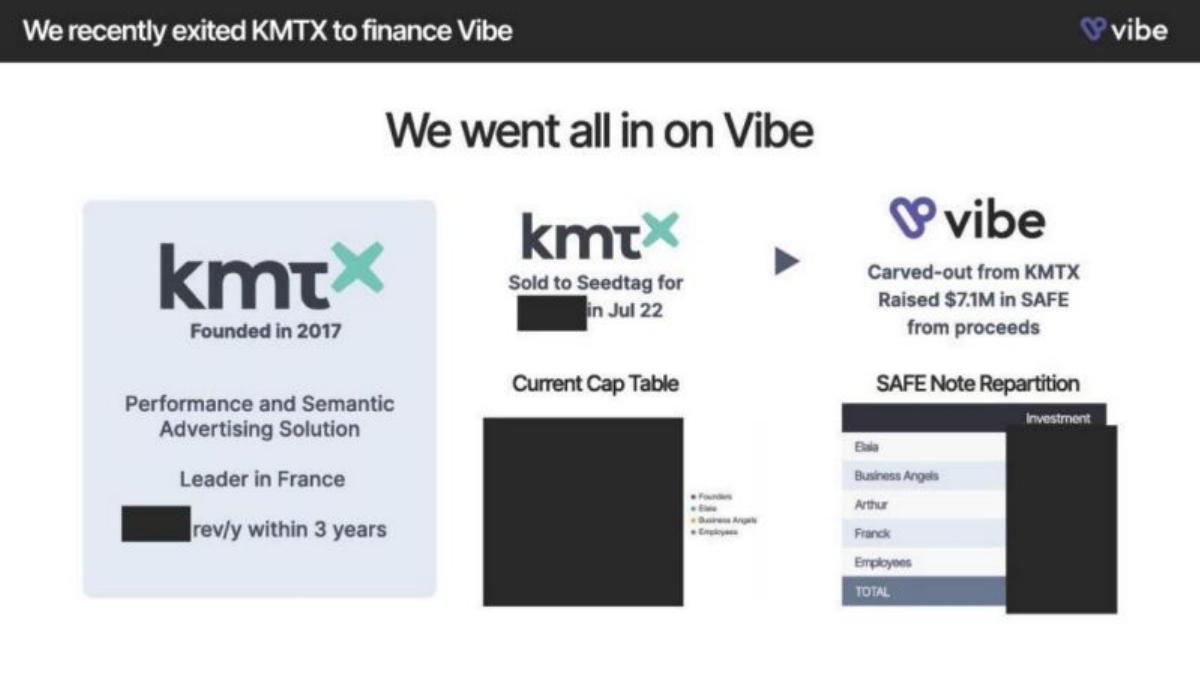
Streaming TV advertising. Series A deck; the slide refers to July 2022.
Vibe deck, slide 3. Exact stored slide matched to this analysis.
Our analysis: It explains unusual funding — founders reinvesting sale proceeds — and shows the cap table.
Evidence and limitation: The cap table figures are masked here. In a live pitch, show them or offer them in the data room.
What a founder can adapt: If your funding history is unusual, explain it plainly and show who owns what.
Supporting analysis
What the deck claims: "We recently exited KMTX to finance Vibe — We went all in on Vibe." KMTX: founded 2017, performance and semantic advertising, leader in France, sold to Seedtag in July 2022. "Vibe: carved-out from KMTX, raised $7.1M in SAFE from proceeds." "Current cap table" and "SAFE note repartition" tables (figures masked in the published version; rows include founders, business angels and employees).
Presentation choice: It explains unusual funding — founders reinvesting sale proceeds — and shows the cap table.
When it does not fit: The cap table figures are masked here. In a live pitch, show them or offer them in the data room.
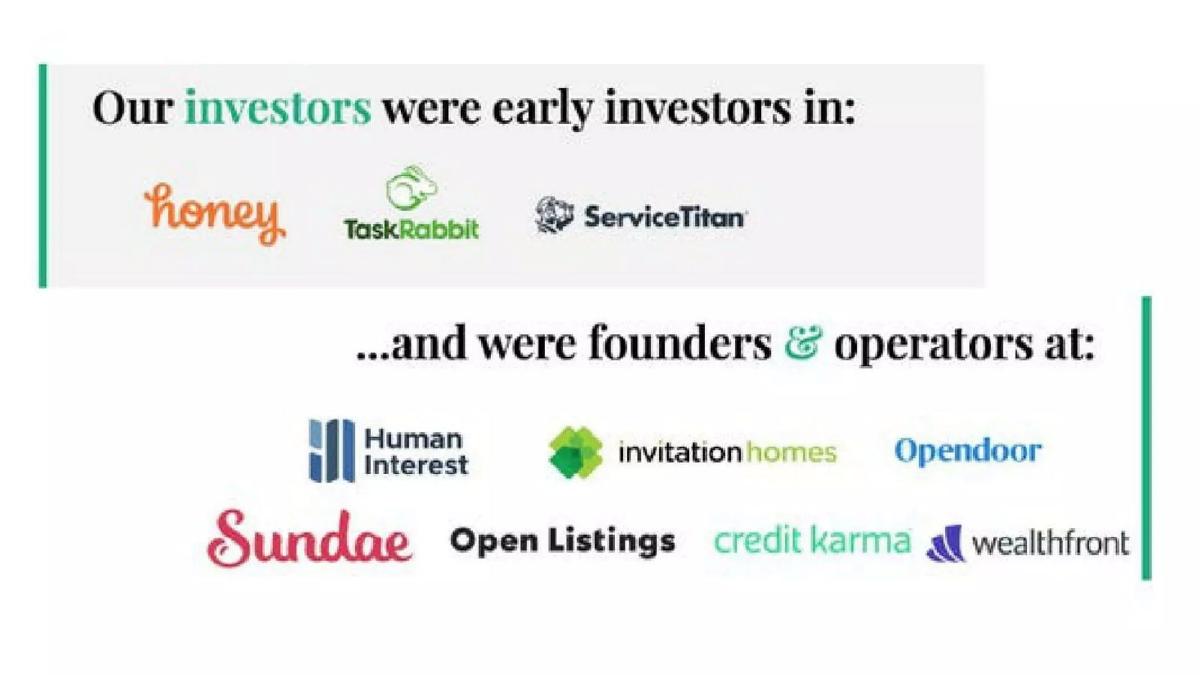
Rental home investing. A different slide from this deck appears in another guide. Stage and year are not stated on this slide.
Doorvest deck, slide 3. Exact stored slide matched to this analysis.
Our analysis: It explains why these investors are relevant: they backed or ran similar companies.
Evidence and limitation: The investors themselves aren't named, only their past companies. Name them and what they put in.
What a founder can adapt: If investors bring relevant experience, say what it is.
Supporting analysis
What the deck claims: "Our investors were early investors in: Honey, TaskRabbit, ServiceTitan … and were founders & operators at: Human Interest, Invitation Homes, Opendoor, Sundae, Open Listings, Credit Karma, Wealthfront."
Presentation choice: It explains why these investors are relevant: they backed or ran similar companies.
When it does not fit: The investors themselves aren't named, only their past companies. Name them and what they put in.
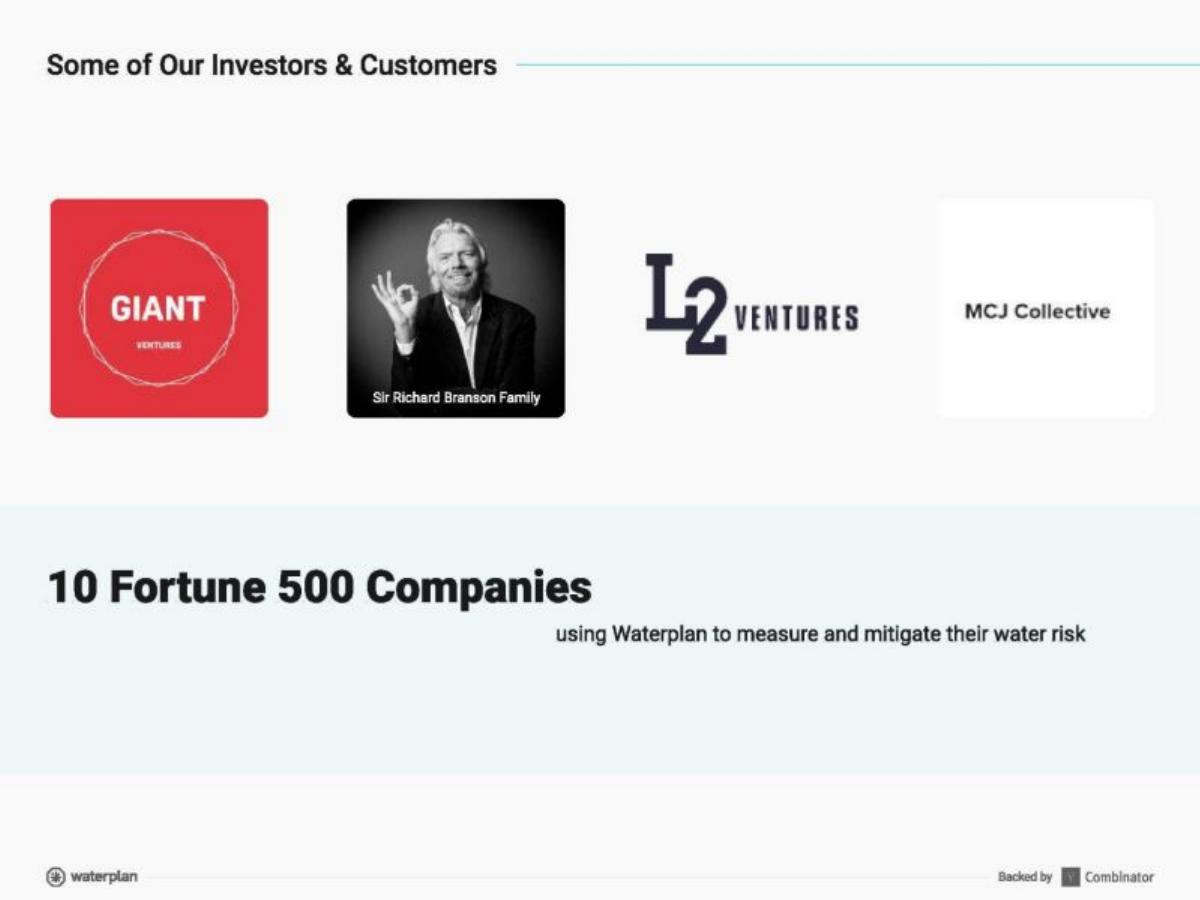
Water risk software, backed by Y Combinator per the slide footer. Stage and year are not stated on the slide.
Waterplan deck, slide 4. Exact stored slide matched to this analysis.
Our analysis: Named investors and a customer count are both real evidence.
Evidence and limitation: The title mixes investors and customers. Split them so each makes its own case.
What a founder can adapt: Treat this as a slide to improve on. Keep the named investors.
Supporting analysis
What the deck claims: "Some of Our Investors & Customers": Giant Ventures, Sir Richard Branson Family, L2 Ventures, MCJ Collective. "10 Fortune 500 Companies using Waterplan to measure and mitigate their water risk."
Presentation choice: Named investors and a customer count are both real evidence.
When it does not fit: The title mixes investors and customers. Split them so each makes its own case.
Explain unusual funding. Vibe shows the founders financed it from selling their last company.
Logos alone don't say how committed investors are. Add amounts or say who led.
Keep investors and customers apart. Waterplan mixes them.
Build your investors slide
One line per round, then what it achieved.
Rounds. For each round: amount, type (pre-seed, seed, SAFE), lead and month?
Total. Total raised to date?
Results. What did the money achieve: revenue, customers, product?
Why them. What does each key investor bring beyond money?
Ownership. Will you show the cap table or offer it in the data room?
Copyable framework: Raised $[x] to date: $[a] [round] led by [investor] ([month year]); $[b] [round] led by [investor] ([month year]). Since then: [result].
Illustrative example 1 — written by us
Before: Backed by top investors. [logos]
After: Raised $2.4M: $400K pre-seed from angels (Mar 2024) and $2M seed led by [Fund] (Jan 2025). Since the seed: revenue from $8K to $41K MRR.
What improved: Our illustrative rewrite; figures and names are invented. It adds amounts, rounds, leads, dates and what the money achieved.
What this guide adds
The ask slide guide covers what you're raising now; the team guide covers founders and advisors. This guide covers the money already raised and the investors behind it.
Common mistakes
Logos without amounts. Say how much and who led.
No dates. Give the month and year of each round.
Investors mixed with customers. Put them on separate slides or sections.
Money not linked to results. Show what the last round paid for.
Unexplained unusual funding. Explain grants, founder money or SAFEs plainly.
Diagnostic checklist
Each round shows amount, type, lead and date.
Total raised is stated.
What the money achieved is shown.
Investors and customers are separate.
Cap table is shown or offered.
Frequently asked questions
How we chose these examples
Corpus: published pitch deck teardowns on StartupFundraising.com. Founder-uploaded private decks are excluded.
Selection (2026-09-24): we searched extracted text of slides 2–6 for funding history terms (raised, total raised, our investors, cap table, previous rounds), excluding fund decks and public-company updates, and inspected ten candidates. We excluded slides where funding was a minor line among many metrics (Humaans, Fabric) and a timeline that duplicated another example (EquityBee).
Overlap check: the ask guide covers the current raise; the team guide covers people. This guide covers past funding and existing investors.
Review: all seven stored slide images were inspected on 2026-09-24 and matched to company, deck and slide number (editorial model review). No person has yet completed an editorial review of this page.
Figures are as shown on the slides. We make no claim that any slide caused a fundraising outcome.