How startups show their story so far in a pitch deck: dated timelines, founder stories and pivots. Seven real company history slides compared.
Company History Slide: Timeline Examples
Seven real slides, shown in full, compare how startups present what has happened so far: dated timelines, founding stories and pivots.
TL;DR
A company history slide shows how fast you move and what you've already proven. The strongest slides below date every step and include hard results, not just launches (Daily Hundred: from "Company founded" in April 2012 to "First full paying client" in February 2014, with each funding round dated). Some also explain a pivot (98point6: a 2022 decision to separate care delivery from technology, then an acquisition in 2023). Founder-story slides (Once Upon a Farm) explain why the company exists but don't show pace. Date every entry, include results and funding, and keep it to one slide. The roadmap covers the future; this slide covers the past.
Company history slides from real pitch decks
Each example shows the exact stored slide above its analysis and links to the full teardown. Dates and claims are as shown on the slides; we have not verified them.
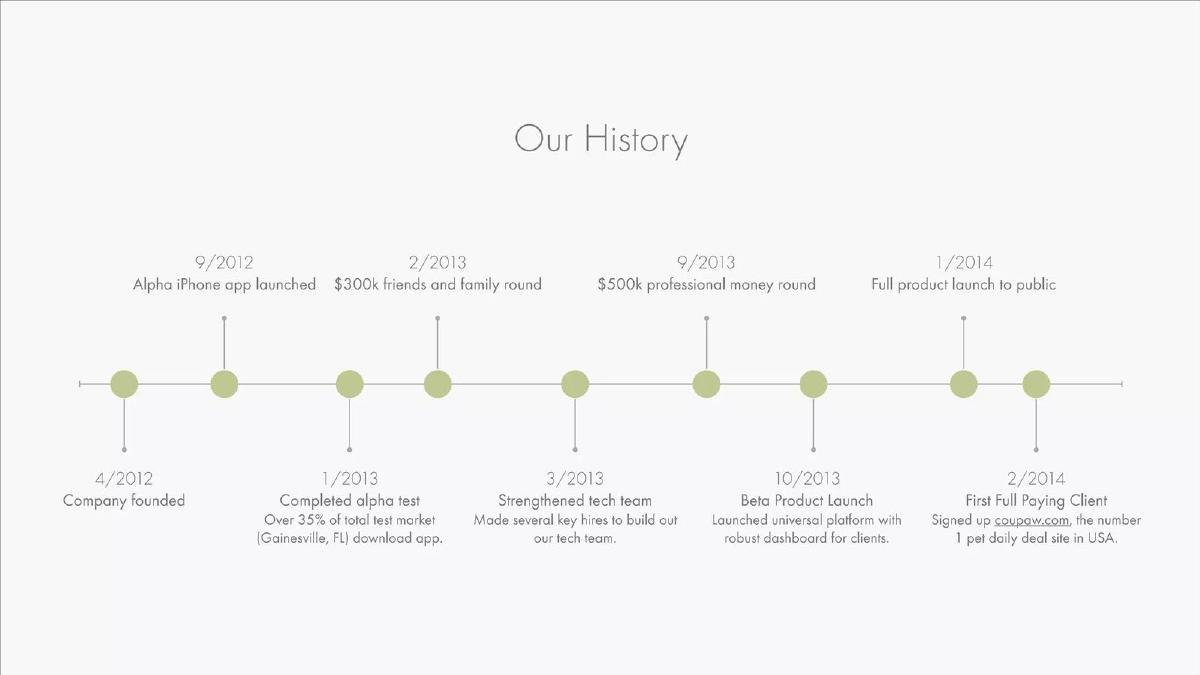
Daily Hundred company history slide — slide 3
Daily deals for pet owners. Timeline runs April 2012 to February 2014.
Daily Hundred deck, slide 3. Exact stored slide matched to this analysis.
Our analysis: Every entry is dated to the month, and funding and results sit on the same line as launches.
Evidence and limitation: Twenty-two months to a first paying client is a question investors will ask. Be ready to explain it.
What a founder can adapt: Put rounds, launches and first revenue on one dated line.
Supporting analysis
What the deck claims: "Our History": 4/2012 company founded; 9/2012 alpha iPhone app launched; 1/2013 completed alpha test ("over 35% of total test market (Gainesville, FL) download app"); 2/2013 $300k friends and family round; 3/2013 strengthened tech team; 9/2013 $500k professional money round; 10/2013 beta product launch; 1/2014 full product launch to public; 2/2014 first full paying client (Cosquin.com, "the number 1 pet daily deal site in USA").
Presentation choice: Every entry is dated to the month, and funding and results sit on the same line as launches.
When it does not fit: Twenty-two months to a first paying client is a question investors will ask. Be ready to explain it.
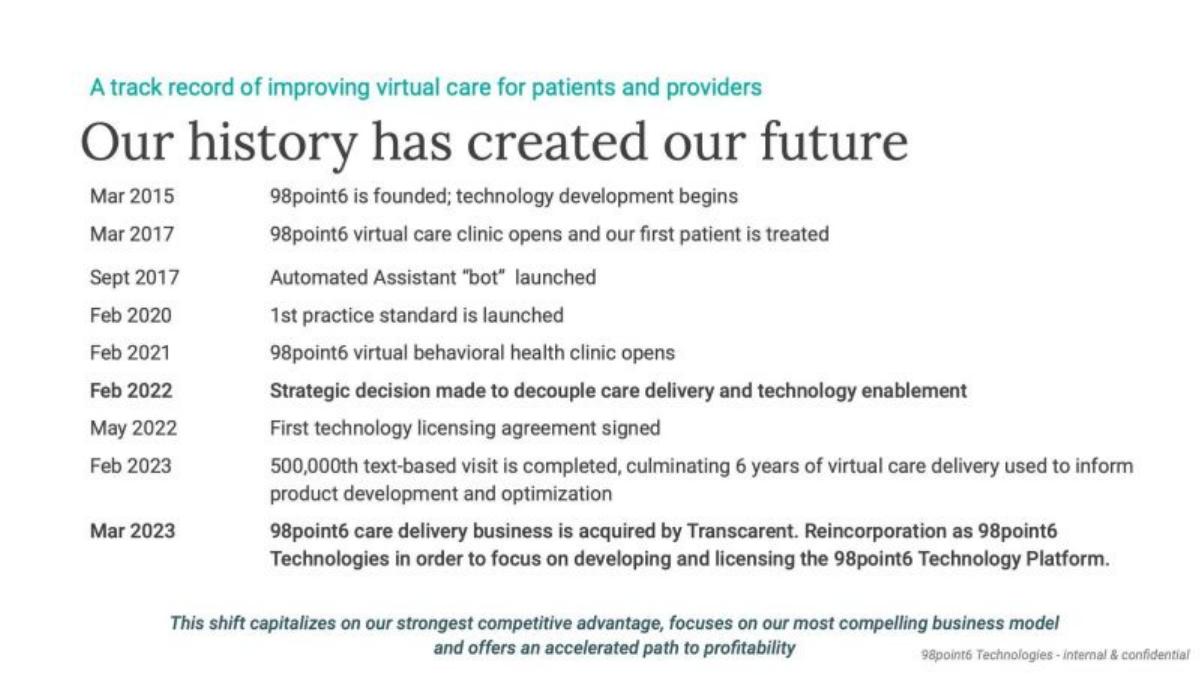
Virtual primary care technology. Timeline runs March 2015 to March 2023.
98point6 deck, slide 5. Exact stored slide matched to this analysis.
Our analysis: It explains a pivot through dated events and says why the new direction is better.
Evidence and limitation: Eight years of entries in small text. Bold the three that matter most.
What a founder can adapt: If you've pivoted, show the decision point and what it kept from before.
Supporting analysis
What the deck claims: "Our history has created our future": Mar 2015 founded, technology development begins; Mar 2017 virtual care clinic opens and first patient treated; Sept 2017 automated assistant "bot" launched; Feb 2020 first practice standard launched; Feb 2021 virtual behavioral health clinic opens; Feb 2022 "strategic decision made to decouple care delivery and technology enablement"; May 2022 first technology licensing agreement signed; Feb 2023 500,000th text-based visit completed; Mar 2023 care delivery business acquired by Transcarent, reincorporation as 98point6 Technologies. Footer: "This shift capitalizes on our strongest competitive advantage, focuses on our most compelling business model and offers an accelerated path to profitability."
Presentation choice: It explains a pivot through dated events and says why the new direction is better.
When it does not fit: Eight years of entries in small text. Bold the three that matter most.
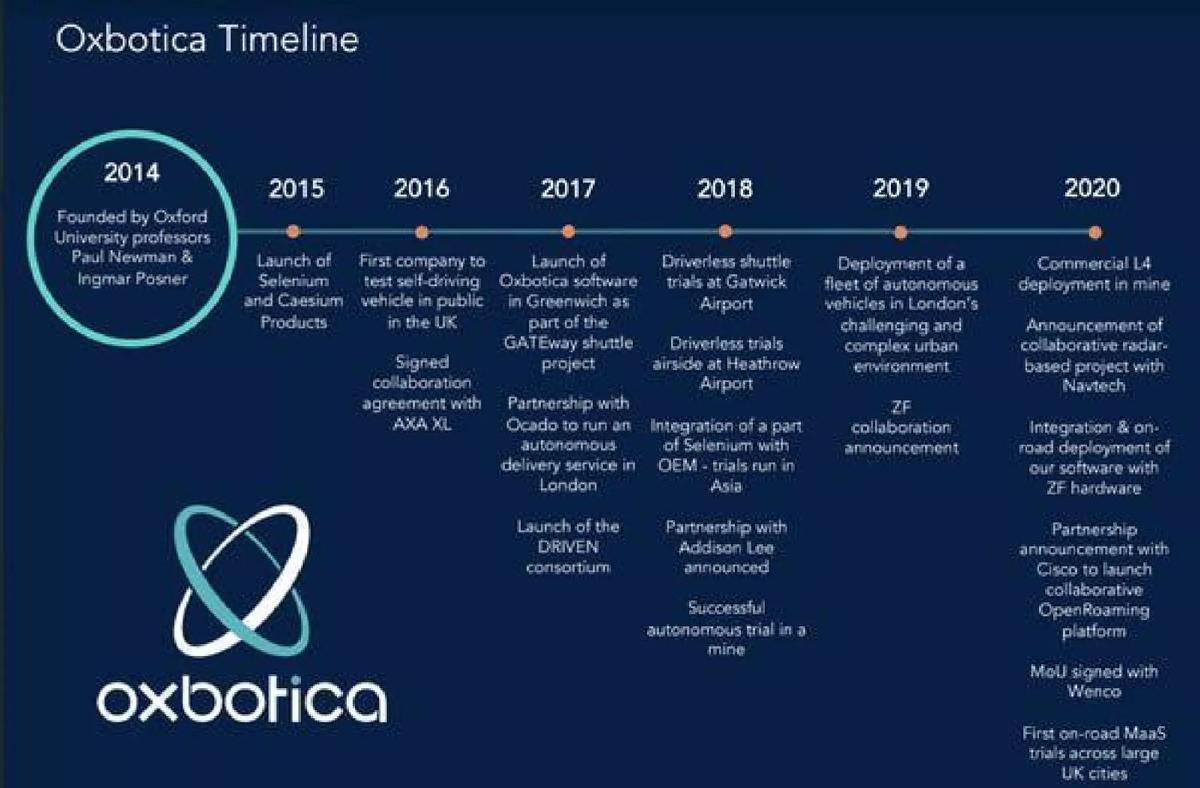
Autonomous vehicle software, UK. Timeline runs 2014 to 2020.
Oxbotica deck, slide 3. Exact stored slide matched to this analysis.
Our analysis: Each year adds a named partner or deployment, building credibility over time.
Evidence and limitation: Very dense. Pick one headline per year.
What a founder can adapt: For long development cycles, show named partners and trials each year.
Supporting analysis
What the deck claims: "Oxbotica Timeline": 2014 founded by Oxford University professors Paul Newman & Ingmar Posner; 2015 launch of Selenium and Caesium products; 2016 first company to test self-driving vehicle in public in the UK, signed agreement with AXA XL; 2017 Ocado partnership, GATEway shuttle, DRIVEN consortium; 2018 driverless trials at Gatwick and Heathrow, OEM integration trials in Asia, trial in a mine; 2019 autonomous fleet in London, ZF collaboration; 2020 commercial L4 deployment in mine, Navtech, ZF, Cisco, Wenco partnerships, first on-road MaaS trials in UK cities.
Presentation choice: Each year adds a named partner or deployment, building credibility over time.
When it does not fit: Very dense. Pick one headline per year.
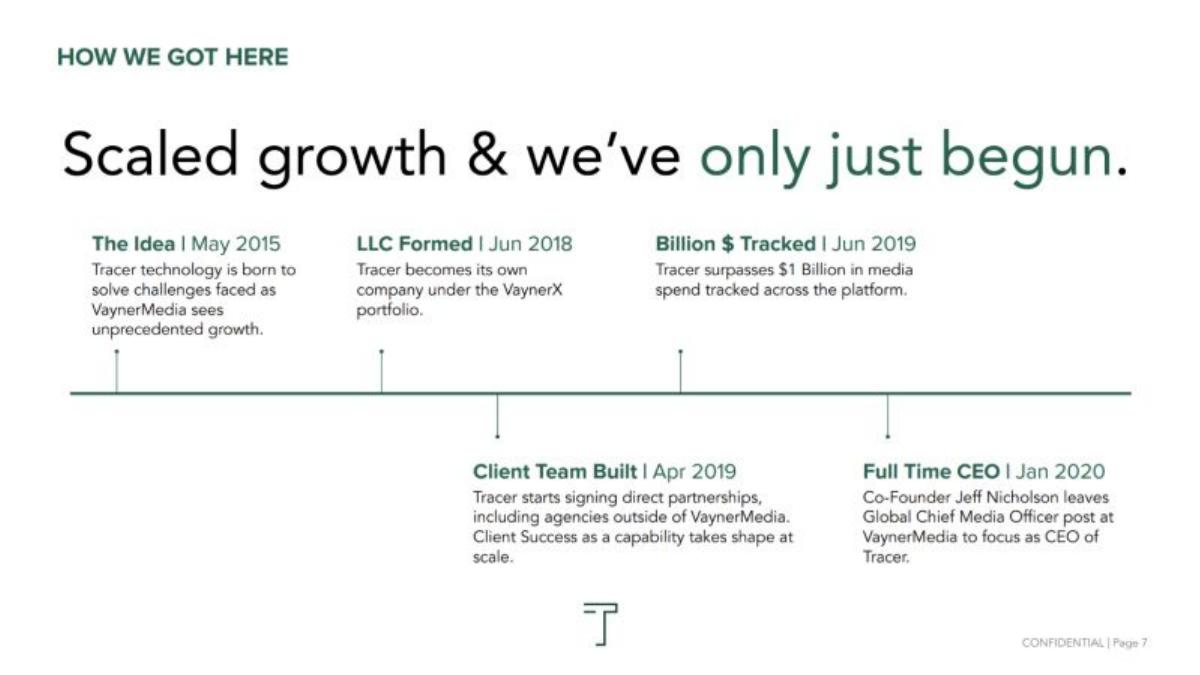
Marketing data platform spun out of VaynerMedia. Timeline runs May 2015 to January 2020.
Tracer deck, slide 6. Exact stored slide matched to this analysis.
Our analysis: Five entries only, each a real step: spin-out, scale, outside clients, a full-time CEO.
Evidence and limitation: "Scaled growth" has no revenue figure. Add one.
What a founder can adapt: For a spin-out, show when it became independent and when leadership went full time.
Supporting analysis
What the deck claims: "How We Got Here — Scaled growth & we've only just begun." The Idea (May 2015): Tracer technology is born inside VaynerMedia. LLC Formed (Jun 2018): own company under the VaynerX portfolio. Billion $ Tracked (Jun 2019): Tracer surpasses $1 billion in media spend tracked. Client Team Built (Apr 2019): direct partnerships including agencies outside VaynerMedia. Full Time CEO (Jan 2020): co-founder Jeff Nicholson leaves Global Chief Media Officer post at VaynerMedia to focus on Tracer.
Presentation choice: Five entries only, each a real step: spin-out, scale, outside clients, a full-time CEO.
When it does not fit: "Scaled growth" has no revenue figure. Add one.
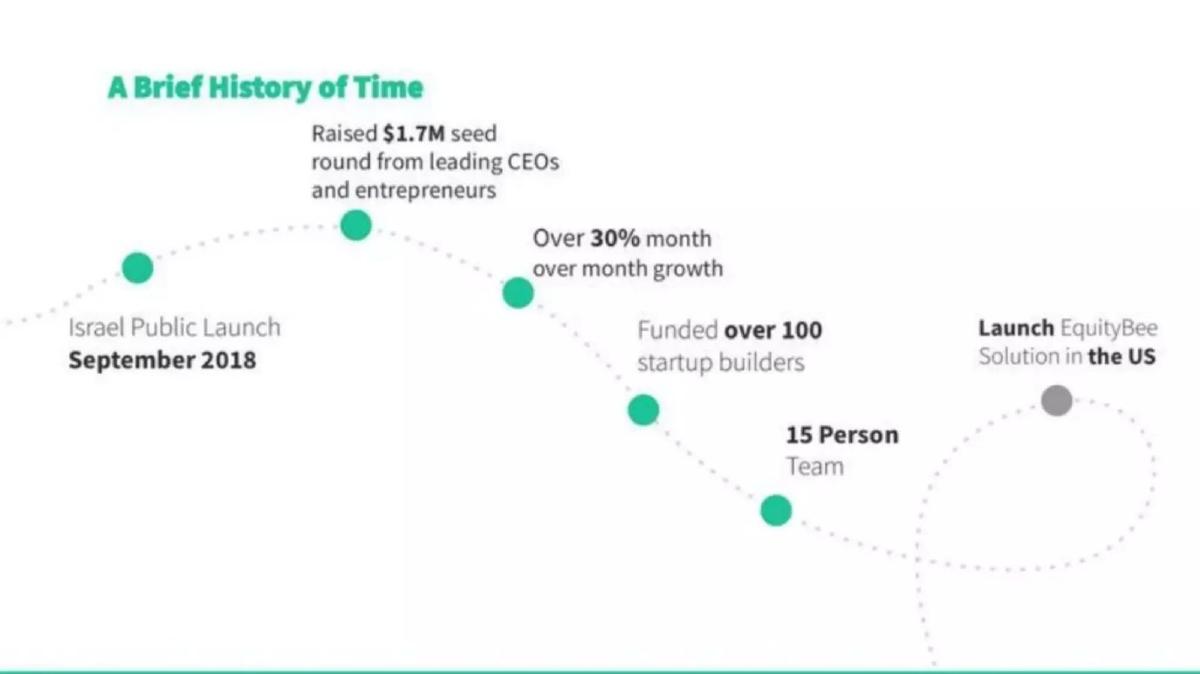
Funding for employee stock options. The slide refers to September 2018 onward.
EquityBee deck, slide 4. Exact stored slide matched to this analysis.
Our analysis: A short arc from launch to next step, with growth and funding on the path.
Evidence and limitation: Only the launch is dated. Date the other points.
What a founder can adapt: End the timeline with the step this round pays for.
Supporting analysis
What the deck claims: "A Brief History of Time": Israel public launch September 2018; raised $1.7M seed round from leading CEOs and entrepreneurs; over 30% month over month growth; funded over 100 startup builders; 15 person team; next: launch EquityBee solution in the US.
Presentation choice: A short arc from launch to next step, with growth and funding on the path.
When it does not fit: Only the launch is dated. Date the other points.
Once Upon a Farm deck, slide 3. Exact stored slide matched to this analysis.
Our analysis: A founder story explains why the company exists and why this founder understands the customer.
Evidence and limitation: No results or pace. Pair it with a dated timeline or traction slide.
What a founder can adapt: Use a founder story when your personal link to the problem is the point.
Supporting analysis
What the deck claims: "Our Story": as a mother of two, Cassandra couldn't find organic pre-made baby food of the quality she wanted; existing food was shelf-stable and highly processed, "akin to canned food"; in 2015 she paired with co-founder Ari Raz to create an HPP, organic, non-GMO baby food.
Presentation choice: A founder story explains why the company exists and why this founder understands the customer.
When it does not fit: No results or pace. Pair it with a dated timeline or traction slide.
Dated steps with results show pace; stories show motive.
Example
Format
Dated to month
Results shown
Funding shown
Daily Hundred
Timeline
Yes
First paying client
Yes
98point6
Dated list
Yes
500,000 visits
No (acquisition shown)
Oxbotica
Yearly timeline
Year only
Partners, deployments
No
Tracer
Timeline
Yes
$1B tracked
No
EquityBee
Path
Launch only
Growth, users
Yes
Miel de Tierra
Timeline
Year only
Break-even, retailers
Yes
Once Upon a Farm
Founder story
Year only
No
No
Key Takeaways
Date every entry by month and year. Pace is the point.
Mix launches with results: first paying client, revenue, break-even.
Explain a pivot in one line if you've had one. 98point6 does.
A founder story explains why; a timeline shows how fast. Choose based on stage.
Keep past and future apart. The roadmap slide handles what's next.
Build your company history slide
Five to eight dated entries, ending where this round starts.
Start. When and why was the company founded?
Proof points. Dates of first product, first paying customer, key revenue milestones?
Funding. Dates and amounts of each round?
Pivots. Any change of direction? When, and why?
Now. What step does this round pay for?
Copyable framework: [Mon YYYY] founded · [Mon YYYY] first product · [Mon YYYY] first paying customer · [Mon YYYY] $[x] [round] · [Mon YYYY] [milestone] · Next: [what this round funds].
Illustrative example 1 — written by us
Before: Founded 2022. Launched product. Growing fast.
After: Mar 2022 founded · Sep 2022 beta · Jan 2023 first paying customer · Jun 2023 $600K pre-seed · Mar 2024 $30K MRR · Next: US launch.
What improved: Our illustrative rewrite; dates and figures are invented. It dates each step, shows results and funding, and ends with the next step.
What this guide adds
The roadmap guide covers future plans; the traction guide covers current metrics. This guide covers the path so far: when things happened and how quickly.
Common mistakes
Undated entries. Give month and year.
Launches without results. Include first revenue, customers, break-even.
Too many entries. Five to eight is plenty.
Mixing past and future. Put plans on the roadmap slide.
Hiding a pivot. Investors will find it. Explain it in one line.
Diagnostic checklist
Every entry is dated.
Results and funding are on the timeline.
Any pivot is explained.
It ends with what this round funds.
Frequently asked questions
How we chose these examples
Corpus: published pitch deck teardowns on StartupFundraising.com. Founder-uploaded private decks are excluded.
Selection (2026-09-24): we searched extracted text of slides 2–6 for history terms (our history, our story, timeline, how we got here, brief history), excluding fund, mining and public-company decks, and inspected ten candidates. We excluded Ober (appears to be a fictional sample deck), RME (title slide only) and Cachet (deck already used in another guide).
Overlap check: the roadmap guide covers future plans and the traction guide covers current metrics. This guide covers the path so far.
Review: all seven stored slide images were inspected on 2026-09-24 and matched to company, deck and slide number (editorial model review). No person has yet completed an editorial review of this page.
Claims are as shown on the slides. We make no claim that any slide caused a fundraising outcome.