Tracer’s Seed deck is a masterclass in leveraging institutional pedigree. Spun out of VaynerMedia after three years in stealth, the company avoids the typical 'problem/solution' framework in favor of a narrative about proven scale. By the time of this raise, Tracer had already tracked over $1 billion in media spend (Slide 7) and secured over 200 client partners including Sanofi and Conde Nast (Slide 10). The deck positions the company as a hybrid 'Pilot & Plane'—combining a browser-based data platform with expert consulting. While it lacks traditional financial slides or a specific 'Ask,' the…
Key takeaways
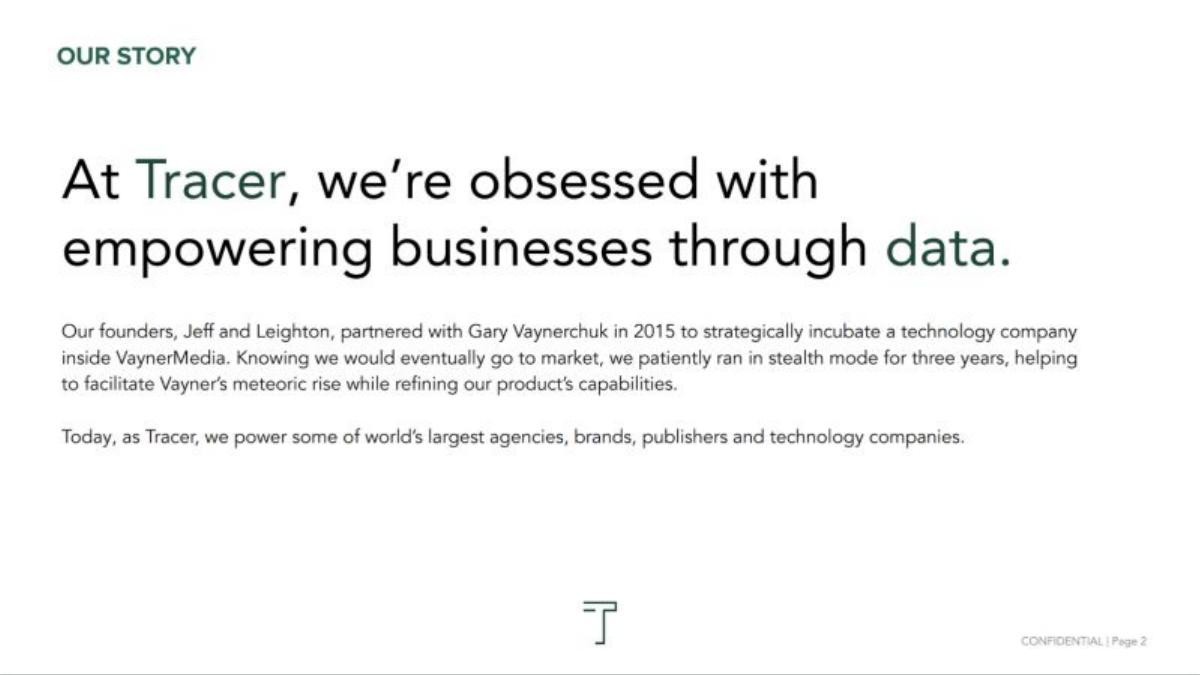
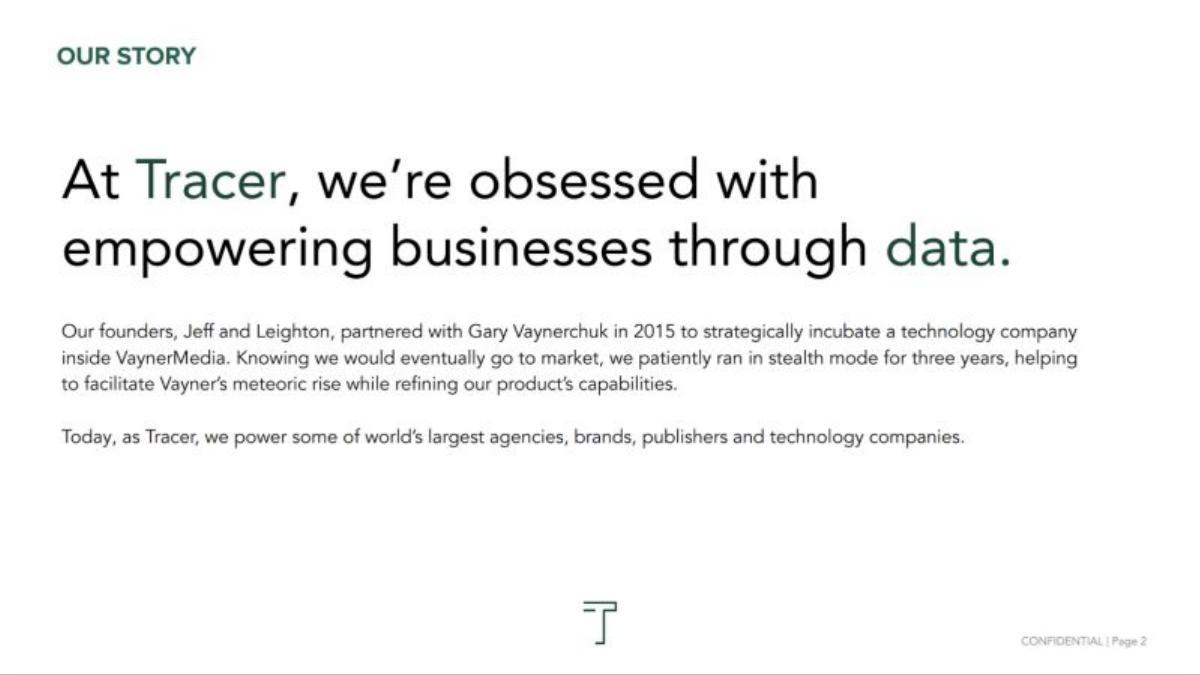
- The company operated in stealth mode for three years inside VaynerMedia before spinning off in 2018 (Slide 2).
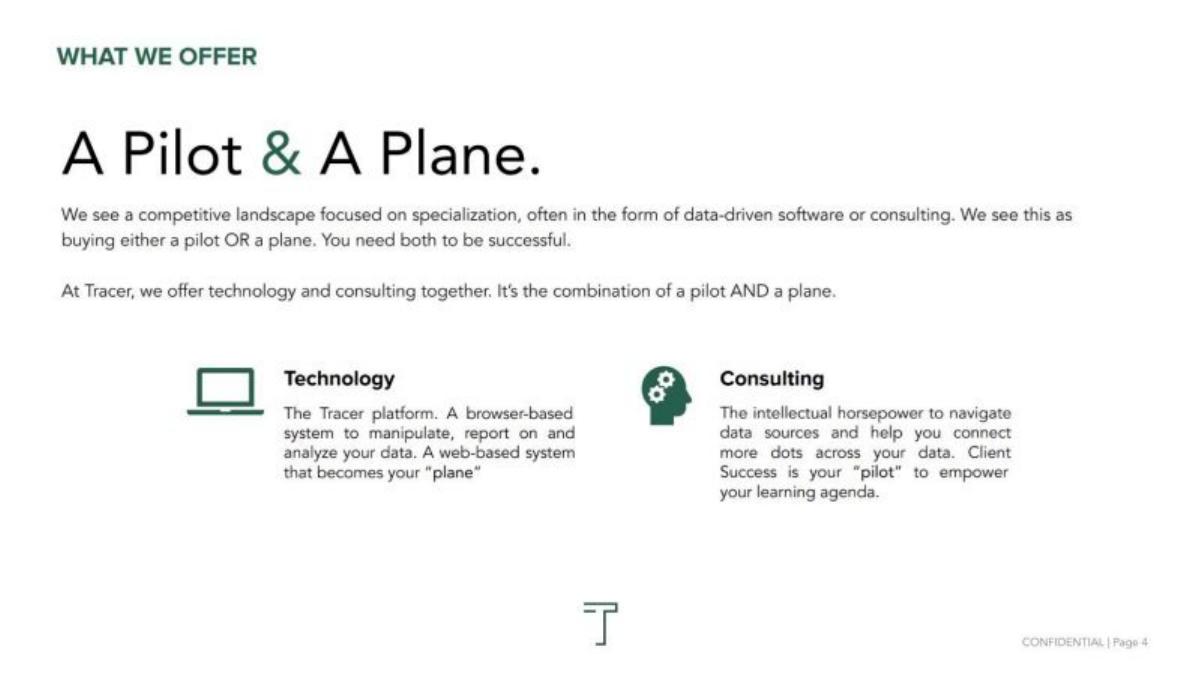
- Tracer defines its value proposition as 'A Pilot & A Plane,' combining a browser-based technology platform with human consulting (Slide 4).
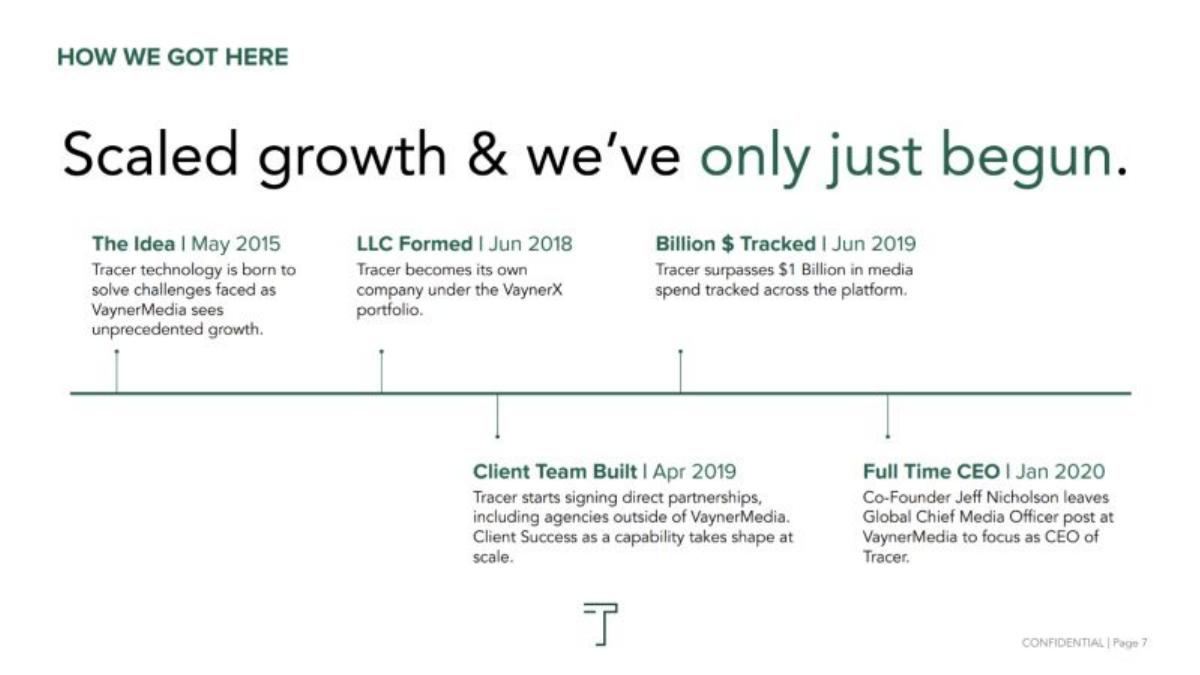
- The platform surpassed $1 billion in tracked media spend by June 2019 (Slide 7).
- Co-founder Jeff Nicholson transitioned from Global Chief Media Officer at VaynerMedia to full-time CEO of Tracer in January 2020 (Slide 7).
- The deck identifies Excel as its '#1 Competitor' where most data challenges begin (Slide 9).
- Tracer claims a diverse client base of over 200 direct and indirect partners, specifically naming VaynerMedia, Sanofi, and Conde Nast (Slide 10).
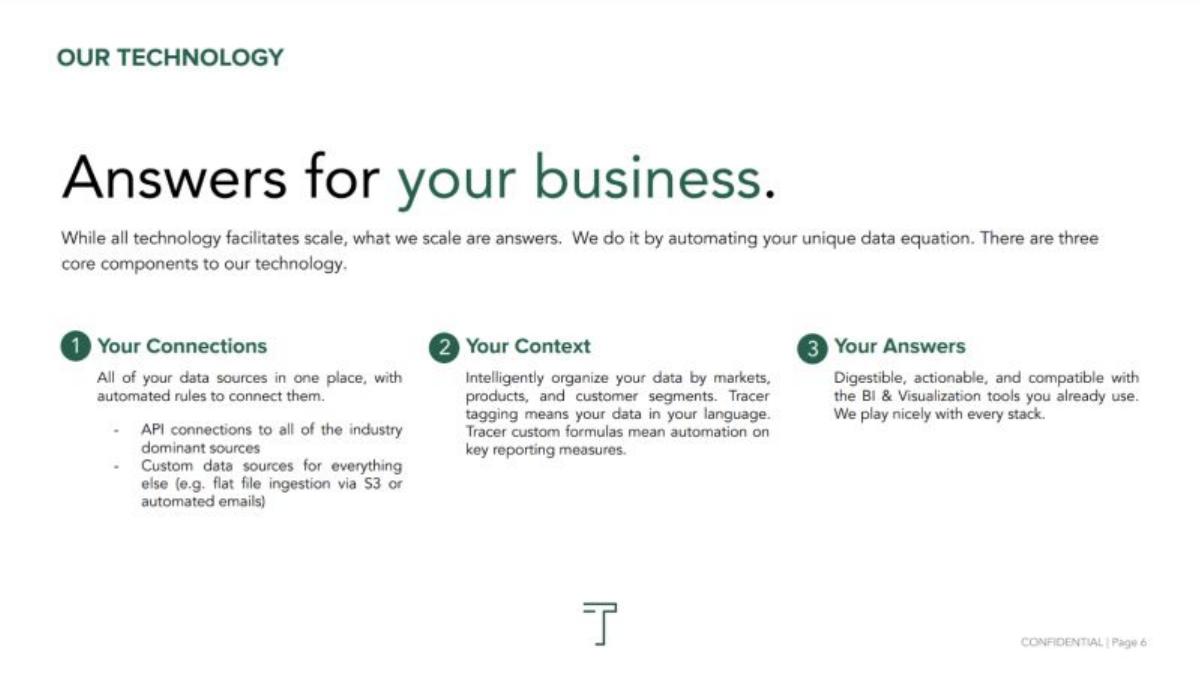
- The technology stack is built on three pillars: Connections (API and custom), Context (tagging and formulas), and Answers (BI tool compatibility) (Slide 6).
- The deck omits a formal 'Ask' slide, financial projections, and detailed unit economics.
The Narrative of Proven Incubation
Tracer’s 10-slide deck is an exercise in institutional credibility. Unlike most Seed-stage startups that must spend half their deck proving a problem exists, Tracer spends its time explaining why its solution is already battle-tested. Having been incubated within Gary Vaynerchuk’s VaynerMedia, the company enters the market not as an experiment, but as a spin-off of a successful internal tool. This context is vital for understanding why the deck can afford to be light on traditional metrics and heavy on high-level strategy.
Slide 1: Title Slide
The deck opens with a minimalist title slide featuring the Tracer logo. There is no tagline or mission statement here, relying instead on the brand's visual identity from the outset.
Slide 2: Our Story
Slide 2 establishes the company’s pedigree. It states that founders Jeff and Leighton partnered with Gary Vaynerchuk in 2015 to incubate the technology inside VaynerMedia. The slide explicitly mentions a three-year stealth period used to 'refine our product’s capabilities' while facilitating Vayner’s growth. This immediately signals to investors that the product has already survived the 'zero-to-one' phase within a high-volume environment.
Slide 3: The Market
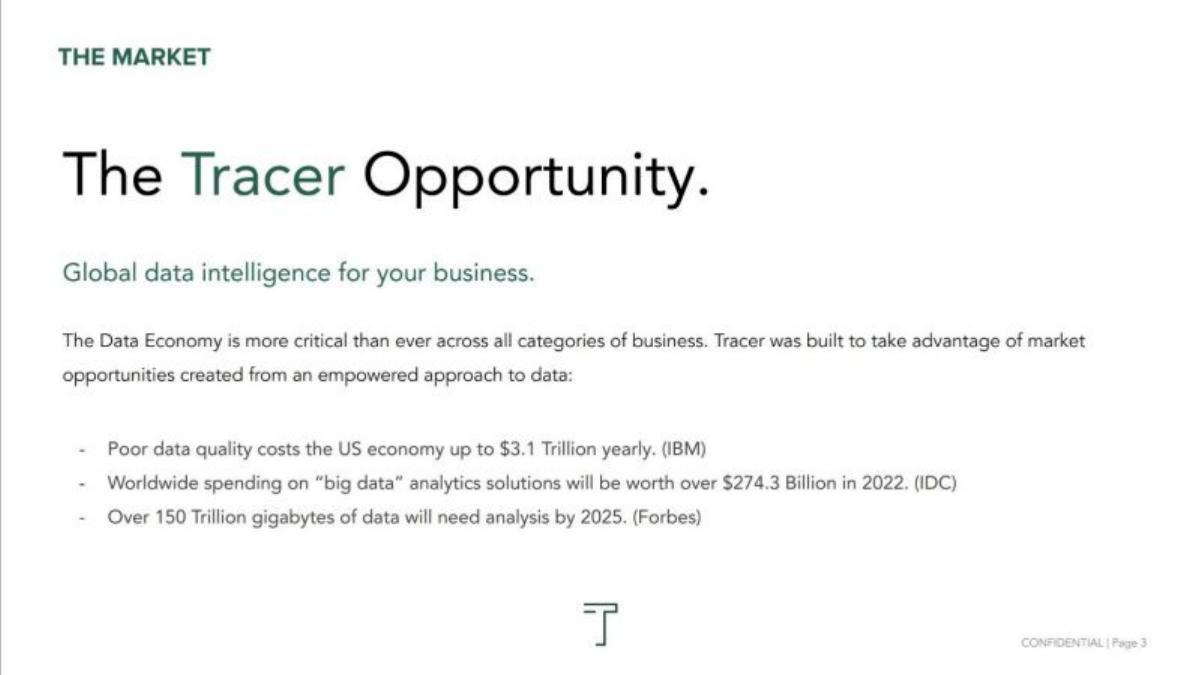
Tracer uses Slide 3 to frame the 'Data Economy.' Rather than focusing on a niche, they cite broad macroeconomic figures: a $3.1 Trillion cost to the US economy due to poor data quality (IBM), a $274.3 Billion market for big data analytics by 2022 (IDC), and the 150 Trillion gigabytes of data needing analysis by 2025 (Forbes). This slide serves to validate the ceiling of the opportunity rather than the specific floor they are currently standing on.
Slide 4: What We Offer - A Pilot & A Plane
This is the core conceptual slide of the deck. Tracer identifies a gap in the competitive landscape: most firms sell either software or consulting. They use the metaphor of a 'Pilot' (Consulting/Client Success) and a 'Plane' (The Tracer Platform). By positioning themselves as both, they justify a higher-touch service model that might otherwise be seen as a lack of scalability in a pure SaaS play. They define the 'plane' as a browser-based system to 'manipulate, report on and analyze your data.'
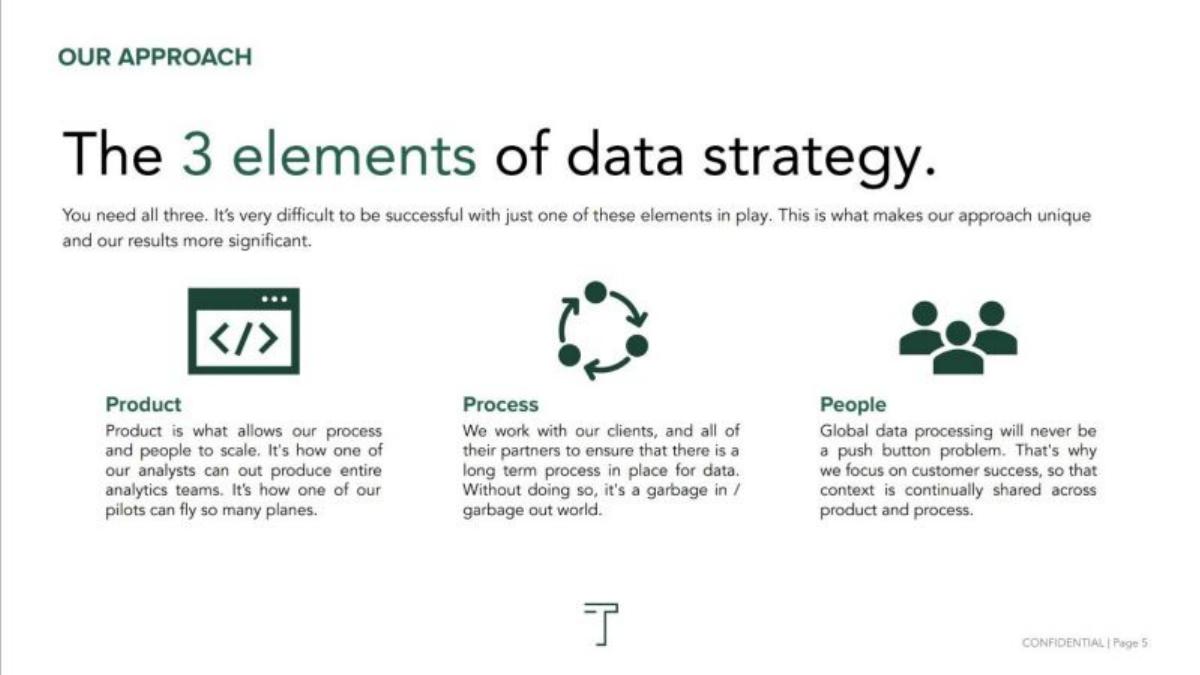
Slide 5: Our Approach - The 3 Elements
Slide 5 expands on the previous concept by breaking data strategy into Product, Process, and People. The 'Product' section contains a bold claim: that one of their analysts can 'out produce entire analytics teams.' This suggests that their internal efficiency is a primary driver of their value proposition. The 'People' section emphasizes that data processing will 'never be a push button problem,' further reinforcing their commitment to a service-supported software model.
Slide 6: Our Technology
This slide provides the closest thing to a product breakdown. It lists three components: 1. Connections (API connections to dominant sources and custom S3/email ingestion), 2. Context (tagging data by markets, products, and segments), and 3. Answers (compatibility with existing BI and visualization tools). Notably, Tracer positions itself as a middleware layer that 'plays nicely with every stack' rather than a replacement for tools like PowerBI or Looker.
Slide 7: How We Got Here
The timeline on Slide 7 is the strongest evidence of traction in the deck. It marks the 'Idea' in May 2015, the LLC formation in June 2018, and a major milestone in June 2019: surpassing $1 Billion in media spend tracked across the platform. It also notes that CEO Jeff Nicholson left his role as Global Chief Media Officer at VaynerMedia in January 2020 to lead Tracer full-time, signaling total commitment from the founding team.
Slide 8: Our Family
The team slide focuses on culture and collective experience rather than individual resumes. It lists core values like 'Reason not Rank' and 'Proactive Leadership.' Below a group photo, a grid of logos represents the 'Diverse Backgrounds' of the team, including major brands like Spotify, BlackRock, ESPN, Roku, and Pinterest. This is a 'prestige' slide designed to show that the company can attract top-tier talent.
Slide 9: Our Competition
Tracer takes a direct approach to the competitive landscape. They name Excel as their '#1 Competitor.' They also differentiate from Tableau (which they claim lacks focus on contextual data enrichment) and Datorama (which they criticize for having 'many small costs' and requiring 3rd-party implementation). By framing the competition this way, Tracer positions itself as the more 'complete' and 'rigorous' solution.
Slide 10: Our Partners
The final slide emphasizes partnerships as a competitive advantage. It claims over 200 direct and indirect client partners, specifically naming VaynerMedia, Sanofi, and Conde Nast. It also mentions direct relationships with platform giants like Google, Amazon, and Facebook, and technology partners like LiveRamp and Roku. This slide serves as the final 'social proof' to close the deck.
What Works in This Deck
The Pedigree: The connection to VaynerMedia is the deck's strongest asset. It provides immediate proof that the product can handle enterprise-scale data ($1B+ tracked spend) and has a built-in customer base. For a Seed round, this level of de-risking is rare.
The 'Pilot & Plane' Metaphor: It clearly articulates a hybrid business model. Many startups struggle to explain why they have a large services component; Tracer turns this into a strategic advantage by arguing that software alone is insufficient for complex data problems.
Competitive Framing: Identifying Excel as the primary competitor is a smart move. It acknowledges the reality of how most enterprises actually work while positioning Tracer as the necessary evolution for those outgrowing spreadsheets.
What Is Missing From This Deck
The Ask: There is no slide detailing the amount being raised, the valuation, or the intended use of funds. While this information is often shared in person or in a follow-up, its absence in the deck makes the presentation feel more like a capabilities deck than a fundraising tool.
Financials and Unit Economics: The deck is completely devoid of revenue figures, growth rates (other than the $1B spend milestone), or unit economics like CAC and LTV. Investors are left to guess at the actual profitability or revenue scale of the business.
Product UI: Despite calling the platform a 'browser-based system,' there are no screenshots of the actual interface. This makes the 'Product' feel abstract and leaves the investor wondering about the actual user experience.
What a Founder Should Copy
The Traction Timeline: Slide 7 is an excellent example of how to show a long-term commitment and steady progress. Highlighting a major 'North Star' metric (like the $1B tracked spend) is much more effective than simply listing dates of incorporation.
The Partner Grid: If you have enterprise clients, naming them and categorizing them (Client vs. Tech vs. Platform) as seen on Slide 10 is a powerful way to demonstrate market fit and ecosystem integration.
The Hybrid Model Defense: If your startup requires a service component to succeed, don't hide it. Copy Tracer’s 'Pilot & Plane' approach to frame your services as a feature that ensures customer success rather than a bug that prevents scaling.
Frequently asked questions
- What is the 'Pilot and a Plane' concept mentioned in the deck?
- On Slide 4, Tracer explains that the market usually offers either software (the plane) or consulting (the pilot). Tracer argues that businesses need both to be successful. They provide the 'plane' via their browser-based data manipulation platform and the 'pilot' via their Client Success team, which provides the 'intellectual horsepower' to navigate data sources.
- How does Tracer differentiate itself from competitors like Tableau or Datorama?
- According to Slide 9, Tracer views Tableau as being too focused on the presentation layer without enough emphasis on contextual data enrichment. They critique Datorama for a model that involves many small costs and relies on third-party implementation. Tracer positions itself as the only player providing the technology, the business tagging, and the consulting in one package.
- What evidence of market traction does the deck provide?
- The deck provides significant evidence of traction through its timeline on Slide 7 and partner list on Slide 10. Key milestones include surpassing $1 billion in tracked media spend by mid-2019 and amassing over 200 client partners. The deck also highlights that they have run the first ads on Snapchat and helped partners build their own APIs.
- Who are the founders and what is their background?
- The deck identifies Jeff and Leighton as the founders (Slide 2). Jeff Nicholson's background is specifically highlighted on Slide 7; he was the Global Chief Media Officer at VaynerMedia before becoming Tracer's full-time CEO. The team slide (Slide 8) also shows logos from previous employers including Spotify, BlackRock, ESPN, and Roku, though individual bios are not provided.
- What is missing from this pitch deck compared to standard Seed decks?
- This deck is notably missing several standard components: there is no 'Ask' slide detailing how much they are raising or the terms, no financial projections or historical revenue, no detailed unit economics (CAC/LTV), and no specific product screenshots showing the actual UI of the 'browser-based system' mentioned on Slide 4.