Traceless, a Hamburg-based biotech firm, utilized this 15-slide deck to secure a $39M Series A in 2024. The deck is notable for its restraint; it avoids dense technical jargon in favor of clear, process-oriented diagrams and high-quality product photography. By focusing on the 'bio-circular' nature of their material—specifically how it leaves no trace compared to traditional starch-based bioplastics—the company successfully positioned itself as a scalable industrial solution rather than a niche laboratory experiment. While the deck lacks traditional financial projections or a detailed competi…
Key takeaways
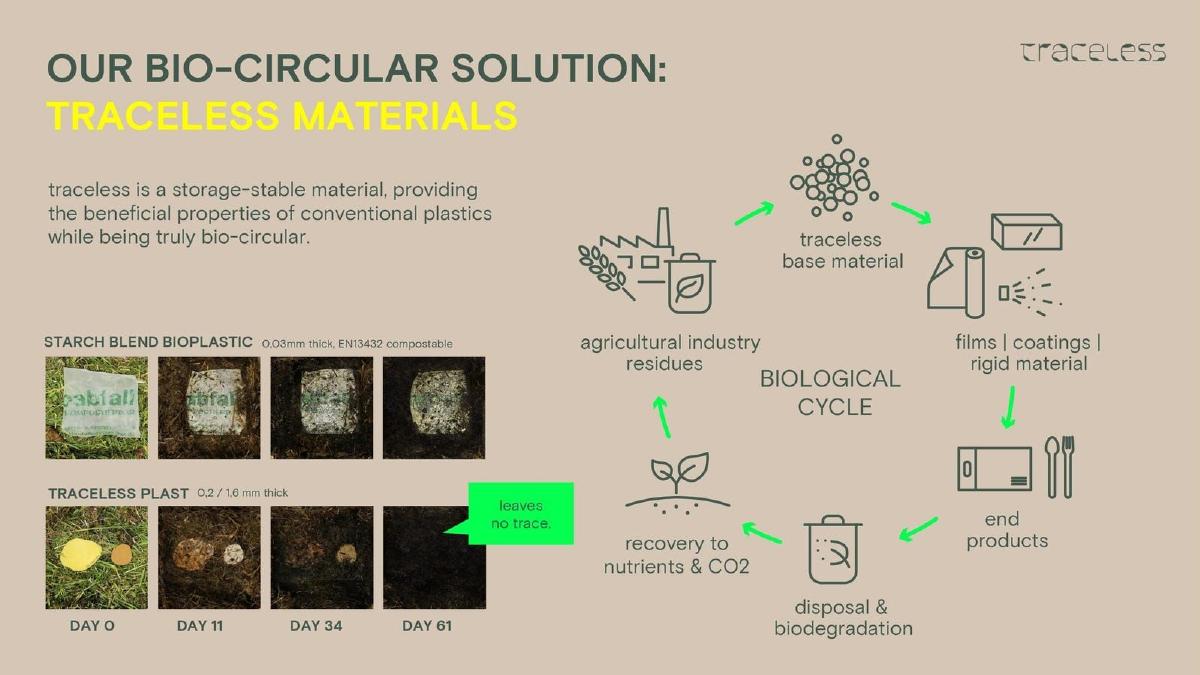
- The deck uses a side-by-side visual comparison on Slide 3 to prove their material fully biodegrades by Day 61, whereas starch blends remain visible.
- A PCT patent-pending status is highlighted on Slide 4 to establish intellectual property defensibility early in the technical explanation.
- The 'Ready for Scale-Up' roadmap on Slide 6 clearly marks the Series A as the bridge between a Demo Plant and a full Industry Plant by 2030.
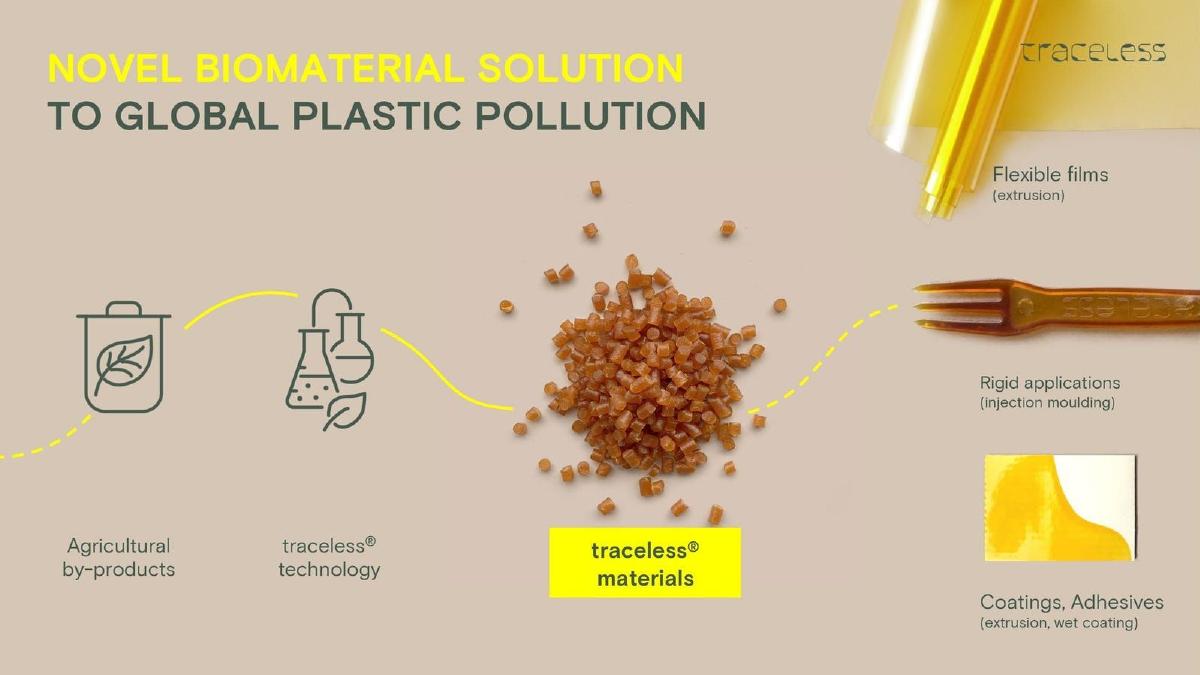
- Slide 2 simplifies a complex biotech supply chain into three steps: agricultural by-products, technology, and materials.
- The company emphasizes versatility on Slide 5, showcasing applications in packaging, single-use items, and adhesives to suggest a broad TAM.
- Despite the $39M raise reported by Business Insider, the deck itself omits a specific 'Ask' slide or use-of-funds breakdown.
- The team slide (Slide 7) focuses on collective 'scale-up expertise' and a group photo rather than individual founder bios or CVs.
- The deck relies on a 'Bio-Circular' loop diagram (Slide 3) to explain the end-to-end environmental impact, from residue to nutrients.
The Traceless Series A Teardown
Biotech fundraising often falls into the trap of being too academic. Founders frequently lead with molecular structures and lab results, losing investors who are more interested in industrial scale and market application. The Traceless Series A deck, which supported a $39M raise in 2024, takes the opposite approach. It is a visual-first document that treats the technology as a proven engine and focuses heavily on the output: a versatile, truly compostable material ready for global supply chains.
Slide 1-2: The Value Proposition
The deck opens with a minimalist title slide followed immediately by a high-level overview of the solution. Slide 2, titled Novel Biomaterial Solution to Global Plastic Pollution , is a masterclass in simplification. It maps the journey from 'Agricultural by-products' through 'traceless technology' to the final 'traceless materials.' By placing physical objects—a fork, a flexible film, and a coated adhesive—on the right side of the slide, the company anchors the abstract concept of 'biotech' in tangible consumer goods.
Slide 3: The Proof of Efficacy
One of the most compelling slides in the deck is Slide 3, Our Bio-Circular Solution . This slide addresses the biggest skepticism in the bioplastic space: does it actually disappear? The company includes a time-lapse series of photos comparing their material to a standard starch-blend bioplastic. At Day 61, the starch blend is still a visible white fragment in the soil, while the Traceless material has vanished. The callout 'leaves no trace' isn't just a marketing slogan; it is presented here as a verified empirical result. The right side of the slide features a circular diagram showing the 'Biological Cycle,' reinforcing that the product returns to the earth as nutrients and CO2.
Slide 4: The Process and IP
Slide 4, On the Basis of an Innovative Technology , moves into the 'how.' It breaks down the manufacturing into four icons: Plant residues, Extraction, Natural Polymers, and Granulate. Crucially, the slide includes a badge for 'PCT patent-pending,' which is a vital signal for Series A investors looking for defensibility. The green speech bubble stating 'Easy to scale!' addresses the second most common concern in biomaterials: the 'lab-to-fab' gap. By showing the granulate as the midpoint, they signal that their material can be used in existing plastic processing machinery (extrusion and injection molding).
Slide 5: Market Versatility
Slide 5, Replace Plastics In... , is a gallery of prototypes. This is a critical slide for establishing the Total Addressable Market (TAM) without using a single spreadsheet. By showing tomatoes in film packaging, hardware in bags, single-use cutlery, and paper coatings, Traceless demonstrates that their technology isn't a one-trick pony. It suggests that they can compete across multiple billion-dollar verticals simultaneously.
Slide 6: The Industrial Roadmap
For a $39M Series A, investors need to know exactly where the capital is going. Slide 6, Ready for Scale-Up , provides a linear progression from 2020 to 2030. It shows the company has already cleared the 'Technology Development' and 'Pilot Plant' hurdles. The 'Series A' marker is placed squarely over the 'Demo Plant' and 'Industry Plant' transition. This justifies the large round size; building industrial-scale chemical or biotech plants is capital intensive, and the roadmap makes the path to becoming a 'Leading Biomaterial Manufacturer' look inevitable rather than aspirational.
Slide 7-8: Team and Mission
Slide 7, Multidisciplinary Team with Scale-Up Expertise , features a group photo of approximately 25 employees in Hamburg. Interestingly, the deck chooses not to highlight individual executive bios. Instead, it sells the 'collective' and the 'mission.' The mission statement—'We engineer advanced biomaterials that integrate into nature’s biological cycle without leaving a trace'—is a concise summary of the entire 15-slide narrative. The deck concludes on Slide 8 with a bold yellow call to action: 'Be part of the solution, not part of the pollution.'
What Traceless Does Well
Visual Evidence: The soil degradation time-lapse is the 'killer app' of this deck. It removes the need for long technical whitepapers by providing visual proof of the product's primary claim.
Tangibility: By showing the material as a 'granulate' (the standard form factor for the plastic industry), they communicate that their product is a 'drop-in' solution. This reduces the perceived risk for potential manufacturing partners.
Clarity of Purpose: The deck never wanders into secondary benefits or tangential markets. It stays laser-focused on one problem (plastic pollution) and one solution (plant-based materials).
What is Missing from the Deck
Unit Economics: There is no mention of the cost per kilogram compared to traditional petroleum-based plastics (like PE or PP). In the materials world, price parity is often the only thing that matters for mass adoption.
Traction and Partnerships: While the deck shows many product prototypes, it does not list any signed LOIs (Letters of Intent) or pilot programs with major CPG (Consumer Packaged Goods) brands. For a Series A, investors usually look for validation from the market.
Competitive Landscape: The deck ignores other players in the space (like PHA or PLA manufacturers). A slide explaining why Traceless is superior to existing 'green' alternatives beyond just degradation speed would have strengthened the case.
Founder Takeaways
Show, Don't Just Tell: If your product has a physical transformation (like degrading or cleaning something), use a time-lapse photo series. It is more persuasive than any chart. · Define the Funding Bridge: Use a roadmap slide to show exactly which stage of industrialization the current round will fund. Traceless clearly showed the Series A was for the jump to industrial scale. · Standardize Your Output: If you are creating a new material, show it in a form factor that the industry already understands (like granulate). This signals that you understand the existing supply chain. · Keep the Design Consistent: Traceless used a very specific color palette (muted earth tones with high-vis yellow/green accents) that reinforced the 'nature meets technology' theme of the company.
Frequently asked questions
- How much did Traceless raise with this deck?
- According to reports from Business Insider, Traceless raised $39 million in a Series A round in 2024. The deck itself is dated 2023, suggesting it was the primary vehicle for the year-long fundraising effort.
- What is the core technology behind Traceless?
- As shown on Slide 4, the technology involves extracting natural polymers from agricultural residues to create a granulate. This process is noted as being 'environmentally friendly, cost efficient, and scalable,' with a PCT patent pending.
- Does the deck include financial projections?
- No. The 15-slide deck focuses entirely on the mission, the biological cycle, the manufacturing process, and the product roadmap. There are no revenue charts, burn rate figures, or margin projections included in this version.
- How does Traceless differentiate from other bioplastics?
- Slide 3 provides a direct visual comparison. While 'Starch Blend Bioplastic' is still visible after 61 days in soil, 'Traceless Plast' is shown to have completely disappeared, supporting their claim that the material 'leaves no trace.'
- What is the company's long-term goal?
- Slide 6 outlines a roadmap to become a 'Leading Biomaterial Manufacturer' by 2030. The Series A funding is specifically positioned to move the company from the 'Demo Plant' phase to the 'Industry Plant' phase.