Tract’s 12-slide pitch deck is a masterclass in narrative-driven edtech positioning. By framing their platform as the 'safe' alternative to banned services like TikTok and YouTube, they addressed a primary pain point for both educators and parents. The deck relies heavily on early-stage traction, citing 15,000+ sign-ups and a 72% month-over-month growth rate on Slide 9. While the deck lacks a traditional team slide or detailed financial projections, it compensates with high-fidelity engagement data, such as a 30% DAU/MAU ratio on Slide 11. The visual storytelling emphasizes the 'creator' aspi…
Key takeaways
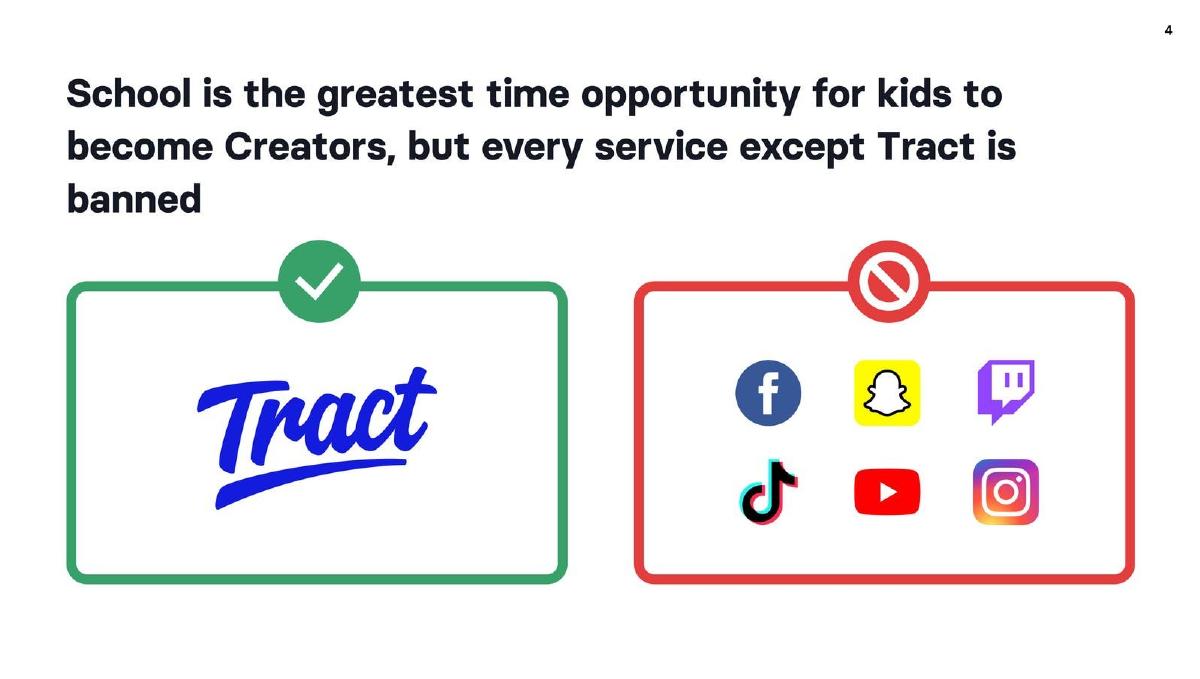
- Tract positions itself as the only creator platform not banned in schools, contrasting itself against giants like TikTok and YouTube on Slide 4.
- The deck highlights a 72% month-over-month growth in active users over a six-month period on Slide 9.
- Early traction is evidenced by 15,000+ sign-ups and 5,500+ monthly active users as reported on Slide 9.
- Engagement metrics are strong for a Seed stage company, boasting an 80% WAU/MAU and 30% DAU/MAU on Slide 11.
- The platform targets the 'creator' aspiration, noting that kids want to be creative, famous, and teach on Slide 2.
- Tract uses external market validation, citing the pause of 'Instagram Kids' to emphasize the need for safe social spaces on Slide 7.
- The deck identifies that creators make up 5% of their total user base, as noted in the footer of Slide 11.
- Individual user case studies on Slide 11 show high session lengths, with one 'Affiliate' user spending 225 minutes per day on the platform.
Tract Pitch Deck Teardown
Tract is an education technology startup that successfully raised $7 million in Seed funding in 2022. Based in North America, the company focuses on a peer-to-peer learning model that mirrors the mechanics of the creator economy. This teardown analyzes their 12-slide deck, which leans heavily on the 'safe social' narrative and early engagement data to prove market fit.
Slide 1: Title Slide
The deck opens with a high-contrast, vibrant blue background featuring the Tract logo in a white, script-style font. The tagline at the bottom, 'The online community where kids teach kids,' immediately establishes the peer-to-peer nature of the platform. The use of geometric shapes in the corner suggests a playful, youth-oriented brand identity without appearing overly juvenile, which is a delicate balance for edtech companies targeting the K-12 space.
Slide 2: The Aspiration
Slide 2 addresses the psychological driver behind the product. It states, 'Kids aspire to be Creators because they want to be creative, famous, and teach.' By highlighting 'teach' alongside 'famous,' Tract aligns the platform with the existing desires of Gen Z and Gen Alpha (who often cite 'YouTuber' as a top career choice) while grounding it in an educational context. This slide sets the stage for why the platform is inherently engaging to the end-user.
Slide 3: [Omitted/Visual Transition]
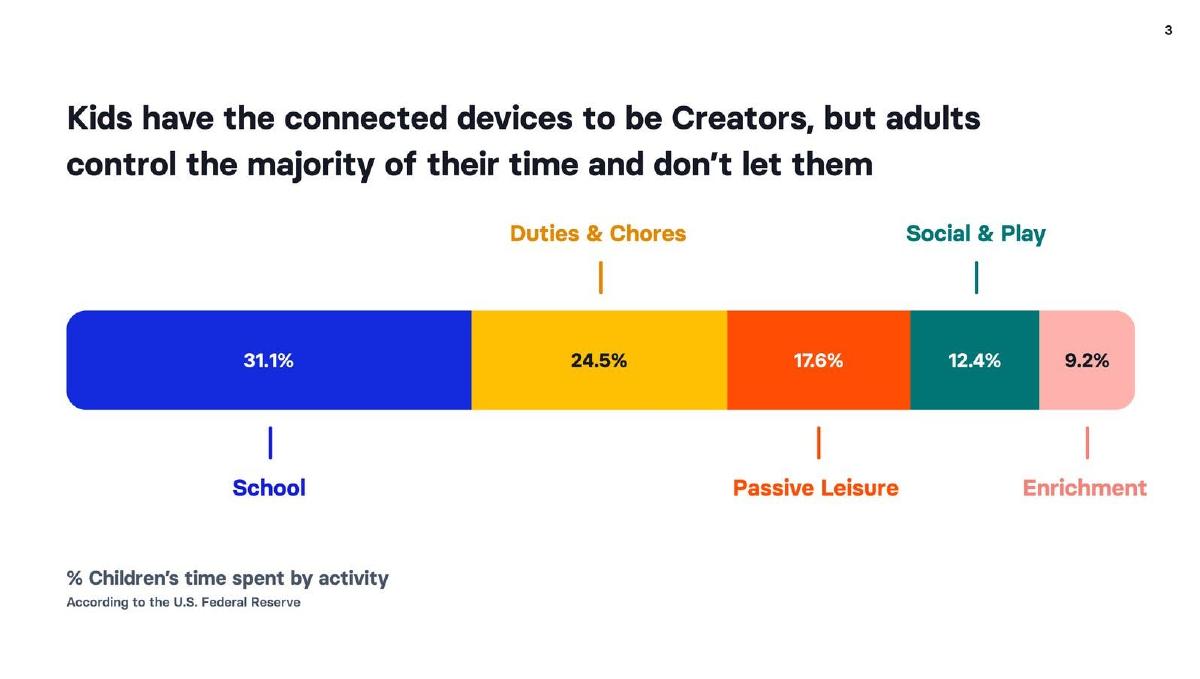
Based on the provided sequence, Slide 3 serves as a transition or visual reinforcement of the creator theme, though the specific text is minimal. It maintains the brand aesthetic established in the opening slides.
Slide 4: The Competitive Gap
This is arguably the most important strategic slide in the deck. It presents a binary choice: Tract versus 'every other service.' It lists Facebook, Snapchat, Twitch, TikTok, YouTube, and Instagram inside a red box with a 'banned' symbol. The headline reads, 'School is the greatest time opportunity for kids to become Creators, but every service except Tract is banned.' This identifies a massive, captive audience (students in school) and a total lack of competition due to institutional gatekeeping. Tract positions itself as the only 'green-checked' solution for this environment.
Slide 5 & 6: Product and Context
These slides further elaborate on the platform's role within the school day. While the specific text provided for these slides is repetitive of the 'Tract pitch deck' placeholder, the visual narrative in the full deck typically focuses on the interface and how students interact with content. The goal here is to show that the platform looks and feels like the apps kids use at home, but with the guardrails required by schools.
Slide 7: The Safety Mandate
Slide 7 addresses the 'Why Now?' and the primary barrier to entry for kids' social networks: safety. It features a screenshot of a tweet from Adam Mosseri (Head of Instagram) announcing the pause of 'Instagram Kids.' The text on the left reads, 'Providing safe access to the best of what the internet offers, and a social network both kids and adults want.' By referencing the failure of a tech giant like Meta to launch a kids' product, Tract highlights the difficulty of the problem they are solving and the value of their 'safety-first' architecture.
Slide 8: [Omitted/Visual Transition]
Slide 8 continues the narrative flow, likely bridging the gap between the problem (safety/access) and the evidence of Tract's success.
Slide 9: Traction and Growth
This slide provides the 'hard proof' required for a Seed round. The headline, 'It's early, but already working...' is followed by two key metrics: 15,000+ Sign-Ups and 5,500+ Monthly Active Users. A line graph shows a sharp upward trajectory from June to December, with the MAU growing from 351 to 5,638. The slide explicitly notes '72% MoM growth over the last 6 months.' This level of growth is exactly what Seed investors look for to validate that the product has found an initial audience.
Slide 10: [Omitted/Visual Transition]
Slide 10 acts as a lead-in to the deeper engagement metrics, moving from 'how many users' to 'how active are they.'
Slide 11: Engagement and User Personas
Slide 11 is a data-heavy slide that proves the platform is 'sticky.' It lists four critical engagement metrics: 80% WAU/MAU (Weekly Active Users / Monthly Active Users), 30% DAU/MAU (Daily Active Users / Monthly Active Users), 2.5 Posts per Week, and 18.4 Engagements per Week. A 30% DAU/MAU is a very healthy benchmark for a social/educational platform. The slide also profiles three specific creators—Coby, Fair129, and Winter123—detailing their grade levels and session lengths. Notably, 'Fair129' is listed with a 225-minute session length per day, which is an extraordinary level of engagement. A small footer note clarifies that 'Creators are 5% of the user base,' providing transparency into the platform's ecosystem dynamics.
Slide 12: Closing Slide
The deck concludes with the Tract logo, serving as a bookend to the presentation. It does not include a specific 'Ask' or contact information in the provided text, though in a live pitch environment, this would typically be the time for the founders to discuss the $7M raise reported by Business Insider.
What Works in the Tract Pitch Deck
1. Clear Market Differentiator: The 'Banned vs. Approved' slide (Slide 4) is a powerful way to demonstrate a moat. In K-12 edtech, the biggest competitor isn't usually another startup; it's the school's firewall. By positioning Tract as the only creator platform that can bypass that firewall, they create a category of one.
2. Strong Engagement Benchmarks: Many Seed-stage companies focus only on total sign-ups, which can be a vanity metric. Tract's inclusion of DAU/MAU and WAU/MAU (Slide 11) shows that they understand what actually drives value in a social network: retention and stickiness. The 80% WAU/MAU is particularly impressive and suggests that once a student starts using Tract, it becomes a weekly habit.
3. Tapping into Cultural Trends: The deck doesn't just talk about 'learning outcomes'; it talks about 'Creators' and 'Stars.' By acknowledging that kids want to be famous (Slide 2), Tract aligns its product with the actual motivations of its users, rather than trying to force-feed a traditional educational experience that kids might find boring.
4. External Validation: Using the Instagram Kids failure (Slide 7) as a backdrop is a clever tactical move. It frames the 'safety' aspect not just as a feature, but as a massive market opportunity that even the largest companies in the world are struggling to capture.
What is Missing from the Tract Pitch Deck
1. The Team Slide: A $7M Seed round is almost always a bet on the founders. The absence of a team slide in this deck is a significant omission. Investors would want to know if the founders have backgrounds in education, social media, or child safety. (Note: Tract was co-founded by Ari Memar and Esther Wojcicki, a well-known educator, which would have been a major selling point).
2. Business Model: There is no mention of how Tract intends to make money. In edtech, this is a critical question: Is it a B2B model selling to schools/districts, or a B2C model selling subscriptions to parents? Without a revenue slide, the deck feels more like a consumer social pitch than a business pitch.
3. Competitive Landscape: While the deck mentions social media giants, it ignores other edtech players in the peer-learning or video-sharing space (such as Flip, formerly Flipgrid). A slide addressing how Tract differs from existing classroom video tools would have strengthened the case.
4. The 'Ask': The deck does not state how much money is being raised or what the milestones for the next 18 months will be. While this information is often shared in a separate document or verbalized, including a 'Use of Funds' slide helps investors understand the scale of the ambition.
Founder Takeaways: What to Copy
Use the 'Binary Choice' Slide: If your startup operates in a regulated or restricted environment (like schools or hospitals), create a slide similar to Tract's Slide 4. Show the 'incumbents' that users love but are banned, and show your product as the only safe, compliant alternative. It immediately justifies your existence.
Profile Your Power Users: Slide 11's use of 'Creator Profiles' is excellent. Instead of just showing aggregate data, showing that a real 6th grader is spending 225 minutes a day on your platform makes the traction feel tangible and human. It proves that the product isn't just being 'used,' it's being 'loved.'
Focus on Ratio Metrics: If you are building a platform that requires repeat usage, don't just report total users. Report DAU/MAU. It shows you have a 'leaky bucket' under control and that your growth is sustainable. Tract's 30% DAU/MAU is a gold standard for early-stage social platforms.
Leverage Market News: If a major player in your industry fails or pivots (like the Instagram Kids pause), use it to your advantage. It proves there is a 'problem' that even the giants can't solve, which increases the perceived value of your unique approach.
Frequently asked questions
- What is Tract's core value proposition according to the deck?
- Tract positions itself as a safe, school-approved online community where kids teach other kids. It bridges the gap between the 'creator economy' aspirations of children and the strict safety requirements of the K-12 environment, allowing kids to create and share content where traditional social media platforms are banned.
- How does Tract compare itself to traditional social media?
- On Slide 4, Tract explicitly lists Facebook, Snapchat, Twitch, TikTok, YouTube, and Instagram as 'banned' in school environments. Tract positions itself as the 'checked' or approved alternative that provides the 'best of what the internet offers' without the safety risks that led to the pausing of projects like Instagram Kids.
- What specific traction metrics did Tract use to raise its Seed round?
- Tract reported 15,000+ sign-ups and 5,500+ Monthly Active Users (MAU). They also showcased a 72% month-over-month growth rate over the six months leading up to the deck's creation. Furthermore, they highlighted high stickiness with a 30% DAU/MAU ratio and an 80% WAU/MAU ratio.
- Who are the 'Creators' on the platform?
- Creators are students who produce educational content. Slide 11 notes that creators represent 5% of the user base. The deck categorizes them into tiers like 'Partner,' 'Affiliate,' and 'Creator,' showcasing specific examples of students from 6th to 11th grade who post daily and engage deeply with the community.
- What is missing from the Tract pitch deck?
- The deck is notably missing a team slide, which is unusual for a $7M Seed round. It also lacks a clear business model or monetization strategy, a competitive landscape analysis beyond social media bans, and a specific 'Ask' slide detailing how the $7M would be allocated.